You work hard. You answer the phone. You do solid work. Your crew shows up. Your jobs get done.
And still, the leads feel uneven.
Some weeks are packed. Some weeks are thin. You stay busy, but not always with the jobs you want. Too many small jobs. Too much driving. Too much chasing. Not enough of the bigger work in the towns around you.
We hear the same things from contractors all the time.
“We tried ads and they didn’t work.”
“That’s what the last agency said.”
“We got burned before.”
“I don’t believe you.”
Fair enough.
A lot of contractors do have a lead problem. But the core problem is simpler than many assume. It is not that marketing is fake. It is not that your business is weak. It is not that people do not need your service.
It is that they do not see you when they go looking.
You may be known in your hometown. Great. That does not help much ten miles away if you never show up there.
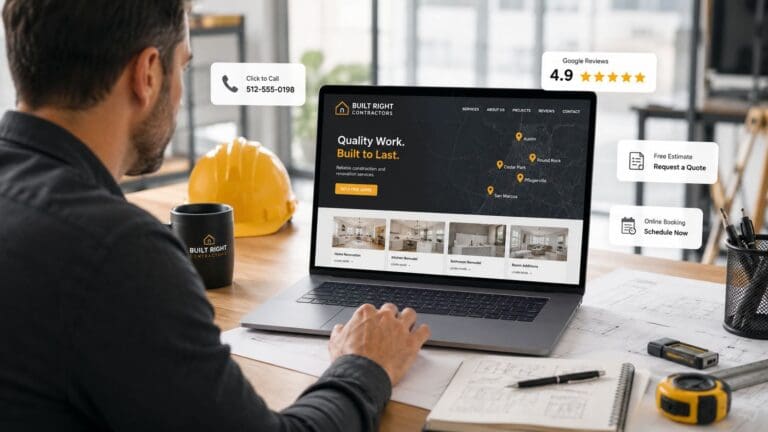
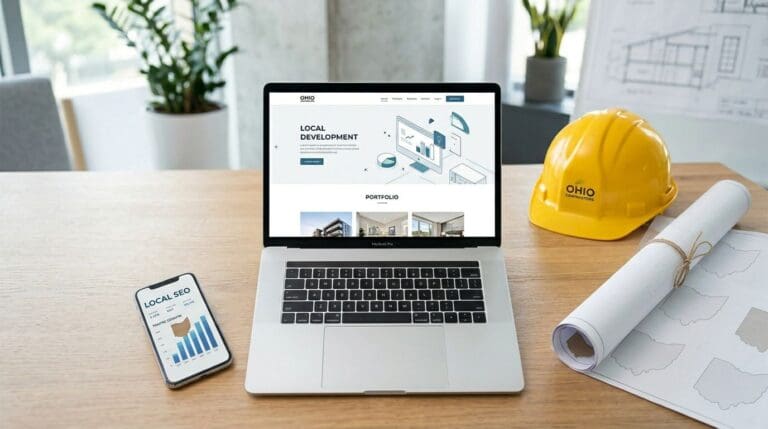
That is where local business web design gets messed up. Most websites are built to exist. Not to get found. Not to convert. Not to cover the full service area. And not to support ads that bring in work now.
So let’s clear this up.
Why Your Marketing Fails and You Stay Buried
The pain is not hard to spot
You are not crazy for being skeptical.
A lot of contractors have spent money on websites, ads, directory listings, or some monthly package that sounded good and did nothing. They got reports. They got jargon. They got excuses.
What they did not get was control.
The usual result looks like this:
- You stay busy, but not profitably: Small jobs fill the calendar while bigger jobs go to companies people found first.
- You compete on scraps: The same lead gets passed around to a handful of contractors.
- You spend without clarity: Money goes out. Calls do not come in at a steady pace.
- You feel stuck in your own backyard: People know you where your shop is, but nearby towns act like you do not exist.
That last one is the killer.
The problem is not effort
Most contractors think the issue is weak ads, bad timing, or a slow season.
That is often not the issue.
The bigger issue is invisibility.
By 2025, most small businesses in the U.S. are projected to have a website, which means having a site alone does not make you stand out. It puts you in a crowded field, not in front of the right buyer. The same source notes the U.S. Web Design Services sector includes a significant number of businesses. Your site can sit there like every other site unless it is built into a visibility system (Network Solutions small business website statistics).
That is why many contractors feel marketing failed when the underlying issue is simpler. The website was never enough to begin with.
If you want the blunt version, read this and let it sink in: https://cherubinicompany.com/websites-dont-generate-leads/
Key takeaway: A weak lead flow does not always mean weak demand. It often means buyers searched in towns you want to serve and never saw your business.
Why good contractors still lose work
Bad contractors lose work because they do bad work.
Good contractors lose work for a different reason. They are buried.
A homeowner with an urgent problem does not care that you have been around for years if you do not show up when they search. They are not driving around looking for your truck. They are not asking around first. They are using their phone.
The companies that win understand one thing.
They buy visibility.
Small contractors often rely on hope. Hope that referrals keep coming. Hope that one website page covers ten towns. Hope that an old site will somehow bring leads on its own.
Hope is not a plan.
What local business web design should do
Most local business web design advice focuses on colors, layouts, logos, and little checklists.
That is not the main job.
The main job is this: make sure your business is visible where you want work, and make sure the traffic you do get turns into calls.
That is it.
If your website does not help with that, it is decoration.
Your Website Is Not a Salesman It Is a Bucket
Stop expecting your website to create demand
A website is not a salesman.
It is a bucket.
It does not go out and find people. It does not knock on doors. It does not create traffic. It sits there and waits.
That is why so many contractors get disappointed. They paid for a site and expected leads to show up by magic. Then nothing happened. So they decided websites do not work.
That is the wrong lesson.
The right lesson is this. Websites do not create traffic. They catch it.
If no one is being sent to the site, the bucket stays empty.
If the wrong people land there, the bucket stays empty.
If the site is built badly, the bucket leaks.
A bad bucket wastes the traffic you paid for
This part matters.
94% of a customer’s first impression is based on website design. Over 62% of traffic comes from mobile devices, and 57% of users say they will not recommend a business with a poorly designed mobile site (Hook Agency web design statistics).
That means a contractor can finally get traffic and still lose the lead in seconds.
Not because the service is bad.
Because the website felt sloppy, slow, or annoying on a phone.
That is the whole bucket problem. You can pour traffic in all day, but if the site is weak, you never keep the lead long enough to get the call.
If you want the website to do its intended job, start here: https://cherubinicompany.com/turn-your-website-into-a-lead-machine/
What buyers search for
People rarely search your company name unless they already know you.
They search the problem.
They search the service.
They search the place they are in.
A buyer does not type your business name if they have never heard of you. They type things like:
- Service plus city: “septic installer Newark”
- Service plus county: “excavation near Licking County”
- Urgent problem on mobile: “concrete contractor near me”
- Big job intent: “land clearing company in Pataskala”
That is how buying starts.
So if your website only talks about your company in general terms, or only mentions your hometown, it is not lined up with how people look for work.
Pretty is not the point
A clean website helps. No question.
But local business web design should not be judged by whether it looks modern to another marketer. It should be judged by whether it helps a buyer take the next step fast.
Use this test:
| Question | If the answer is no |
|---|---|
| Can a visitor tell what you do right away? | They leave |
| Can they tell where you work? | They assume you do not serve them |
| Can they call fast from a phone? | You lose urgent jobs |
| Can they request a quote without friction? | Leads drop off |
Practical rule: A website should answer three things fast. What do you do. Where do you do it. How do I contact you now.
That is useful. It is just useful.
And useful wins.
The Visibility Gap Why You Are Invisible 10 Miles Away
Your hometown is not your service area online
This is the part most contractors miss.
You may do work across several towns or counties. But online, Google knows what you clearly tell it.
If your website and business profile talk about your home city, then Google has no strong reason to show you in the next town over.
That is the visibility gap.
You feel local. But online, your reach is much smaller than your actual service area.
What near me really means
When someone searches “near me,” Google does not treat that like a mystery.
It ties that search to the location of the person searching.
So “excavation near me” often becomes a local intent search tied to that city or area.
That means your homepage is not enough.
There has been a 40% year over year rise in multi-city searches for contractors, and 75% of mobile users will abandon a website that is not specific to their location. That is why trying to rank one general homepage across a wide service area is a losing move (Leadpages small business web design article).
You need a presence in each city where you want work.
Why good contractors stay trapped
Look at the difference.
A contractor based in one town usually has these signals online:
- Their address is in that town
- Their website mentions that town often
- Their reviews mention that town
- Their homepage speaks generally, not by city
That setup tells Google one thing. This business belongs here.
It does not say the business works in every nearby city that matters to you.
So the contractor gets boxed in.
They might rank at home. They disappear elsewhere.
A simple example
Say your shop is in Newark.
You also want jobs in Heath, Granville, Pataskala, Hebron, and Buckeye Lake.
But your website says Newark. Your pages are broad. No city-specific service pages. No local match for those places.
Now a buyer in Granville searches on their phone for your service.
Google looks for the closest and most relevant result for that buyer’s location.
If your website does not clearly connect your service to Granville, you gave Google very little to work with.
Another contractor did.
They get the click. You do not.
Key takeaway: If you never say you work in a city, do not expect Google to assume it for you.
One homepage cannot carry ten towns
One homepage cannot carry ten towns; many local business web design efforts go wrong here.
Business owners get one homepage and one services page. Maybe an about page. Maybe a contact page. Then they expect that little stack of pages to carry the whole region.
It will not.
The buyer in each town wants relevance.
Google wants relevance too.
A site that treats every city the same usually feels generic. A site that has a strong presence for each target city gives both the search engine and the buyer something specific to grab onto.
That is how you break out of being “the contractor in town” and become visible across a region.
Introducing the Lead Machine The System for Getting Found
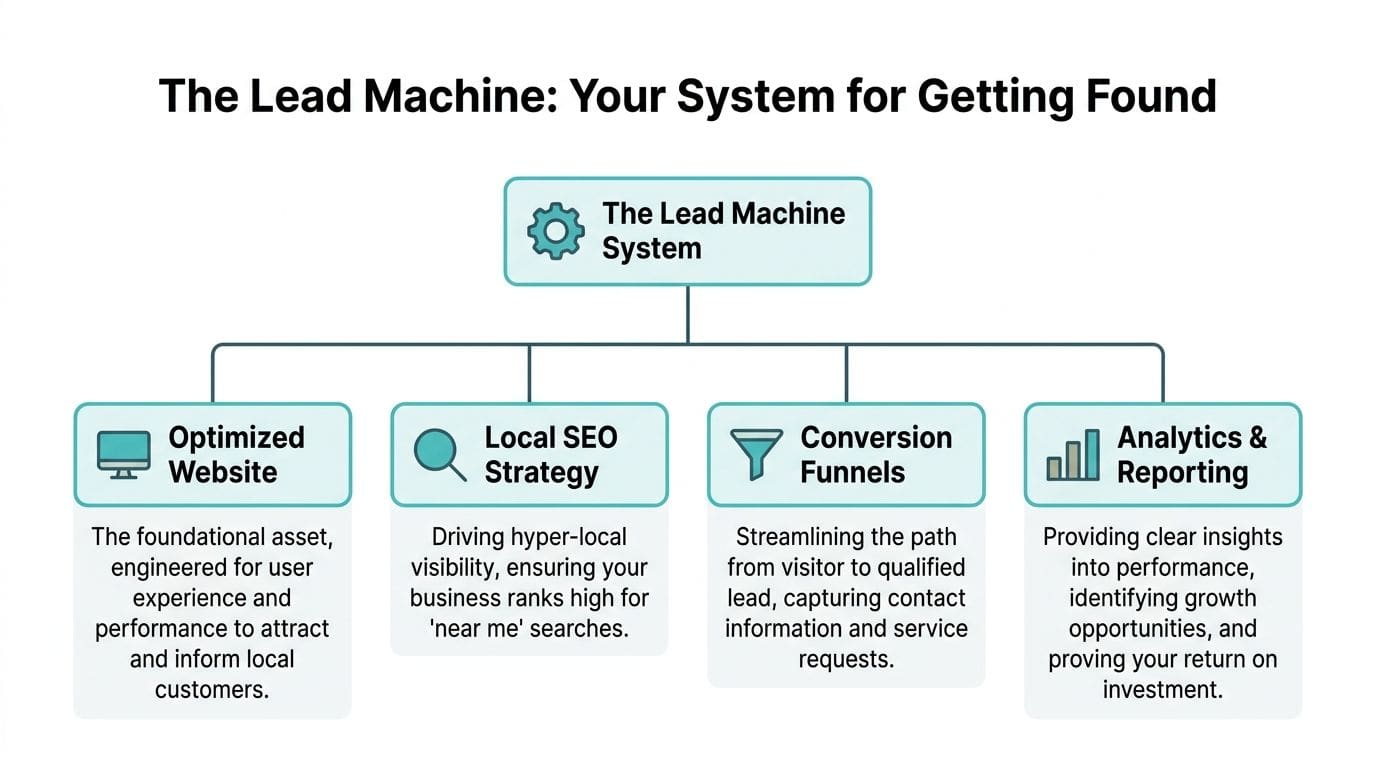
A normal website is a brochure.
A Lead Machine is a system.
It is built for one job. Turn visibility into calls.
That means it is not just there to look good. It is built around the way buyers search, the towns you want to cover, and the actions you want people to take.
What makes it different
A Lead Machine is built around structure.
Not fluff. Not a clever tagline. Structure.
That usually includes:
- Service pages: Clear pages for what you do
- City pages: Real coverage for the places where you want jobs
- Calls to action: Simple next steps that push people to call or request a quote
- Mobile design: Built for the phone in a customer’s hand
- Tracking and routing: So inquiries get captured and handled
- Business profile alignment: So the website and your local presence support each other
This is what local business web design should have provided contractors all along.
Fast matters because slow costs leads
Google expects sites to be fast and stable.
A key metric called Largest Contentful Paint should be under 2.5 seconds, and for every extra second your site takes to load, the chance a visitor leaves increases by 32% (Sheaf Media Group on local business web design tactics).
You do not need a technical lecture to understand the point.
Slow site. Lost lead.
A purpose-built Lead Machine is made to meet that standard so people do not bounce before they ever call.
This is not a writing exercise
Some business owners think they can patch this together with random pages, recycled copy, and broad promises.
That usually creates a mess.
If you are publishing service and city pages at scale, the writing still has to sound natural and readable. This guide on how to humanize AI text for SEO is useful because it focuses on keeping pages readable while protecting search visibility.
Readable pages matter because buyers can feel fake copy fast.
A machine, not a one-off project
A Lead Machine works because it solves two problems at once.
First, it gives you a real presence in the cities you want to serve.
Second, it converts the traffic that lands there.
That is why it is a better fit for contractors who want regional growth, not just a nicer homepage.
One option in this category is The Cherubini Company, which builds contractor websites around service pages, city pages, calls to action, review capture, and ad support as part of its Lead Machine approach.
Bottom line: If a website is not built by service and city, and if it is not built to turn traffic into calls, it is not a lead system.
Fueling the Machine How Ads Create Predictable Work
Visibility does not happen by waiting
Even a strong Lead Machine still needs traffic.
That is where most contractors get confused. They think the site is the whole answer. It is not.
The website is the asset.
Ads are the fuel.
Ads put you in front of people who are looking right now. Not someday. Not after months of hoping. Right now.
That is how you stop waiting for referrals to carry the whole business.
Why ads fail on weak websites
A lot of contractors say ads did not work.
Sometimes they are right. But the failure was the setup.
Ads sent to a weak website waste money because:
- The page is too general: It does not match the job the buyer wants
- The location is unclear: The visitor does not feel like you serve their area
- The next step is weak: No obvious call path, no strong quote action
- The site feels sloppy on mobile: Buyers leave before contacting you
That does not mean ads are bad.
It means the traffic was sent to the wrong destination.
A good resource on this is Google Ads for local business, because it frames ad traffic around local intent instead of broad, wasteful clicks.
Why the system works
Big companies do not rely on luck.
They build a system.
The same logic works for a contractor.
One part captures demand. One part creates visibility.
That combination gives you a much stronger grip on lead flow than a stand-alone site ever will.
Here is the clean comparison:
| Setup | What happens |
|---|---|
| Website without ads | Sits and waits |
| Ads without a Lead Machine | Traffic leaks out |
| Lead Machine plus ads | Visibility turns into calls |
That is why this approach is simpler than most marketing talk makes it sound.
It is not about doing more random things.
It is about making one thing feed the other.
What this changes for the owner
When ads fuel a Lead Machine, the business gets options.
You can push harder into towns you want more work from.
You can shift focus toward bigger jobs.
You can stop treating every week like a surprise.
If you want to see that machine-and-fuel idea in plain English, this breaks it down well: https://cherubinicompany.com/fuel-your-leads-with-google-ads/
Practical takeaway: Ads should not be treated like a gamble. They should be used to create visibility for a site that is built to convert.
That is the difference between spending and investing.
Stop Guessing and Start Controlling Your Lead Flow
You do not need more noise.
You do not need more vague advice.
You do not need another pitch about “brand awareness” while your phone stays quiet.
You need control.
Guessing creates a fragile business
A lot of contractors are running good operations on top of weak lead systems.
That is why the business feels shaky even when the work is solid.
You are depending on referrals, old contacts, repeat business, and whatever scraps drift in from a site that was never built to cover your service area.
That keeps you reactive.
You take smaller jobs because they are there.
You stretch crews to fill gaps.
You keep spending on things you cannot measure clearly.
That is not stability. It is survival.
Control comes from visibility
The fix is not magic.
It is a clear local business web design system tied to paid visibility.
That means:
- A site built by service and city
- Clear paths to call or request a quote
- Coverage beyond your hometown
- Paid traffic that puts you in front of active buyers
- A setup that supports steady work instead of random spikes
When that is in place, you stop acting like every lead is an accident.
You start building a business that can choose better jobs, expand into better areas, and grow without guessing.
The choice is simple
You can keep treating your website like a lucky charm.
Or you can treat it like a working asset.
You can keep hoping people find you.
Or you can build a system that makes sure they do.
The contractors who grow are not the most talented. They are often the ones who made themselves easy to find in the places they want to work.
That is the whole game.
You think that customers “can” find you but, If customers “don’t” find you, nothing else matters. Lead Machines are built to fix that.
If you are tired of guessing and want a straight answer about where your visibility breaks down, talk to The Cherubini Company. They help contractors build Lead Machines and pair them with ads so the business gets seen in the cities that matter, not just the town where the office sits.