You’ve been burned before. A slick marketing agency promised you the world, took your money, and left you with a website that does nothing but collect dust. You’re a contractor, not a marketer. You just want the phone to ring with good jobs.
We hear it all the time. “We’ve tried running ads and they didn’t work.” “That’s what the other agency said.” “I don’t believe you.”
You don’t have a marketing problem. You have an invisibility problem.
You’re probably known in your hometown. Your truck gets recognized. But drive ten miles away, and you’re a ghost. When a customer in that town searches for “[your service] near me,” Google looks for contractors who work in their specific city. If you haven’t told Google you work there, you don’t show up. You don’t exist. It’s that simple.
Your website isn’t the problem. The fact that no one sees it is the problem.
Your Last Website Didn’t Work Because It Was Invisible
You wrote a big check for a website or some ads. You waited for the phone to ring. And you got crickets. It’s no wonder you think marketing is a scam.
It’s not. You just bought the wrong tool for the job. You bought a pretty online brochure when you needed a machine to get you leads.
The real issue is simple: your business is invisible to customers who are actively looking to hire someone but don’t know your name.

Right now, a homeowner ten miles away is typing into Google, looking for exactly what you do. They’re searching for things like “[your service] in [their town].”
If your website doesn’t clearly tell Google you work in their town, you will not show up. You have zero chance of getting that job. Ever.
The Visibility Gap Explained
Most contractors are well-known in their own backyard. But that reputation doesn’t exist online in the next town over.
Your last website was built to be a digital brochure. It looked nice and listed your services. But it was never built to show up where customers are actually searching.
It was based on a lie: the idea that websites create their own traffic. They don’t. They sit and wait.
You think customers can find you. The hard truth is, if customers don’t find you, nothing else you do matters. This visibility gap is choking your business.
– Pat Cherubini
Big companies buy visibility with huge ad budgets. Small contractors are left to rely on hope.
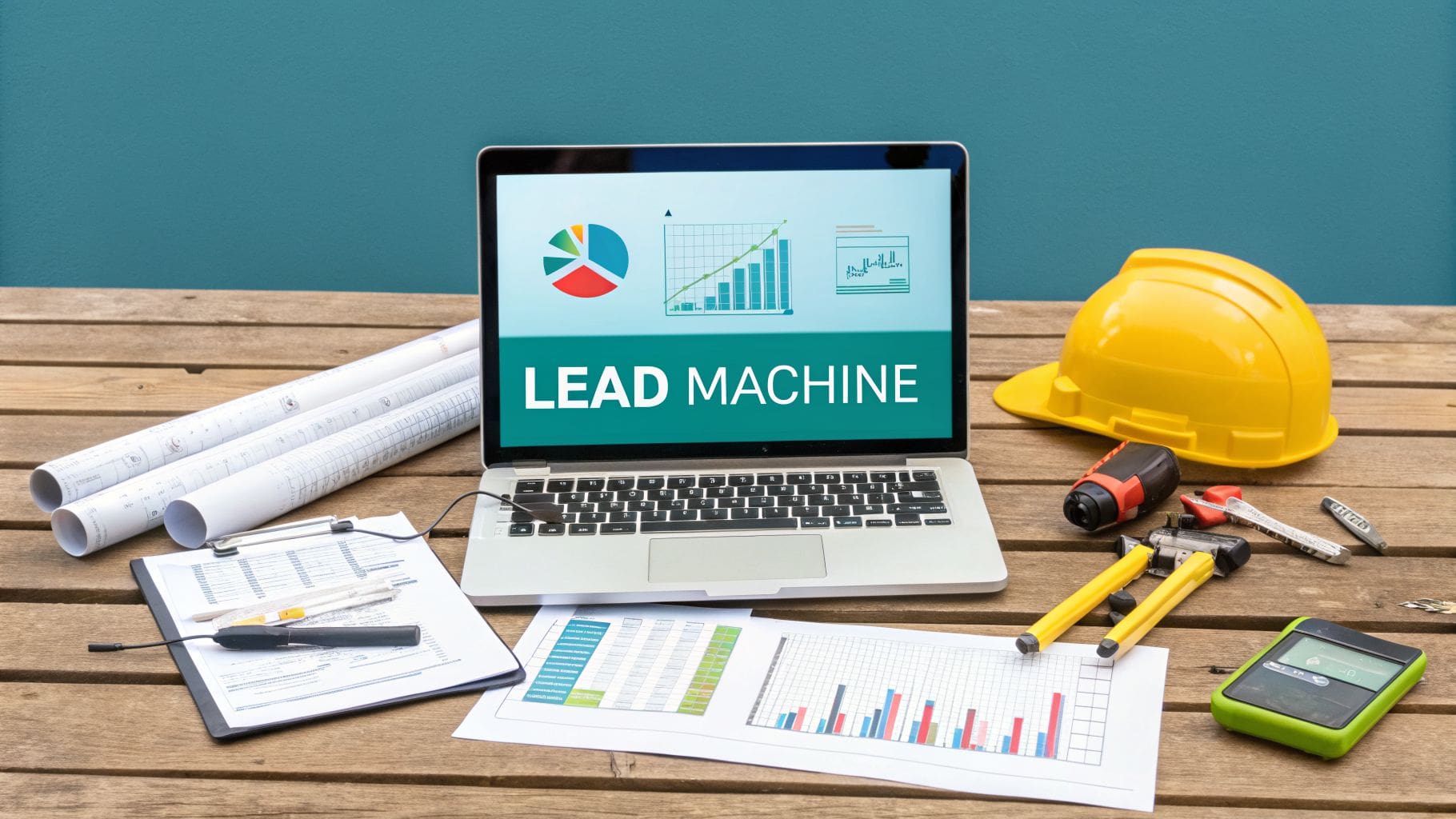
The only way to compete is to stop buying “websites” and start building a system designed to fix your invisibility. You need a Lead Machine.
From Brochure to Business Tool
A great-looking website is worthless if no one sees it. Your last website wasn’t a waste of money; it was a lesson. It taught you that a pretty site doesn’t equal phone calls.
To get a different result, you need a different tool. You’re done with brochures.
You need a machine built to be visible across your entire service area. Then you need to fuel that machine with ads to turn that visibility into calls. It’s not about getting a better-looking website; it’s about getting a system that actually works. You can learn more about how lead generation websites are designed to suck in customers in our detailed guide.
Stop Thinking “Website.” Start Thinking “Lead Machine.”
Let’s be clear: you don’t need another “website.” You probably have one of those. It’s a digital business card that does nothing to bring in jobs from the towns around you.
A standard website is a passive brochure. It waits for someone to find it.
A Lead Machine is different. It’s a sales tool built for one purpose: to generate a steady flow of calls and quote requests from people ready to buy—across your entire service area.
A Lead Machine is a two-step system. First, we build a website designed to turn traffic into calls. It is structured by service and city to get you found in all the places you work. Second, we fuel it with paid ads. The website is the asset. The ads are the fuel. Together, they produce consistent leads.
What Actually Makes a Lead Machine Work?
A Lead Machine is a system where every part has a job. Forget colors and fonts. These are the parts that put money in your pocket.
Here is what’s required:
- Dedicated Service Pages: A separate page for each major service you offer. This tells Google you’re an expert.
- Specific City Pages: This is the game-changer. An individual page for every single town you want to work in. This makes you visible when people search there.
- Obvious Calls-to-Action: Big, clickable phone numbers and simple forms on every page. No guesswork.
- Built for Mobile: Your customers are on their phones. The site must be fast and easy to use on a small screen.
- Google Business Profile Alignment: Your website and Google profile must send the same signals about where you work and what you do. This builds trust with Google.
A pretty website is just an expense. A Lead Machine is an asset that makes you money.
Standard Website vs Lead Machine: A Contractor’s Guide
This table breaks down the crucial differences.
| Feature | Standard Website (The Brochure) | Lead Machine (The Sales Tool) |
|---|---|---|
| Primary Goal | Inform visitors about the company | Capture leads and generate calls |
| Geographic Reach | Visible only in its home city | Visible across the entire service area |
| Page Structure | Generic “Services” and “About” pages | Dedicated pages for each service and city |
| Calls-to-Action | Buried “Contact Us” page | “Click-to-Call” buttons on every page |
| Traffic Source | Relies on hope and referrals | Built to convert paid traffic from ads |
| Business Impact | A static online expense | A dynamic, lead-generating asset |
| Mobile Experience | Often slow and clunky on phones | Fast, simple, and built for mobile users |
The takeaway is simple. A website informs. A Lead Machine captures demand.
A standard website is built to inform. A Lead Machine is built to capture demand. It finds people who are looking for your services right now and makes it incredibly easy for them to contact you.
A web designer who only talks about looks is missing the point. You need a system that takes traffic from ads and turns it into jobs. Anything else is just an online decoration.
Learn how to turn your website into a Lead Machine and close the visibility gap that’s holding you back.
Finding a Partner Who Understands Your Business, Not Just Code
You don’t need a designer who talks about code or branding. You need a partner who understands you’re in the business of booking jobs. Choosing a website designer is about their process, not their portfolio.
When you’re looking for a web designer, treat it like you’re comparing different design services for a big project. Do they talk about leads, or just “making it pop”? Do they have a plan to make you visible in all the towns you serve? This conversation separates the brochure-builders from the lead-builders.
This decision tree makes it clear.

The chart is simple: if you just want to park information online, a basic website is fine. But if you want the phone to ring, you need a Lead Machine.
Why a Local, Family-Owned Agency Matters
A big, national agency sees you as an account number. They don’t know your market. They don’t get the grind of being a small business owner.
A local, family owned website design agency is different. We are Cherubini Designs, and we’re a small business, too. We’ve been building websites right here in Newark, Ohio, for 29 years. We know what it takes to get found in Licking County, Columbus, Granville, and Zanesville because we live here.
When you work with us, you work directly with the owners. Angie is the Founder, Co-Owner, and lead website designer in Newark Ohio. She’s the creative force behind over 457 successful projects. Pat is the Co-Owner and advertising expert who fuels the websites with traffic. No middlemen.
We are not a website factory. We specialize in custom web design for small businesses. Every project is built to make you money and build a long-term relationship.
The Cherubini Designs Difference
As a premier website design company in Ohio, we focus on what moves the needle. We don’t build pretty pages; we build business assets. We are a Licking County website design company that gets results. Our approach is a complete system:
- A Revenue-Focused Website: Angie, a former stay-at-home mom turned business owner, builds websites designed for one thing: turning visitors into leads. She is a 4-year colon cancer survivor with the strength and focus to build what works.
- A Visibility Strategy: Pat makes sure people actually find your website. He runs the paid ads that put you in front of customers searching for your services right now. He provides the fuel.
This is more than website design and digital marketing. It’s a system built to solve your lead problem. We understand your website needs to be a tool that produces a predictable return—not another headache.
The Critical Questions to Ask Before Signing on the Dotted Line
Good contractors get burned because they don’t know what to ask. You have to get past “how much?” and dig into what actually makes a difference.
The answers will tell you if you’re talking to a real partner or someone selling a pretty template. A pro will have straight answers. A salesman will use confusing jargon.
Questions About Visibility and Leads
The point is to get found and make the phone ring. A designer who can’t explain how they do that is a red flag. Their job is to solve your invisibility problem.
Here are the questions that matter:
- “How will this website get my business leads from the next town over?” If they talk about “brand awareness,” they don’t get it. The answer must be about building specific pages for each city and service you offer.
- “What’s your strategy for turning a visitor into a customer?” The answer should be about clear calls-to-action, big phone numbers, simple forms, and a mobile-first design. It should be easy for someone to call you.
- “Can you show me results from other contractors?” They need to have clear examples of how their work generated more leads for businesses like yours.
The goal isn’t to have a website; it’s to have a tool that makes the phone ring. A designer who can’t explain how that happens is selling you hope, not a system.
Questions About Traffic and a Complete System
A website without traffic is useless. It’s a billboard in the desert. Your website is only one piece of the puzzle. The other part is the fuel.
- “Do you manage the ads needed to drive traffic to the site?” You need a complete solution. A website builder with no plan to get people to the site is only giving you half of what you need. Ads create visibility. The website turns it into leads. You need both.
- “What’s included in the price, and what costs extra?” Get a clear list of what you’re paying for. You can find helpful information on the true cost of a small business website in our breakdown.
- “What happens after the website is live?” You need a partner, not a vendor who vanishes after launch. Find out how they handle updates and problems.
It helps to see what other businesses ask. Take a look at these top 10 request for proposal questions for more ideas. Asking these questions protects your investment and ensures you hire someone focused on your goal: booking more jobs.
Red Flags That Signal a Bad Website Investment
You’ve been burned before. You spent good money and got nothing. Learning how to choose a web designer is about recognizing the warning signs of a bad deal.
This time, you’ll know what to look for, so you can walk away from a bad investment.

Here are the red flags that tell you you’re talking to the wrong person.
They Focus on Looks, Not Leads
This is the most common trap. The designer talks about “a clean look” or a “modern design.” They talk about fonts and colors, but never how the website will make your phone ring.
A pretty website that doesn’t generate work is a worthless expense. You’re buying a tool to get jobs. If they can’t explain how their design will turn a visitor into a lead, they are not the right partner.
They Use Confusing Jargon to Sound Smart
If you feel like you need a dictionary, run. They use terms to sound impressive and justify a high price.
An expert can explain things in simple terms. They should talk to you about leads, service areas, and visibility. Jargon is a smokescreen.
A website without a plan for traffic is a billboard in the desert. Ads without a website built to convert are like pouring gasoline on the ground and lighting a match. You need both working together.
They Make Unrealistic Promises
Any designer who “guarantees” a #1 ranking on Google is lying. These are empty promises to get you to sign a contract.
No one can guarantee a ranking. A real partner will talk about a strategy for improving your visibility across your entire service area. They’ll be honest that it’s a process, not a magic button.
They Have No Plan for Traffic
This is the biggest red flag. A website does not create its own traffic. It sits and waits.
Ask them directly: “How are we going to get people to the website?”
If they don’t have a clear answer that involves a paid advertising strategy (like Google Ads), they are only selling you half a solution. A website without traffic is useless. An ad without a website built to convert is wasted money. You need a partner who can build and fuel the machine.
Contractor Website FAQs: Your Questions, Answered
Let’s cut to it. These are the questions we hear every day. Here are the straight answers.
How Much Should a Contractor Website That Gets Leads Actually Cost?
You can get a simple “brochure” website for a few thousand dollars. But that’s just a digital business card. It won’t pull in jobs.
A true Lead Machine—a site built to show up in multiple cities and turn visitors into calls—is a serious business asset. It’s an investment in a system designed to produce a return. At The Cherubini Company, our pricing is flat-rate and transparent. We build systems for growth, not just pretty pages.
Forget the upfront cost. The only number that matters is the return on your investment.
If I Have a Great Website Do I Still Need Paid Ads?
Yes. A website doesn’t create its own traffic. Hope is not a marketing strategy.
Paid ads, like Google Ads, are the fuel. They create instant visibility. They put you in front of customers searching for your services right now.
The Lead Machine is the engine. It takes that visibility and converts it into calls and jobs. The two work together. One without the other is a waste of money.
What Is More Important: Website Design or Showing Up on Google?
Visibility comes first. Always. If a customer can’t find you, your beautiful design is worthless.
The #1 job of your online presence is to solve your invisibility problem. It has to get you found in every city you serve.
Once a customer lands on your site, then the design kicks in. It must look professional, build trust, and be easy to use on a phone. That’s what turns a visitor into a lead. Any designer who only talks about making things “pretty” is missing half the equation.
You need a partner who builds for both visibility and conversion. Anything less is just a digital decoration that costs you money instead of making you money.
You think that customers “can” find you but, If customers “don’t” find you, nothing else matters. Lead Machines are built to fix that.
Ready to stop being invisible and start getting predictable leads? The team at The Cherubini Company, a family-owned business in Newark, Ohio, builds Lead Machines that get contractors seen and get their phones ringing. Schedule your free consultation today.