You already know the pain.
Some weeks the phone rings enough to keep everybody moving. Other weeks it goes quiet and you start wondering where the next solid job is coming from. So you lean harder on referrals, yard signs, repeat customers, and hope.
That's not a lead problem first. It's a visibility problem.
Most contractors are known in their hometown. People there know your name. They've seen your trucks. They've heard about you from a neighbor. But go 10 miles away, 15 miles away, or into the next town where you seek work, and you vanish. When somebody searches for your service in their town, you don't show up, so you don't get a chance to earn the call.
That's a significant trust issue too. If they never see you, they can't trust you. If they do see you, your website has seconds to prove you're real, local, safe, and easy to reach.
If you want to learn how to build trust on your website to win more jobs, stop thinking about trust as a badge in the footer. Trust starts with visibility. Then your site has to back it up fast.
The Real Reason Your Phone Is Not Ringing
You might be a big name in your own area and still be invisible where the next job is.
That's what happens to a lot of contractors. They've built a real business. Good crews. Good equipment. Good word of mouth. But online, their visibility stops at the city where their shop is located. That creates a fence around the business, and most owners don't even know it's there.

The visibility gap is costing you jobs
When a homeowner or property owner searches for a contractor, they usually search by service and location. They don't search your company name unless they already know you. If you do excavation, septic, concrete, restoration, plumbing, or heating and cooling, they search for that service in the town they're standing in.
Google reads “near me” as their current city.
So if your business only clearly talks about your home city, Google has no reason to assume you also work in all the nearby towns you drive to every week. That part is simple. If you've never said you work there, why would Google show you there?
You think customers can find you. The bigger problem is that they don't find you.
This is why contractors feel stuck in feast or famine. They're busy when referrals happen to come in. They're slow when they don't. They don't control the flow because they don't control visibility.
Word of mouth is not a system
Word of mouth is great. It proves you do good work.
It is not a system for steady growth.
A real system puts you in front of buyers who are looking right now, in the towns where you want jobs. That's why your local listings and service area signals matter. If you haven't cleaned that up, start with your Google Business Profile optimization, because it helps support the areas you want to be found in.
Here's the hard truth. Big companies buy visibility. Small contractors usually rely on hope. Hope feels cheaper. It costs more in lost jobs.
Why Your Website Fails to Build Trust
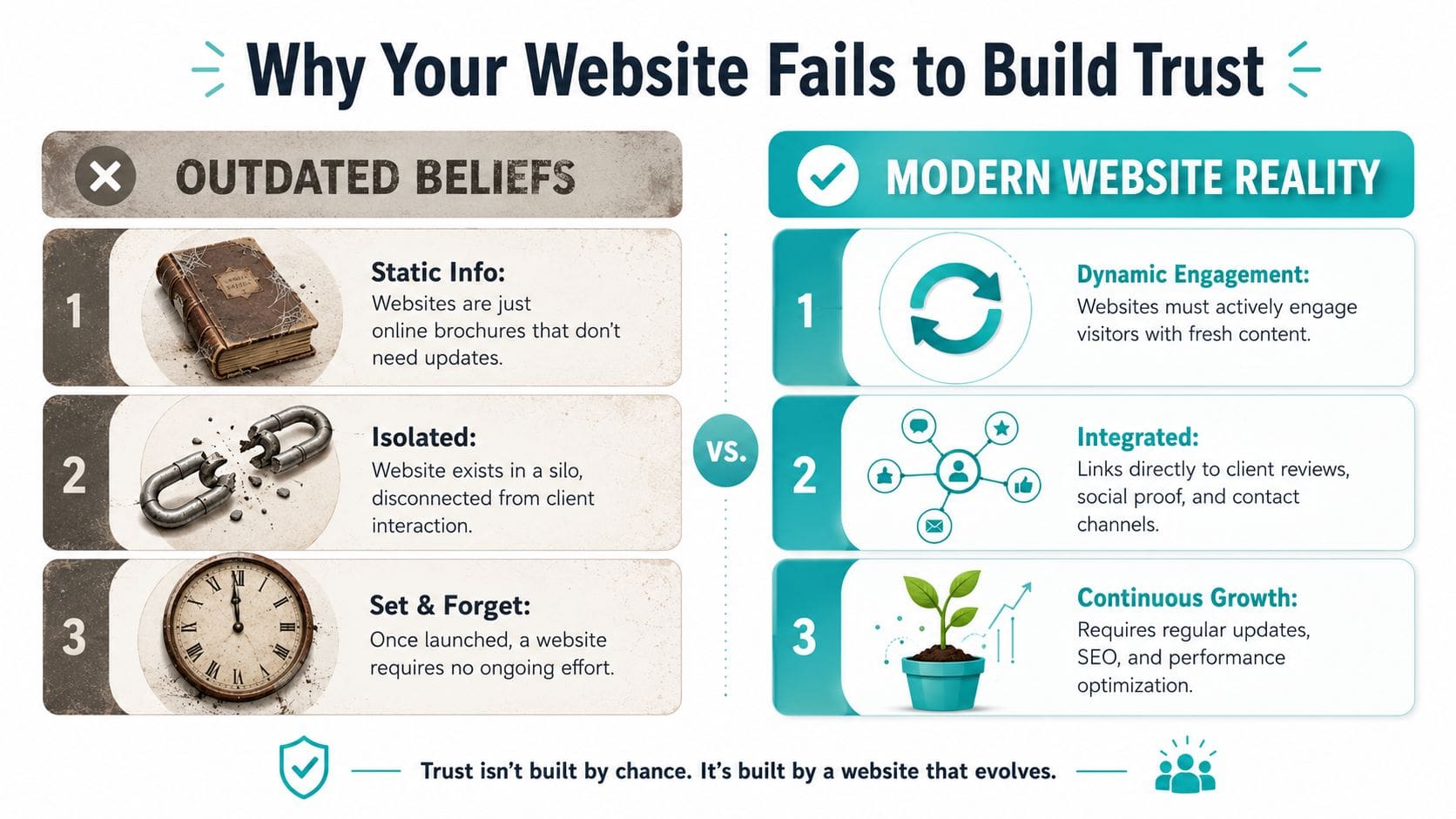
Most contractor websites fail for one reason. They were built like brochures.
They look decent. They say “quality work” and “family owned.” They have a stock photo of a smiling crew that isn't your crew. They mention one city, one phone number, and a contact form buried on the back end of the site. Then the owner waits for the leads to show up.
That is not how this works.
A website does not create traffic
Your website sits there and waits.
If nobody lands on it, it does nothing. If the wrong people land on it, it does nothing. If the right people land on it and it feels vague, stale, or fake, it does nothing.
That's why “we have a website” means almost nothing. A website alone is not a lead source. It is a conversion tool. Its job is to turn existing attention into calls.
Here's where contractors get burned. An agency sells them a pretty site and calls it marketing. Then the contractor waits. No steady traffic. No clear service area coverage. No proof. No system. Just another expense.
Trust is not polish. Trust is proof.
For contractors, trust comes from operational proof.
Research on public trust points back to transparency about who runs a business and how it operates. For contractors, that means your website has to prove you'll show up, cover the right territory, and handle the job safely. It also means clear service-area coverage, real job examples, licensing or insurance, and fast human contact options matter more than generic polish, as noted in the Reuters Institute summary on trust drivers.
A buyer is not asking, “Is this website pretty?”
They're asking:
- Do you work in my area
- Have you done this kind of job before
- Are you legit
- Can I reach a real person fast
- Will this be a headache if I call
If your site does not answer those questions fast, trust breaks.
What weak websites usually get wrong
A weak contractor site usually has the same bad pattern.
| Problem | What the visitor thinks |
|---|---|
| Stock photos | “This doesn't feel real.” |
| Vague claims | “You sound like every other contractor.” |
| No city pages or clear service areas | “Maybe you don't work here.” |
| Hidden contact options | “This is going to be a hassle.” |
| No team details | “Who am I even hiring?” |
Practical rule: If your site makes a stranger work hard to figure out who you are, where you work, and how to contact you, it is losing jobs.
If you want to know how to build trust on your website to win more jobs, stop decorating and start proving.
Five Trust Signals That Turn Visitors Into Calls
Trust doesn't come from one magic badge.
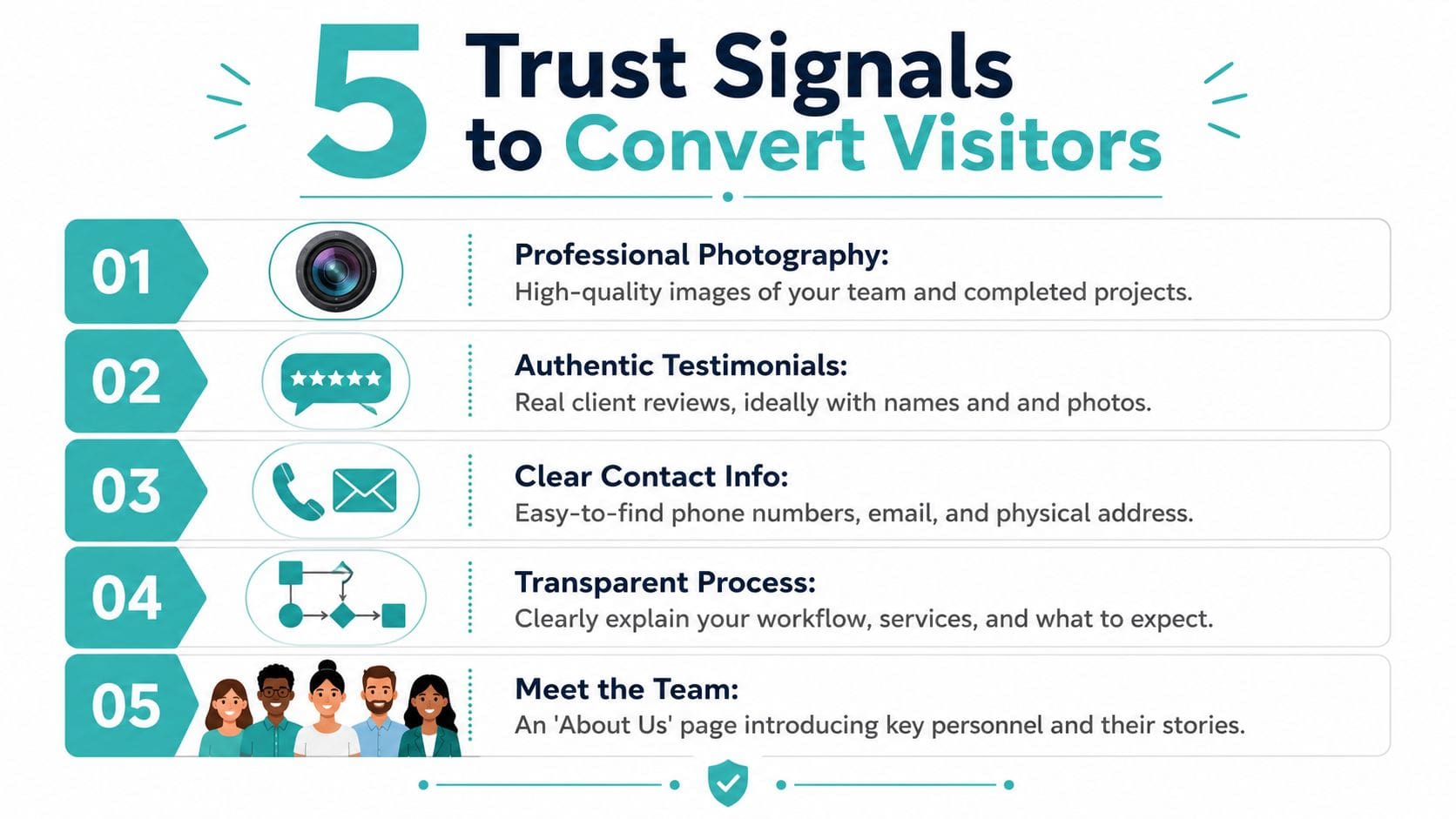
It comes from a sequence. Industry guidance on trust-building pages points to a simple order: secure the site, say exactly who you are and where you serve, show social proof, show real team details, and make contact immediate. Those are the elements that reduce uncertainty right when somebody is deciding whether to call, according to this website trust guidance.
Start with location clarity
If you want work in Newark, Heath, Granville, Zanesville, Lancaster, or any other nearby market, your website needs to say that clearly.
Not in one buried sentence.
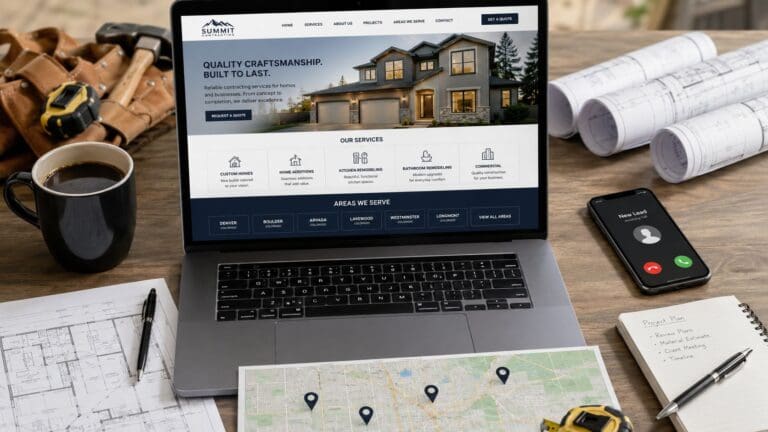
It needs real service pages and city coverage that make it obvious where you work and what you do there. When a visitor lands on that page, they should know in seconds that you handle their kind of job in their area.
Use real job proof
Many contractors often slack off here.
Don't use fake office shots and stock images of people in clean uniforms standing around smiling. Use real photos from actual jobs. Show the driveway you poured. Show the septic install. Show the cleanup. Show the before and after. Show the equipment. Show the kind of work the buyer is about to hire you for.
Specific proof beats generic claims every time.
Make contact immediate
Trust dies when contact is hard.
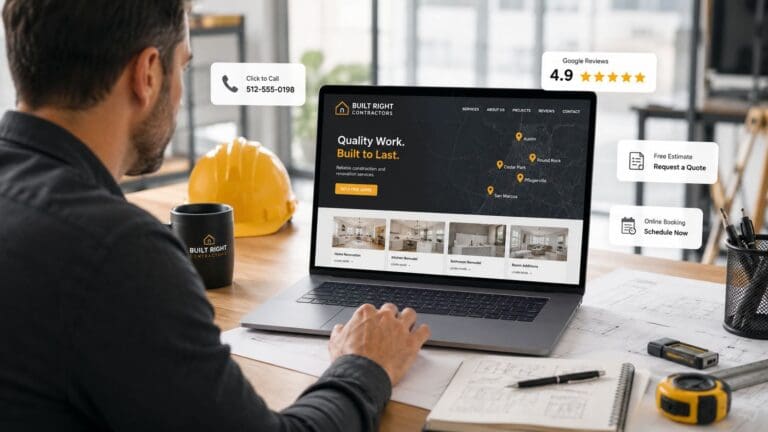
A high-trust site needs:
- Click-to-call buttons so a mobile visitor can call without hunting
- Short forms that don't feel like homework
- Multiple contact options so people can choose how they want to reach you
- Contact prompts near every conversion point so they don't have to scroll back up
If the next step is easy, more serious buyers take it.
Show real reviews where people can see them
A good review does more than praise you. It helps the next buyer picture the result.
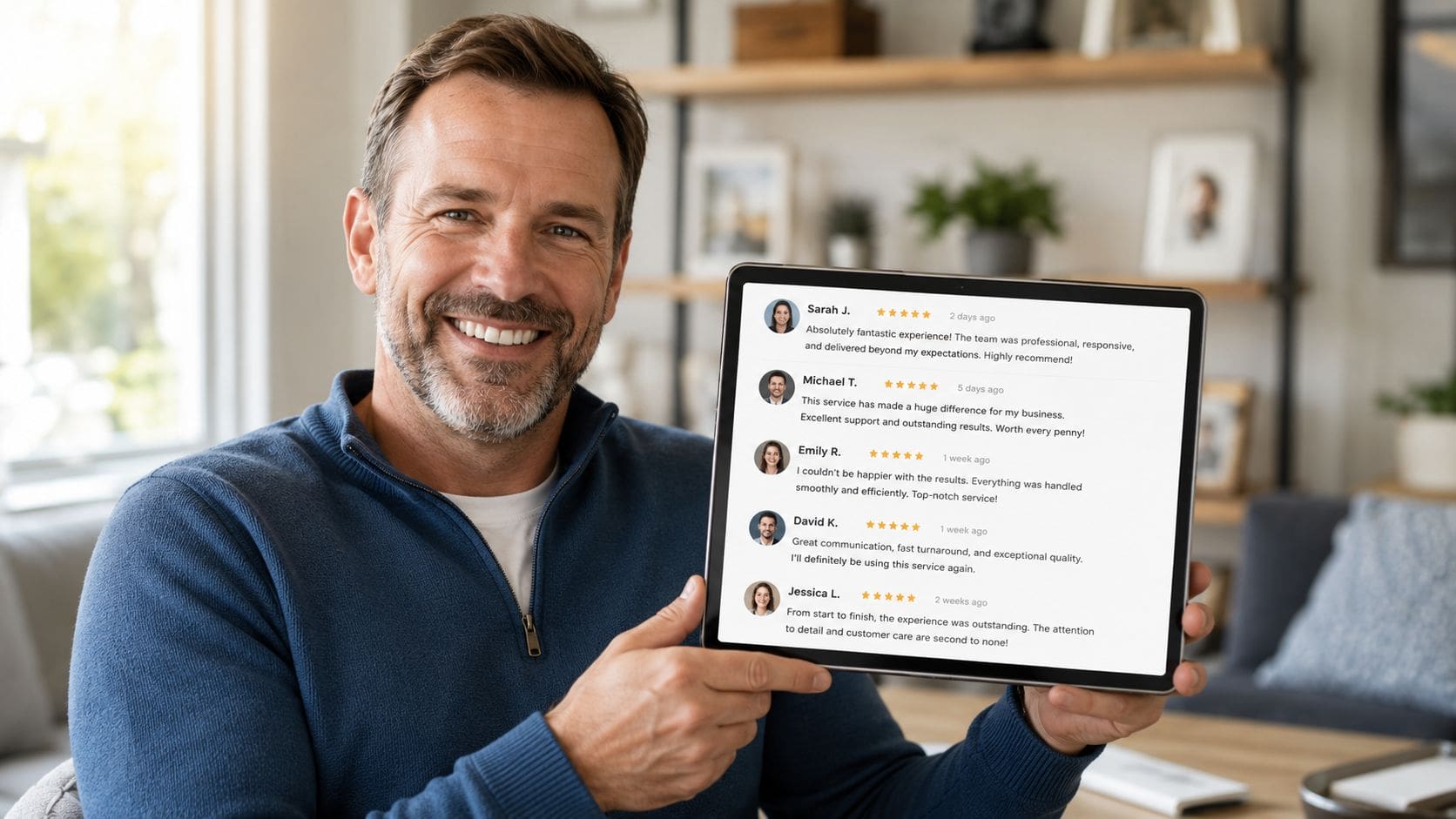
Put recent reviews where people can easily see them. Near the top. On service pages. Near forms. Near call buttons. Not hidden on one lonely testimonials page nobody visits.
Show the people behind the business
People hire people.
They want to know who owns the business, who answers the phone, and who shows up on the property. Real team and company details lower risk. A real name, real face, and real company story beat empty slogans.
If your website looks anonymous, it feels risky.
These five signals do one job. They answer the unspoken question in the buyer's head. “Can I trust these people enough to call?”
Master Social Proof to Win the Job Before You Quote
A static testimonials page is weak.
It might look nice to you. It does almost nothing for a cautious buyer if the quotes are old, generic, or disconnected from real jobs. Trust today comes from an active review system, not a dusty page built years ago.
Specific beats generic
“Great company. Highly recommend.”
That kind of review is better than nothing. It is not strong proof.
A better review mentions the job type, the area, and what happened. Something like fast repair, clean estimate process, on-time crew, clear communication, or solid cleanup. Specific reviews lower risk because they sound real and tie to real outcomes.
Best-practice guidance says a strong trust system is a continuous review workflow, not a static page. The process should include collecting, sharing, monitoring, and responding to reviews. For contractors, the strongest setup pairs reviews with job-type and service-area detail because that raises credibility far more than volume alone, as explained in this piece on building trust with quality reviews.
What a real review system looks like
A strong review system has moving parts:
- Collect consistently after completed jobs, not once in a while
- Share prominently on your website where buyers make decisions
- Monitor public platforms so bad feedback doesn't sit unanswered
- Respond like a real business to both praise and complaints
That last one matters. Silence makes a business look careless. A calm response shows accountability.
If you need a place to start tightening this up, review these online reputation management tips for contractors.
Reviews should match the job you want
If you want bigger work, your proof should support bigger work.
That means you should feature reviews tied to the exact services and areas you want more of. Don't let your best proof get buried under random comments that don't help the next buyer make a decision.
Good social proof helps the customer trust you before they ever ask for a quote.
That matters because by the time you're quoting, the buyer is already deciding whether you feel safe, credible, and worth the conversation.
The System That Turns Visibility Into Jobs
A lot of contractors ask the wrong question.
They ask, “How do I make my website build trust?”
That's too small.
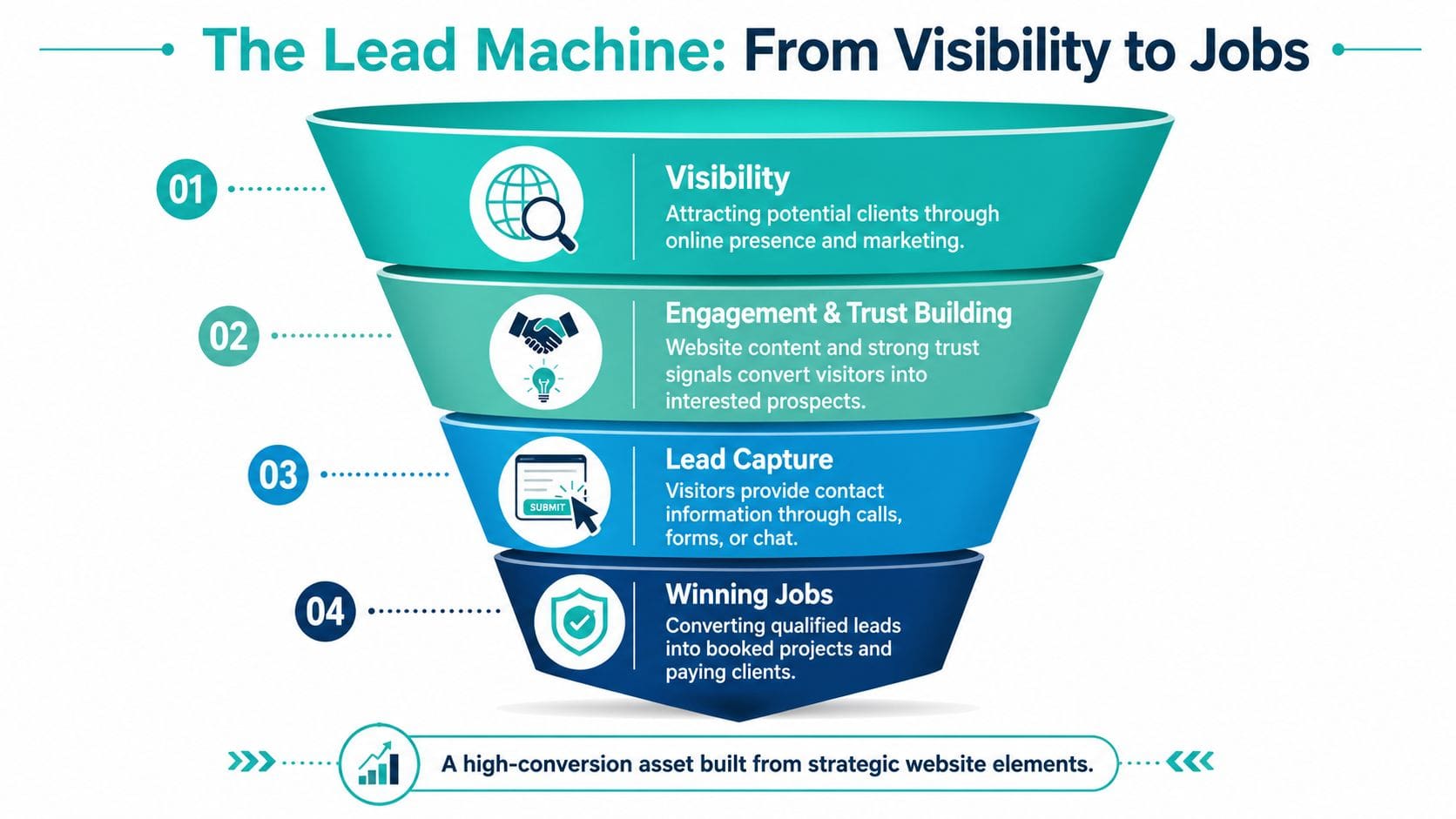
The right question is, “How do I build a system that gets seen in the right places and turns that attention into calls?” That is where most marketing falls apart. It handles one piece and ignores the rest.
Trust has to happen fast
Buyers now use a mix of your own website proof and outside proof. They also make decisions faster. Guidance on evidence-based web pages says proof needs to be placed high on the page because contractor websites need to look credible in seconds, even if the visitor never reads the whole page. The question is not just whether you use reviews. It's what proof you place so the business looks credible instantly, as explained by Orbit Media on evidence for webpages.
That changes the game.
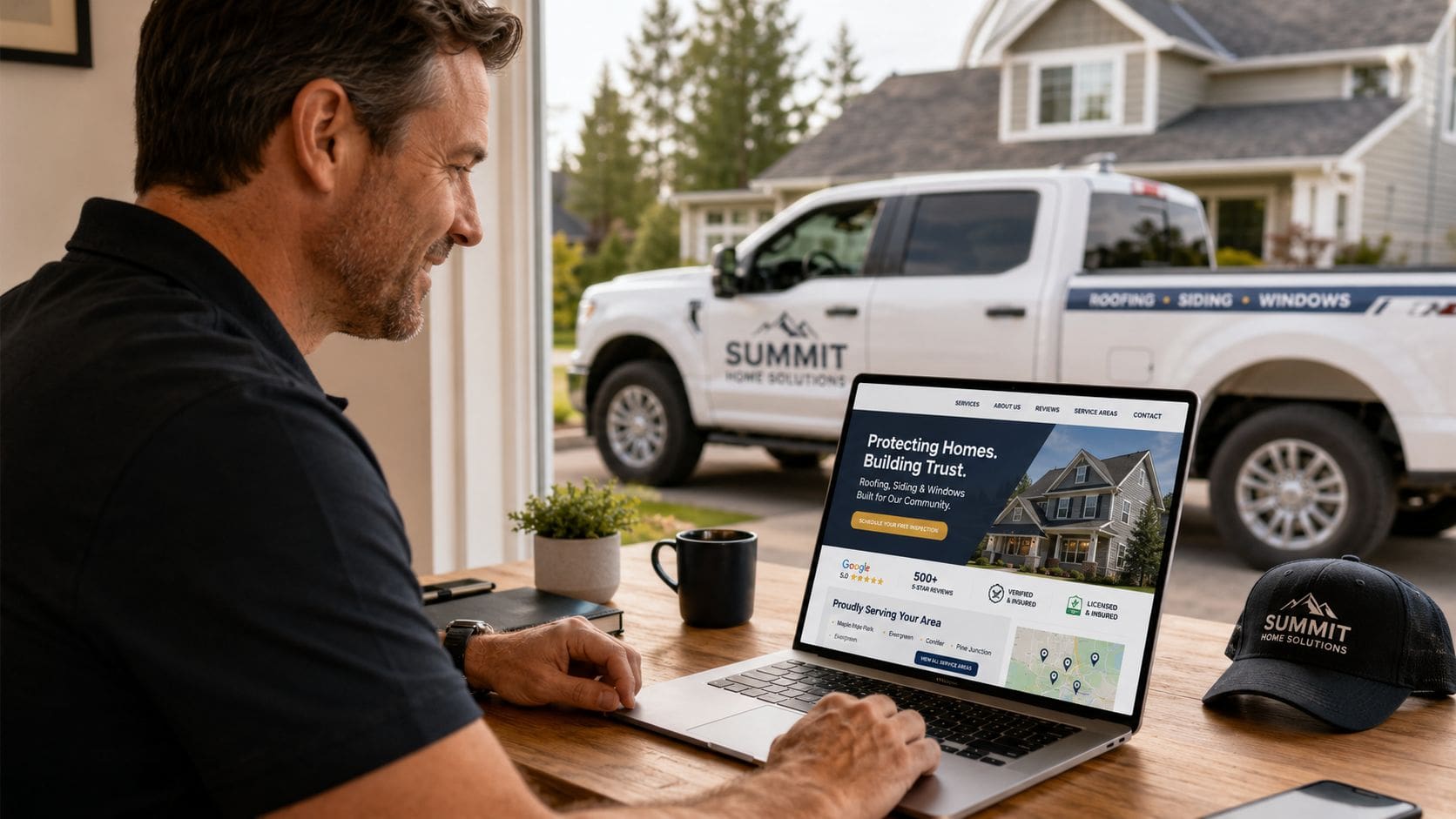
You don't have endless time to explain yourself. Your site has to prove itself almost immediately. Service area. real work. reviews. team. easy contact. All visible fast.
The Lead Machine is the only logical fix
A Lead Machine is not a pretty website.
It is a website built for one job. Turn traffic into calls.
That means it is structured by service and city. It is built for real local visibility. It has clear contact paths, strong trust signals, and the right proof in the right places. It is designed to capture demand in more than just your hometown.
Then comes the second half. Ads create visibility.
A website without traffic sits still. Ads put you in front of buyers who are searching right now. But ads alone are not the answer either. If the page they hit is weak, vague, slow, or hard to trust, you waste money.
That's why Lead Machines and ads work together as one system.
| Piece | Job |
|---|---|
| Lead Machine | Turns visitors into calls and quote requests |
| Ads | Create visibility and send buyers to the right pages |
| Both together | Build a repeatable lead flow instead of random spikes |
What this looks like in practice
A contractor who wants more work in nearby cities needs a site that covers those cities clearly. Then that site needs traffic.
That's the whole logic.
One option is a contractor-focused system like the Lead Machine website design approach, which combines service-and-city page structure, contact paths, and trust elements built for lead generation. The point is not the label. The point is the system.
A website is the asset. Ads are the fuel. Without both, you're guessing.
This is why so many contractors feel like marketing never works. They paid for half a system and expected full results.
Stop Guessing and Start Controlling Your Leads
If your lead flow depends on referrals alone, you do not control it.
If your website looks nice but nobody sees it, you do not control it.
If people in nearby cities need your service and never see your business, you do not control it.
That's why so many owners stay busy but still feel uneasy. They're doing work, but they're not building a dependable pipeline. They take small jobs they'd rather skip. They deal with tire kickers. They wonder why weaker competitors keep showing up online while they stay hidden.
Control comes from a system
You do not fix this by posting more random stuff online.
You fix it by building a system that does two things well. First, it makes you visible where you want work. Second, it makes that visibility believable enough to turn into calls.
That is how to build trust on your website to win more jobs. Not with fluff. Not with vague promises. Not with a prettier brochure.
You need clear proof. Clear locations. Clear services. Real reviews. Real people. Fast contact. And traffic sent into that system on purpose.
A fragile business waits. A stable business gets seen.
This is the line a lot of contractors need to hear.
If you don't control visibility, you don't control revenue.
And if you don't control revenue, your business is more fragile than it should be.
You can keep hoping people hear about you. You can keep waiting for the slow season to pass. You can keep paying for disconnected marketing pieces that never add up.
Or you can build the thing that makes sense.
You think customers can find you but, if customers don't find you, nothing else matters.
Lead Machines are built to fix that.
If you're tired of guessing and want a direct plan for getting found in the cities you want work from, talk to The Cherubini Company. They build Lead Machines for contractors who need visibility, trust, and a steady path from search to call.