You’re probably in one of these spots right now.
You’ve tried ads and they didn’t work.
You paid for a website and nothing changed.
An agency promised leads, then hid behind reports.
Now when someone says “local web marketing services,” you hear “more money out the door.”
That reaction makes sense.
A lot of contractors don’t have a work problem. They have a visibility problem. They’re known in their own town, but ten miles away they barely exist online. That’s the core issue. When someone searches for your service, they usually search by what you do and where they need it. Not by your business name. If you don’t show up in that city, you’re out before the job even starts.
That’s why guessing fails. That’s why random tactics fail. And that’s why most local web marketing services miss the point.
The Real Reason Your Marketing Fails
A homeowner in the next city needs your service right now. They search. Your competitor shows up. You don’t. That lead is gone before your estimator even has a chance.
That is why your marketing keeps disappointing you.

You do not have a work ethic problem
You have a visibility problem.
Contractors usually blame the wrong thing. They blame the website. They blame the ad spend. They blame seasonality. Sometimes they blame themselves for not following up fast enough. Those things matter, but they are not the first failure point.
The first failure point is simpler. Buyers in the cities you want do not see you when they search by service and location.
Google does not reward effort. It rewards clarity and relevance. If your office is in one town, your site talks about one town, and your pages are broad and generic, Google connects you to one town. It does not care that your trucks drive 30 miles in every direction.
That gap between where you can work and where you are visible is the invisibility gap.
It is brutal for service-area contractors trying to expand into multiple cities. You may have the crews, the equipment, and the capacity. None of that matters if your company is practically invisible outside your home base.
Practical rule: If your website does not clearly show that you offer a specific service in a specific city, do not expect Google to put you in front of buyers there.
A social page does not fix that. A pretty homepage does not fix that. Ranking for your own company name does not fix that. As explained in why websites don’t generate leads on their own, a site only converts attention after you get it.
Growth stalls when your visibility stops at city limits
This is why a lot of contractors stay busy and still feel stuck.
You get enough calls to survive, but not enough of the right calls to control your schedule or your margins. You take too many small jobs. You drive too far for weak estimates. You fight over the same pool of local leads while better jobs in nearby cities go to companies that built visibility there first.
That is not a branding issue. It is a coverage issue.
Known-name searches do not create expansion. Broad traffic does not help if it comes from the wrong area. Hometown-only visibility keeps your business smaller than it should be, even when demand exists all around you.
Most local web marketing services talk in vague language because vague language hides weak strategy. “More presence.” “More awareness.” “Better branding.” Fine. None of that answers the only question that matters.
Do you show up for the right service in the right city at the moment the buyer is ready to call?
If the answer is no, your marketing is failing.
Agencies miss the problem because they sell pieces, not a system
Contractors get burned.
One agency sells a website. Another sells SEO. Another sells ads. Nobody takes responsibility for building city-by-city visibility that turns into calls. So you end up with activity, reports, and excuses instead of a lead flow system.
The fix is not more random tactics. The fix is a Lead Machine.
A Lead Machine is built to close the invisibility gap across the towns you want to own. It gives Google and buyers a clear signal about what you do, where you do it, and why you are the company to call. Then ads add speed and volume on top of that foundation.
That is how you get control. Not by hoping people “find you.” By building a system that makes sure they do.
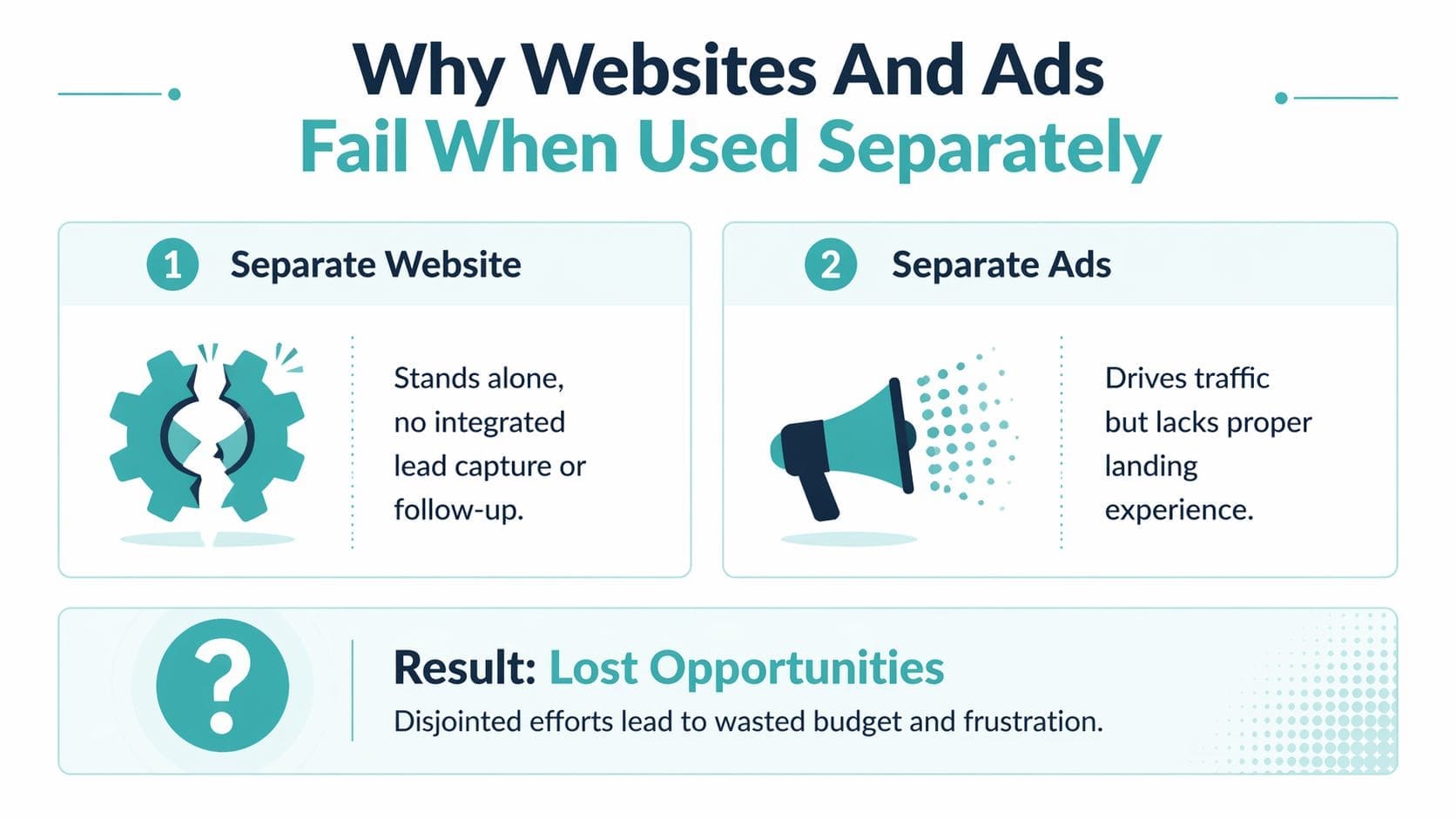
Why Websites And Ads Fail When Used Separately
Most contractors have already tried one half of the solution.
They bought a website. Or they ran ads. Sometimes they did both, but not in a way that worked together. Then they concluded marketing doesn’t work.
That’s the wrong conclusion.
The right conclusion is that disconnected parts fail.
A website does not create traffic
A website is not a lead source by itself.
It does not go out and find buyers. It sits there and waits. That’s it. If nobody lands on it, it produces nothing. Contractors need to understand this because a lot of bad local web marketing services sell websites as if the site alone will fix lead flow.
It won’t.
That idea is broken, and websites don’t generate leads on their own. They only convert attention that already exists.
A site can help close the deal. It can help turn a visitor into a call. But first, someone has to land there.
Ads without a conversion system burn money
Now take the other side.
Ads can create visibility fast. That’s their job. But if the click goes to a weak website, the money is wasted. You paid to get attention, then sent that attention to a dead end.
A bad mobile site is a killer here. Consumer behavior in 2026 confirms the problem. 57% of users will not recommend a business with a poorly designed mobile website, according to local marketing trend data cited by FasterCapital.
That means even if the ad worked, the website still lost the job.
A contractor doesn’t need “more traffic” if the site turns buyers away the second they land on it.
Many agencies conceal shortcomings. They blame the ad platform. They blame the market. They blame seasonality. Sometimes the actual problem is much simpler. The ad did its part. The website failed.
One without the other creates the same result
Look at the split clearly:
| Setup | What happens |
| | |
| Website only | You wait and hope people show up |
| Ads only | You pay for visits that don’t turn into calls |
| Website plus ads without alignment | You get noise, confusion, and weak lead flow |
| System built to convert plus ads built to drive intent | You finally get control |
That’s the difference.
- Pretty websites don’t save weak traffic.
- Traffic doesn’t save weak websites.
- Reports don’t matter if the phone stays quiet.
A contractor who says, “We tried ads and they didn’t work,” is often telling you they paid for clicks without having a site built to catch them.
A contractor who says, “We already have a website,” is often telling you they own a brochure that sits online doing nothing.
Both situations are common. Both lead to the same result. Frustration.
The System Big Companies Use To Dominate Your Area
A homeowner in the next town searches for the exact service you sell. Your company can do the job. Your crew can get there. Your phone still never rings because your business does not show up for that town.
That is the actual problem. Invisibility.
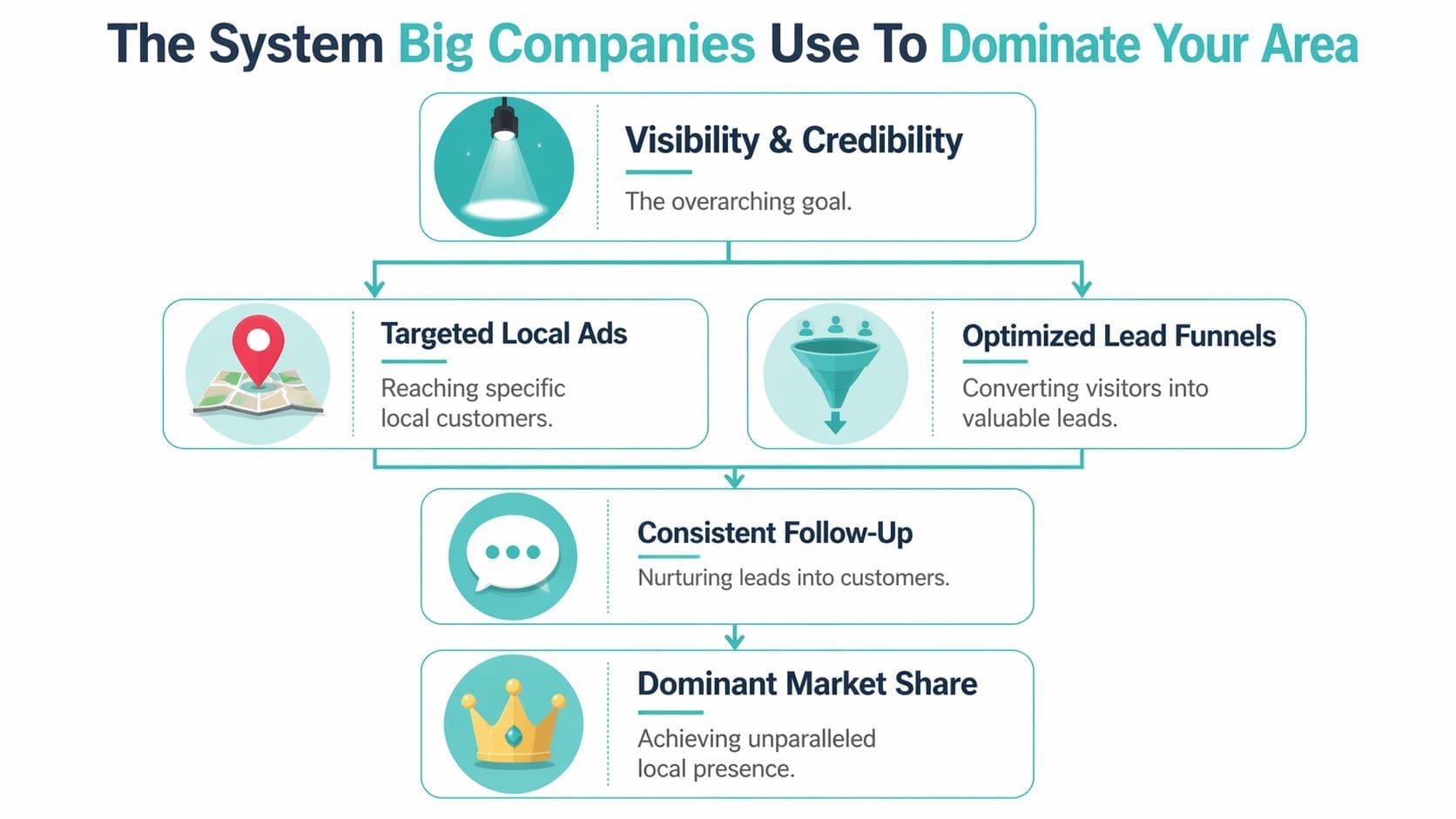
Big companies beat smaller contractors on coverage. They build systems that claim territory city by city, service by service, then keep adding fuel. Smaller contractors keep relying on one generic website and a vague service-area line in the footer. That setup leaves money sitting in nearby towns for someone else to collect.
A Lead Machine is built to claim territory
A Lead Machine is a website built to turn regional visibility into booked jobs. It is not a digital brochure. It is a structure designed to cover the towns you want, match the services buyers search for, and push visitors to call, form fill, or request an estimate.
For service-area contractors, that structure usually includes:
- Service pages tied to real buyer intent
- City pages for each target market
- Clear calls to action on every page
- Mobile-first layouts for urgent searches
- Fast load times that keep people from bouncing
- Call tracking and form tracking so you can see what is working
- Review proof placed where buyers look
That is how bigger operators expand across multiple towns without guessing. They do not wait for Google to connect the dots. They build the dots.
Multi-city expansion fails when your site stays stuck in one-town mode
This is the blind spot that keeps contractors small.
You may serve fifteen towns. Your current site often acts like you serve one. One homepage. One services page. One contact page. Maybe a sentence that says “proudly serving the surrounding area.” Google has no reason to rank that site across your full territory, and buyers in those towns have no reason to trust that you work there every day.
A serious local growth plan needs regional page coverage. BrightLocal’s local SEO guide explains why local relevance, proximity, and prominence shape visibility. For a contractor, relevance starts with pages that clearly connect each service to each target city.
That is the invisibility gap.
The contractor who publishes real city and service coverage gets seen in more places. The contractor with one generic site stays trapped in the hometown market, then wonders why expansion never sticks.
Structure beats jargon
Agencies love to bury owners in terms they barely explain. That confusion is useful for them. It is expensive for you.
If you want a plain-language breakdown of how search visibility ideas are shifting, read AEO vs SEO vs GEO. Then come back to the part that matters. New labels do not fix weak structure.
You need a website that shows where you work, what you do, and why a buyer should contact you now. You need pages built to rank in each city you want to own. You need a system that can scale as your service area grows. If you want to see how ads fit into that system, review this guide on fueling lead generation with Google Ads.
Big companies already know the formula
They build an asset first. Then they use that asset to spread across the map.
That is why they keep showing up in your area.
A Lead Machine gives you control over lead flow because it gives you coverage. Coverage by city. Coverage by service. Coverage that matches how people search when they need excavation, septic, grading, plumbing, restoration, or clearing work.
Judge local web marketing services by one standard. Do they close the invisibility gap across your full territory, or do they leave you hidden outside your home base? If the system does not solve that, it is not a growth system. It is overhead.
Fueling Your Lead Machine With Local Ads
A contractor opens a new city page, waits for the phone to ring, and gets nothing.
That is what happens when the Lead Machine has no fuel. The site can be built correctly, the city pages can exist, and the service structure can be sound, but if nobody sees it yet, lead flow stays thin. Ads fix that fast. They put your business in front of buyers while your organic visibility grows across the map.
Ads exist to get in front of buyers now
Local ads are not a branding exercise for service contractors. They are a visibility tool for high-intent searches.
Someone has a drain problem, a failed septic system, standing water, or a grading job that cannot wait. They search by service and location. If your ad appears, you have a shot. If it does not, the invisibility gap stays wide open, especially in the cities outside your home base.
That is why smart contractors use ads with precision. They do not spray budget across broad terms and hope for calls. They target the services that make money, the locations they want to own, and the searches that signal real buying intent.
Ads should send traffic to a page built for action
Discipline matters here.
Do not pay for clicks and dump people on a generic homepage. Send them to a service-and-city page built to convert. The message in the ad should match the page. The page should match the job the buyer needs done. If you want a clear example of what that looks like, study a high-converting landing page with testimonials.
This is the point many agencies miss, or ignore. They sell traffic because traffic is easy to report. Contractors do not need reports full of clicks. They need booked estimates, qualified calls, and jobs in the right zip codes.
That is why a system built to fuel your leads with Google Ads beats random campaign management. The goal is controlled lead flow. Ads drive demand into the Lead Machine. The Lead Machine turns that demand into calls.
Good ads don’t replace the website. They power it
Used alone, ads are expensive. Used alone, a website is slow.
Together, they give you control.
| Part | Role |
| | |
| Lead Machine | Captures and converts local demand |
| Local ads | Put you in front of buyers immediately |
| Both together | Create repeatable lead flow by service and city |
That is the fundamental difference between marketing that feels random and marketing that scales across a region. A weak site with no ads leaves you buried. Ads without a conversion system waste money. Lead Machines plus ads give service-area contractors a practical way to close the invisibility gap city by city.
That is how you stop guessing. That is how you stop waiting. That is how you get control over lead flow instead of letting the market decide when your phone rings.
What To Expect From A Real Lead Generation System
A real system should change how your business feels to run.
Not just how it looks online.
If your current marketing gives you random calls, weak leads, and no clear way to tell what’s working, then you don’t have a system. You have activity. Those are not the same thing.

Real lead generation gives you control
The first thing a contractor should expect is clarity.
You should know where calls came from. You should know which forms came through. You should know whether the lead turned into a job. If you cannot track that, then the whole thing turns into opinion and excuses.
That is one reason so many small business campaigns fail. 70% of small business marketing fails due to poor attribution, and a real system focuses on tracked calls, form submissions, and measurable cost per job, as outlined in Bain’s discussion of underserved small business marketing.
That point matters more than most contractors realize. If you can’t trace a lead back to the source, you can’t improve anything. You just keep spending.
Expect better decisions, not just more noise
A solid system should help you make tougher, better business choices.
That means:
- Turning down weak jobs when the pipeline improves
- Targeting better work instead of taking whatever shows up
- Expanding into nearby cities with a clear plan
- Reducing stress because lead flow is less random
Many pay-per-lead setups fail contractors. They push shared leads, not control. They keep you dependent. You end up competing with other contractors for the same prospect and hoping you answer first.
A Lead Machine model is different because the website is the asset. The traffic goes to your system. The calls are tracked through your process. That is a much stronger setup than renting scraps.
Bottom line: If your marketing partner can’t show how a call became a job, they’re selling motion, not results.
Expect a site built to convert trust fast
Trust matters, but not in a fluffy way.
The buyer lands on the page and decides fast. Do you look legitimate? Do you seem local? Is the next step clear? Are there visible reviews or proof points that reduce doubt? That’s what matters.
If you want a useful example of what that trust layer can look like, this article on a high-converting landing page with testimonials shows why proof on the page matters so much. Contractors don’t need complicated storytelling. They need a page that lowers friction and makes calling feel safe.
Flat-rate clarity beats lead-selling games
A real lead generation system should also be straightforward in how it’s sold.
Contractors get burned when pricing is vague, performance is hidden, and every answer sounds slippery. The clean model is simple. Flat rate. Clear scope. Visible tracking. No shared lead nonsense.
Here’s the practical contrast:
| Weak setup | Strong setup |
| | |
| Shared lead resale | Your own lead path |
| Vague reports | Tracked calls and form fills |
| Generic website | Service-and-city structure |
| Random activity | Repeatable process |
That is what local web marketing services should deliver. Not mystery. Not hype. Control.
Predictable leads change how you run the company. You stop chasing every small job. You stop wondering what next month looks like. You stop making decisions from panic.
How To Choose The Right Local Marketing Partner
A bad marketing partner does not just waste money. They keep you invisible in the cities where you want work, then bury that failure under reports, jargon, and excuses.
That is the true test. Can they show you how you get visible across multiple towns, or are they selling another isolated tactic that dies the minute you stop paying for it?
Ask one question first: do they build a system or sell parts?
Contractors expanding into several cities need more than a decent homepage and a few ads. They need a Lead Machine. That means city-by-city visibility, pages built to convert, tracking that shows what produced calls, and ads that feed the whole thing instead of operating in a silo.
If a company talks only about rankings, keep your guard up. If they talk only about ad spend, same problem. You are hiring them to build control over lead flow.
Multi-city growth is where weak agencies get exposed. A lot of general advice, including broad lists like 10 essential local business marketing strategies, can be useful at a high level. But contractors serving a region need a tighter plan. They need a partner who can explain how your visibility gap gets solved city by city.
Ask who owns the machine
Ownership is not a side question. It is the deal.
If they build the website, can you keep it? If they create landing pages, tracking numbers, and forms, do those stay with you? If the relationship ends, do you still have a functioning lead system, or does everything disappear overnight?
That is why this guide on how to choose a website designer for long-term business control matters. The right decision is not about design taste. It is about whether you are paying to build an asset or paying rent on someone else’s platform.
If the marketing partner controls everything and you control nothing, you are not building long-term value. You are building dependence.
Use this filter before you sign anything
Do not ask for a pitch. Ask for clear answers.
- Can they map your invisibility gap by city?
If they cannot show where you are missing in search and maps, they do not understand the core problem. - Can they explain how the website and ads work together?
If those are sold as separate services with separate logic, expect separate failures. - Do they have a plan for expansion beyond your home base?
“We target your service area” is lazy talk. Real planning names the cities, the page structure, and the traffic strategy. - Do they track calls, forms, and booked jobs?
You need job-producing signals, not pretty dashboards. - Is pricing clear and scope defined?
Vague contracts protect the agency, not you. - Can they explain the process in plain English?
Good operators are clear. Slippery ones hide behind buzzwords.
The right local marketing partner does not try to impress you with complexity. They diagnose the invisibility problem, show you the gaps, and build a Lead Machine that gives you control over lead flow across the exact cities you want to own.
That is the standard. Anything less is another way to stay invisible.
Your Action Checklist To End Invisibility
You do not need another random tactic.
You need to make a few hard decisions and stop pretending your current visibility is “good enough.” If you want more control over lead flow, this is the checklist that matters.
The five moves that matter
- List every city you want jobs from
Not just where you’ve worked before. Where you want work next. - Find out where you’re invisible now
You need a real visibility map, not a guess. - Decide whether you want more leads or better leads
Those are not always the same thing. Bigger jobs usually require better targeting. - Stop buying one-off tactics
If the pieces don’t work together, they will fail separately. - Choose a partner that builds an asset you control
If you don’t own the system, you don’t own your future lead flow.
For a broader look at what local businesses often try, this roundup of 10 essential local business marketing strategies is a decent reference. But for contractors, the main point is simpler than most lists make it sound. Visibility by city, a website built to convert, and ads that drive intent are what move the needle.
What matters now
You don’t need more information than this.
You need to stop confusing “having a website” with being visible. You need to stop confusing “running ads” with having a system. And you need to stop accepting vague reports as proof that anything is working.
You think that customers “can” find you but, if customers “don’t” find you, nothing else matters. Lead Machines are built to fix that.
If you’re tired of guessing and want a straight answer about why your business isn’t showing up where it should, talk to The Cherubini Company. They help contractors fix the problem, invisibility, by building Lead Machines and fueling them with ads so the right cities see you, call you, and hire you.