
You answer the phone. They want a price. You drive out. You measure. You send the quote. Then nothing.
Or worse, they call three other contractors, beat you up on price, and waste half your day for a job they were never going to buy.
That’s the part most contractors hate. Not the work. The nonsense before the work.
If you're trying to figure out how to stop getting tire kicker leads, stop blaming only the caller. Yes, some people are time-wasters. But if your pipeline keeps filling with them, that usually points to a bigger problem.
Bad leads are often what show up when your business isn't visible to enough serious buyers in the right places. When the good prospects don't see you, the junk rises to the top.
You Have a Lead Problem But It’s Not What You Think
The frustration is real.
You answer calls from people who want “just a rough number.” You send estimates to people with no timeline. You hear, “We’re just comparing prices.” You spend evenings chasing follow-up on jobs that were dead from the first call.

That feels like a lead quality problem. It is, but not in the conventional sense.
Tire kickers are the symptom
A lot of contractors treat this like a phone script issue. They think they need better lines, a sharper sales pitch, or a new office person to “handle leads better.”
That’s too small.
When serious buyers can’t find you, your inbound fills up with people who are casually browsing, shopping price, or killing time. The wrong people get through because the right people never saw you in the first place.
Practical rule: If your calendar is full but your jobs are small, scattered, and hard to close, you probably don't have a work ethic problem. You have a visibility problem.
There’s also a cost to this that most owners ignore until they feel burned out. Sales reps lose an estimated 780 hours per year, about 20 full work weeks, chasing tire kicker leads that never convert, according to Prospeo’s analysis of tire kicker leads.
That wasted time doesn't just hurt sales. It hurts operations. It clogs your schedule, drags down morale, and keeps you from spending time on real buyers.
Good leads act differently
Serious buyers usually don't behave like bargain hunters.
They ask clear questions. They have a reason for the project. They know where the job is. They can explain timing. They don't dance around every basic detail.
If you want a useful outside look at that pattern, this breakdown of lead conversion behavior analysis is worth reading. It shows a simple truth. Better leads tend to act with more intent.
Here’s what bad pipelines usually look like:
- Price-first conversations that start and end with “What’s your cheapest option?”
- Weak project details like vague scope, no photos, no job address, no real timeline
- Ghosting after quotes because they were collecting numbers, not choosing a contractor
- Tiny jobs from the wrong areas that pull you away from the work you want
You don't fix that by hoping people become better prospects after they call.
You fix it by changing who sees you, where they see you, and what kind of path they enter before they ever talk to you.
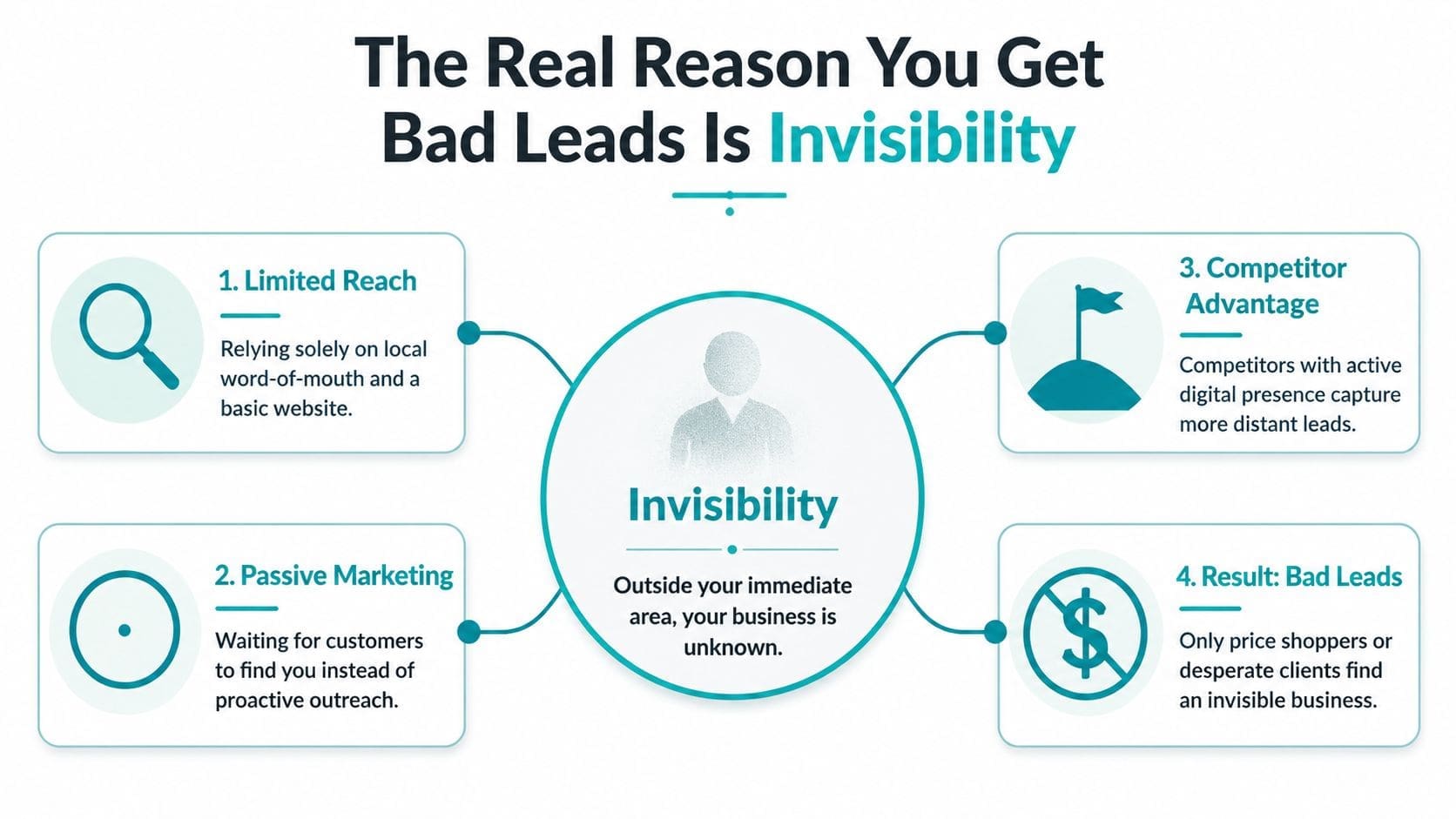
The Real Reason You Get Bad Leads Is Invisibility
Most contractors think, “People know us.”
That’s only half true.
People in your hometown might know you. Past customers might know you. Friends of friends might know you. But ten miles away, in the next town over, you might as well not exist online.
Google doesn't assume anything
A homeowner doesn't search your business name if they don't know you.
They search for what you do and where they need it. If they type “excavation contractor near me,” Google reads that as “excavation contractor in my city.” Same for septic, concrete, grading, land clearing, roofing, plumbing, and everything else.
If your business only clearly talks about your home city, then Google connects you to that city. Not the next one. Not the county over. Not the place where you’d gladly drive for a bigger job.
That’s the visibility gap.
Outside your immediate area, your business can be solid, proven, and profitable, yet still be invisible when a buyer searches.
That invisibility creates a bad pipeline. When qualified buyers in the better towns never see you, you're left dealing with whoever does find you. Usually the cheap jobs, the random jobs, and the people who were never serious.
Invisible contractors get stuck with leftovers
This is why some owners stay busy and still feel stuck.
They’re doing work. They’re answering calls. But they’re not getting enough of the right calls. The stronger jobs are going to companies that show up where people are searching.
If you want the plain-English version of that problem, this page on why contractors don't get enough leads lays it out well. The issue usually isn't effort. It's that buyers in nearby cities don't see you when they need you.
A quick breakdown makes it obvious:
| What you think is happening | What's actually happening |
|---|---|
| People in nearby towns can find you | They search by service and city, not by your name |
| Your website covers your service area | It often only signals your home city |
| More calls should mean better business | More low-intent calls just create more wasted time |
| Bad leads are random | Bad leads often fill the gap when qualified buyers never see you |
If you want more useful background on how businesses boost visibility on Google, that can help frame the issue. The big point is simple. Google responds to clear signals. If you never signal the surrounding cities, you won't show there.
This is why the tire kicker problem starts earlier than most contractors think. It starts before the call. It starts with who sees you at all.
Why Your Website and Word-of-Mouth Are Not Enough
Most contractors lean on two things.
A website. And word-of-mouth.
Both matter. Neither is enough by itself.

Your website doesn't go out and get traffic
A website is not a lead source by itself.
It doesn't wake up in the morning and go find buyers. It sits there and waits. If nobody lands on it, it does nothing. If the wrong people land on it, it helps the wrong people contact you.
That’s why so many owners say, “We have a website, but it doesn’t do much.” Of course it doesn’t. A site without visibility is a brochure on a shelf.
If that idea hits a nerve, this short piece on why websites don't generate leads says it plainly. Websites convert traffic. They do not create it.
Word-of-mouth is good, but you can't control it
Referrals are great when they come in.
The problem is they come in when they want to. You can't scale them on command. You can't turn them up in a slow month. You can't point them at a new city you want to grow in.
That creates the feast-or-famine cycle contractors know too well.
- Busy month and you think the pipeline is fine
- Quiet month and panic shows up fast
- Crews slow down and now every lead feels urgent
- Standards drop and you start entertaining bad-fit jobs
Word-of-mouth is a bonus. It is not a system.
The hard truth is this. Big companies buy visibility. Small contractors often rely on hope.
Hope says the phone will ring because you did good work last year. Hope says people will tell their friends. Hope says your website should somehow “bring in leads.”
Hope doesn't control demand.
If you're serious about how to stop getting tire kicker leads, you need something better than passive marketing. You need a setup that brings the right people to a site built to turn that attention into calls.
Building a System to Attract the Right Customers
The fix isn't more hustle. The fix is a system.
That system starts with a Lead Machine. Not a pretty website. Not a pile of random pages. Not an online business card.
A Lead Machine is a website built for one job. Turn visibility into real calls from people who want the work.
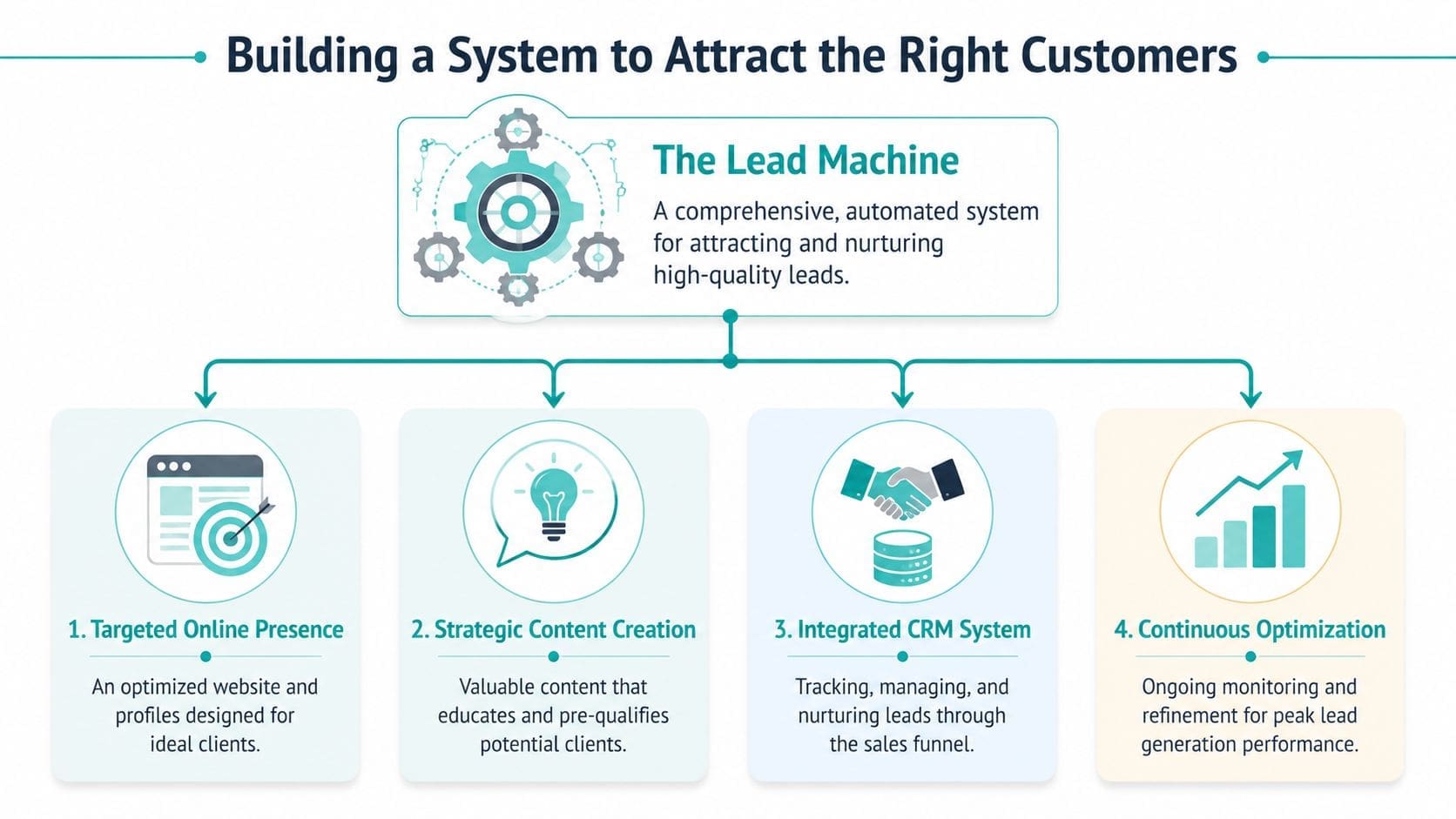
What a real lead system does
A real lead system matches how buyers search.
They look for a service. In a city. On a phone. Usually when they need help now, or soon. So the site needs to meet that moment fast and clearly.
That means the system should do things like:
- Match services to locations so buyers in nearby cities can find the right page
- Make calling easy with clear next steps instead of dead-end browsing
- Set expectations early so weak leads don't drift through
- Capture useful details before someone ever reaches your schedule
Early qualification matters. Businesses that use a structured framework like BANT, which stands for Budget, Authority, Need, Timeline, can achieve up to 2x higher close rates, and one contractor reported a jump from 40% to 78% by asking a direct commitment question early, as described in Capsule CRM’s guide to qualifying leads.
That doesn't mean you need to turn your office into a sales seminar. It means your intake should stop being loose and lazy.
Serious buyers don't mind clarity
A lot of contractors are scared to ask better questions because they think it will scare people away.
Good. Let it.
If someone refuses to give basic project details, a rough timeline, or any sign of commitment, that’s not a lead you need more of. That’s exactly the kind of call that drains your week.
A stronger intake path can include:
| Weak intake | Strong intake |
|---|---|
| Name and phone only | Project type, location, timeline |
| “Request a quote” | Clear next step tied to real intent |
| Anyone can submit anything | Details that help screen out weak fits |
| Every inquiry treated the same | Better leads rise to the top faster |
The goal isn't to get more forms. The goal is to get more calls from people who fit the work you want.
If you want one provider example, The Cherubini Company builds Lead Machines structured by service and city, then pairs them with ad traffic so the website works like a lead system instead of a brochure.
You don't need more noise. You need a better path for the right buyer.
If you're looking for broader thinking around messaging and how businesses shape what prospects see before they reach out, this guide to content strategy essentials gives useful context. For contractors, the point is simple. What the buyer sees before the call affects who calls.
Fueling the Machine with Targeted Ads
A Lead Machine without traffic is still sitting still.
That’s where ads come in.
Not fluff. Not vanity. Not “boosting awareness.” Ads create visibility in the places where buyers are already looking.

Ads should bring buyers, not browsers
When ads are broad, they attract junk.
That’s one reason contractors get frustrated and say ads don't work. A lot of campaigns are aimed too wide, in too many places, with no real control over fit.
Due to broad targeting, 35% of contractor ad leads are often tire kickers. With modern ad platforms, AI lead scoring can flag low-intent inquiries and reduce tire kickers by as much as 28% for service professionals, according to Rounded’s write-up on qualifying leads and filtering out tyre kickers.
That matters because ad traffic shouldn't just create more calls. It should create better calls.
The machine and the fuel have to work together
A smart setup does two things at once.
First, ads put you in front of people searching right now in the cities you want. Second, the Lead Machine catches that attention and turns it into a real next step.
When those two pieces work together, you stop relying on random chance.
- Ads create visibility in the target areas
- The website converts attention into calls and form fills
- The intake path screens for fit before wasted follow-up piles up
- Tracking shows what produced the lead so you stop guessing
If you're trying to understand that setup in plain terms, this page on Google Ads to fuel your Lead Machine is a useful reference.
Good ads don't rescue a weak website. They feed a system built to convert.
This is the part many contractors miss. They either buy ads and send traffic to a weak site, or they build a site and never drive traffic to it. Both fail.
The answer isn't “website or ads.” It's both, working as one system.
Take Control of Your Leads and Your Revenue
You can keep doing it the old way.
Rely on referrals. Hope the phone rings. Answer every random call. Chase every quote. Complain about tire kickers. Stay busy without feeling in control.
A lot of contractors live there for years.
Or you can fix the underlying problem.
You get visible in the cities you want. You stop treating your website like a magic lead generator. You stop sending ad traffic into a dead-end brochure. You build a system that attracts better buyers and filters out weak ones earlier.
The choice is simple
One path is fragile.
It depends on word-of-mouth, memory, luck, and whatever random calls happen to come in. That path creates stress because you never really know what next month looks like.
The other path gives you control.
- Control over where you show up
- Control over what kind of work you attract
- Control over how leads come in
- Control over revenue instead of reacting to it
If you're serious about how to stop getting tire kicker leads, stop thinking only about screening them after they appear. Fix the visibility problem that feeds them. Build the system that pulls in better buyers from the start.
You think that customers "can" find you but, if customers "don't" find you, nothing else matters. Lead Machines are built to fix that.
If you're tired of guessing and want a clear look at why your business isn't showing up where buyers are searching, talk to The Cherubini Company. They build Lead Machines and visibility systems for contractors who need more calls, better leads, and coverage beyond their home city.