You're probably busy right now. Crews are moving. Phones ring some days. Referrals still come in.
But being busy isn't the same as being in control.
A lot of local contractors are stuck in a bad spot. They stay full on small jobs, chase whatever comes in, and assume the bigger jobs just aren't out there. That's usually not true. The bigger problem is this. There's a demand for your service on phones in the towns around you, and your business isn't showing up when it matters.
That's why mobile friendly websites matter for local contractors. Not because mobile design is trendy. Because when your site is hard to use on a phone, you become harder to find, harder to trust, and harder to contact. That kills leads before you even know they existed.
The Invisibility Problem Costing You Jobs
A contractor can have a solid name in his hometown and still be invisible where the growth is.
Say you do excavation, septic, roofing, concrete, or restoration work in a whole cluster of nearby towns. You've got trucks on the road. You've got yard signs out. People in your home base know you. But someone ten miles away has a problem today, searches on their phone, and calls the company they see first. That company gets the shot. You never even knew the lead existed.

Busy does not mean visible
In this regard, many owners deceive themselves.
You think, “People can find us.” Sure, they can find you if they already know your company name. That is not the true measure. The true measure is whether a stranger in another town can find you when they search for the service you do.
That's the gap.
You don't just lose the jobs you bid. You lose the jobs you never got invited to quote.
A website should help fix that. Most contractor websites don't. They sit there like an old brochure and wait. If the site also works badly on a phone, it leaks what little traffic it gets.
The work is there. You're just not showing up
This hurts more in home services and construction because people often search with urgency. They need answers fast. They want to know you serve their town, do their kind of job, and can be reached right now.
That's also why local content matters. If a homeowner is trying to figure out project details before calling, something practical like this guide on costs and permits for new fences helps them move from browsing to action.
If your lead flow feels random, the problem usually isn't effort. It's visibility. That's the core issue behind why contractors don't get enough leads. The jobs are out there. Too many contractors just don't show up where buyers are looking.
Why You Are Invisible Outside Your Hometown
The reason is simpler than most contractors think.
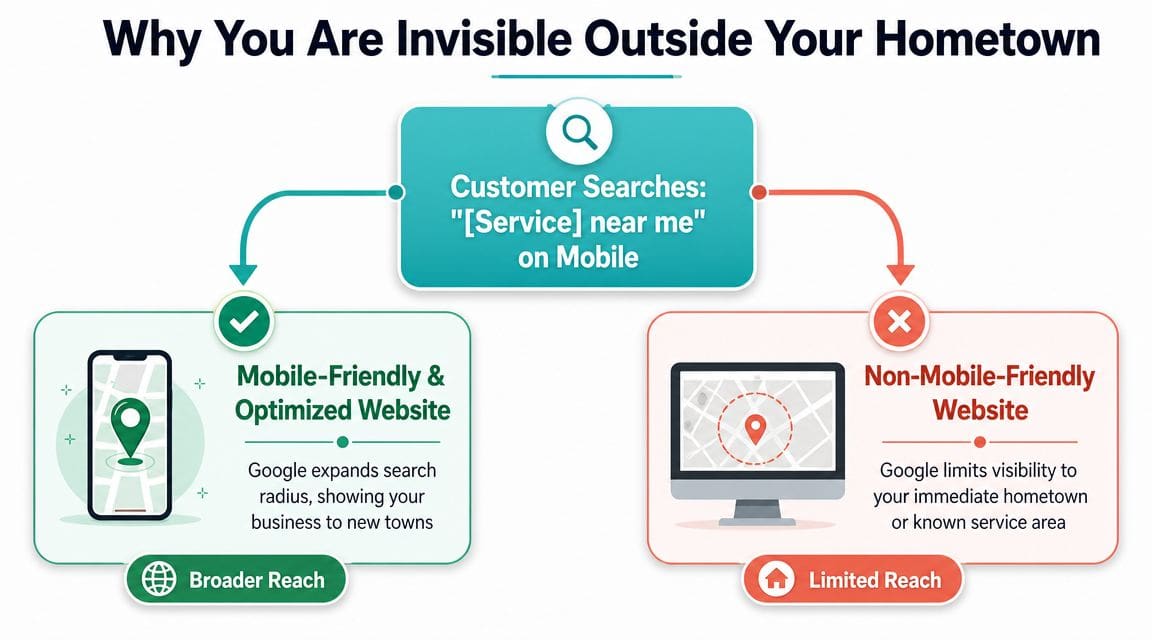
When somebody in the next town searches “[your service] near me” on a phone, Google reads that as a local search in that person's city. It doesn't care that your shop is twenty minutes away if your online presence doesn't clearly say you work there.
Google believes what you tell it
Most contractors have accidentally told Google one thing.
They've told Google where their office is.
They've told Google their hometown.
They've maybe mentioned that same town all over their site.
What they have not done is clearly tell Google about the other cities they want work from.
So Google makes the obvious call. It assumes you mainly belong to the place you keep mentioning.
Here's what that looks like in plain English:
- Your address points to one city. That gives Google a strong hometown signal.
- Your website repeats that hometown. That reinforces the same signal.
- Your nearby service towns are missing. Google has no reason to push you there.
- A mobile searcher in another town sees someone else. The lead goes elsewhere.
Your mobile site is the version Google judges
There's another layer to this. Google has used mobile-first indexing for years, which means the mobile version of your site is the main version used for crawling, indexing, and ranking, as explained in these mobile-friendly website best practices.
That matters because local searches are heavily mobile. If your site is clunky on a phone, your rankings can suffer right where you need them most.
If your mobile site is weak, your service area shrinks in real life, even if you're willing to drive farther.
What invisibility really looks like
It usually isn't dramatic. It's quiet.
You still get some calls. You still get referrals. You still book work in the same familiar areas. Meanwhile, your competitor keeps getting found in the towns where you also want jobs.
That's why mobile friendly websites matter for local contractors. A bad mobile experience doesn't just annoy visitors. It helps lock you inside your home market.
Your Website Is Not a Digital Brochure
A website doesn't create traffic.
It waits for traffic.
That's where a lot of contractors get sideways. They pay for a site, expect it to “generate leads,” and then get disappointed when nothing changes. The site was never the traffic source. It was supposed to be the tool that turns visitors into calls once visibility happens.
Pretty is not useful
A clean design is fine. It's not the goal.
If a homeowner lands on your site from a search or an ad, your site has one job. Help that person decide fast. Can you do the work? Do you serve their area? Can they call you without fighting the page?
If the answer is no, the website failed.
Here's what a brochure site usually does wrong:
- It talks too much about the company. The visitor cares about their problem first.
- It hides the service area. The customer can't tell if you work in their town.
- It buries the phone number. That creates friction at the exact wrong moment.
- It looks fine on desktop and falls apart on mobile. That's where most local buyers are searching.
A contractor website is a tool, not decor
Think about your equipment. You don't buy a skid steer because it looks good parked outside. You buy it because it needs to perform.
A website is the same. If it doesn't turn attention into action, it's just overhead.
A useful contractor website needs to answer basic buying questions fast:
| Question from the visitor | What the site must show |
|---|---|
| Do you do this kind of work? | Clear service pages |
| Do you work in my area? | Clear city and service area coverage |
| Can I trust you? | Straight answers, real proof, easy contact |
| What do I do next? | Obvious call and quote options |
Practical rule: If a visitor has to hunt for your phone number, your site is slowing down your sales.
The website's job is conversion
This is the shift a lot of owners need to make.
Your site is not there to impress your buddies, your spouse, or the last marketing rep who sold you a redesign. It is there to convert traffic. That means calls, quote requests, and booked jobs.
So if you've been treating your site like an online business card, that's the wrong standard. The right standard is simple. Does it help a local buyer on a phone take the next step right now?
How a Bad Mobile Site Actively Loses You Money
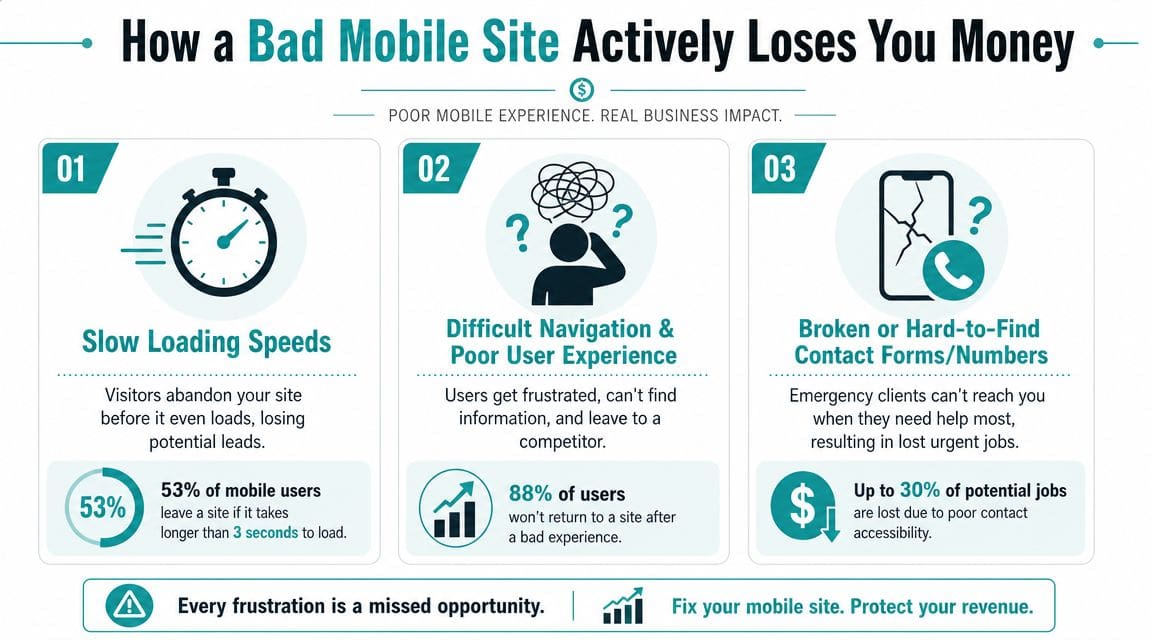
A bad mobile site doesn't just sit there looking outdated. It pushes buyers away.
That's the hard truth. When somebody has a flooded basement, no heat, a failed septic line, or storm damage, they are not in the mood to decode a bad website. They want speed, clarity, and a phone button they can tap.
Slow pages kill ready-to-buy leads
This part is measurable. 83% of users expect websites to load in under 3 seconds, 40% leave if it takes longer, and a one-second delay can reduce conversions by 20%, according to these mobile-friendly contractor website benchmarks.
For a contractor, those aren't vanity numbers. Those are missed calls.
The person searching is often ready now. If your site drags, they don't wait and admire your logo. They back out and hit the next company.
Friction costs you twice
A weak mobile site hurts in two ways.
First, the visitor gets frustrated. Second, your business looks less trustworthy. A clunky phone experience feels like disorganization. People may not say that out loud, but they feel it.
A bad mobile experience usually includes:
- Tiny text and cramped buttons. People can't tap what they need.
- Long blocks of copy. Nobody in a rush reads walls of text on a phone.
- Missing click-to-call options. The lead has to work too hard to reach you.
- Hard-to-use forms. People quit halfway through.
If you want to see what a conversion-focused approach looks like, this page on websites optimized for mobile shows the kind of features that remove friction instead of adding it.
A slow mobile site is like sending your estimator to a big bid in a truck that won't start cleanly. Trust drops before the conversation begins.
Every leak hits the bottom line
Most owners only count the leads they receive. They don't count the ones their website chased off.
That's the expensive mistake.
You paid to build the site. You may also be paying for traffic from ads, referrals, listings, or search visibility. If the site wastes those visits, you're not just missing leads. You're paying to lose them.
The System That Fixes Invisibility and Converts Leads
Trying harder won't fix this. Random marketing won't fix it either.
You need a system.
The website is the asset
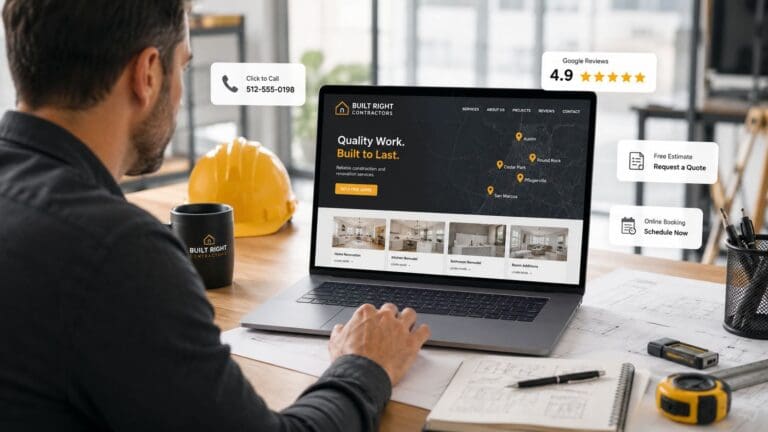
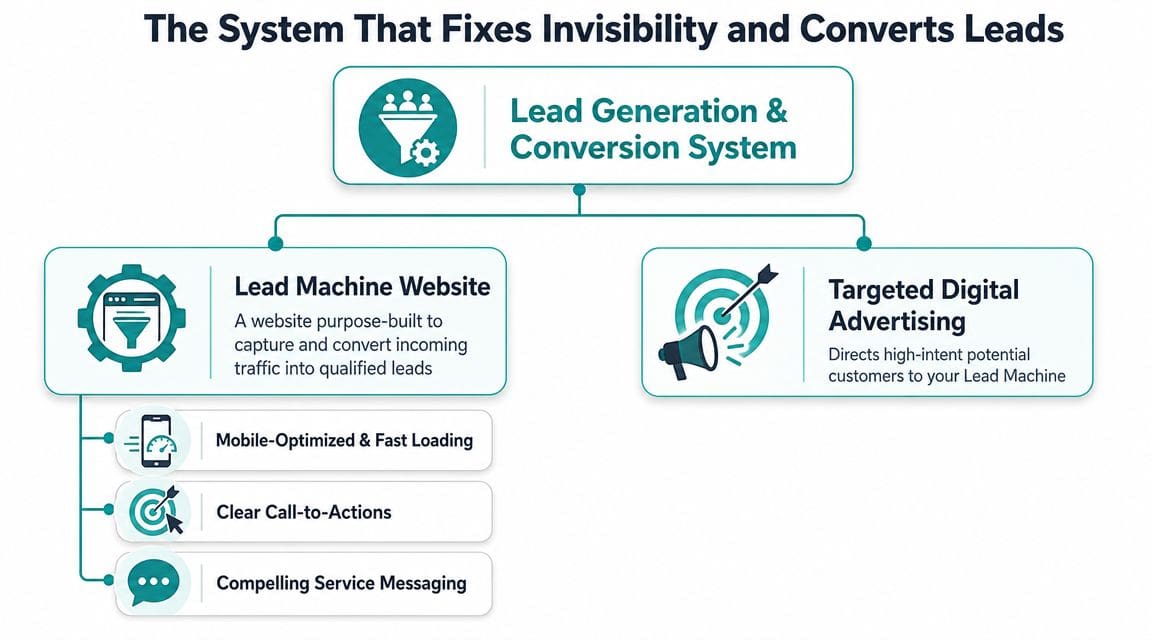
A real lead system starts with a site built for one purpose. Turn traffic into calls and quote requests.
That means the site needs to be fast on phones, easy to use, clear about services, and clear about service areas. It also needs pages built around the work you do and the cities you want to win.
That last part matters more than most contractors realize. If you do grading in one town, septic installs in another, and excavation across a wider radius, your website has to reflect that. Otherwise, you stay boxed into your hometown online.
With over 60% of web searches happening on mobile devices and nearly 80% of “near me” searches coming from smartphones, a mobile-first approach is not optional, as noted in this article on mobile-friendly websites for contractors.
Ads create the visibility
This is the part contractors miss when they expect the website to do everything by itself.
Websites don't create traffic. Ads create visibility. They put you in front of buyers who are already searching for the work you do. Then the website does its real job, which is converting that attention into action.
That's why the system works as a pair:
| Part of the system | What it does |
|---|---|
| Lead Machine website | Converts visitors into calls and quote requests |
| Ads | Put you in front of local buyers searching now |
One example is The Cherubini Company's Lead Machine approach, which combines a high-converting website built around service and city coverage with paid traffic that sends local buyers to those pages.
Why both pieces matter
If you run ads to a weak site, you waste money.
If you build a nice site with no visibility plan, it just sits there.
The website is the tool. The ads are the fuel. You need both if you want steady lead flow instead of hope.
That's why mobile friendly websites matter for local contractors. Mobile performance is not some side feature. It's part of the system that determines whether buyers find you, trust you, and contact you.
Predictable Leads Mean You Control Your Business
Word of mouth is great. It just isn't a system.
If referrals are still carrying your business, you already know the downside. Some weeks are packed. Some weeks get thin. You don't control the timing. You don't control the volume. You definitely don't control which towns the work comes from.
Control starts with visibility
When you control visibility, you stop guessing.
You can show up in more of the places you want work. You can get found by people who don't already know your name. You can stop depending on luck, old customers, and whatever random call happens to come in next.
That changes how you run the company.
- You can be pickier. You don't have to take every small job that appears.
- You can aim for better work. Bigger jobs become easier to target.
- You can smooth out slow periods. Instead of waiting, you create demand.
- You can grow on purpose. New towns stop being a mystery.
Fragile businesses guess
A fragile business hopes the phone rings.
A stronger business builds a repeatable way to get found, get contacted, and get booked. That doesn't mean every lead is perfect. It means you finally have a real engine behind the business instead of a pile of assumptions.
You think customers can find you. But if customers don't find you, nothing else matters. Lead Machines are built to fix that.
If you're tired of guessing, The Cherubini Company helps contractors fix the problem, which is invisibility. They build lead-focused websites designed for mobile use and pair them with advertising that puts your business in front of buyers in the cities you want to reach.