You’re probably working. Hard.
You’ve got jobs on the board, crews moving, phones ringing here and there, and somehow it still feels thin. Too many small jobs. Too much guessing. Not enough control.
That’s the main problem for a lot of local contractors. Not effort. Not talent. Not reputation in your hometown.
It’s visibility.
You might be known where your shop is. But a few towns over, you disappear. And if people don’t see you when they search for the work you do, you don’t exist to them.
Your Phone Is Not Ringing and You Do Not Know Why
A lot of contractors live in the same cycle.
One month feels packed. The next month feels soft. Then the phone goes quiet and everybody starts saying the same thing. We need more leads. We need better jobs. We need to stop wasting time on price shoppers.
You already know the pain.
You stay busy, but not always with the kind of work you want. Small jobs fill the calendar. Bigger jobs go to someone else. Referrals come in when they come in. Then they stop. You didn’t turn anything on. You can’t turn it back on.
That’s not a lead system. That’s luck.
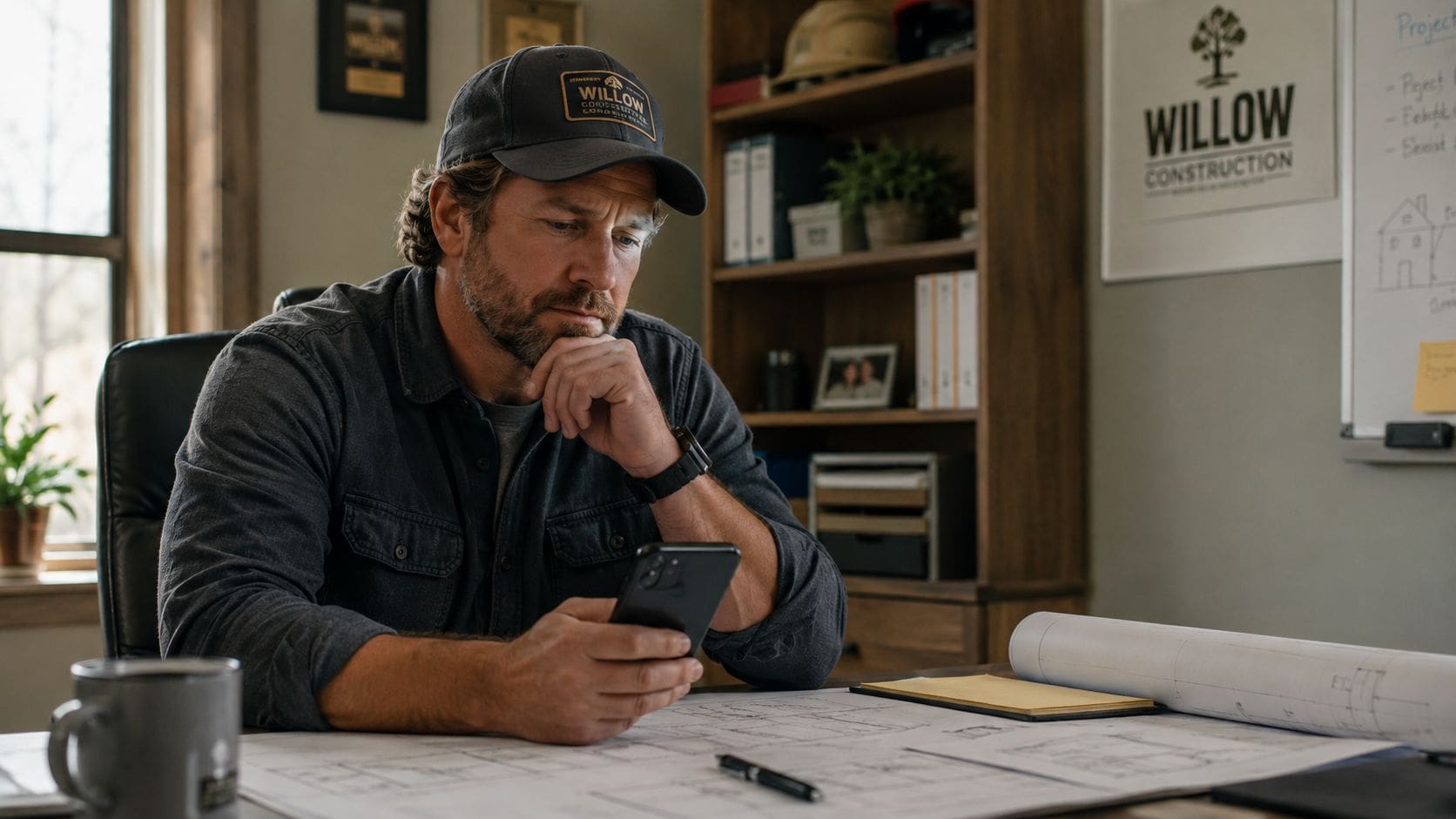
You’ve probably been burned before
Most owners I talk to have tried something already.
They paid for a website. They hired somebody for ads. They got a pile of vague updates and no clear answer when the phone didn’t ring. That kind of experience teaches you to stop trusting marketing talk.
Good. You should be skeptical.
A contractor should question anything that sounds slippery. If somebody can’t explain where calls come from, what the website is supposed to do, or why jobs are weak outside your home area, they’re guessing with your money.
You don’t need more promises. You need a system that makes the business visible where buyers are already looking.
There’s also the missed-call problem. If you do start getting more demand, somebody still has to answer it. For service businesses that need to handle HVAC emergency calls, response matters because buyers don’t wait around when they need help now.
The jobs you want aren’t always the jobs you get
Here’s what this usually looks like on the ground:
- Busy crews, weak margins because smaller jobs keep filling the gaps.
- Word of mouth doing all the heavy lifting because there’s no steady source of new demand.
- Slow seasons hitting hard because nobody built a system to keep leads coming.
- Bad leads wasting time because the business isn’t filtering buyers well before they call.
- No clear tracking because you can’t tell what caused the call.
That mess looks like a bunch of separate problems.
It isn’t.
It’s one problem with a bunch of symptoms. You don’t control when and where people find you.
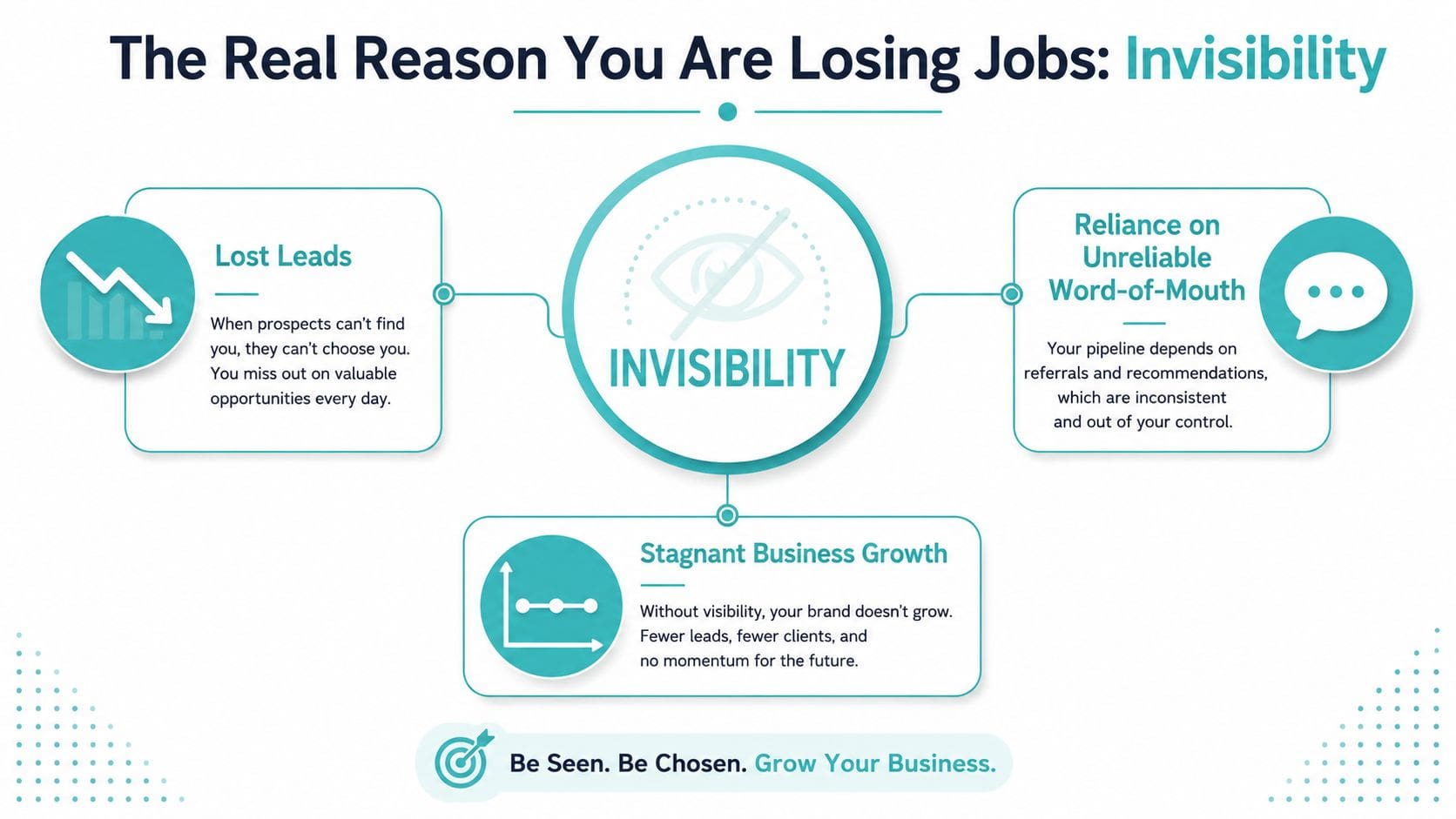
The Real Reason You Are Losing Jobs Is Invisibility
Most local contractors think they have a lead problem.
They do. But the lead problem starts earlier.
It starts when a customer searches and never sees your business.
That’s the whole thing.
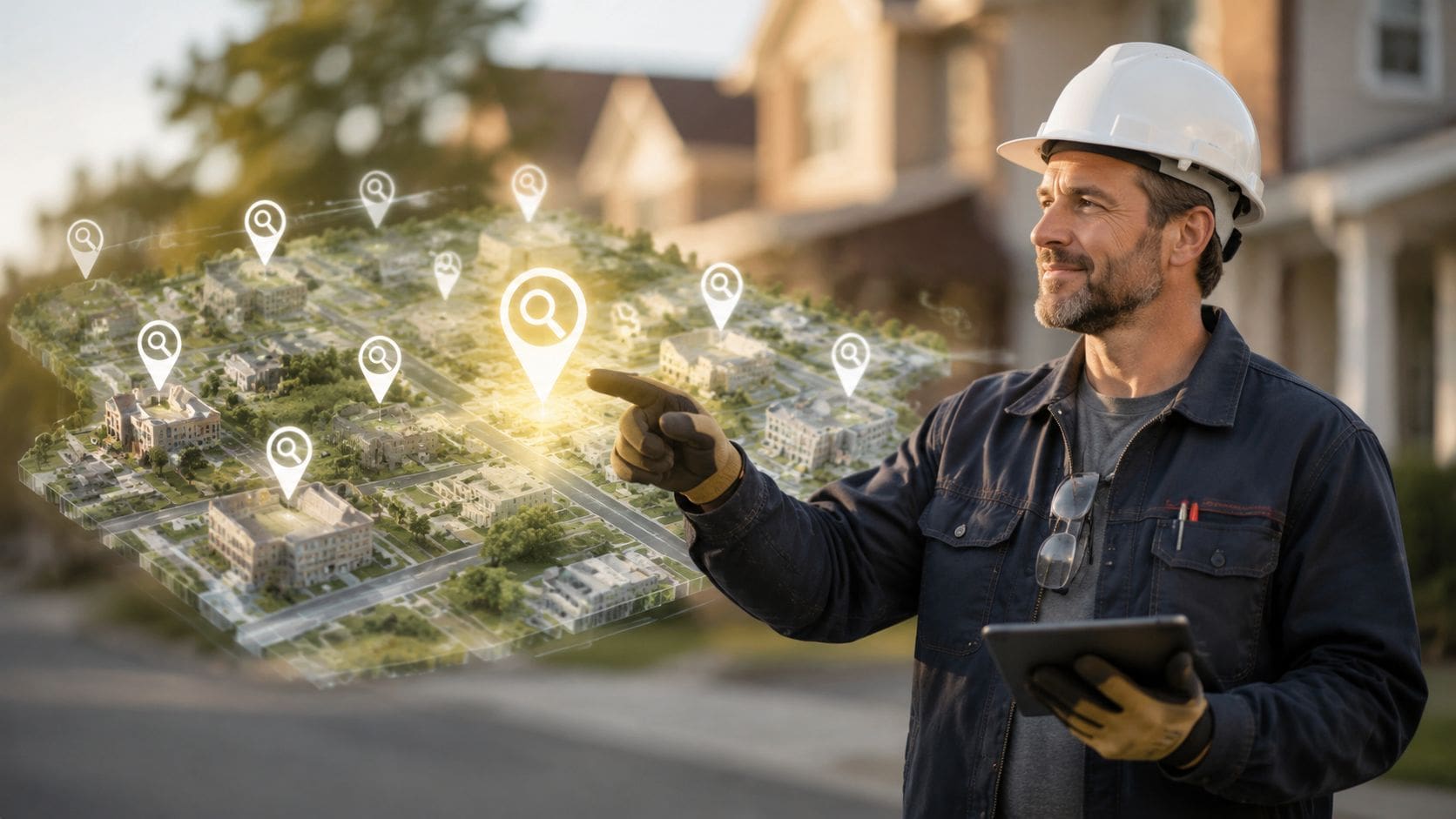
If somebody types in “excavation contractor near me” or “concrete contractor near me,” Google reads “near me” based on where that person is standing. So the search becomes a city-based search in that person’s area. If your business only clearly shows up in your hometown, then the towns around you might as well be off limits.
You may work there every week. Google doesn’t care what you know. It cares what your business clearly signals.
Being able to do the work doesn’t matter if you don’t show up
A lot of contractors confuse being findable with being visible.
Those are not the same thing.
If somebody already knows your company name, sure, they can probably find you. But most buyers don’t search your name. They search the service they need in the city they’re in. If you don’t appear in that moment, the job goes to someone else and you never even knew it existed.
That’s lost revenue with no paperwork attached.
Practical rule: If your service area is bigger than your visibility area, your business is leaking jobs every day.
This gets worse for companies with larger territories. One verified gap in contractor marketing is multi-city visibility and territory expansion for businesses with larger service areas. Most public-facing content stays focused on one city or a tight radius, which doesn’t help contractors win work across multiple counties or edge-of-metro areas. That gap is especially important for site-prep and heavy-equipment contractors, where jobs are often broader and higher value than a typical home-service call, as noted in this Houzz contractor market example.
Your map listing alone won’t fix this
A lot of owners put too much hope into one profile.
Your Google listing matters. It helps. But it does not solve a regional visibility problem by itself. If you want a plain-English overview of how a Google Business Profile for service businesses works, that resource gives a useful baseline.
Still, many contractors get stuck at this point. They assume one profile and one generic website should cover every town they serve.
It won’t.
Here’s the hard truth in simple terms:
| What you believe | What actually happens |
|---|---|
| People around me can find me | Only some of them can |
| My service area is obvious | It isn’t unless your business says it clearly |
| My reputation should carry me | Reputation can’t help if you’re not seen |
| I’m losing bids | You’re also losing searches before bids even happen |
This is why the problem feels confusing. You think demand is low.
A lot of the time, demand is there. You’re just invisible when it shows up.
Your Website Is a Brochure Collecting Dust
A website does not create traffic.
It waits for traffic.
That’s it.
A lot of contractors got sold the idea that a website would “generate leads.” So they paid for one, launched it, and then sat there wondering why nothing changed. That’s because most websites are digital brochures. They look fine. They say a few things. They collect dust.
If nobody is being sent to the site, nothing happens.
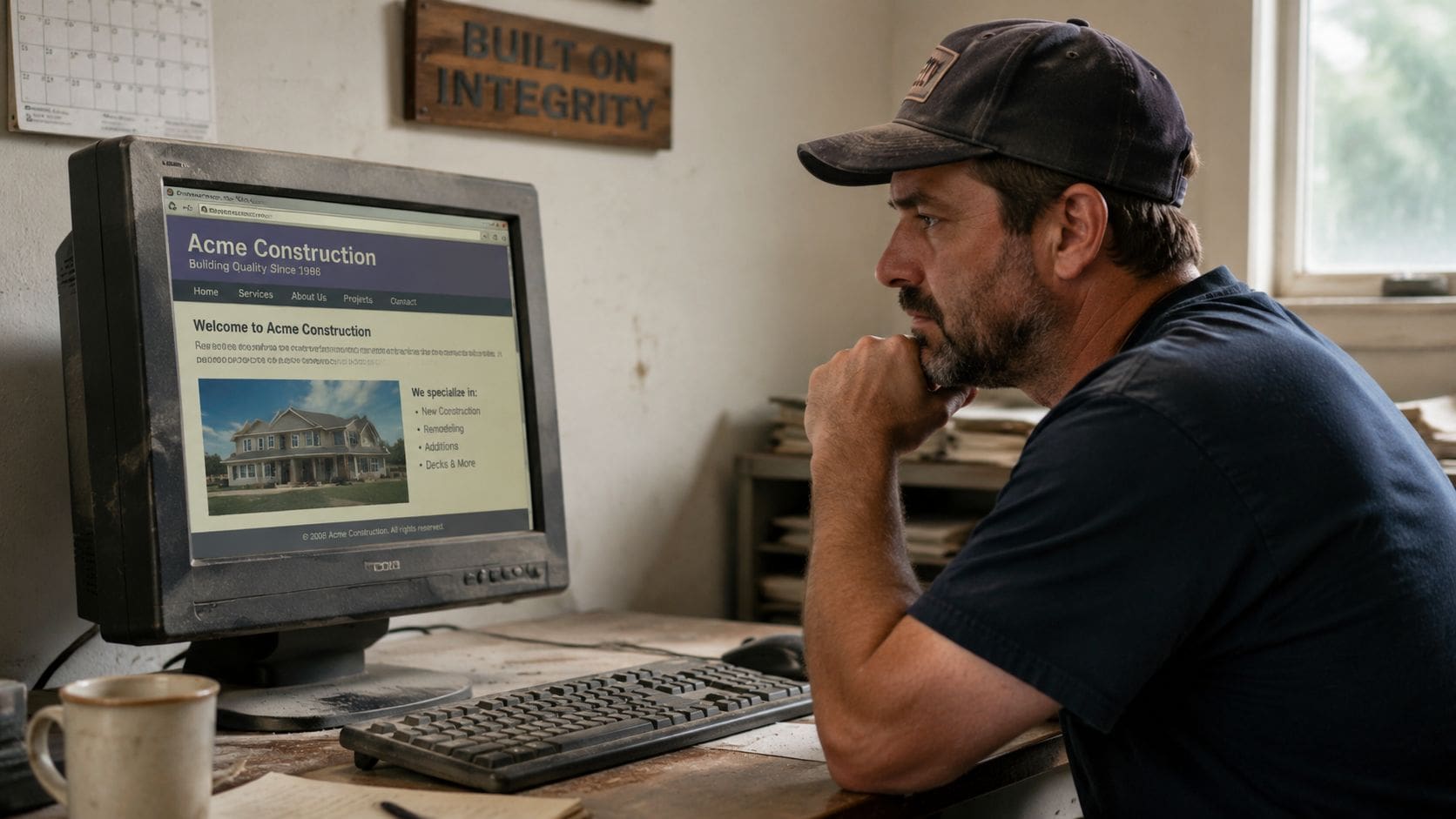
A brochure is not a lead system
A printed brochure only works if somebody hands it to the buyer.
A website works the same way. If you don’t have visibility, the site just sits there. It doesn’t go out and pull searches toward you. It doesn’t expand into nearby cities by magic. It doesn’t force people to call.
That’s why so many contractors feel ripped off by web projects. They bought a thing that was never enough by itself.
If you want to see the difference between a basic website and one built to pull its weight, this breakdown of a lead generation website vs regular website for contractors is worth your time.
Word of mouth is good, but it’s a terrible plan
Referrals are fine.
They are not control.
When your whole business depends on referrals, you get feast or famine. A happy customer sends a friend. A builder remembers your name. A past client circles back. Then nothing happens for a while and the pipeline thins out behind the scenes.
You didn’t build that flow. So you can’t manage it.
- Referrals are delayed because they show up on someone else’s schedule.
- Referrals are narrow because they usually stay close to where you’re already known.
- Referrals are hard to scale because they don’t expand your visibility on command.
- Referrals don’t fix territory gaps because silence in the next town stays silence.
A contractor who relies on referrals alone doesn’t own demand. He borrows it.
There’s a lot at stake here. The construction industry accounted for 4.4% of U.S. GDP in 2025 and about $2.2 trillion in annual spending, according to Construction Coverage’s U.S. construction spending data. That means local contractors aren’t operating in a tiny niche. They’re operating inside a massive market.
The problem isn’t that there’s no money moving.
The problem is that invisible contractors don’t get their share of it.
What a dead website usually looks like
You’ve seen these sites before. You may own one.
- One service page that tries to cover everything.
- One city mentioned over and over because that’s where the office is.
- No clear next step beyond a generic contact form.
- No structure for multiple service areas so nearby towns never get real visibility.
That kind of site won’t help you grow outside your own backyard.
How Competitors Buy Visibility While You Hope for It
Your competitors are not always better contractors.
A lot of them are just easier to find.
That’s the difference.
While many local contractors wait on referrals, better timing, or luck, other companies choose to put themselves in front of buyers who are searching right now. They don’t wait to be discovered. They buy visibility.
That’s what ads do.
They create presence where intent already exists.
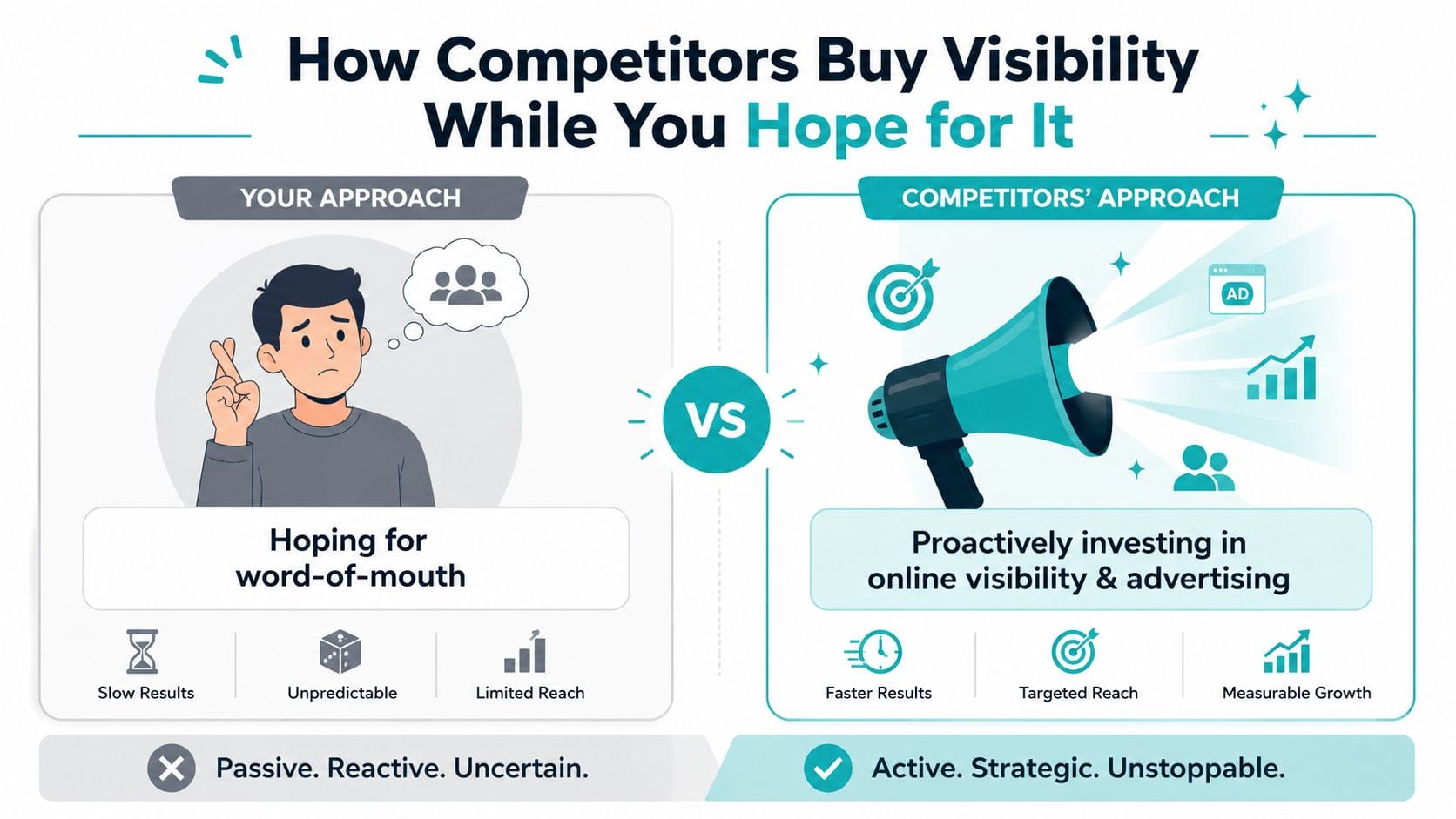
Hope is not a strategy
A lot of contractors avoid ads because they think ads are risky.
No. Blind ads are risky.
Running traffic into a weak website is risky. Paying somebody who can’t explain the plan is risky. Spending money without a system is risky.
But visibility itself is not the problem. Visibility is the point.
In March 2026, U.S. construction spending was estimated at a seasonally adjusted annual rate of $2,185.5 billion, with private construction at $1,659.0 billion, residential at $929.7 billion, nonresidential at $729.4 billion, and public construction at $526.4 billion, according to the U.S. Census Bureau monthly construction spending release. Money is moving through the market every day.
Visible companies get a shot at that work.
Invisible companies don’t.
The real difference between you and them
This isn’t complicated. It’s just uncomfortable.
| Hope strategy | System strategy |
|---|---|
| Wait for referrals | Create visibility on purpose |
| Rely on one town | Reach multiple nearby cities |
| Send people to a weak site | Send people to a site built for calls |
| Guess what worked | Track what brought the lead |
If you want a plain explanation of how paid search fits into this, read this simple guide to Google Ads for local contractors.
The contractor buying visibility is not gambling. He is deciding that being seen is part of the job.
Big companies understand this first
Larger companies don’t sit around asking why the phone is slow while doing nothing about it.
They assign budget to visibility. They make sure buyers can find them. They send those buyers somewhere useful. Then they keep doing it.
Small contractors often do the opposite. They spend aggressively on trucks, trailers, and equipment, then act like demand should somehow take care of itself.
It won’t.
You can be the best option in the county and still lose to a weaker company that showed up first.
The Lead Machine System Built for Contractor Leads
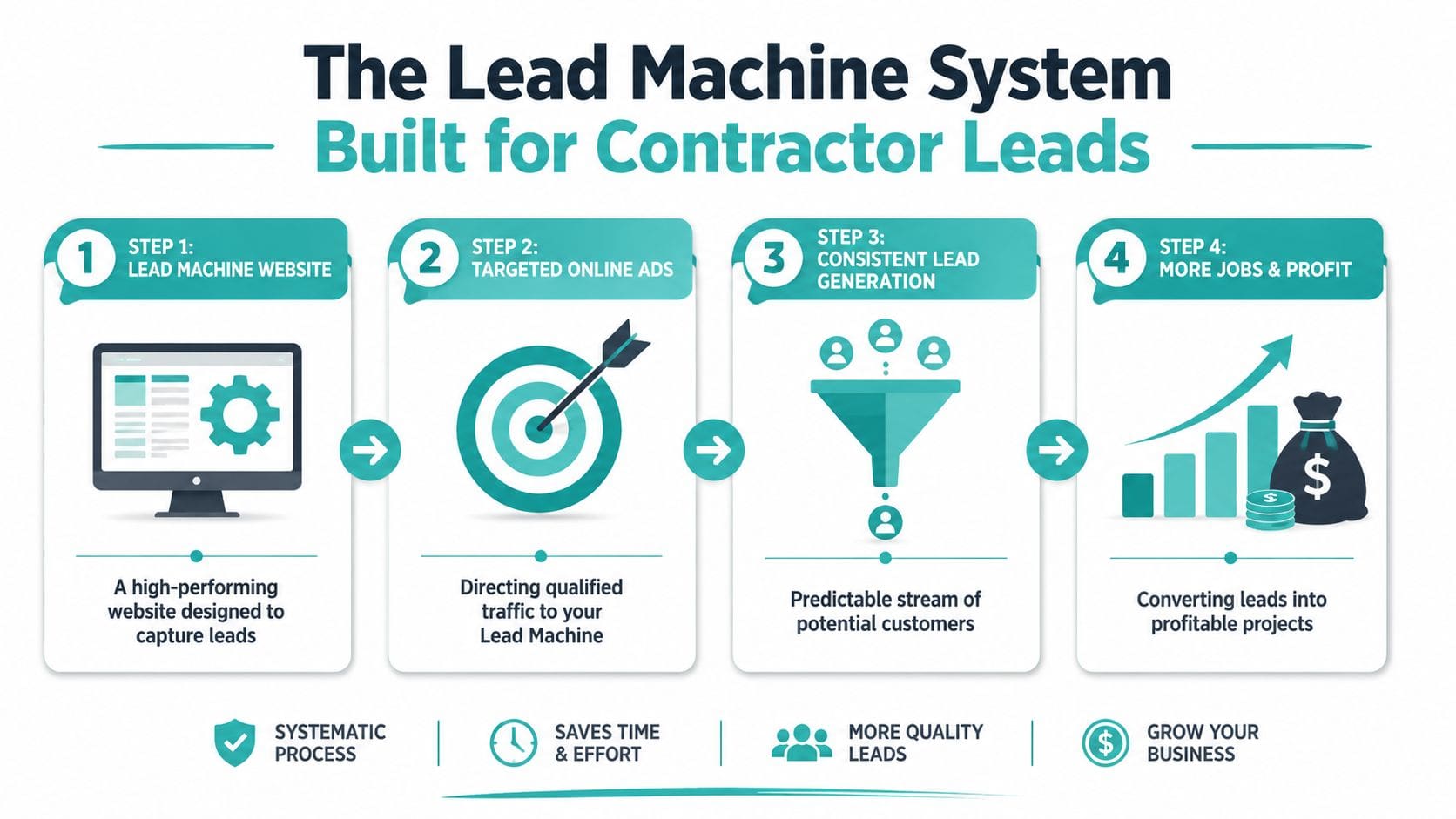
A Lead Machine is not a pretty website.
It’s a website built for one job. Turn visibility into calls and quote requests.
That’s the first part.
The second part is ads. Ads create visibility and send buyers to the Lead Machine. Without traffic, the site sits there. Without a strong site, the ad spend gets wasted.
You need both.
What the system actually does
This is a two-part system for local contractors who want control.
-
Build the machine
The website is structured by service and city. It gives Google clear signals about where you work and what you do. It gives buyers clear reasons to call. -
Fuel the machine
Ads put you in front of people who are already searching. They don’t replace the website. They feed it. -
Capture real demand
Calls, form fills, and estimate requests come from buyers with intent, not random browsers. -
Improve over time
When the system is built right, you can see what’s working and keep pushing into the places that matter.
That’s why a Lead Machine is different from a normal site. It is an asset designed for lead flow, not a digital business card.
Why city structure matters
Most contractors talk about their home city because that’s where the office is.
That’s not enough if you want work in surrounding towns.
A Lead Machine is built to make your service area clear. Not vague. Not implied. Clear. It aligns your website with the places you specifically want jobs from and gives each service-city combination room to be found.
This matters even more when buyers are trying to judge trust. Homeowner guides often tell people to check ratings and licenses, but they rarely show buyers how to judge scope clarity, change-order risk, or whether a quote looks thin before work starts. That’s one reason a stronger web presence can help answer deeper trust questions, as reflected in this homeowner contractor search example from Thumbtack.
If you want a general reference on a Google Business Profile for small businesses, that can help you understand one part of the visibility picture. But the profile is only one piece. The website still has to do the selling once the buyer lands.
One practical option
One example is Lead gen websites for contractors from The Cherubini Company. Their setup is built around service pages, city pages, calls to action, and paid traffic support. That fits the Lead Machine model because the site is meant to capture demand across more than one city, not just sit online and hope.
Ads without a conversion site waste money. A site without visibility wastes time.
That’s the whole system in one sentence.
Take Control of Your Leads and Your Revenue
If you don’t control visibility, you don’t control much.
You can control workmanship. You can control scheduling. You can control how your crew shows up. But if buyers in the next city never see your business when they search, then your revenue still depends on chance.
That’s a fragile business.
A stronger business gets built when visibility stops being random. When your website is built to convert. When your service area is clear. When traffic is being sent on purpose. When trust is established before the call, not after.
Better leads come from better visibility
A lot of low-quality leads happen because the business shows up poorly or explains itself badly.
The right buyer wants proof. They want to see your work. They want to understand what you do. They want to feel that your estimate will be clear and your process won’t turn messy halfway through the job.
That’s why a proper lead website matters. It helps answer key trust questions before the phone call starts.
- Scope confidence helps buyers see that you know what the job involves.
- Professional proof helps separate you from the guy with a vague profile and a lowball number.
- Clear next steps help serious buyers act fast.
- Better filtering helps cut down wasted conversations.
Stop guessing
You don’t need more random tactics.
You need a system that makes you visible in the places you want to win. That’s how local contractors stop living job to job. That’s how you stop depending on luck, referrals, and old reputation alone. That’s how you turn “we should be getting more calls” into something real.
If customers can find you only in one town, then you don’t have a marketing problem. You have a visibility gap.
You think that customers “can” find you but, If customers “don’t” find you, nothing else matters. Lead Machines are built to fix that.
If you’re tired of guessing and want a direct look at where your visibility is breaking down, talk to The Cherubini Company. They build Lead Machines for contractors who need to show up in more cities, get more calls, and stop relying on luck.