You've probably said this already.
“We tried ads. They didn't work.”
What usually happened is simple. You paid for clicks, got a few weak calls, heard a lot of excuses, and ended up right where you started. Busy one month. Slow the next. Still guessing.
That doesn't mean Google Ads for plumbers don't work. It means your setup was broken before the ads even started.
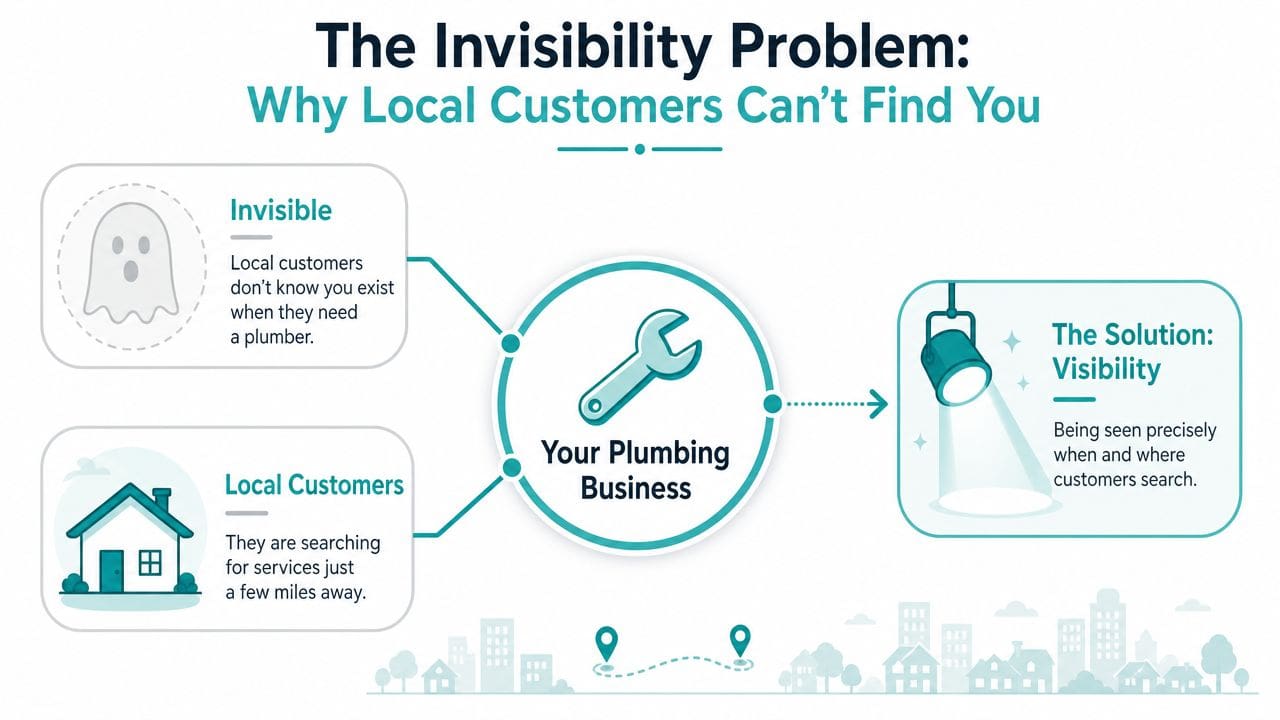
Most plumbing companies don't have a lead problem first. They have a visibility problem. People can't hire you if they don't see you when they search. And if your business only shows up in your home town, you're invisible in the places where you also want work.
Why Your Google Ads Keep Failing
If you've been burned by an agency, your frustration is valid.
A lot of plumbers got sold the same story. New website. More traffic. Better leads. Then the phone didn't ring, or it rang with junk. Nobody could explain where the money went. Nobody could tell you which calls were real. Nobody could tell you what turned into jobs.
That's the first problem. Most ad campaigns are built backwards.
They chased activity, not booked work
A bad campaign can produce clicks and still fail your business. Clicks don't pay your guys. Calls don't matter if they come from people outside your area, after hours, or from shoppers looking for the cheapest price.
You don't need “more marketing.” You need a system that shows up in the right places and filters for real jobs.
A lot of owners also wait too long because they're slammed with work. Then slow season hits and the pipeline is empty. That cycle keeps repeating because there's no control.
The real issue isn't the ad account
The issue is that most plumbers never fixed the business side of lead flow. They never fixed visibility by city. They never fixed the website. They never fixed tracking. Then they blamed the ads.
If you want the plain-English version, this guide to Google Ads for contractors points to the same basic truth. Ads fail when they're dropped on top of a weak lead system.
Word of mouth is great. It just isn't a growth plan.
When someone has a leak, a backed-up drain, or no hot water, they don't wait around for your past customer to mention your name. They search. If you're not there, your competitor gets the call.
Your Lead Problem Is Actually an Invisibility Problem
Most plumbers think they need more leads.
What they need is to show up where buyers are already looking.
When someone types “plumber near me,” Google doesn't read that as some vague idea. It turns “near me” into the city or area where that person is standing. If your business has only told Google about your home town, then Google has no reason to believe you serve the next town over.
That's the gap.
Your trucks go farther than your online visibility
You may work all over the region.
Your crew may drive across county lines every week. But online, a lot of plumbing companies only exist in one city because that's the city on their address, website, and business profile. So they're known in town, but nearly invisible ten miles away.
That's why a lot of owners say, “We're busy, but not with the jobs we want.” They're visible enough to get scraps. Not visible enough to control territory.
According to LocaliQ's home services search benchmarks, Google gets about 180,000 monthly searches in the U.S. for the exact phrase “plumber near me.” That matters because those are not casual browsers. Those are people looking right now.
People can find you isn't the same as people do find you
At this point, contractors fool themselves.
If somebody already knows your company name, yes, they can find you. That isn't the problem. The problem is the homeowner who has never heard of you and searches for the service instead of your name.
They search by problem and place.
- Service first: drain cleaning, water heater repair, leak repair, sewer issue
- Location second: near me, their city, their side of town
- Speed third: who shows up first and looks ready to help
If you don't appear at that moment, you are out of the running before the phone ever has a chance to ring.
Practical rule: If you want work from a city, your business has to be visible in that city. Google won't guess.
That's why this isn't really a lead conversation. It's a control conversation. This breakdown of the visibility problem gets to the heart of it. Leads don't start with luck. They start with being seen.
Why Your Website and Past Ads Did Not Work
Your website didn't fail because websites are bad.
It failed because a website by itself does nothing.
A website is a tool. It sits there and waits. It doesn't create demand. It doesn't go out and get attention. It can only convert the traffic you send to it. If nobody sees it, it might as well be a brochure in a desk drawer.

Most contractor websites are built to look nice, not to produce calls
That's why owners say, “We paid for a new site and nothing changed.”
Of course nothing changed. The site didn't create traffic. And if the ad traffic that did arrive landed on a generic, weak site, that traffic got wasted.
This page on why websites don't generate leads says it plainly. Websites don't generate leads. They convert visibility into action, if they're built right.
Most failed ad campaigns had the same disease
The campaign may have been getting attention, but it wasn't built around qualified leads.
A practical benchmark from this plumber lead quality playbook is to count only calls lasting 60 to 90 seconds or longer as conversions. Short calls often come from low-intent price shoppers. That one point tells you a lot. If your old agency celebrated every call the same way, they probably weren't measuring what mattered.
Here's what usually goes wrong:
| Problem | What it causes |
|---|---|
| Broad targeting | Wrong people click |
| Weak filtering | Price shoppers get through |
| Generic pages | Buyers don't trust what they see |
| No clean tracking | Nobody knows what produced jobs |
| Click-focused reporting | You pay for activity, not results |
The owner sees “leads.” The business sees wasted time.
The phone ringing is not the finish line
This is the part most marketing people skip.
A call is not the goal. A booked, profitable job is the goal. If the calls come from the wrong area, the wrong service type, or at the wrong time, your ad spend didn't buy growth. It bought noise.
The campaign should answer one question. Did this turn into work worth taking?
That's why old campaigns often feel dishonest. The reports look busy. The business still feels fragile.
The System That Turns Visibility into Jobs
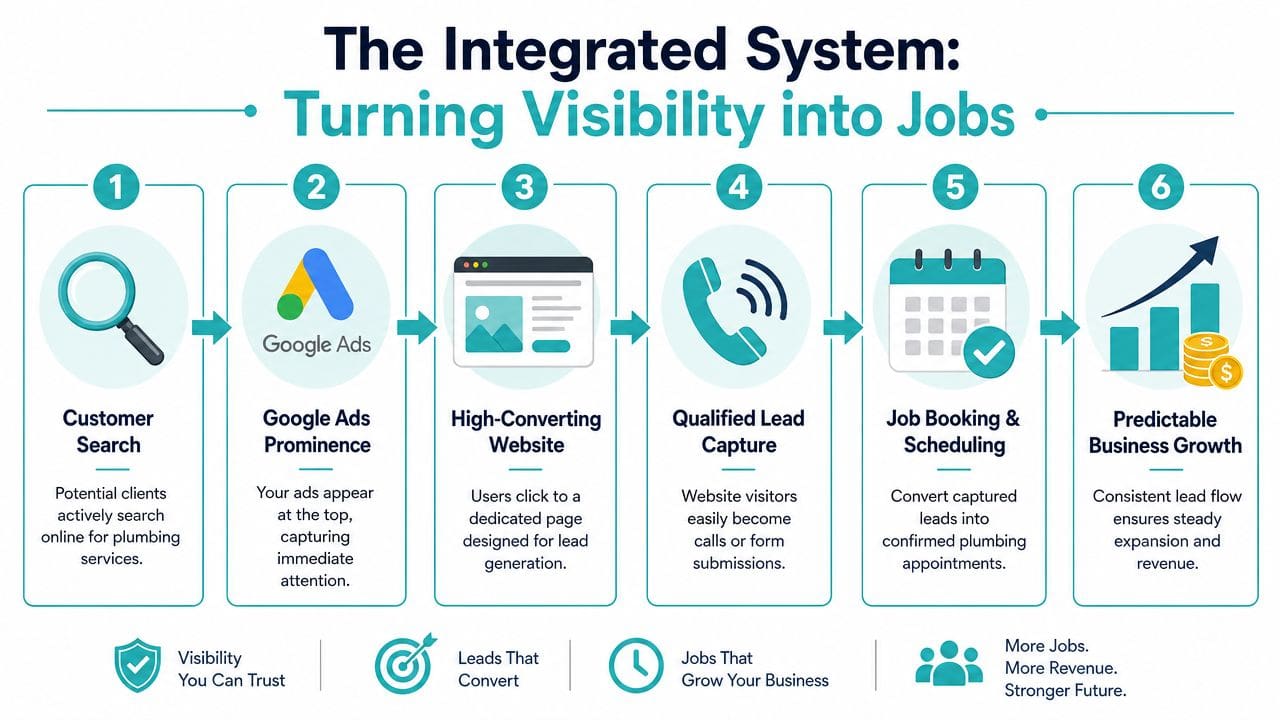
Google Ads for plumbers work when they're part of a system.
Not a random ad account. Not a pretty website. Not a bundle of marketing services. A system.
One part creates visibility. The other part turns that visibility into calls.
The website is the machine
A real Lead Machine is a website built for one job. Get the visitor to call, fill out the form, or take the next step.
It isn't there to impress your buddies. It isn't there to win design awards. It's there to capture demand from the exact services and cities you want.
That means the site has to match how customers search. Service by service. City by city. It has to make calling easy. It has to be clear. It has to be built for buyers, not for your ego.
If you want a simple definition, this explanation of a Lead Machine lays it out. It's a website built to turn traffic into leads.
The ads are the fuel
Ads do the part your website cannot do on its own. They create visibility.
A 2025 guide from Bullseye Internet on Google Ads for plumbers says Google Ads can generate calls within hours of launch, while search engine optimization may take 4 to 8 months to show results. The same guide cites an average return of $2 for every $1 spent. That's why serious contractors use ads when they want speed and control.
This is the practical point. If you need the phone to ring in the near term, waiting around isn't a strategy.
Both pieces have to work together
Without ads, the website waits.
Without the website, the ads spill traffic onto something weak and waste money.
That's why the setup has to work like this:
- Visibility first: Ads put you in front of buyers searching now.
- Conversion next: The site gives them a clear path to call.
- Tracking after that: You judge success by booked work, not vanity numbers.
The Cherubini Company offers this as a flat-rate Lead Machine plus paid visibility system. That means the website is built to capture demand by service and city, and the ads are used to drive local buyers to it. That's one example of the model. The model is what matters.
If you want Google Ads for plumbers to work, stop treating ads like the whole answer. Ads are fuel. They need an engine.
What a Predictable Lead System Actually Looks Like
A predictable lead system gives you one thing every plumbing owner wants and very few build.
Control.
You stop waking up wondering whether this week will be packed or dead. You stop taking low-value work just to keep the schedule full. You start making decisions like an owner with options, not a contractor reacting to whatever scraps come in.
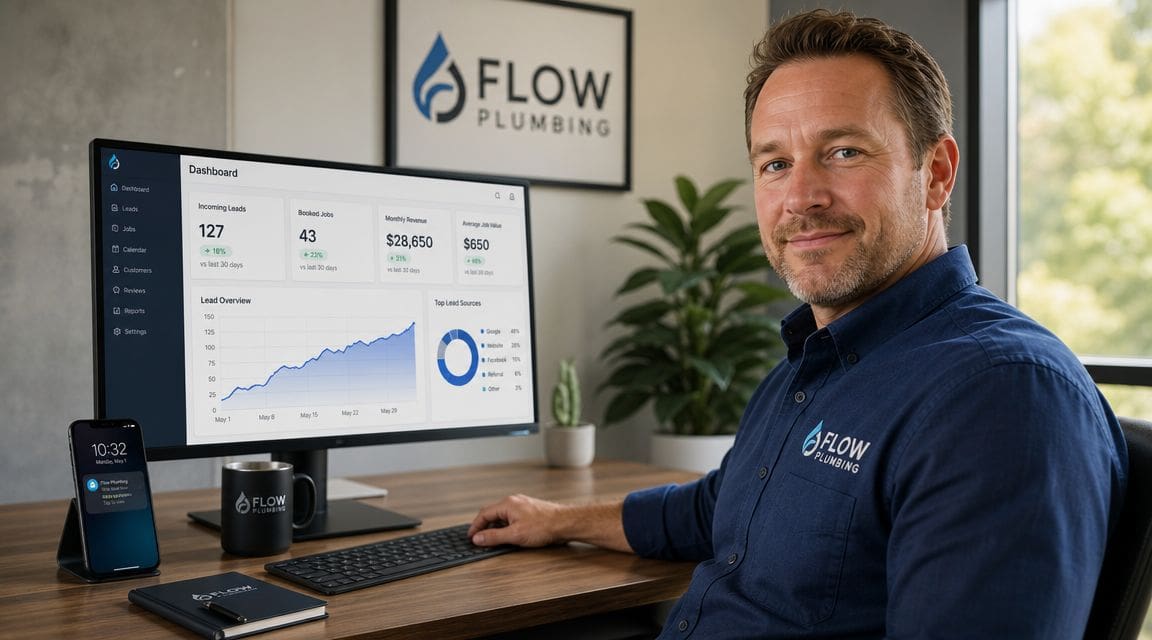
You budget from revenue goals, not gut feel
Too many plumbers ask the wrong question. They ask how much to spend on Google Ads.
That question puts the platform in charge. Your business should be in charge.
According to EightySix Digital's guide on what plumbers should spend on Google Ads, the smarter approach is to work backward from booked jobs. The guide uses a 50% close rate to show that 15 extra jobs would require 30 leads per month, and it recommends a 3 month test with tracking before you scale.
That is how a real lead system is built. Start with the jobs you want. Then figure out the lead volume, service mix, and budget needed to produce them.
Good systems produce the right leads
More calls means nothing if half of them are garbage.
The same EightySix Digital guide says healthy campaigns turn clicks into leads and leads into booked jobs at strong rates. The point is simple. Volume alone is a bad scoreboard. You want calls from people in the right towns, looking for the right services, at the right time to buy.
That changes how you run the business:
- You protect your schedule: You stop stuffing it with weak jobs that drain time and margin.
- You choose where to grow: You can push into nearby cities instead of waiting for word of mouth to wander there.
- You spend with purpose: You see which services and locations produce work worth keeping.
- You calm the chaos: Slow weeks stop feeling like a mystery.
The system has to be measurable
A lead system is not ads. It is not a website. It is not call volume.
It is a trackable process that shows you which service, city, and campaign produced booked work. If you cannot see that, you are still guessing, no matter how many reports your marketing company sends over.
That is the whole point behind a plumbing lead generation system that tracks what turns into real jobs. Lead generation only matters when it helps you make better decisions with confidence.
The goal is booked work you want, from the areas you want, at a pace you can control.
That is what a predictable lead system looks like. Clear targets. Clean tracking. Better jobs. Fewer bad surprises.
Stop Guessing and Start Controlling Your Growth
If your Google Ads for plumbers haven't worked before, don't blame the tool first.
Blame the missing system.
Your business doesn't grow because you “have a website.” It grows because buyers in the cities you want can find you, trust what they see, and contact you fast. That takes visibility first, then conversion, then clean tracking.
Big companies buy visibility. Small contractors often rely on hope. Hope is why the phone gets quiet without warning.
Predictable leads give you control. Control lets you choose better jobs, cover more territory, and stop living month to month.
You think that customers "can" find you but, If customers "don't" find you, nothing else matters.
Lead Machines are built to fix that.
If you're tired of guessing, The Cherubini Company helps contractors fix the underlying problem. They build Lead Machines and run ads that create visibility in the cities you want, then turn that visibility into calls and form leads.