
Most advice about brand reputation management is backwards.
It tells contractors to watch reviews, post on social media, and clean up bad comments. Fine. But that misses the core issue. Your reputation doesn’t help you if nobody sees it when they need your service.
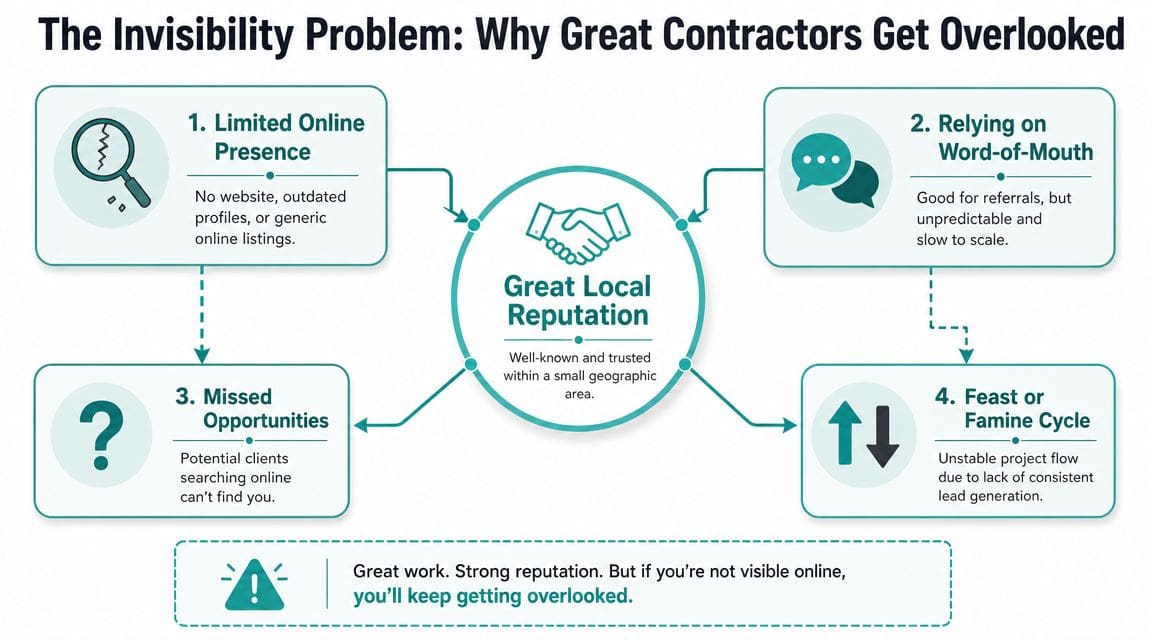
A lot of contractors have a good name in town. People know them. Past customers trust them. Suppliers know them. Other builders know them.
Then somebody ten miles away searches for your service, and you don’t show up.
That isn’t a reputation problem in the usual sense. It’s a visibility problem. And that visibility problem is what kills leads.
Your Reputation Is Useless If No One Can Find You
A lot of contractors wear word of mouth like a badge of honor.
They shouldn’t.
Word of mouth is good. It also gives you zero control. One month you’re slammed. Next month you’re chasing scraps, taking little jobs, and wondering where the bigger work went.

Word of mouth doesn’t scale on command
You can’t turn it up when crews are slow.
You can’t point it at the exact city where you want more work.
You can’t make it show up on Tuesday morning when somebody searches for a contractor and needs an estimate now.
That is why good contractors stay stressed. Not because they do bad work. Not because people dislike them. Because they don’t control when and where people see them.
Practical rule: If your leads depend on other people remembering your name at the right time, you don’t have a system. You have luck.
Most talk about brand reputation management typically goes soft. It treats reputation like a public relations issue. For contractors, it isn’t. It’s a sales issue.
If a homeowner or property manager can’t find you, your good name has no job to do.
The real pain isn’t bad work
The pain is this:
- You’re busy, but with the wrong jobs. Small work fills the week, but it doesn’t build the business you want.
- You work outside your hometown. Online, it often looks like you don’t.
- You already paid for a website. It sits there and waits. It doesn’t go get buyers.
- You’ve been burned before. So now every marketing promise sounds the same.
- You lose jobs you never even knew existed. A competitor showed up. You didn’t.
When negative junk does show up in search, it needs handled fast. If you’re dealing with that problem, this guide on how to fix negative search results is worth reading because search results shape trust before anyone calls.
Your local profile matters too. If your business listing is weak, incomplete, or out of sync with your website, you make this problem worse. That’s why getting serious about your Google Business Profile setup matters.
A strong reputation helps.
A visible reputation wins jobs.
What Brand Reputation Really Means for a Contractor
Brand reputation management isn’t about logos, slogans, or trying to look fancy online.
For a contractor, it means one simple thing. When somebody searches for what you do, what they find makes them trust you enough to call.
Exactly.
Reputation is what shows up before the call
Most buyers don’t start by searching your company name.
They search for the job they need done.
Then they compare what they see. Reviews. Photos. Service info. Location signals. Whether your business looks active. Whether the search results feel clean or sketchy.
That matters because 93% of consumers say online reviews influence purchasing decisions, and 74% say they won’t move forward if they see negative content on the first page of search results according to these online reputation management statistics.
That isn’t fluff. That’s money.
If the first page looks strong, your reputation helps you close. If the first page looks weak, mixed, or messy, your reputation pushes people away before you even get a chance.
A contractor’s reputation online isn’t what he says about himself. It’s what a buyer sees in the first few seconds and believes.
Good work alone doesn’t carry the sale
A lot of owners assume their real-world reputation should be enough.
It isn’t enough online unless it’s visible and easy to understand.
Here is what buyers usually want to see fast:
| What they look for | Why it matters |
|---|---|
| Clear service information | They need to know you do the exact job they need |
| Proof of past work | Photos help them believe you can deliver |
| Recent reviews | They want to know other people trusted you |
| A clean search presence | Confusion kills calls |
| A clear next step | If calling is hard, they move on |
This is why brand reputation management matters for contractors. It isn’t a side task. It affects who calls, who trusts you, and who hires somebody else.
If you want a look at how firms in other markets think about brand positioning, this roundup of best brand agencies in South Africa is useful as a contrast. Different market, same lesson. Reputation has to be shaped on purpose. It doesn’t manage itself.
For contractors, though, the job is simpler than agencies make it sound. Show up clearly. Look trustworthy. Make it easy to call.
The Invisibility Problem Killing Your Business
Here’s the trap.
You think customers can find you because people in your town know you.
But search doesn’t work off what people around town know. Search works off what the internet can connect to the place where the buyer is searching.
How the nearby city problem happens
Let’s keep it simple.
You have an office in one town. Your address is there. Your website mentions that town. Your listings mention that town. Your reviews often mention that town.
Then somebody in the next city over searches for your service “near me.”
Google reads that as your service in their city, not yours.
If your online presence barely mentions that city, Google has no good reason to put you there. Why would it assume you work in a place you’ve never clearly tied to your business?
So you disappear.
Not because you’re bad.
Because you’re absent.
Why this gets worse with search summaries
This problem got nastier when search started building summaries before the click.
ReviewShake puts it plainly in its article on brand reputation management: Google and AI create summaries about your business before a customer even clicks. If your information is messy online, that summary gets messy too.
That means bad first impressions can happen even when the buyer never visits your website.
A weak reputation signal in one city can spill into a weak summary everywhere.
If your service area is bigger than your online footprint, you’re losing work in silence.
Big companies know reputation is measurable. Some systems even score reputation on a 100 to 1,000 scale using 9 unique factors, as explained in this reputation score guide from Reputation. You don’t need that kind of setup to understand the lesson.
If buyers in the cities you serve don’t see you, all the review tracking in the world won’t save you.
Your phone setup matters too. When visibility starts working, missed calls get expensive. If you’re reviewing call handling, this article on choosing a hosted PBX solution can help you think through how calls should be routed.
The core issue is still the same. You don’t have a reputation problem first.
You have a where-do-you-show-up problem.
Connecting Your Reputation to a Lead-Generating System
A website is not a lead source.
It’s a tool.
By itself, it just sits there.
That is why so many contractors say, “We already have a website and it doesn’t do anything.” They’re right. A brochure site doesn’t do much. It waits for traffic that may never come.
Reputation needs a machine
Your good name needs a system that can turn trust into calls.
That system has to do a few basic things well:
- Show the right service in the right city. If you want jobs in nearby towns, your site has to reflect that reality.
- Back up your claims. Reviews, project photos, and clear service details build trust.
- Make contact easy. Call buttons, quote forms, and fast pages matter.
- Track what happens. If you don’t know what produced the lead, you’re still guessing.
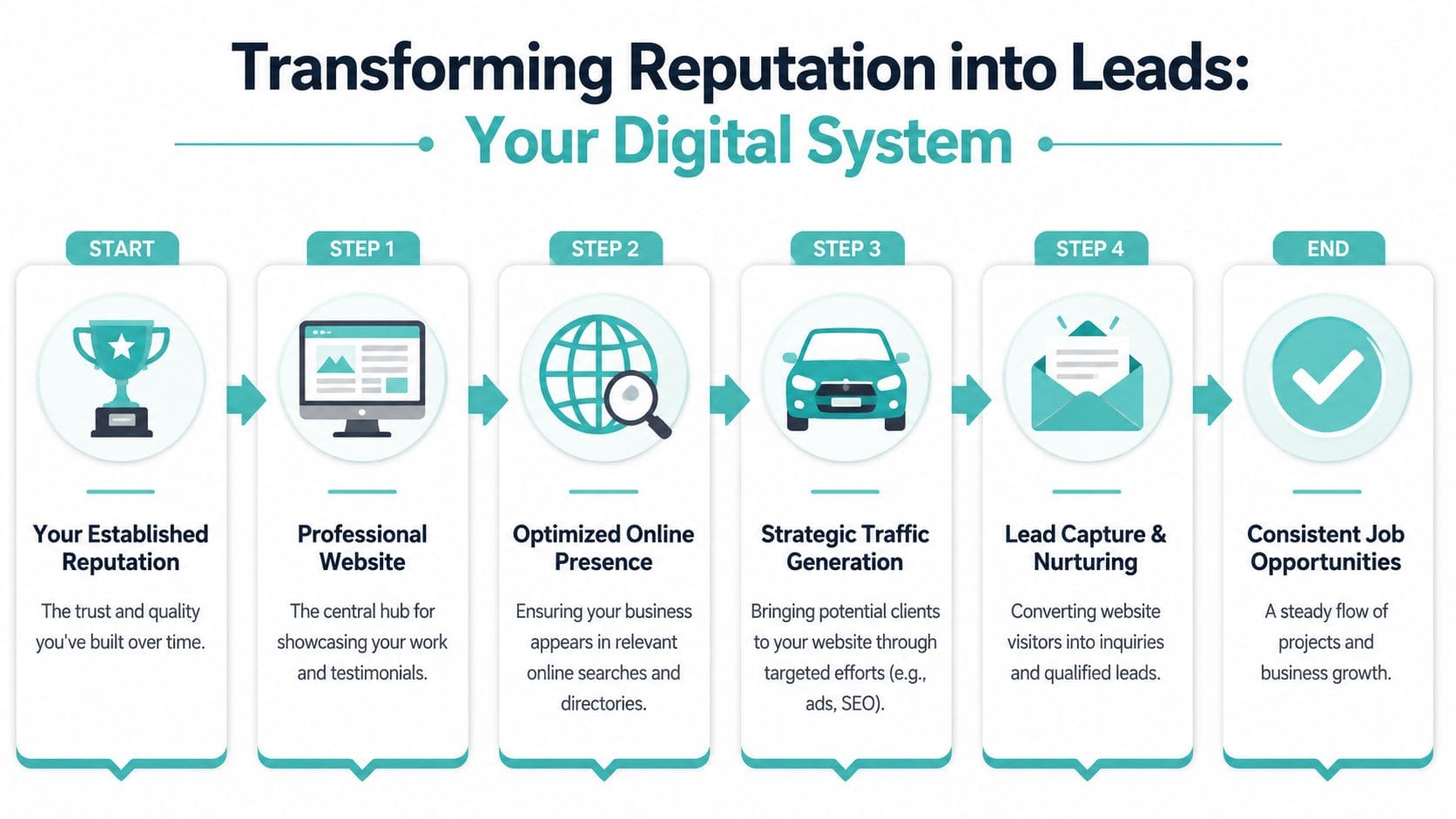
That is what a Lead Machine is. Not a pretty website. Not an online business card. A tool built for one job.
Get found. Build trust. Get the call.
A system beats reacting
Sprout Social’s overview of reputation management makes an important point. Reputation is a measurable, always-on job tied to reviews and customer experience. Without a system, you’re reacting instead of controlling growth.
That’s exactly how most contractors operate online. They respond when something goes wrong. They don’t build the structure that helps the right things show up all the time.
Here is the difference:
| Weak setup | Lead-generating setup |
|---|---|
| One general website | Service and city structure |
| Random reviews | Reviews placed where buyers see them |
| No clear path to contact | Calls and quote requests built in |
| Hope people find it | Built to capture demand |
If you need more customer proof on the page, collecting more reviews helps. This guide on how to get Google reviews is a useful place to start thinking about that part of the system.
The Cherubini Company builds Lead Machines around this idea. A contractor’s reputation should not float around the internet in pieces. It should be organized into a site built to turn search traffic into calls across the cities that business wants to serve.
Good reputation without a system is wasted trust.
How Ads Turn Your Good Name into Real Jobs
Even the best Lead Machine is dead if nobody sees it.
Contractors frequently get confused about ads.
Ads are not magic. They are not the whole strategy. They are just the fuel that puts your business in front of people who are already looking.
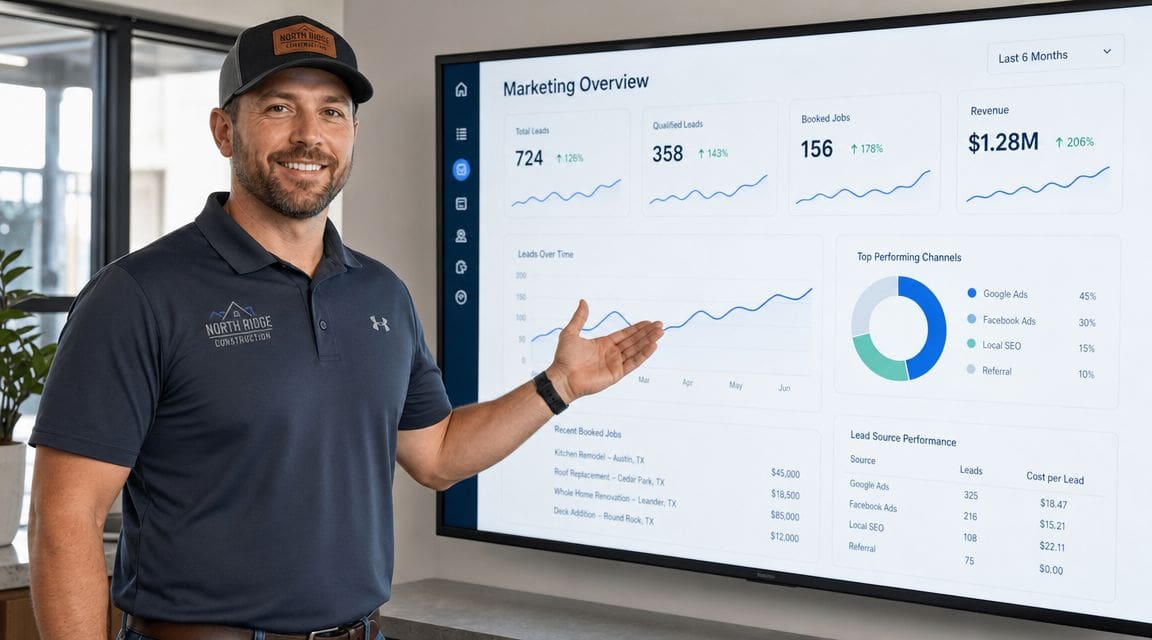
Why ads failed before
A lot of owners say, “We tried ads and they didn’t work.”
Usually that’s true.
But the ads often weren’t the actual problem. The traffic was being sent to a weak page, a generic website, or a homepage that didn’t match the service and city the buyer cared about.
That’s like pouring fuel on the ground and blaming the fuel because the truck didn’t move.
What ads actually do
Ads create visibility on demand.
They let you show up in the places where you want work, instead of waiting and hoping your name spreads there on its own.
That matters because, as noted in that earlier reputation score guide, large companies track reputation with up to 9 different factors. The takeaway isn’t that you need a giant scoring model. It’s that visibility is a numbers game, and your good name needs enough exposure for those numbers to work in your favor.
Bottom line: If people in the right cities don’t see your business at the moment they search, your reputation never gets a chance to sell the job.
A simple way to think about it:
- The Lead Machine catches demand. It gives buyers a focused place to land.
- Ads create the traffic. They put that page in front of active searchers.
- Your reputation closes the gap. Reviews, trust signals, and proof help convert interest into calls.
If you want to understand how paid traffic fits into that system, this page on Google Ads for your Lead Machine lays it out in plain English.
Websites without traffic don’t work.
Ads without a strong destination waste money.
Together, they become a system.
Stop Guessing and Start Controlling Your Leads
Contractors don’t usually have a lead problem first.
They have a visibility problem.
They’re known in one pocket of the market and missing in the rest. Their reputation may be solid, but it isn’t showing up where buyers are searching. So the jobs go to whoever is visible.
What control actually looks like
Control doesn’t mean chasing every marketing trend.
It means having a setup that does three things:
- Shows up in the cities you want
- Makes your business look trustworthy right away
- Turns that attention into calls
That is what brand reputation management should mean for a contractor. Not babysitting the internet all day. Not posting nonsense online. Not buying another pretty website.
A reputation only helps when it is attached to a working lead system.
The choice is simple
You can keep relying on referrals, luck, and whatever traffic happens to stumble onto your website.
Or you can build a machine that puts your business in front of buyers on purpose.
One path keeps you guessing.
One path gives you control.
When your visibility improves, your options improve too. You can go after better jobs. You can stop living on small work. You can fill slow seasons instead of waiting them out. You can make decisions based on what is coming in, not what you hope shows up next week.
You think that customers “can” find you but, if customers “don’t” find you, nothing else matters. Lead Machines are built to fix that.
If you’re tired of guessing and want a simple system that helps contractors get seen in the right cities, turn that visibility into calls, and stop wasting money on marketing that goes nowhere, take a look at The Cherubini Company. They build Lead Machines and run ads to solve the problem: invisibility.