You already know how this goes.
You’re solid in your home town. People know your name. Referrals come in. The phone rings enough to keep the wheels moving. Then one crew opens up, a slow patch hits, or you decide you want bigger jobs in the next few towns over. Suddenly there’s a problem.
Not a work problem. Not a quality problem.
A visibility problem.
The contractor down the road isn’t beating you because he’s better. He’s beating you because he shows up where you don’t. If a customer searches for your service in the next town over and your business doesn’t appear, you lost that job before you ever had a shot at it.
That’s why contractor lead machine websites matter. They’re not about looking modern. They’re about getting found, getting calls, and getting control.
Your Biggest Problem Is Not a Lack of Leads
A lot of contractors say they need more leads.
That’s close, but it’s not the main problem.
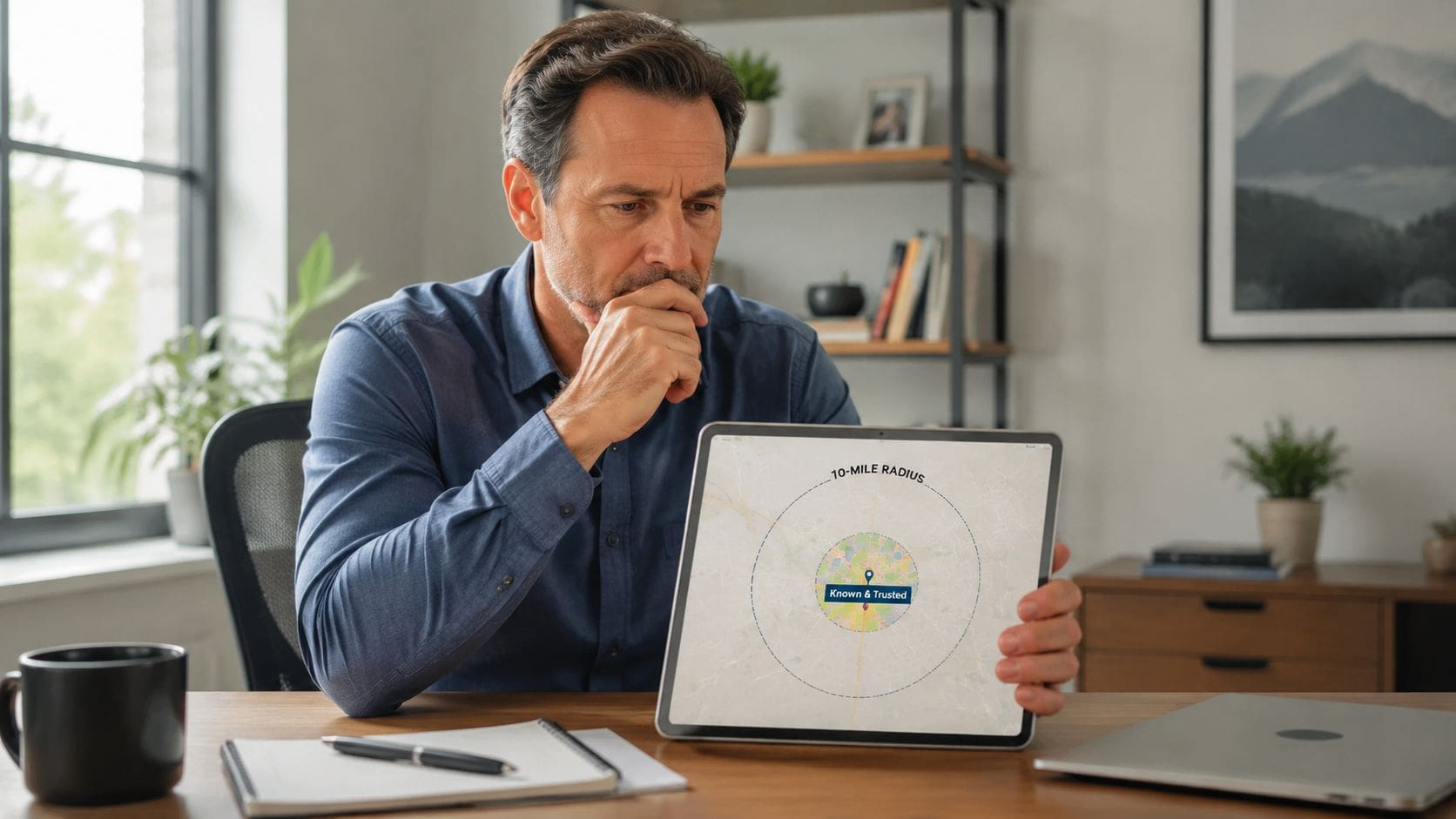
The problem is that you’re invisible in the places you already want to work. You may be the go-to name in your own town, but ten miles away, Google has no reason to think you belong there. So when someone searches for your service near them, your company doesn’t show up.
The jobs you’re losing are the ones you never see
Here’s the trap. You think customers can find you because people in your network can find you.
That’s not how buyers search.
They don’t type your business name unless they already know you. They search for what they need and where they need it. If you don’t appear for that local search, you are out of the running. No call. No estimate. No chance.
You’re not only losing jobs to competitors you know. You’re losing jobs to competitors you never knew you were competing with.
That creates the cycle most contractors hate:
- Word of mouth runs the business: Good when it’s flowing. Brutal when it slows down.
- Crews stay busy with the wrong work: Too many small jobs. Not enough high-value jobs.
- You keep guessing: No clear system. No control over where the next job comes from.
- Slow seasons hit hard: Not because demand vanished, but because you weren’t visible when people were looking.
This is a revenue problem, not a website problem
The construction sector was worth about $13 trillion in 2023, and Autodesk says it could reach roughly $15.5 trillion by 2030 as a projection. In a market that big, even small gains in local lead capture matter because they connect to very large revenue pools, as noted in Autodesk’s construction industry statistics.
That matters at the local level too. If you’re missing searches in nearby towns, you’re leaving money behind for somebody else to collect.
A lot of owners don’t need more effort. They need more visibility.
If that sounds familiar, read why your lead problem isn’t what you think it is. It gets to the point fast.
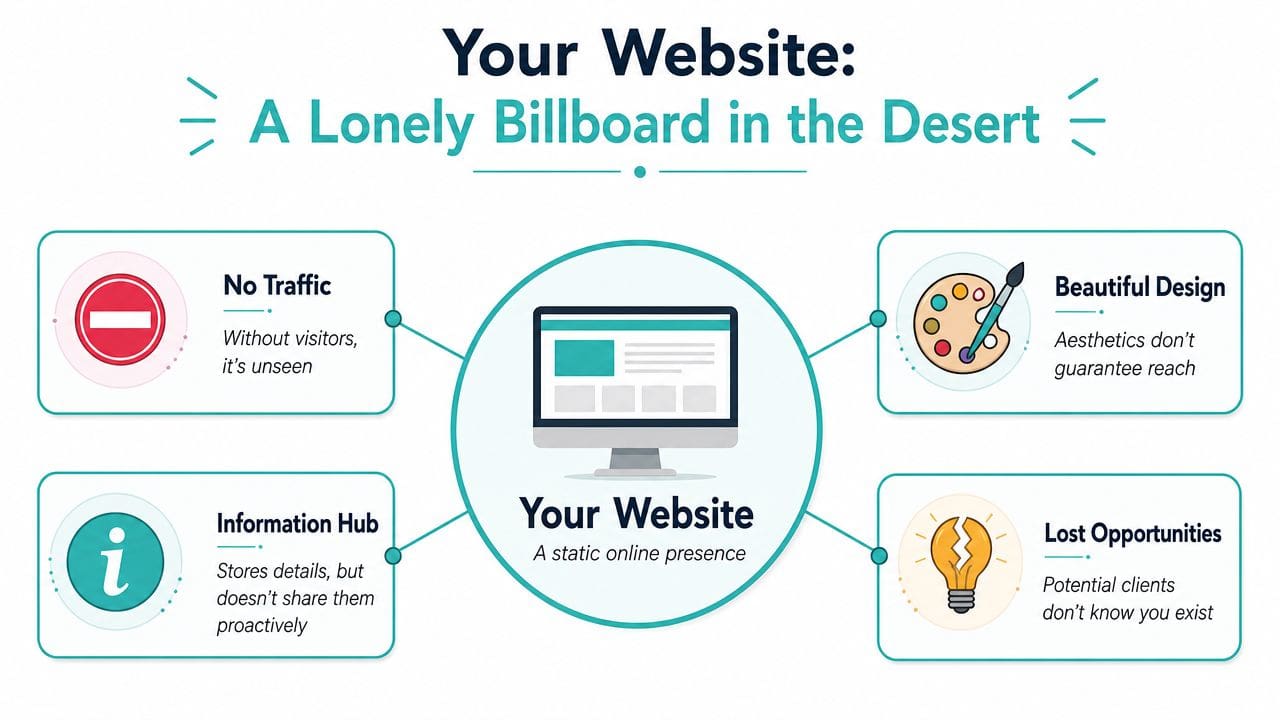
Why Your Website Is a Billboard in the Desert
A website doesn’t create traffic.
It waits for traffic.
That’s the part most contractors were never told when they paid for a site that looked sharp but did nothing for the business. They got sold design. They needed a system.
A pretty site won’t save a bad setup
If your website is basically Home, About, Services, and Contact, you don’t have a lead system. You have a brochure.
A brochure site can confirm you’re real. No more.
It doesn’t push into new towns. It doesn’t create demand. It doesn’t put you in front of buyers searching right now. And it sure doesn’t fix the problem of being invisible outside your home area.
| What most contractors have | What it actually does |
|---|---|
| A nice looking homepage | Confirms the business exists |
| A short services page | Gives general information |
| A contact form | Waits for someone to care enough to use it |
| A few photos | Shows past work, but doesn’t drive reach |
Why contractors feel burned by websites
This is why so many owners say, “We already tried a website.”
They did. It just wasn’t built to do the job they needed done.
Practical rule: If nobody sees the site, the site can’t produce calls.
The site wasn’t broken because it looked bad. It was broken because it had no visibility engine attached to it and no structure for the areas you serve.
That’s why websites don’t generate leads on their own. They only convert the traffic they get. If traffic never comes, the whole thing sits there like a billboard in the desert.
What Is a Contractor Lead Machine Website
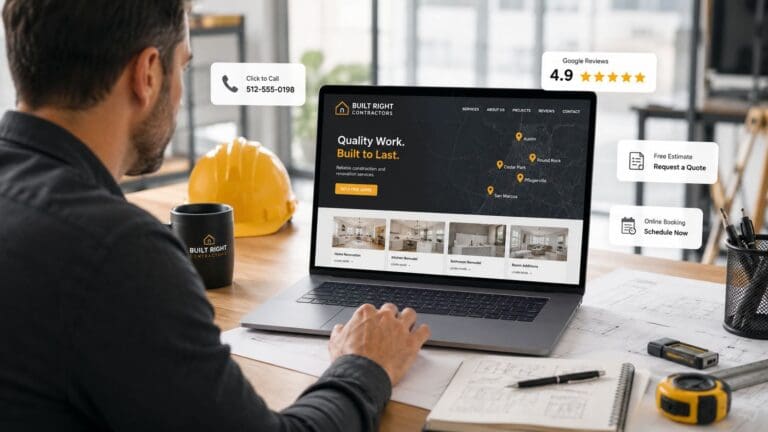
A contractor lead machine website is a website built for one job.
It turns traffic into calls and quote requests.
Not compliments. Not clicks with no action. Not a fancy online brochure. It is built to help buyers land on the right page, trust what they see, and contact you fast.
What the machine has to do
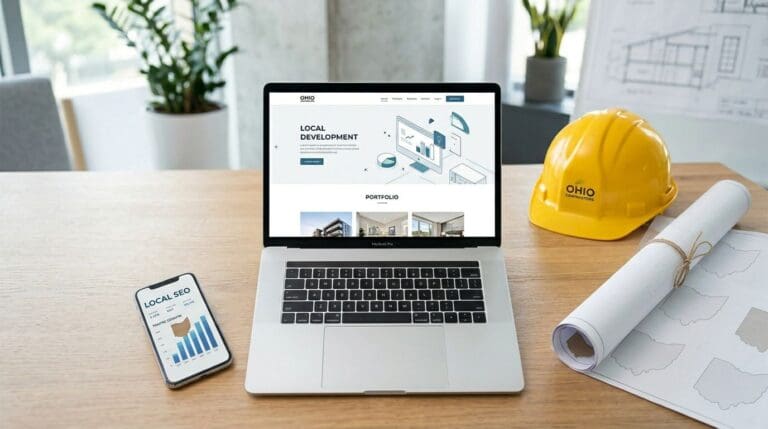
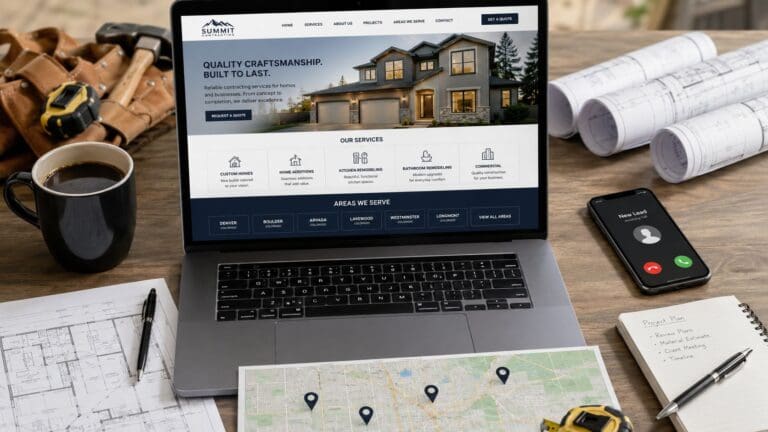
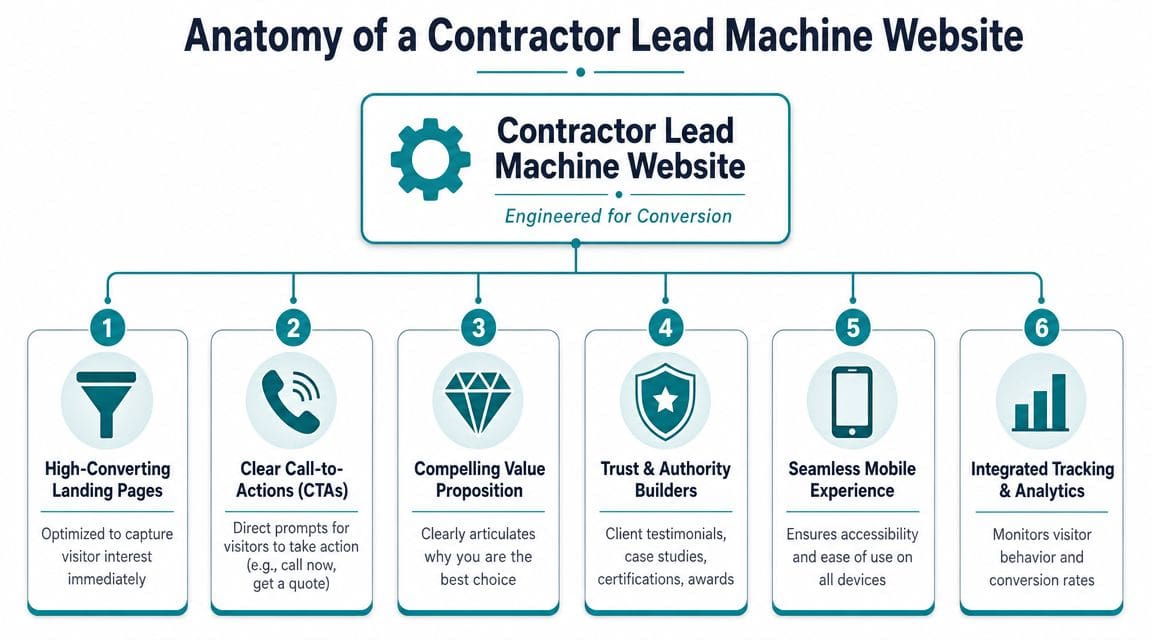
A real lead machine is structured around your services and your service area. That means each major service gets its own page, and each target city gets pages that match the work you want there.
That structure matters. Projul’s contractor marketing guidance says effective lead machines for multi-city expansion need specific service pages in each location, not a lazy list of town names. That’s how you expand without wasting effort on thin or duplicate pages.
Here’s what that looks like in plain English:
- Service and city coverage: You need pages that make it clear what you do and where you do it.
- Clear calls to action: Call now. Request a quote. Simple next step.
- Mobile-first layout: Your buyers are on their phones. If the page fights them, you lose.
- Trust signals: Reviews, proof of work, and business details that reduce doubt.
- Tracking: You need to know which pages and campaigns are producing real inquiries.
What separates it from a normal website
A normal website talks about the business.
A lead machine is built around the buyer’s decision.
That means the page answers three things fast:
- Do you do this work?
- Do you do it in my area?
- How do I contact you right now?
If the page buries those answers, it loses.
The best contractor sites aren’t trying to impress other contractors. They’re trying to make it easy for a customer to call.
If you want a broader marketing view, Riff Analytics’ lead generation framework is useful because it treats lead generation as a system, not a collection of random tactics.
If you want the contractor version of that idea, what a Lead Machine is lays out the model clearly.
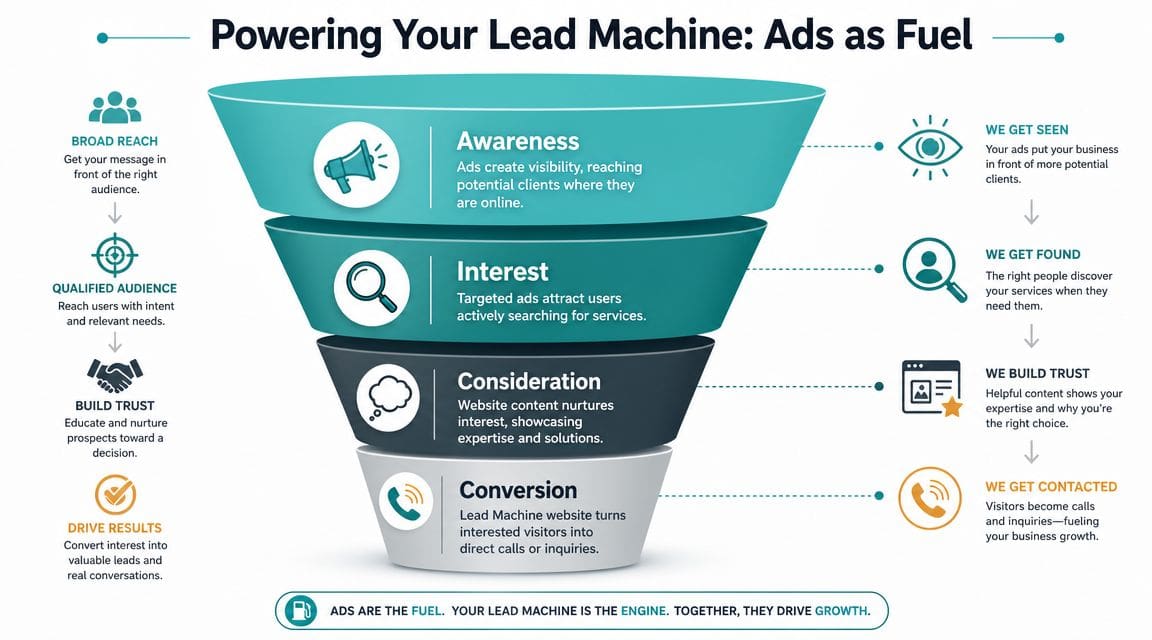
Ads Are the Fuel That Makes the Machine Run
A Lead Machine without traffic is dead weight.
Ads solve that.
They create the visibility you’re missing by putting your company in front of buyers who are already searching for the exact service you offer in the areas you want to reach.
Ads are not the problem. Bad destinations are.
A lot of contractors say ads didn’t work.
Usually, ads sent people to the wrong place. Maybe the homepage. Maybe a weak site. Maybe a page that looked fine but didn’t match the search, didn’t build trust, and didn’t make calling easy.
That doesn’t mean ads failed. It means the system failed.
Lead generation guidance for contractors says getting started with paid ads often requires a budget of $2,000 to $5,000 per month to be effective. If you’re spending that kind of money, sending traffic to a brochure site is wasteful. The traffic needs to hit a page built to convert.
The website is the asset. Ads are the fuel.
This is the relationship:
| Part of the system | What it does |
|---|---|
| Lead Machine website | Turns interest into calls and quote requests |
| Ads | Create visibility and send high-intent traffic |
| Tracking | Shows what is producing real opportunities |
Without the site, ad money leaks.
Without the ads, the site sits there.
When contractors say they want more leads, what they usually need is a better destination and a steady source of local attention.
If you’re creating ad creative at scale, tools like ShortGenius automated ad generation can help produce ad assets faster. That only matters if the traffic lands on a page built to get action.
For a contractor-focused setup, Google Ads for your Lead Machine shows how the two parts fit together.
Moving From Guesswork to a Predictable System
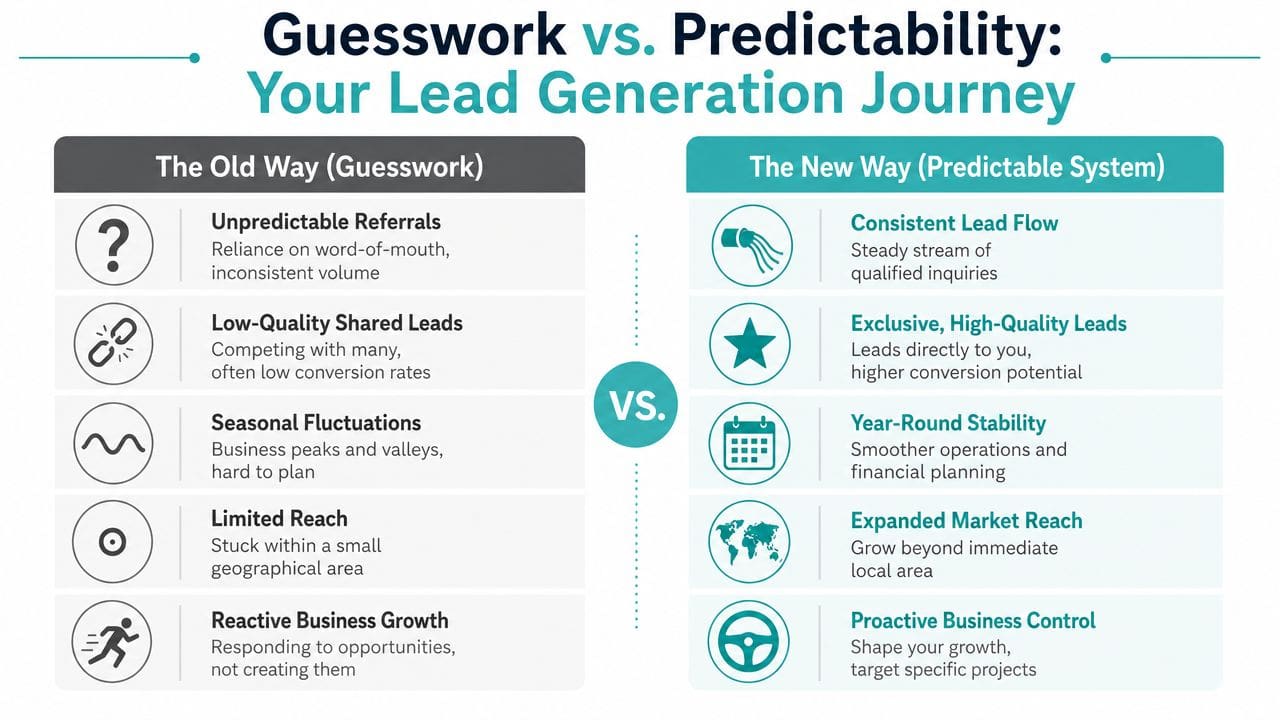
Most contractors are running two lead systems at the same time, and neither one is under control.
The first is referrals. The second is hope.
Hope that past customers talk. Hope that the phone keeps ringing. Hope that a lead platform sends something decent. Hope that next month looks like last month.
Shared leads create bad business habits
A lot of owners buy leads because it feels easier. Then they learn what they really bought.
Shared leads. Bad fits. Shoppers. People who called three other companies first. Jobs that turn into price fights.
ActiveProspect’s guidance on buying construction leads makes the right point. Actual return comes from lead quality and exclusivity, not lead volume alone. If the source is shared, unclear, or impossible to verify, your close rate suffers and your time gets burned up.
That’s why an owned lead machine matters. The lead came through your visibility, your page, and your process.
The old way versus the useful way
The difference is simple:
-
Old way
- Wait for referrals
- Buy shared leads
- Guess which marketing is working
- Take too many weak jobs
- Ride out slow periods and hope demand comes back
-
Useful way
- Control where you show up
- Drive buyers to pages built for action
- Track calls and quote requests by source
- Focus on better jobs
- Build steadier demand across more than one town
Better leads don’t just fill the schedule. They give you the power to say no to work you shouldn’t take.
A predictable system changes the business. You stop acting like every inquiry is precious. You can be selective. You can protect margins. You can stop stuffing the schedule with low-value work just to keep people busy.
That is what control looks like.
The First Step to Fixing Your Invisibility
You don’t need another round of vague marketing talk.
You need to know where you’re invisible, which cities are being missed, and whether your current site gives buyers a clear path to call. If it doesn’t, that’s the problem to fix first.
A lot of business owners get distracted by design trends and platform chatter. Even a broad resource like MeshBase’s website builder review is only useful if you remember the core point. The platform isn’t the strategy. Visibility is the strategy. Conversion is the job.
Start with what buyers see
The first step is brutally simple.
Check whether your business clearly shows the services you offer and the places you want work from. Then check whether your business profile and website are aligned. If those two things don’t match, you’re sending mixed signals and making it harder to get found.
Your Google Business Profile matters here. If you haven’t looked at how to optimize your Google Business Profile, start there.
You think that customers can find you.
But if customers don’t find you, nothing else matters.
Lead Machines are built to fix that.
If you’re done guessing, Local Contractors of America builds Lead Machines for contractors. That means a conversion-focused website structured by service and city, paired with paid visibility that sends local buyers to pages built to generate calls and quote requests. If you want a clear next step, ask for a visibility review and see where your business isn’t showing up now.