The frustration is real. A lot of contractors aren’t bad at marketing because they’re lazy. They’re stuck because they’ve been sold random parts instead of a system. One company sells a website. Another sells ads. Another talks about search rankings. None of it connects. So the phone stays uneven, the slow weeks get stressful, and you keep leaning on referrals because at least referrals feel familiar.
The hard truth is simple. Most contractor marketing fails because the business is not visible where buyers are searching. That’s the core issue behind the feast-or-famine cycle.
Why Your Current Marketing Feels Like a Gamble
A lot of contractors think they have a lead problem.
They do. But the lead problem usually starts as a visibility problem.
If your whole business runs on word of mouth, you already know what happens next. One month is packed. The next month gets thin. Then you start taking smaller jobs you don’t even want because the schedule has holes.

Random marketing is not a strategy
Most contractors aren’t running a real digital marketing system.
They’re trying disconnected stuff like:
- A brochure website: It looks decent, but it just sits there.
- A few ads here and there: No real plan, no clear path from click to call.
- A social page: Fine for credibility, useless for steady demand by itself.
- Agency promises: Fancy reports, weak results, no control.
That isn’t strategy. That’s guessing.
And guessing feels expensive when every missed job is real money.
Practical rule: If you can’t clearly say how someone finds you, lands on your site, and turns into a call, you don’t have a lead system.
Why contractors stop trusting marketing
A lot of owners have been burned before. That’s not paranoia. That’s pattern recognition.
You paid for a site. You paid for ads. You got traffic talk, impression talk, click talk. But you didn’t get enough good calls. So now every new pitch sounds like the last one.
That’s why “digital marketing for contractors” gets a bad name. Not because marketing can’t work. Because most of what gets sold to contractors is either half a system or no system at all.
Here’s the cleaner way to look at it:
| What contractors often buy | What actually happens |
|---|---|
| A website alone | It waits for traffic |
| Ads alone | They send visitors to a weak site |
| Generic marketing packages | Nobody owns the result |
| A connected lead system | Visibility turns into calls |
A website without traffic is dead weight.
Ads without a conversion system waste money.
If your marketing feels like a gamble, that’s because it is. You’re putting money out with no control over the path back.
The Invisibility Gap Where Your Jobs Are Disappearing
Most contractors are known in their hometown.
That’s the trap.
You think you’re visible because people in your own town know your name, your trucks, or your reputation. But go ten miles out, maybe twenty, into the next city where you also do work. Search for your service there. A lot of the time, you’re gone.
That’s the invisibility gap.
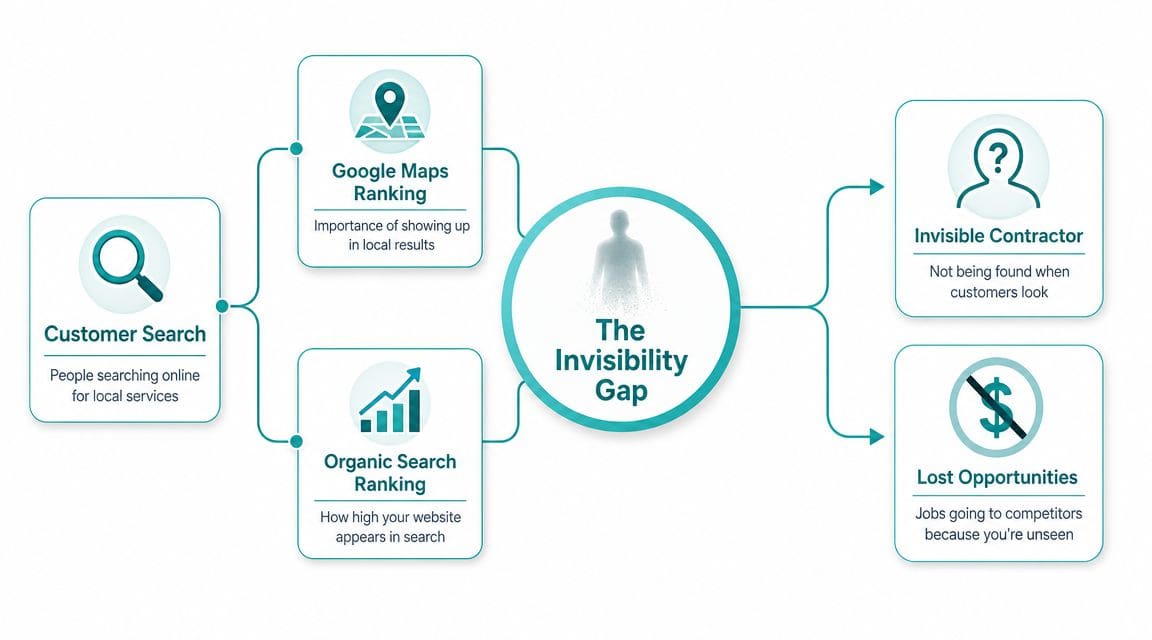
What buyers actually search for
People usually don’t search your company name unless they already know you.
They search for what you do and where they need it. If somebody types “excavation contractor near me” or “plumber near me,” Google reads that as service plus local place. It ties that search to the city the searcher is in.
That means if your business only clearly signals your home city, Google has no strong reason to show you in the nearby cities where you also want work.
It’s obvious once you hear it.
If you never tell Google you work in those places, why would Google assume you do?
People don’t hire the contractor they can eventually find. They hire the one they see when they search.
The cost of not showing up
This isn’t a small issue.
WebFX reports there are 1.7 million online searches for independent contractors each month in its construction statistics roundup. That is a huge amount of demand happening online before the phone ever rings.
For every one of those searches where you don’t show up, somebody else gets the shot.
That’s why so many owners feel like work is slipping through their hands without knowing where it went. The jobs didn’t vanish. They went to the company that showed up first in the right city at the right moment.
If this sounds familiar, this breakdown of why contractors don’t get enough leads will hit close to home.
The problem is not effort
You may work all over your county and beyond.
You may have trucks on the road every day.
You may have a solid name with past customers.
None of that guarantees visibility in local search outside your home base. This is why contractors can stay busy and still feel unstable. They’re active in the field, but they’re invisible when new buyers search in the next town over.
And if a buyer never sees you, you never even get the chance to compete for the job.
Your Website Is Not a Lead Generator
A website does not create traffic.
It doesn’t matter how pretty it is. It doesn’t matter how much you paid. It doesn’t matter if the designer called it modern, clean, or premium.
Your website sits there and waits.
That’s it.

The website myth that wastes time
A lot of owners buy a site thinking leads will somehow start showing up after launch.
They won’t.
A website is a tool for converting attention into action. It can help turn a visitor into a caller. But first, somebody has to get there. No traffic means no calls. That’s why so many contractors feel disappointed after a rebuild. They bought the container and expected it to supply the demand.
Here’s the blunt version:
- No visibility: nobody visits
- No visitors: nobody calls
- No calls: the website did nothing for the business
If you want a deeper look at why so many contractor sites fail, this page on lead gen websites that suck in leads explains the difference.
Ads without a real landing place are a leak
Now the other mistake.
Some contractors finally agree to run ads. Good. Ads can create visibility fast. But then the traffic gets sent to a weak site with no clear path to call, no service-by-city structure, and no strong lead capture.
That burns money.
A contractor-focused training source notes that common ad spend can land in the $3,000 to $5,000 per month range, and in some cases qualified leads can cost about $1,000 each in competitive situations, as explained in this restoration marketing discussion on YouTube. If you’re paying that kind of money to push people into a site that doesn’t convert, you’re not marketing. You’re leaking cash.
A bad website doesn’t just fail to help. It actively makes paid traffic less profitable.
The website and the ads need each other
In this scenario, contractors get misled.
They’re told the website is the answer. It isn’t.
Then they’re told ads are the answer. They aren’t.
The answer is the combination. One part creates visibility. The other part turns that visibility into calls. Separate them and both get weaker.
That’s the mistake behind a lot of failed digital marketing for contractors. The parts are there, but they’re not built to work together.
The Two-Part System That Creates Predictable Leads
The fix is not more random tactics.
The fix is a two-part system.
Part one is the Lead Machine. Part two is ads. One converts. One creates visibility. Together, they give you control.
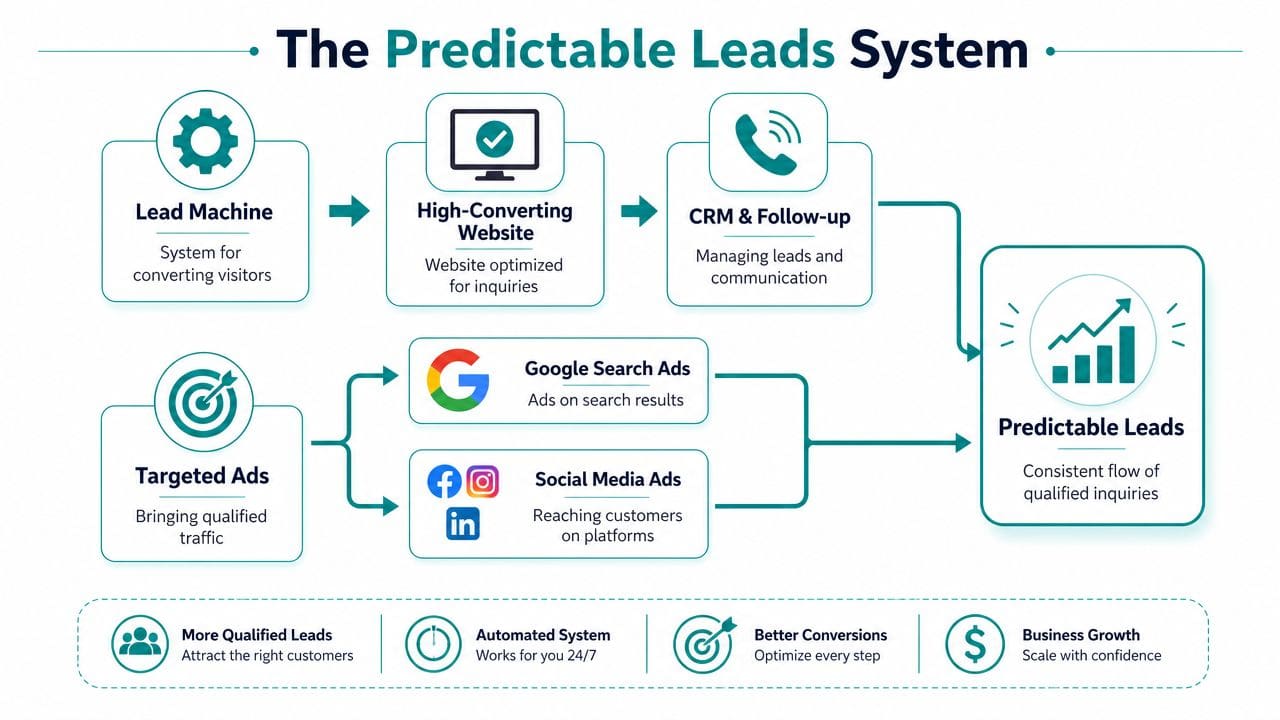
Part one is the asset
A Lead Machine is not a pretty website.
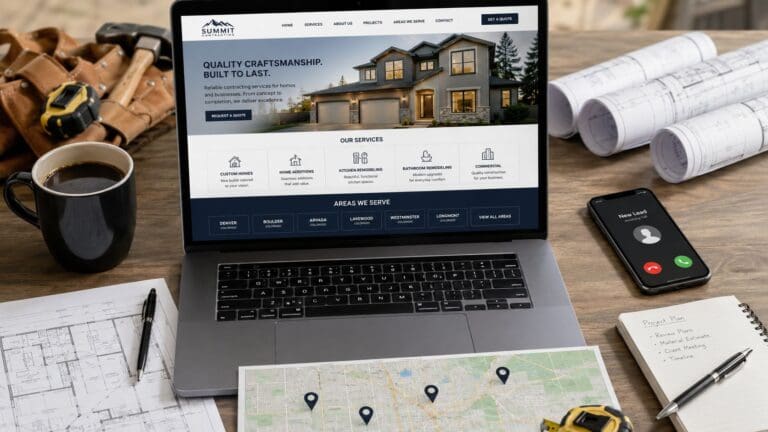
It is a website built for one job. Get the visitor to call, submit, or reach out. It is structured around the services you offer and the cities you want work from. That matters because most contractor sites are built like online brochures when they should be built like job-winning tools.
Recent contractor marketing guidance highlighted by 800.com’s digital marketing for contractors article points to a significant issue many businesses ignore. Single-location thinking doesn’t solve multi-city service demand. A Lead Machine is built with location-specific pages and geographic targeting so a contractor can show up across a wider region instead of being boxed into one town.
If you want a straight explanation of the model, this page covers what a Lead Machine is.
Part two is the fuel
Ads do one thing really well.
They put you in front of buyers who are searching right now.
Not next month. Not after they ask around. Right now.
That makes ads useful for contractors who need immediate visibility while the site does its job converting traffic into calls.
Here’s the simple breakdown:
- Lead Machine: Built to capture demand
- Ads: Built to create demand visibility
- Both together: Built to produce steady lead flow
What works: Stop buying parts. Build the machine, then feed it traffic.
This matters beyond local service work
If you also chase larger commercial jobs, the same lesson holds. Visibility and positioning still matter, even when the sales cycle is more formal. For owners looking at public-sector work, these insights for prime government contractors are useful because they show how winning work depends on being found, qualified, and ready when the opportunity appears.
That’s the point. Different market, same truth.
The contractor who gets seen gets the chance.
One example of this two-part approach is The Cherubini Company, which builds Lead Machines for contractors and pairs them with paid visibility campaigns. That’s not magic. It’s just a connected system instead of disconnected marketing.
How a Lead Machine Works to Fill Your Pipeline
Think of a Lead Machine like an online billboard that does something.
A normal billboard just gets seen. A Lead Machine gets seen, proves you do the work, shows the right city, and pushes the person to call. It’s built around the way buyers act when they need help fast.
It matches how local buyers make decisions
Most local buyers are not browsing for fun.
They need a service. They need it in their area. They want a clear next step. So the Lead Machine is built to match that behavior. It has service pages for what you do and city pages for where you do it. That helps your business show up with stronger local relevance and helps the buyer know they’re in the right place.
That matters a lot for contractors working beyond one town. If your service area spreads across multiple locations, the site has to reflect that reality or your visibility stays boxed in.
For businesses that grow across repeating territories, the same logic shows up in other models too. This look at franchise lead generation is useful because it shows how location-based demand needs a system that can scale from market to market without getting sloppy.
It is built to turn interest into contact
Once the visitor lands, every part of the site should help one outcome.
The phone call. The form fill. The quote request.
That means the site needs to be easy to use on a phone, quick to understand, and clear about what happens next. No hunting around. No vague message. No clutter.
A working Lead Machine usually includes things like:
- City and service structure: So buyers land on the page that fits their need
- Clear calls to action: So they know how to contact you fast
- Call routing and forms: So leads don’t get lost
- Review support: So trust is built before the first conversation
You can see the idea behind these systems on this page about Lead Machines for contractors.
If the site doesn’t make it easy for a ready buyer to contact you, it isn’t helping your pipeline.
This is why digital marketing for contractors should not be treated like design work. It’s lead flow work. The whole thing exists to fill the pipeline with better chances to win better jobs.
Take Control of Your Leads and Your Business
A fragile business waits and hopes.
A stronger business controls visibility.
That’s the fundamental divide.
If you rely only on referrals, you don’t control timing. If you have a website with no traffic, you don’t control attention. If you run ads into a weak site, you don’t control conversion. That’s why so many contractors stay busy but still feel exposed. They’re working hard without owning the flow of new demand.
What control actually looks like
Control means your business can show up in the cities you want.
Control means buyers can find you when they search.
Control means your marketing is built to turn attention into calls instead of wasting it.
Here’s the practical choice:
| Keep guessing | Build a system |
|---|---|
| Hope referrals keep coming | Create visibility on purpose |
| Show up in one town | Reach the cities around you |
| Spend without clarity | Track what is producing calls |
| Stay reactive | Build a steadier pipeline |
If your online presence is weak, fix that first. This guide on how to manage your online presence is a good place to start looking at the problem the right way.
You don’t need more marketing noise.
You need a system that makes you visible, turns that visibility into leads, and gives you more control over revenue.
You think that customers “can” find you but, If customers “don’t” find you, nothing else matters. Lead Machines are built to fix that.
If you’re tired of guessing and want a straight answer on what’s keeping your business invisible, talk to The Cherubini Company. They build Lead Machines for contractors and pair them with paid traffic so the website and the ads work as one system instead of fighting each other.
Get the playbook to grow your business by joining Local Contractors of America.