You’ve heard some version of this before.
“We tried ads. They didn’t work.”
“That’s what the last company said.”
“We’ve been burned before.”
“We get work. We just need more of the right work.”
Fair enough.
Most contractors don’t have a work quality problem. They have a visibility problem. They’re known in their hometown. Their trucks get noticed. Their signs are out. People know the name.
Then you go 10 miles down the road and it’s like your business doesn’t exist.
That’s the problem. Not effort. Not hustle. Not even your reputation. If people don’t see you when they search, you don’t get considered. A local SEO for contractors city pages strategy fixes that, but only when it’s part of a real lead system.
You’re Invisible 10 Miles From Home
A contractor can be busy in one town and dead quiet in the next one over.
That happens all the time. A company does solid work, has a good name locally, and assumes that reputation carries into nearby cities. Online, it doesn’t. Google doesn’t care that you drove there last week. Google cares what your business clearly says about where you work.
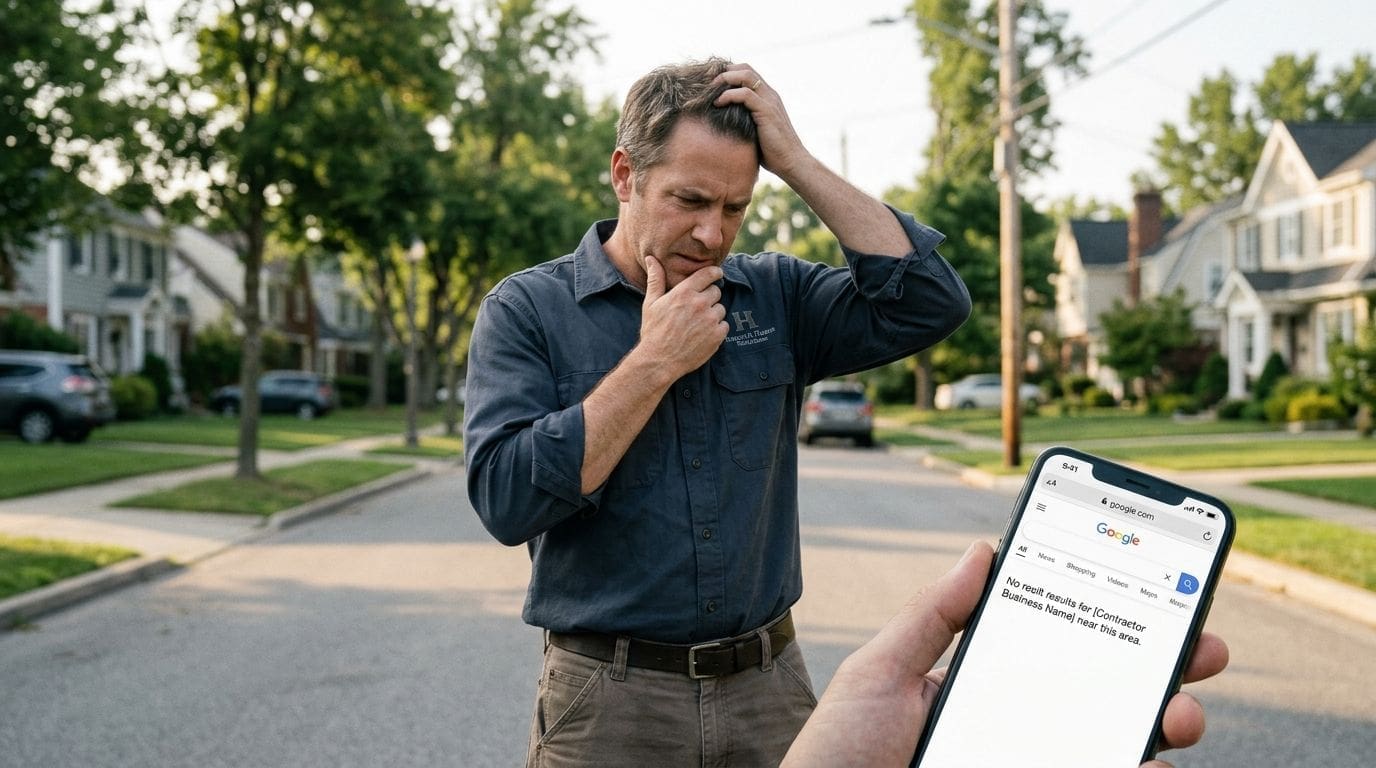
Near me means a real city
When a homeowner searches for “excavation contractor near me” or “plumber near me,” Google turns that into a local result based on where that person is standing. If they’re in the next town over, Google is looking for businesses tied to that town.
If your site only talks about your home city, Google makes a simple decision. It assumes you work there, and not much farther.
That’s why a contractor can be respected in one place and invisible in another.
Your reputation does not travel online unless your website gives it somewhere to land.
If you want to better understand proximity-based rankings, that idea is worth looking at. It helps explain why your rankings change from one city to the next, even when your service stays the same.
The jobs you lose never show up on your radar
The worst part is this. You usually don’t know what you missed.
You don’t get a bad lead.
You don’t get an estimate request.
You don’t get a phone call.
Nothing happens because someone else showed up first.
Here’s what that looks like in plain language:
- You work in five towns. Your website only makes it clear that you work in one.
- A buyer needs help now. They search by service and city, not by your company name.
- Google sends them elsewhere. Not because your work is worse. Because your visibility is worse.
That’s why so many contractors think they need “more leads” when the underlying issue is simpler. They’re not showing up where the buyer is searching.
The Real Reason You’re Losing High-Value Jobs
The hard truth is simple. You don’t have a lead problem first. You have an invisibility problem first.
If you don’t control visibility, you don’t control revenue. You’re left hoping referrals keep coming, hoping old customers call back, hoping someone tags your business in a local group.
Hope is not a system.
Buyers search by service and place
When searching for a contractor, customers typically don’t know your company name. They know their problem. They know their city. That’s what they type.
8 in 10 US consumers search for local businesses online at least once a week. If your business is invisible in their city when they search, you lose the chance to even be considered for the job.
That one fact should change how you think about marketing.
You’re not competing only on price, reviews, or workmanship. First, you’re competing for the right to be seen.
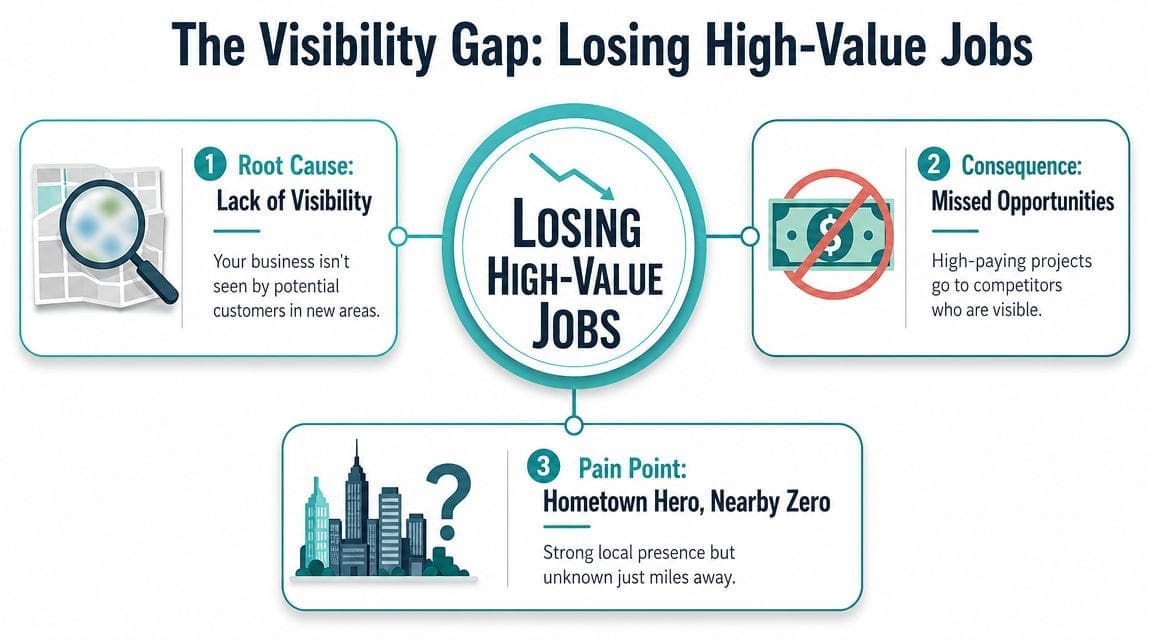
Hometown hero, nearby zero
A lot of owners get fooled by partial success.
They rank in their home area, so they assume the whole region is covered. It isn’t. The map in your head is bigger than the map Google trusts.
Here’s the gap:
| What you believe | What the buyer sees |
|---|---|
| “We service the whole county.” | “I only see companies that look local to my town.” |
| “People can find us if they want us.” | “I’m choosing from whoever showed up first.” |
| “Our name is known around here.” | “I’ve never heard of them.” |
Bottom line: If the buyer doesn’t know your name already, they search for what you do and where they need it done.
That’s where high-value jobs disappear. Not because your crew can’t do them. Because your company never entered the conversation.
Why Your Website Collects Dust Instead of Leads
A website is not a lead source by itself.
It does not go out and find buyers. It does not create traffic. It sits there and waits. That’s why so many contractors spend money on a site, feel good for a month, then wonder why nothing changed.
A pretty site can still fail.

A brochure is still a brochure
A lot of contractor websites are digital brochures. They show a few photos. They list services. They have an about page. Maybe there’s a form that nobody fills out.
That’s not a machine. That’s a sign in the dark.
And when owners say, “Our website doesn’t work,” they’re usually right. But they blame the wrong thing. The issue isn’t that they have a website. The issue is that the website was never built to support visibility across every city they want jobs from.
Why most websites fail contractors
They fail for predictable reasons:
- They only talk about one location. So nearby cities never get clear coverage.
- They aren’t built around service plus city. That means weak local relevance.
- They don’t guide the visitor well. Calls and form fills get lost.
- They aren’t aligned with the rest of local visibility. That includes your business profile and local signals. If you need help with that side, this guide on optimizing your Google Business Profile gives useful context.
A website without visibility is a parked truck with no fuel in it.
That’s why “just build me a website” is usually the wrong request. You don’t need something that looks better. You need something that helps you get found in the cities where you want work.
A Lead Machine to Dominate Every City You Service
Contractors must stop thinking in pages and start thinking in systems.
A Lead Machine is not a pretty website. It’s a website built for one reason. Leads. It’s structured by service and city so Google can match your business to the places you want to work.
That’s what a local SEO for contractors city pages strategy is supposed to do. Not impress other marketers. Not win design awards. Just make you visible in the right cities and turn that visibility into calls.
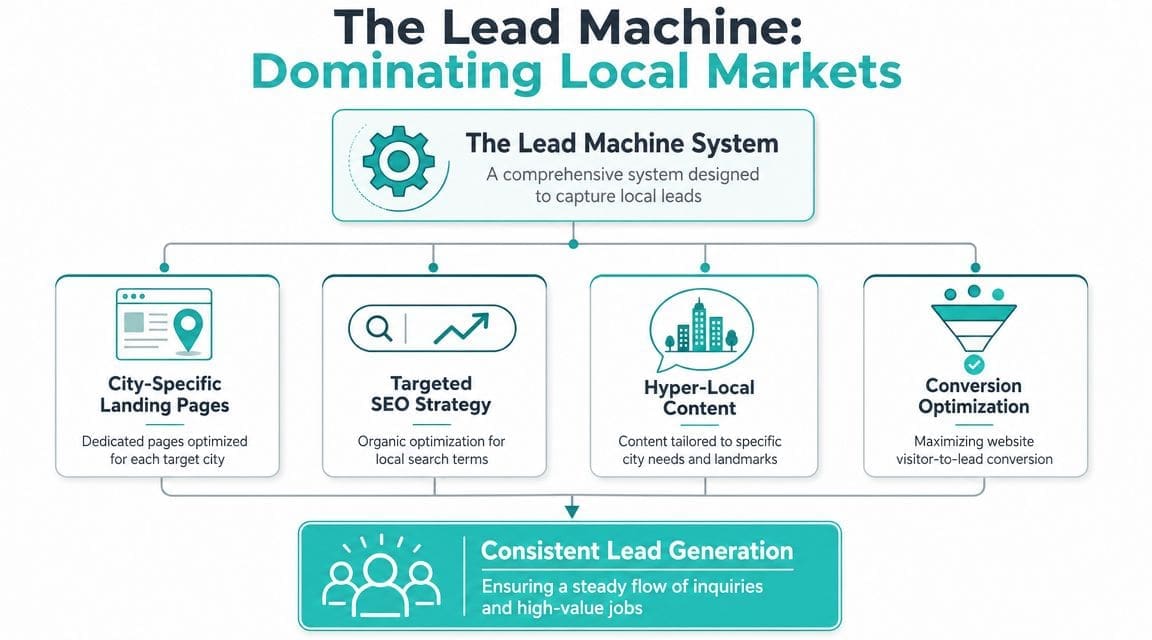
City pages tell Google where you actually work
Over 60% of local searches for contractors happen on mobile devices. A city-page strategy puts you in front of those high-intent searches at the moment someone in that town needs your service.
That matters because buyers aren’t browsing for fun. They’re standing in a driveway, at a jobsite, or in a kitchen with a problem that needs fixing.
A real machine includes pieces that work together:
- Service pages for what you do
- City pages for where you do it
- Fast mobile design so people can use it on the spot
- Clear calls to action so they know what to do next
- Tracking so you stop guessing where leads came from
This is an asset, not a gamble
If you serve multiple towns, you need coverage in multiple towns. That’s not optional. It’s basic visibility.
For contractors trying to manage multi-location search rankings, the pattern is the same. You need separate location coverage that makes sense to both Google and the buyer.
One option in this space is multiple Lead Machines, which are structured for multi-city visibility with service pages, city pages, conversion paths, and tracking built around lead generation. The point is not the label. The point is the structure.
Practical rule: If you want jobs from a city, your website needs a real page for that city.
That’s how you stop being “the guy from out of town” online.
How Ads Create Immediate Visibility and Fuel Your Machine
A strong Lead Machine gives traffic somewhere useful to go. Ads create that traffic.
That’s the part many contractors miss. They either buy a website and wait, or they run ads into a weak site and wonder why the money disappears. Both are broken.
Big companies don’t wait around to be discovered. They buy visibility. Small contractors usually rely on referrals and luck, then call it a strategy.

Ads solve the time problem
City pages matter. But visibility from search takes time to build.
Ads solve that by putting you in front of buyers who are searching right now. Not next quarter. Not after months of waiting. Right now.
That changes the game for contractors who have crews to keep busy, equipment payments to make, and growth plans that can’t sit still.
Why ads work when the machine is right
Ads are not magic. They need the right destination.
When a buyer clicks, they should land on a page that matches what they searched for. The service. The city. The next step. That’s how visibility turns into calls instead of wasted traffic.
Use this simple comparison:
| Without a system | With a system |
|---|---|
| Ads send people to a generic homepage | Ads send people to the right service and city page |
| Buyers get confused | Buyers know they’re in the right place |
| Money gets spent, but leads feel weak | Traffic has a better chance to turn into calls |
| Results feel random | Lead flow becomes more manageable |
If you want the paid side explained in plain language, this page on fueling your leads with Google Ads lays out the role ads play in a lead system.
The website is the asset. Ads are the fuel. You need both if you want control.
That’s how you stop treating marketing like a slot machine.
Stop Guessing and Start Controlling Your Lead Flow
Most contractors don’t need another pitch. They need a system that makes sense.
You already know the pain. Feast or famine. Too many small jobs. Not enough big ones. Good crews sitting when the phone goes quiet. Stress because you know work is out there, but you’re not the one getting the calls.
That doesn’t happen because you aren’t working hard enough. It happens because your visibility is weak outside the places Google already connects to your business.
Control beats hope
Word of mouth is great. It’s also fragile.
Referrals come when they come. Slow seasons still hit. Markets shift. Competitors start spending money to get seen. If your plan is to wait and hope your name gets passed around, you’re giving up control.
A lead system changes that.
Contractors who implement a system of geo-specific city pages and consistent lead tracking see measurable growth, with some achieving 25-35% increases in qualified leads within months. That matters because steady lead flow gives you choices. You can be pickier. You can aim for better jobs. You can stop acting like every inquiry is a gift.
What control actually looks like
It looks like this:
- You show up in more service areas. Not just your hometown.
- You know what is producing calls. No more blind guessing.
- You build an asset you can use long term. Not rented attention with no structure behind it.
- You pair that asset with paid visibility. So you’re not waiting around for traffic.
That’s the difference between random marketing activity and a real business system.
You think that customers “can” find you but, If customers “don’t” find you, nothing else matters. Lead Machines are built to fix that.
If you’re tired of guessing and want a straight answer about how to get visible in the cities you want work from, talk to The Cherubini Company. They build Lead Machines for contractors and pair them with ads so the website doesn’t just sit there. It becomes part of a real lead system.