You've probably heard some version of this before.
“We built you a new website.”
“We cleaned up the design.”
“We did some search work.”
“Give it time.”
Meanwhile, the phone still doesn't ring from the towns where you prefer to work.
That's why so many contractors are sick of marketing talk. You spent money. You got a site. Maybe it even looked good. But good-looking doesn't pay for fuel, payroll, or equipment. Calls do.
Here's the truth. Small business website design is not about making you look modern. It's about whether buyers in the right cities can find you, trust you fast, and call you without thinking twice. If that doesn't happen, the site failed.
Most contractors don't have a work quality problem. They have a visibility problem. They're known in their hometown. Then they disappear a few miles away. That gap costs jobs every week.
Your Business Is Invisible Where It Matters Most
You can be busy in your home city and still be invisible where it counts.
That's the trap. You assume customers in the next town can find you because you work there all the time. But that's not how search works. A buyer doesn't search your company name. They search for the service they need in the place they're standing.

The hometown trap
If your address is in one town, and your website mostly talks about that town, search engines connect you to that town. That sounds obvious because it is obvious. If you never clearly say you work in the nearby cities, why would Google assume you do?
A lot of contractors think, “Well, if someone needs me, they'll find me.” No. They might be able to find you. But if they don't find you when they search, you're out before the job even starts.
Practical rule: Customers don't search by your reputation. They search by service and location.
This is why local visibility work matters so much. Your website and your business listing have to match the area you serve. If you want a useful place to start on that side, learn how to optimise GBP profiles so your service area signals line up better.
A website is standard now. A passive one is a waste
The old excuse was, “We don't really need a website.” That excuse is dead. As of 2026, 83% of small businesses have a website, up from 64% in 2018, and a 2025 survey found 98.7% of owners believed their website would contribute to revenue in the coming year, according to Network Solutions small business website statistics.
That matters for one reason. If your website isn't helping revenue, it's not an asset. It's overhead.
Here's the simple version of the visibility gap:
- In your hometown: People know your name. Referrals help. You get some direct searches.
- Outside your hometown: Buyers don't know you. They search for the service, not your brand.
- If you're missing there: Competitors get the call first.
If this sounds familiar, read why your business doesn't show up on Google. The problem usually isn't your work. It's that your online footprint doesn't match your real service area.
Why Your Current Website Fails to Generate Leads
A website does not create traffic.
That sentence alone would save a lot of contractors a lot of money.
The average agency sells design like it's the answer. New colors. New layout. New fonts. Maybe a drone video on the home page. Then they act confused when nothing changes. Nothing changed because a website sitting alone doesn't go get work. It waits.
Pretty is not the job
Most contractor sites fail for a simple reason. They were built like brochures, not lead tools.
The problem with a brochure site is not that it exists. The problem is that it has no real job. It says who you are. It shows a few photos. It has a contact page nobody can find. Then it sits there like a sign in a back room.
The better standard is blunt. As noted in MarkeTeam's guidance on small business website elements, the primary priority for a local business is not a custom design first, but a fast website optimized for local search and conversion, and the site's job is to route people quickly to a phone call.
Your website should not try to impress buyers into browsing. It should help serious buyers contact you fast.
What a bad contractor site usually does
A weak site often has the same problems:
- Wrong goal: It tries to look polished instead of driving calls.
- Weak direction: No clear next step above the fold.
- Too much friction: Long forms, confusing menus, buried contact info.
- No local focus: It talks about the business, not where the business works.
A strong site also has to be usable. If you need a plain-English checklist for the accessibility side, WebAbility has actionable steps for WCAG compliance. That matters because if people can't use the site, they won't contact you.
If your current site feels more like a business card than a sales tool, this breakdown of small business website design services will make the gap obvious. The issue usually isn't that you need “more website.” It's that the site you have was never built to support visibility and conversion in the first place.
The Visibility Gap Big Companies Exploit
Big companies don't wait to be discovered.
They buy visibility in every market they want. That's the difference. It isn't that they work harder. It isn't that they're better at your trade. They make sure buyers see them when buyers are searching.
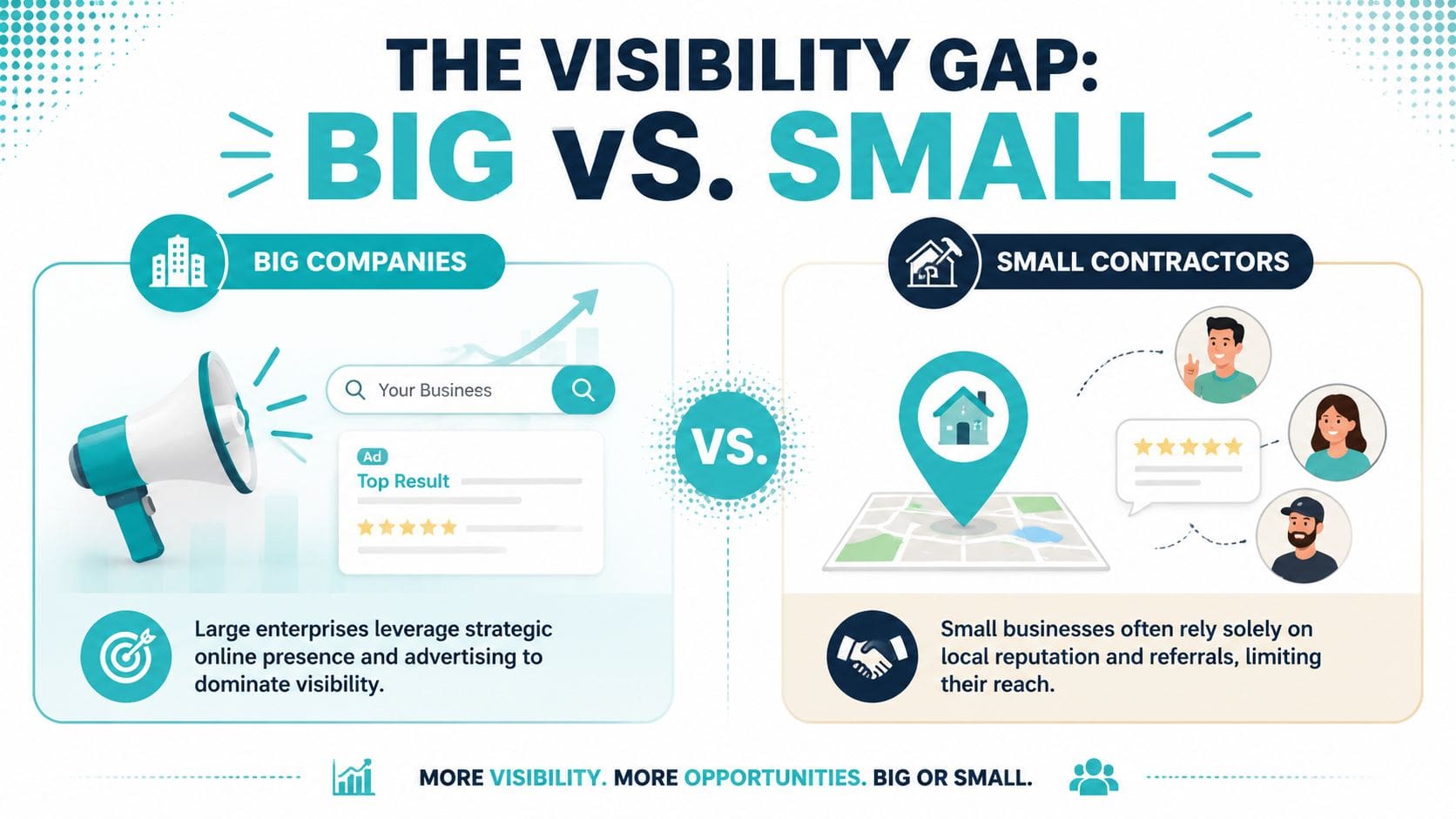
Hope is not a growth plan
Most small contractors rely on three things:
- Word of mouth
- Past customers
- Hope
That can keep you alive. It usually won't help you take over more territory.
When a larger competitor wants work in a nearby town, they don't cross their fingers. They put themselves in front of that town every day. They make sure buyers searching there see their name, their offer, and their phone number.
Here's the blunt comparison:
| Business type | How they get seen | What happens |
|---|---|---|
| Big company | Buys visibility across service areas | They show up where demand exists |
| Small contractor | Relies on referrals and a basic site | They disappear outside familiar territory |
Multi-city growth breaks weak websites
This gets worse when you want to expand past one city.
Typical web design advice talks about local keywords and city pages in a shallow way. It rarely deals with the fundamental problem contractors face, which is how to grow across nearby markets without turning the site into a pile of thin, repetitive pages. That exact blind spot is called out in Think Designs' review of essential website features.
If your site only reflects your home base, your growth stalls at your home base.
That's the visibility gap. You may already do the work in five, ten, or twenty surrounding places. But if your online presence doesn't clearly reflect that, buyers in those places will choose whoever does show up.
The Lead Machine A System Built for Calls
A contractor doesn't need “a website.” A contractor needs a Lead Machine.
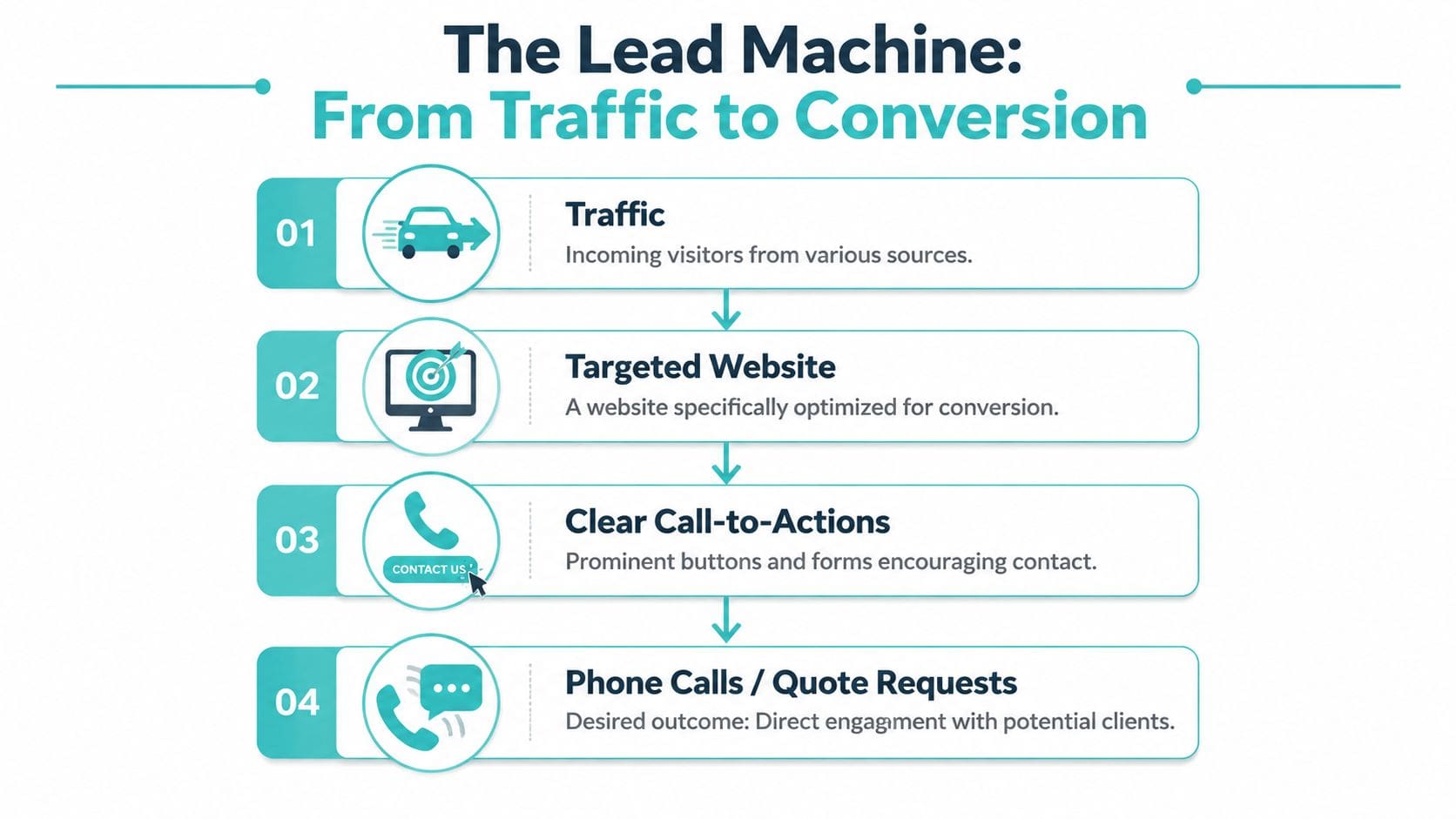
That means one thing. The site has a job. Its job is to turn traffic into calls and quote requests. Not compliments. Not longer visit time. Not someone saying, “Looks nice.”
What belongs in a lead-focused site
A lead-focused contractor site needs clear structure. Good guidance for small business website design starts with discovery, customer journey, site structure, then layout and content. It also recommends a lean core page set such as home, services, about, contact, and privacy policy, with trust pages like testimonials, case studies, and frequently asked questions added where needed, according to Big Red Jelly's small business website guidance.
For contractors, the important part is what that structure does:
- Service pages tell buyers what you do.
- City pages tell search engines where you do it.
- Clear calls to action tell people what to do next.
- Simple quote forms remove friction.
- Proof elements help buyers trust you quickly.
Speed and contact matter more than design awards
A real lead site also follows hard practical rules. Business-focused guidance recommends page load times under three seconds, strong and persistent calls to action, and simplified forms because those details improve search visibility and user engagement, according to Business.com's website design tips.
That's why a Lead Machine is built around speed, clarity, and contact. If a buyer lands on the page and can't tell where you work, what you do, and how to call, the page failed.
Some contractors also need cleaner phone handling once leads start coming in. If you're sorting calls by team, route, or location, this technical guide on implementing a PBX can help you understand the setup side.
One option in this category is The Cherubini Company's Lead Machine approach, which combines service-and-city structure, conversion-focused pages, and call-first design. The point isn't the label. The point is the system. Your website must be built as an asset that turns attention into real contact.
Fueling Your Machine with Paid Visibility
A machine without fuel doesn't move.
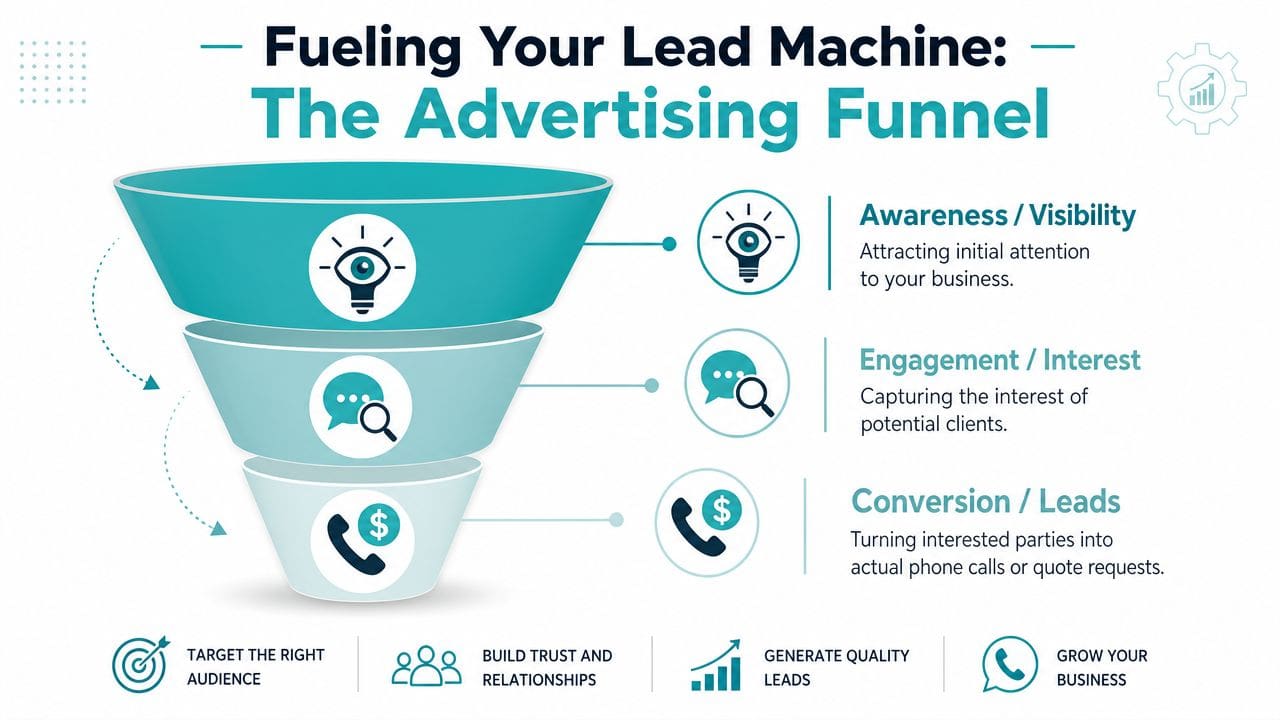
That's where ads come in. Ads are not magic. They are not a gamble when used correctly. They are the direct purchase of visibility from people searching right now in places you want work.
Why ads felt like a waste before
A lot of contractors say they “tried ads” and got nothing. That usually happened because the traffic had nowhere useful to go.
If you send paid traffic to a weak site, you don't have a lead system. You have a leak. The ad gets the click. The site loses the buyer. Then everyone blames the ad.
That's backward.
Ads don't fix a bad website. They expose it.
What paid visibility actually does
Paid visibility solves the problem referrals can't solve. It puts you in front of buyers outside your personal network and outside your hometown, right when they need the service.
A working setup looks like this:
- Ads create visibility: Your business appears in the markets you want to reach.
- The site handles conversion: The buyer lands on a page built to get the call.
- Tracking shows what happened: You stop guessing where leads came from.
This is how you stop treating marketing like luck. You buy attention in the right places and send that attention to pages designed to convert.
If you want to see how that fits together in practice, this page on fueling leads with Google Ads lays out the role ads play in a contractor lead system. The short version is simple. Websites without traffic sit still. Ads without conversion waste money. Together, they create controlled lead flow.
Take Control of Your Lead Flow and Your Business
Word of mouth is good. It's just not enough if you want control.
You can't scale hope. You can't schedule hope. You can't build a stable business around waiting to be remembered. That's why so many contractors feel busy and nervous at the same time. Work comes in, then it slows, then everyone scrambles.
Control starts with visibility
The contractors who feel the most pressure usually have the least control over where leads come from.
When you control visibility, a few important things change:
- You choose the markets: You don't stay trapped in one hometown.
- You build a repeatable pipeline: Not perfect, but far more stable than waiting on referrals alone.
- You stop guessing: Calls, forms, and service-area demand become easier to track.
A business with no lead system is fragile. A business with a real visibility system has options.
The website is the asset. The system drives the result
This is the part most agencies skip. A website alone is not the answer. Ads alone are not the answer. The answer is the system.
Your site must reflect the services you offer and the cities you want. It must make calling easy. It must support fast decisions from serious buyers. Then you put paid visibility behind it so the right people land there.
If you're comparing providers, review what a small business website design company should deliver for a contractor. Not fluff. Not branding talk. A structure built for visibility, calls, and service-area growth.
You think that customers can find you. But if customers don't find you, nothing else matters.
Lead Machines are built to fix that.
If you're done guessing and want a website built to turn visibility into calls, talk to The Cherubini Company. They build lead-focused websites and run paid visibility systems for contractors who want more control over where jobs come from.