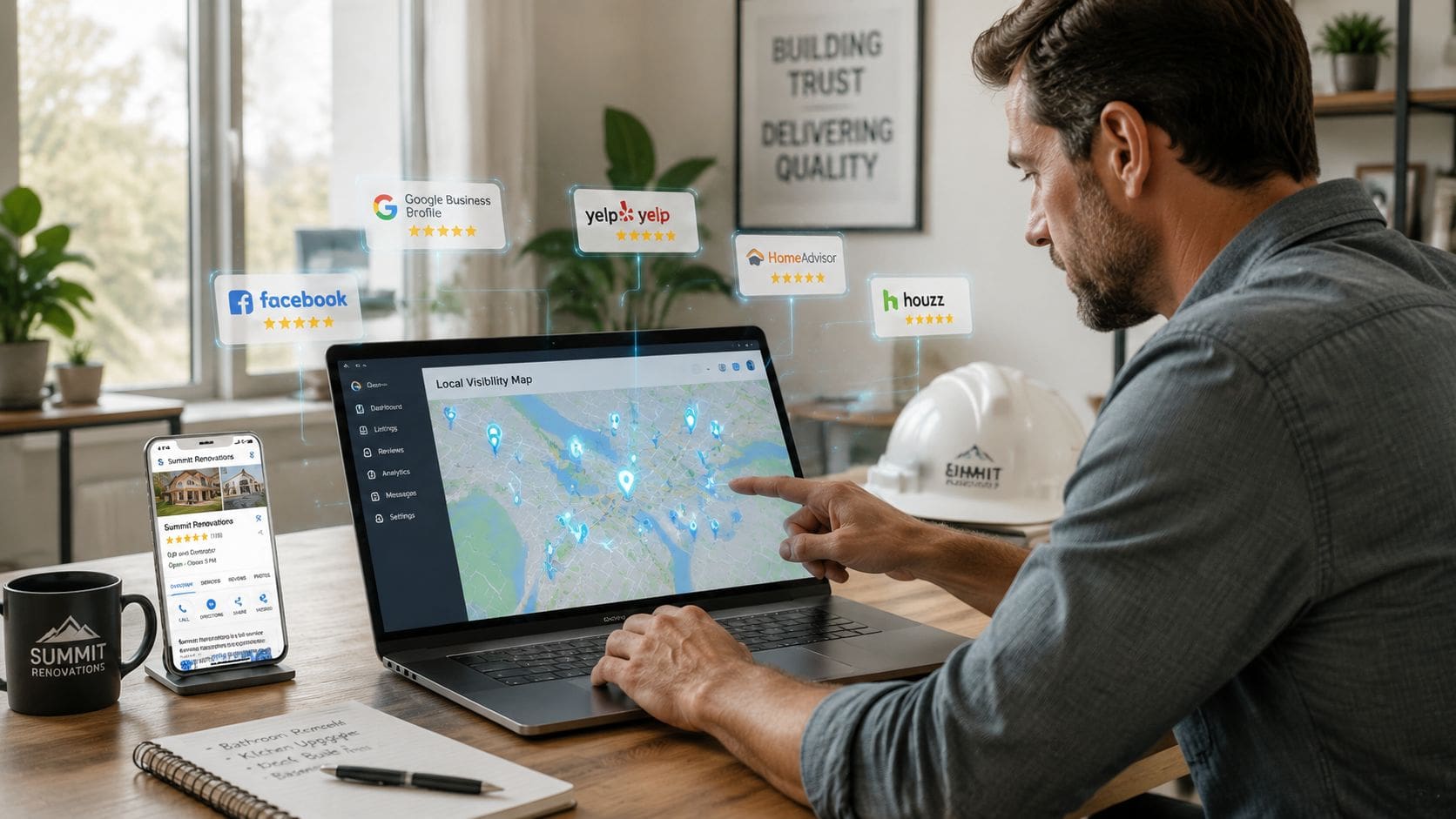
You’ve heard the pitch before.
Get your business on a bunch of free sites. Claim some profiles. Add your phone number. Wait for the calls.
Then nothing happens.
That’s why so many contractors think marketing is fake. They did the work. They followed the checklist. They signed up everywhere. The phone still didn’t ring. So they assume all of it is nonsense.
It isn’t nonsense. It’s just incomplete.
Business directory listings for local contractors matter. But treating them like the whole plan is a trap. Listings are one small part of visibility. If you’re invisible in the cities where searches occur, and your website just sits there like a dusty brochure, no directory on earth is going to save you.
Most contractors don’t have a work problem. They have a visibility problem. They’re known in their hometown. Then ten miles away, they disappear.
If customers search for what you do and don’t see you, you don’t get a shot at that job. That’s the whole game.
You Signed Up Everywhere But the Phone Is Still Silent
A lot of contractors get burned the same way.
Some agency or sales rep tells them to get listed on Yelp, Angi, and a pile of random sites nobody checks. It sounds smart because it sounds busy. There’s a login. A profile. A checklist. A report. It feels like progress.
It usually isn’t.

Being listed is not the same as being visible
Business directories have been around for more than a century, and one provider says it builds 100,000+ business listings every month according to this overview of the history and scale of business directories. That should tell you two things fast.
First, listings are real.
Second, they are crowded.
If thousands of businesses are doing the same thing at scale, “having a profile” alone doesn’t make you stand out. It makes you present. That’s not the same thing.
Practical rule: If a marketing task makes you feel productive but doesn’t increase qualified calls, it’s probably admin work dressed up as strategy.
A listing can help people confirm you exist. It can help search platforms trust your business details. It can support local discovery. Fine. But if your whole plan is “let’s get on more directories,” you’re working on the edges while the core problem stays untouched.
The real trap in directory advice
Most advice around business directory listings is about completion. Fill in every field. Add photos. Pick categories. Keep your phone number right. That’s all fine, and if you care about maximizing online brand discovery, accurate listings are part of the picture.
But contractors don’t need more busywork. They need more jobs.
That’s why I don’t tell owners to obsess over directory count. I tell them to look at whether they are visible where they want work, and whether those listings connect to something built to turn traffic into calls.
If you want a simple example of how listings fit into contractor visibility, this page on a local contractor directory shows the point. A directory isn’t the finish line. It’s one path people use to find and verify a business.
Here’s the hard truth:
- More profiles don’t fix weak visibility
- More listings don’t fix a bad website
- More citations don’t create demand
- More setup work doesn’t mean more revenue
A bad strategy with more volume is still a bad strategy.
That’s why the phone stays quiet after all that “listing work.” You didn’t fail. The plan did.
The Invisibility Gap Where You Lose Jobs Every Day
Most contractors think people can find them because the business shows up when they search their own name.
That’s not the test.
A key test is what happens when a stranger in the next town searches for the service, not your company name. That person doesn’t know you. They don’t care about your logo. They type in something like “excavation contractor near me” or “concrete contractor near me” and Google ties that search to the city they are standing in.
If your business only signals one hometown, Google has no reason to assume you work in the next city over.
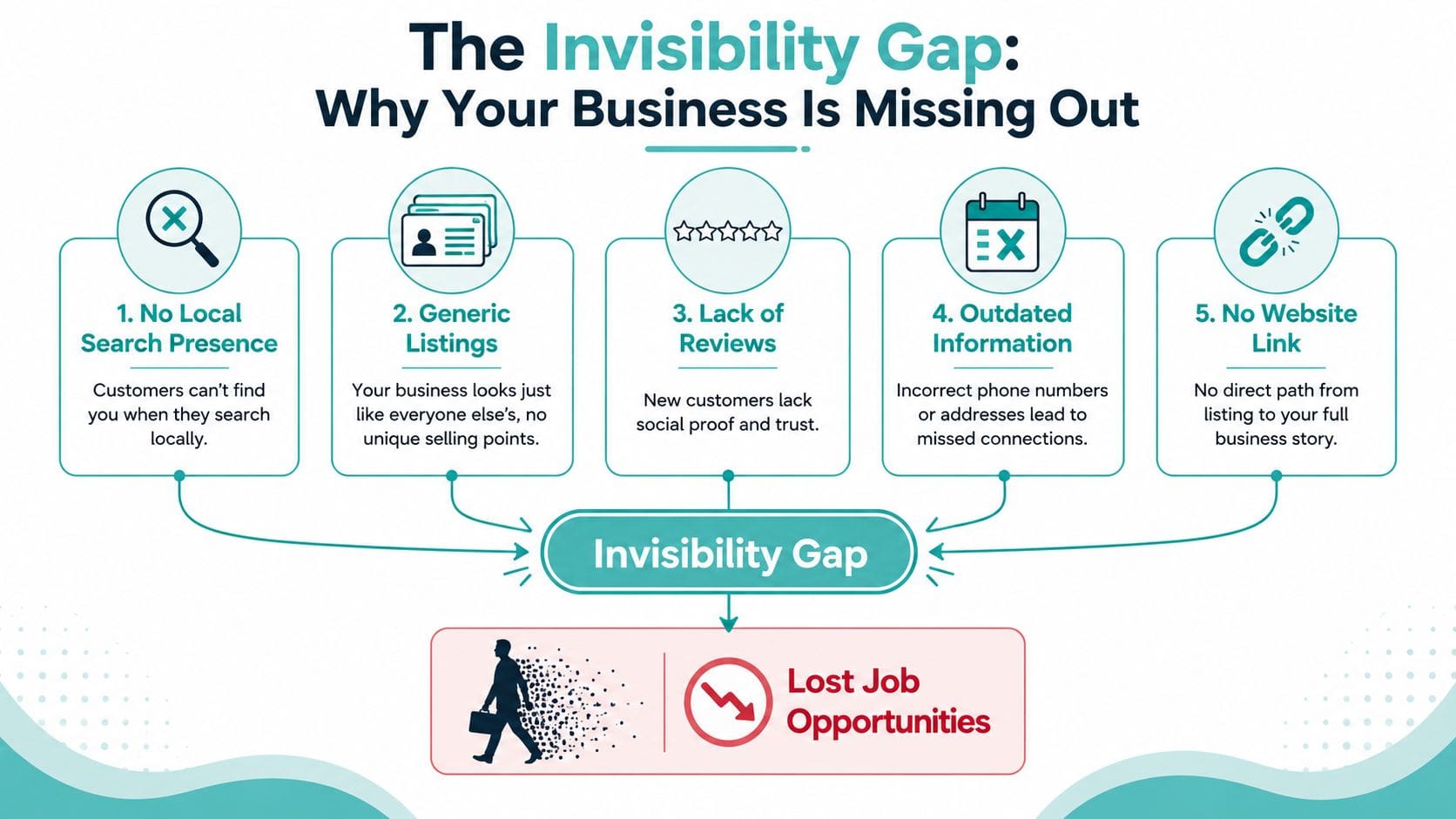
Near me does not mean near your office
Contractors get blindsided.
You might drive twenty miles for a job. You might serve half the county. You might be willing to go even farther for a solid ticket. But your online presence often tells a much smaller story. It tells Google, maps, and directory platforms that you belong in one place.
That creates a visibility gap.
You exist in real life across a broad service area. Online, you barely exist outside your home base.
People aren’t failing to hire you because they hate your work. They’re hiring someone else because they never saw you.
That’s why lead problems often feel random. They aren’t random at all. You’re visible in the town where your address sits, and invisible where a lot of buyers search.
What this costs you
The worst jobs to lose are the ones you never even knew about.
Not because you lost on price.
Not because your crews were too slow.
Not because another contractor had better equipment.
You lost because you never showed up.
Here’s what that looks like:
- Home city dependence means you get boxed into one market while nearby cities stay wide open for competitors
- Name-based thinking tricks you into believing customers can find you, when only people who already know you can
- Weak location signals cause search platforms to assume you don’t work in places you serve every week
- No city coverage leaves money sitting in towns where buyers are already searching for your service
If this sounds familiar, read this breakdown of why contractors don’t get enough leads. It gets straight to the point. Lack of leads is usually lack of visibility.
A website alone won’t fix that. A few business directory listings won’t fix it either. The issue is larger than one platform. Your business needs to be seen where buyers are looking.
That’s the difference between hoping for referrals and controlling demand.
Why Listings Alone Will Never Fill Your Pipeline
A business directory listing is a pointer. That’s all it is.
It points to your phone number, your address, your reviews, or your website. If the listing gets seen by the right person, great. But a pointer is not a pipeline.
That’s where contractors get sold nonsense. They’re told the listing itself is the strategy. It isn’t.
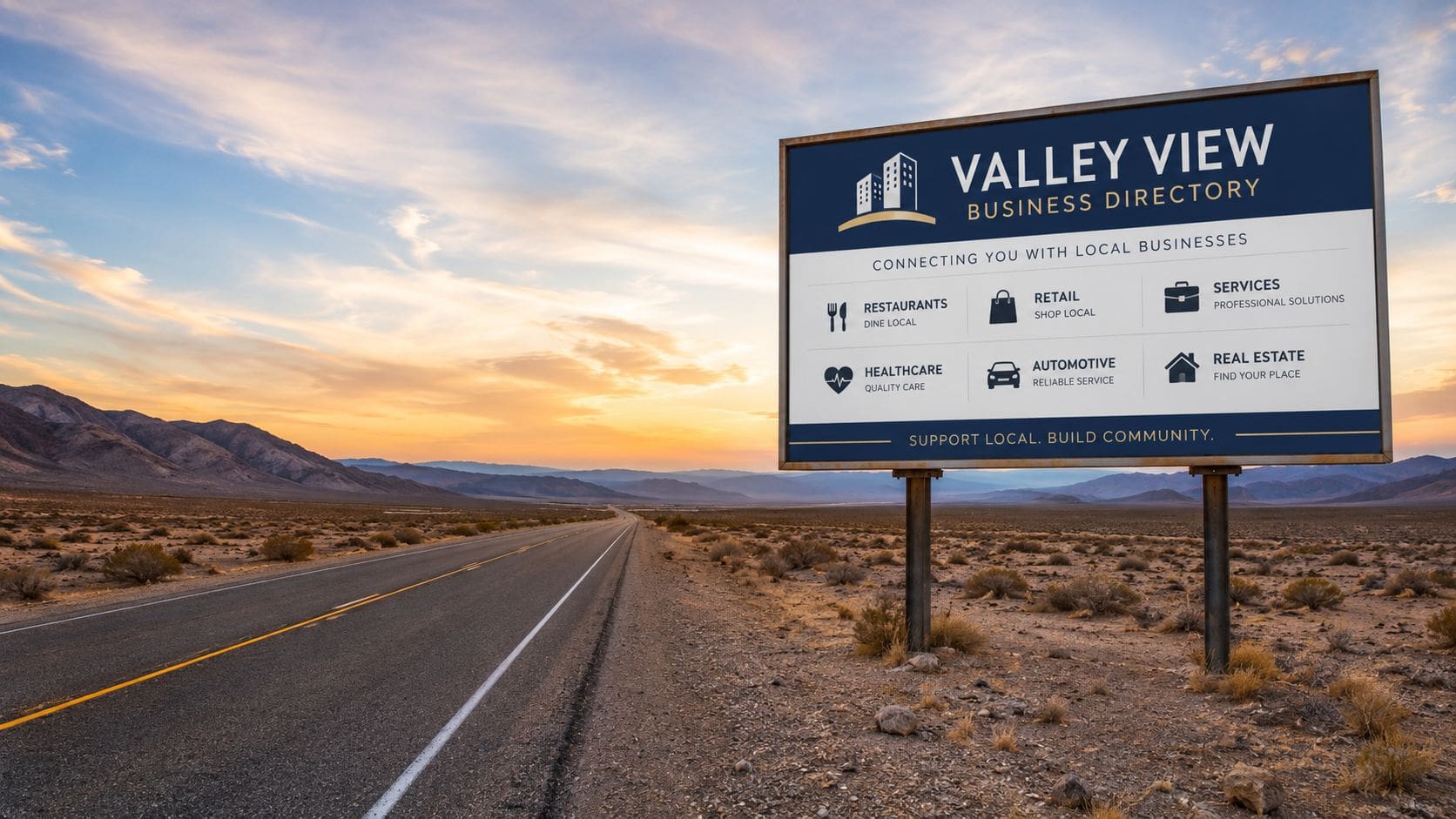
A listing without traffic is a road sign in the desert
You can put up the cleanest sign in the world. If nobody drives past it, nothing happens.
Same thing here.
A listing only helps if people see it. Then it only matters if the next step is clear. If they click through to a weak site, hit a vague homepage, can’t tell what cities you serve, or don’t know what to do next, the lead dies right there.
That’s why I keep saying websites don’t create traffic. They wait for it.
And most contractor websites wait badly.
The wrong goal is more citations
One source says the biggest mistake in directory guidance is focusing on citation count instead of lead quality, because most directories drive low-value traffic instead of real jobs in specific service lines and cities, as noted in this article on why directory strategy should focus on better business leads.
That lines up with what contractors already know in their gut. Not all leads are equal.
A cheap tire kicker from a random directory is not the same as a real buyer looking for your service in a city you want. One wastes your estimator’s time. The other grows the business.
Here’s the simple breakdown:
| What you have | What happens |
|---|---|
| Directory listing only | You might get found, but not consistently |
| Website only | It sits and waits |
| Listings plus weak website | You leak leads |
| Visibility plus a site built for calls | You get a system |
If you want help understanding how listings fit into the bigger picture, this page on local citation building is useful. The key is fitting citations into a revenue plan, not treating them like the plan itself.
Hard truth: A contractor doesn’t need “more internet presence.” A contractor needs more qualified buyers landing in the right place and taking action.
That’s why listings alone never fill the pipeline. They can support visibility. They do not replace a machine built to turn visibility into jobs.
The System That Makes Big Companies Visible Everywhere
Big companies don’t win because they know a secret keyword.
They win because they build systems.
They decide where they want work. They make sure they show up there. Then they route that attention into a website built to make the phone ring. After that, they add paid traffic so they’re not sitting around hoping somebody stumbles across them.
That’s not hype. That’s basic control.
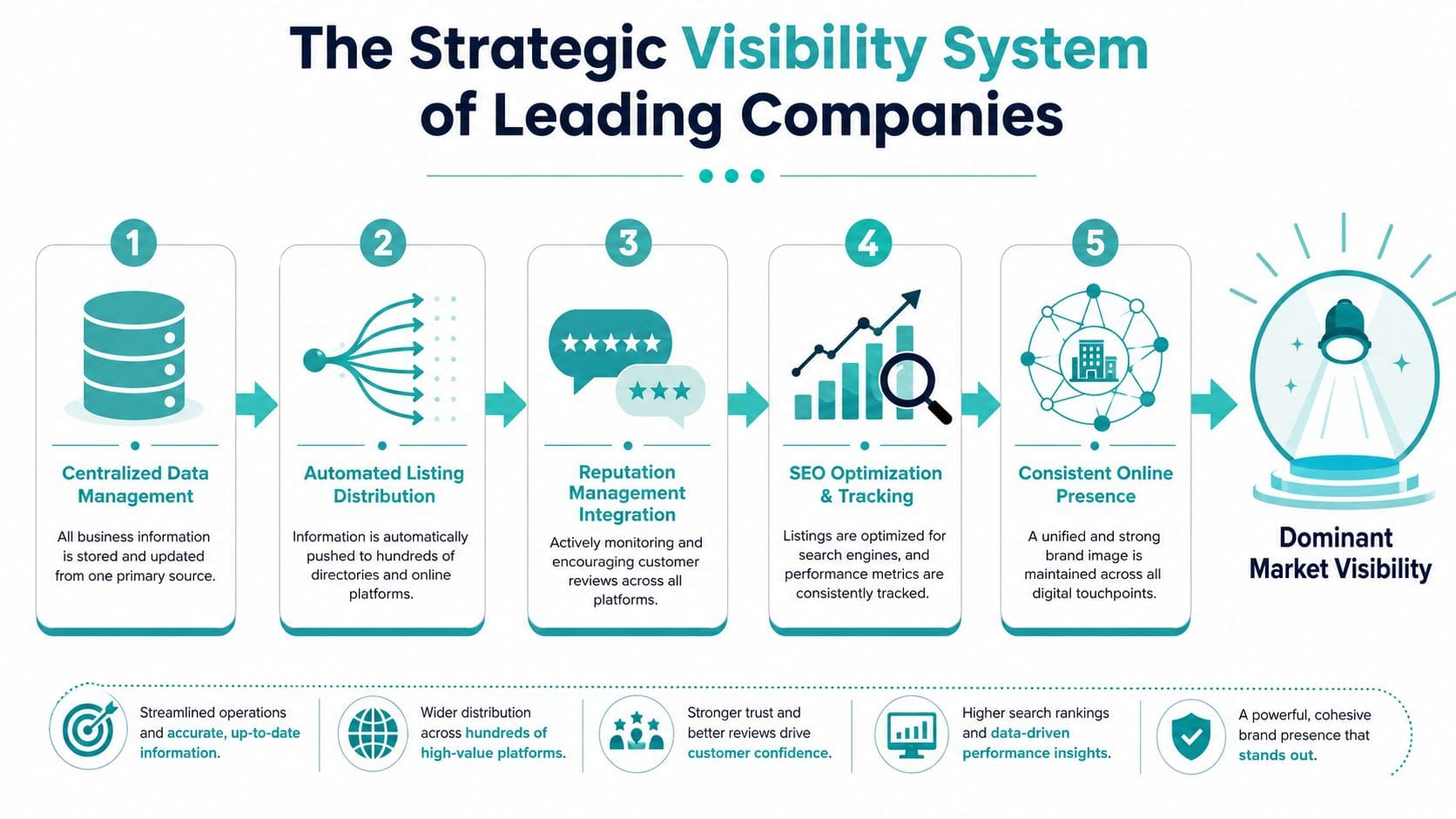
Real visibility is built in layers
A technically sound directory workflow uses a tiered strategy. It starts with major platforms like Google Business Profile, Bing Places, Apple Maps, and Facebook Business, then expands to other quality listings, with ongoing review and maintenance, according to this guide on structured directory workflows in 2026.
That matters because it proves something important. Serious visibility is structured. It is not “sign up on a few free sites and call it done.”
A real system usually includes:
- Core platforms first because the main ecosystems shape how buyers find and verify you
- Accurate business data so your business identity stays consistent across maps, listings, and search results
- Location coverage so your service area is visible beyond your office address
- A conversion asset which means a website built to get calls and quote requests, not just sit there
- Paid visibility so you appear in front of buyers searching right now
Why smaller contractors stay stuck
Most small contractors are not losing because they don’t work hard. They’re losing because they rely on hope while larger competitors buy visibility on purpose.
That’s the difference.
One business says, “We have a website, so people can find us.”
The other says, “We want work in these cities, for these services, and we are going to show up there.”
If you care about measurement, people need to connect marketing channels to revenue instead of counting random activity. If a listing, ad, or page doesn’t help produce calls, forms, and booked work, it’s just motion.
You can also see the general idea behind this approach in what a Lead Machine is. The point isn’t fancy marketing. The point is control.
Bigger companies don’t wait to be found. They build the conditions that make finding them easy.
That’s the system most contractors are missing. Not effort. Not talent. Not grit. System.
Turning Visibility Into Predictable Jobs With a Lead Machine
This is the part most owners should have been shown first.
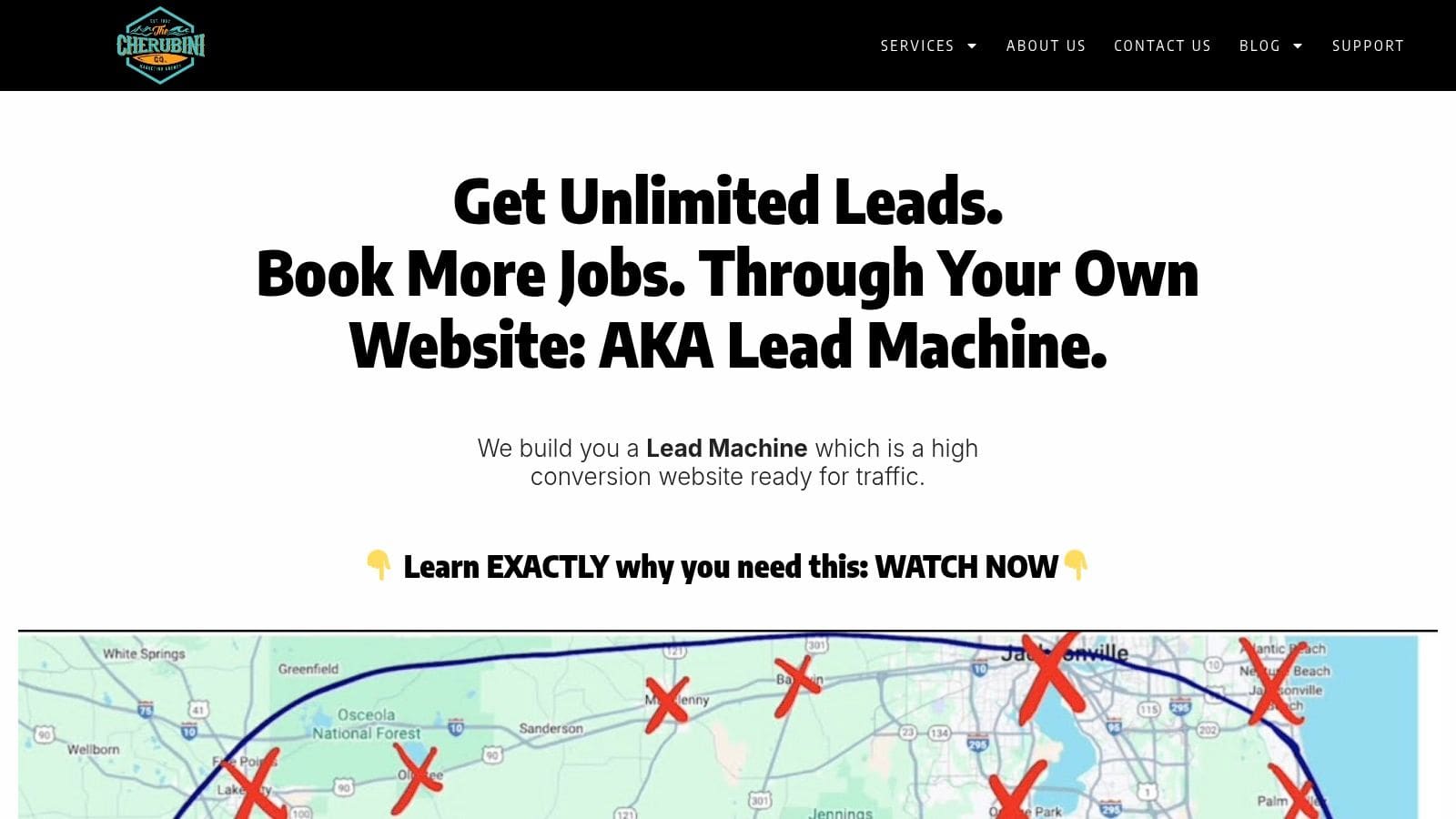
A Lead Machine is a two-step system built for one job. Get seen. Turn that visibility into calls.
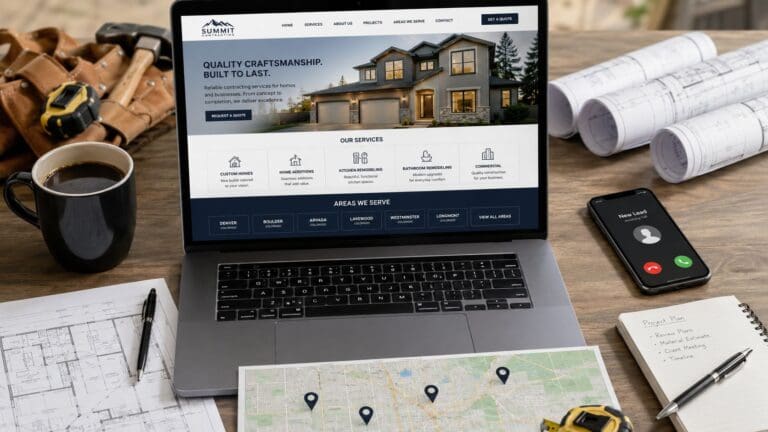
Step one is the machine itself. That means a website built around your services and the cities you want work from. It is not a pretty brochure. It is built to rank, convert, and capture demand. It needs clear calls to action, mobile design, fast load speed, quote forms, call routing, tracking, and alignment with your business listings.
Step two is the fuel. That means paid ads that put you in front of local buyers who are searching now.
Why this works when random marketing fails
Contractors get into trouble when they buy one half of the system.
They buy a website with no traffic.
Or they buy ads that point to a bad site.
Or they pay for leads they don’t control.
Or they throw time at business directory listings and expect that to replace strategy.
That’s why results are all over the place.
A Lead Machine fixes the actual problem. It gives traffic somewhere useful to go, and it gives your business coverage beyond the single city where your shop sits. It is built for service-plus-city visibility, not generic presence.
What to look for
If you’re comparing options, keep it simple.
- You need an asset you control. Not rented leads. Not a marketplace profile that can dry up tomorrow.
- You need city reach. If you work outside your hometown, your online presence needs to reflect that.
- You need traffic on purpose. Buyers searching right now should see you.
- You need clear conversion paths. Calls, forms, and next steps should be obvious.
- You need transparency. Flat rate beats mystery fees and vague reports.
One option in this category is The Cherubini Company’s approach to turning your website into a Lead Machine. The idea is straightforward. Build the site to generate leads, then fuel it with paid visibility.
That’s a much cleaner model than hoping a directory profile, a generic homepage, or some agency report will somehow fix your pipeline.
Bottom line: Ads create visibility. The Lead Machine turns that visibility into calls. You need both.
If customers can’t find you, nothing else matters. Not your workmanship. Not your reviews. Not your equipment. Not your reputation in your hometown.
You think customers can find you. But if customers don’t find you, you never get the chance.
Lead Machines are built to fix that.
If you’re tired of guessing and want a clear visibility system that brings in real local leads, talk to The Cherubini Company. They build Lead Machines for contractors who need to show up in the right cities, get more calls, and stop relying on hope.