
You've probably said some version of this already.
“We tried a website.”
“We ran ads once.”
“That's what the last agency said.”
“We got burned.”
“I don't believe any of this anymore.”
Fair.
Most contractors don't have a work ethic problem. They have a visibility problem. They're known in their hometown. People there know the truck, the name, maybe even the family. But go ten miles out, into the next town where they also do work, and they vanish.
That's where the jobs leak out.
A homeowner doesn't search your business name if they've never heard of you. They search for what you do and where they need it. When someone types “near me,” Google turns that into the city they're standing in. If your business only clearly shows up for your home city, then Google has no reason to think you work anywhere else. That job goes to the contractor who showed up.
This is why so many small business owners hire a small business website design company and still end up angry. They bought a site. They did not fix visibility. Those are not the same thing.
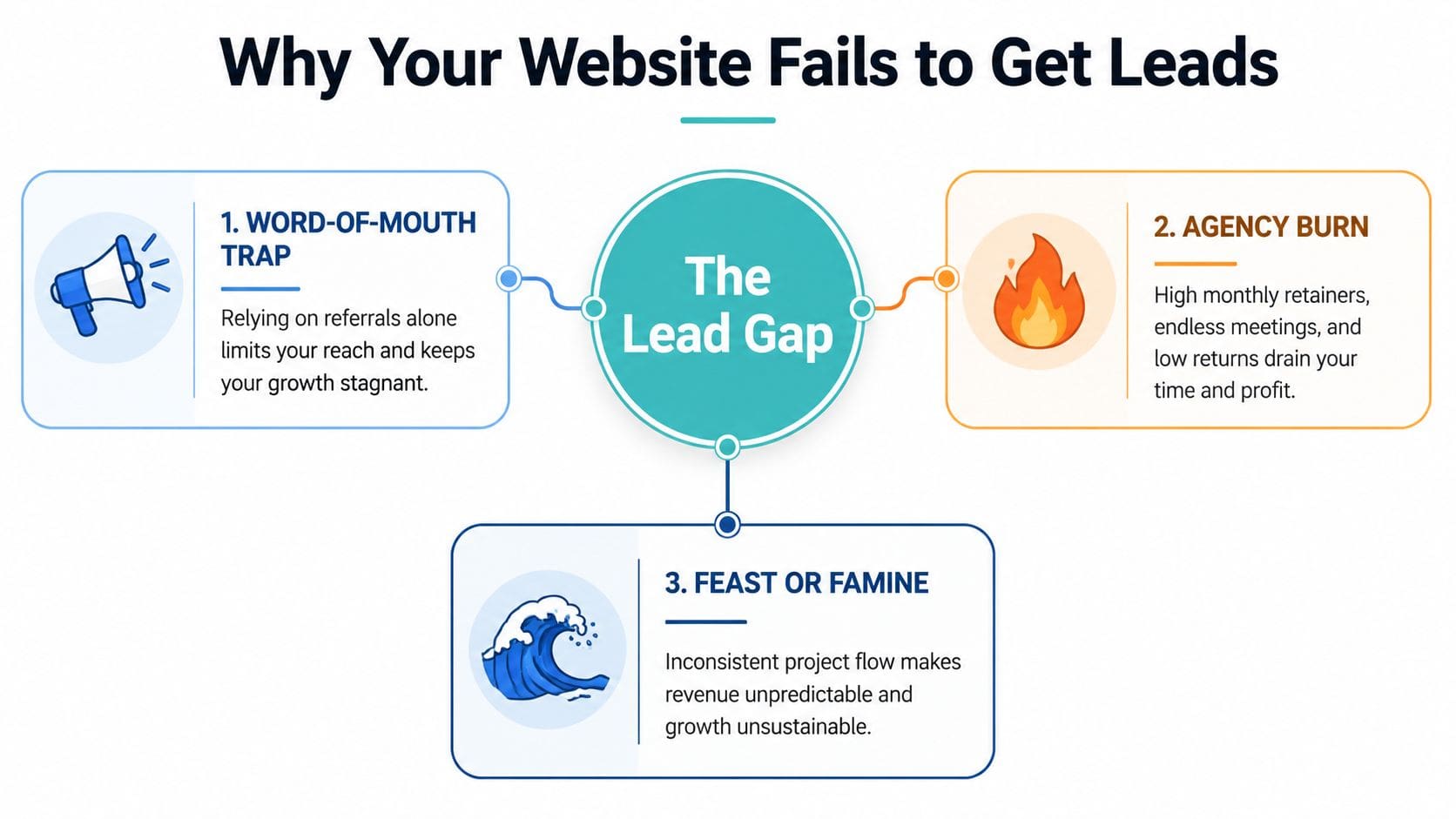
Why Your Website Fails to Get Leads (It's Not What You Think)
You finish a job in one town, drive twenty minutes, and pass three houses that need the exact service you sell. The owners will never call you. Not because your work is bad. Not because your prices are wrong. They will never call because they never see you when they search.
That is why your website feels useless.
A contractor website usually fails for a simple reason. It is sitting online with no system behind it. No clear service-area targeting. No traffic plan. No path that turns a stranger in a nearby town into a phone call.
Most website companies keep selling the wrong deliverable. They sell a design project. You need lead flow.
The issue is visibility in the towns you actually serve
Here's the pattern.
Your company may be known in Newark because that is where your shop is, where your trucks are seen, and where word of mouth has had time to build. But you also want jobs in Granville, Heath, Pataskala, Zanesville, Lancaster, and every other town your crew drives to. If your website barely mentions those places, search engines have no reason to connect you to those searches.
Google is not a mind reader. It matches what people search with what your site clearly says.
If your pages only talk about one city, then your business gets boxed into one city. Every nearby town you service but do not clearly target becomes a blind spot. A homeowner searches. Another contractor shows up. You lose before anyone compares reviews, photos, or pricing.
That is the problem contractors keep misdiagnosing. They think the site failed because it did not magically "generate leads." The site failed because it did not make them visible where the money is.
Why common website advice misses the point
Contractors get fed a lot of weak advice.
Add better photos. Rewrite the headline. Use a brighter button. Clean up the layout. Those things can help at the margins, but they do not fix a service-area visibility problem. A polished site that does not show up in the right towns is still invisible.
The better question is blunt and simple. Will this site help you get found for the services you want to sell in the places you want to work?
That is why so many hires go bad. A contractor asks for a website. The agency delivers pages. Nobody builds the actual lead system. Nobody maps services to towns. Nobody sets up the path from search or ads to call. Then six months later the contractor is angry, and rightly so.
The outside article already in this section makes the same broad point from another angle in this article on why small businesses struggle with DIY websites and agency help. The site has to be built to produce inquiries, not just exist online.
If you want the blunt version, this breakdown of why lead gen websites suck in leads explains why contractor sites stall out.
Your website was never supposed to work alone
This is where a lot of frustration starts.
You paid for a site, so you expected the site to bring in business by itself. That expectation is what keeps contractors stuck. A website is an asset. It needs targeted traffic. It needs city and service pages that match buyer intent. It needs ads feeding it if you want control instead of hope.
Without traffic, the site waits.
Without the right structure, paid traffic gets wasted.
Without both, you own a brochure with a contact form.
Stop asking whether you need a better website. Ask whether you have a Lead Machine. That means a site built around services, towns, and conversion, then fueled by ads so you are not sitting around waiting for referrals to save the month.
What contractors keep getting wrong
These mistakes show up over and over:
- They confuse being known with being searchable. Your hometown knows you. Nearby towns often do not.
- They rely on word of mouth to cover service-area gaps. It works until it doesn't, and then the schedule gets thin fast.
- They blame the site when the actual problem is no traffic strategy. A page cannot convert visitors who never arrive.
- They hire for looks instead of lead flow. A nice design does not fix invisibility.
- They expect one asset to do every job. The website is the machine. Ads are the fuel.
That is the hard truth. You do not need another redesign sold with fancy mockups and vague promises. You need control over where you show up, who lands on your pages, and how those visits turn into calls.
Anything less is digital paperwork.
The Difference Between a Brochure Site and a Lead Machine
You serve five or six towns. Your trucks go there every week. Your crew knows the roads. But when a homeowner in the next town searches for your service, you do not show up. A competitor with a weaker reputation gets the call because they are visible and you are not.
That is the invisibility gap.
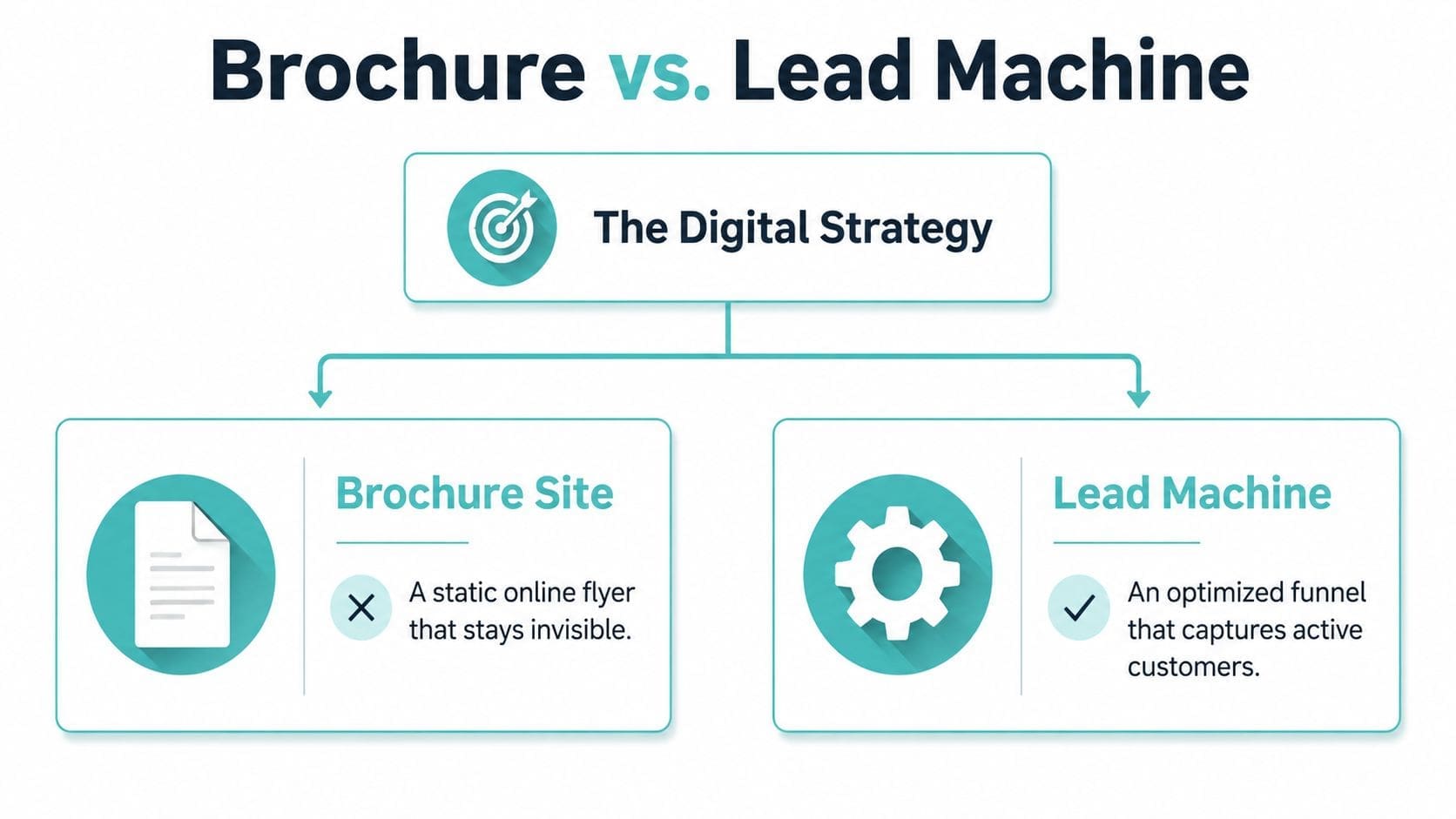
A brochure site does nothing to close it. A Lead Machine is built to close it on purpose.
What a brochure site does
A brochure site acts like digital paperwork. It lists your company, shows a few photos, adds a contact form, and calls that marketing.
That setup fails contractors every day.
It does not target the jobs you want most. It does not map your services to the towns that need coverage. It does not guide a visitor from search to trust to call. It just sits there, available but weak.
A lot of web companies sell this because it is easy to produce. One home page. One generic services page. One gallery. One contact page. Clean design, thin strategy.
You do not need that.
What a Lead Machine does
A Lead Machine is a website built to capture demand in the towns you serve, then fed with ads so you control lead flow instead of waiting for referrals.
That is the whole model.
The site is structured around real buying intent. Each core service gets its own page. Each target town gets its own page when it makes business sense. The message matches what the buyer searched for. The page answers the right questions fast. The call button is obvious. The form is easy to complete. The next step is clear.
Then ads put traffic into that system.
Without ads, you are waiting on Google to eventually notice you. Without the right pages, ad traffic hits a weak site and disappears. Contractors lose money both ways.
Visibility gets the click. Structure gets the call.
The real difference
The difference is not design style. It is job function.
| Type | Job | Result |
|---|---|---|
| Brochure site | Displays basic company info | Looks fine, brings little control |
| Lead Machine | Matches services, towns, and buyer intent | Produces calls and form fills |
| Ads sent to a weak site | Buy attention without conversion structure | Spend goes out, leads do not come back |
| A decent site with no traffic plan | Waits to be discovered | Stays quiet in the towns you want |
If you want a clearer side-by-side breakdown, read this explanation of a lead generation website vs brochure website for small businesses.
What has to be built into the machine
A Lead Machine does a few specific things well. Miss any of them and performance drops.
- Service pages match the exact work the buyer wants.
- Town or service-area pages help you show up where you want more jobs.
- Clear calls to action turn interest into calls, form fills, and booked estimates.
- Mobile-first layout makes it easy to contact you from a phone, which is where a lot of service searches happen.
- Fast load times keep impatient buyers from backing out.
- Ad landing paths give paid traffic somewhere relevant to go.
This is the part contractors often miss. The website is not the finished product. It is the machine. Ads are the fuel source that lets you choose where visibility happens and when.
Why contractors feel stuck
You already know you do good work. That is not the problem.
The problem is that your market does not reward good work it cannot see.
If your website talks broadly about your company but says nothing useful about drain cleaning in one town, panel upgrades in another, or roof repair in a third, you stay invisible in the places that should be feeding your schedule. That is why some months feel random. You are depending on leftovers, repeat customers, and luck.
A Lead Machine fixes that by giving you coverage, control, and a direct path from search to call.
Everything else is decoration.
How to Vet a Website Design Company and Avoid Getting Burned Again
You already know how this call usually goes.
A web company asks what colors you like, shows a few pretty layouts, says they “build for growth,” and sends a proposal that sounds polished but says almost nothing. Six months later, your site still doesn't show up in the nearby towns you serve. The jobs go to the company that looks easier to find.
That is the invisibility gap.
If you want to stop getting burned, stop shopping for a website and start screening for a company that can build a lead system you control. That means pages built for the right services, coverage in the towns you want, and a plan to turn ad traffic into calls.

Ask questions that expose whether they understand lead flow
Do not waste time asking about their “creative process.”
Ask the questions that reveal whether they know how contractors get work.
- How will you help me show up in the towns where I want more jobs?
- What pages will you build for each service and each service area?
- How will paid ads connect to the website?
- What happens after someone clicks an ad or finds a page?
- How do you track calls, quote requests, and booked estimates?
- Who owns the website, domain, and content after launch?
- What support do you provide after the site goes live?
Those questions force a real answer.
If they cannot explain how a homeowner in a nearby town goes from search or ad click to phone call, they do not have a system. They have design software.
Make them explain traffic and conversion in plain English
A decent-looking site helps credibility. That is obvious.
What matters more is whether the company can explain how your site gets found and what happens next. If they talk only about branding, mockups, and animations, you are hearing the pitch for a brochure site. A contractor needs a machine that takes traffic from Google Ads, Local Services Ads, branded search, and service pages, then pushes that visitor to call or request an estimate.
Ask this directly: How will this website help me get more of the jobs I want in the towns I already serve?
Then stay quiet.
A serious company will talk about service pages, town pages, call paths, forms, tracking, and ad landing pages. They will not hide behind jargon. If you want a benchmark for what a real build should include, review these website design packages for small business and compare them against any proposal you get.
Red flags that should end the call
Some mistakes are obvious. Others sound professional until you look closer.
They lead with visuals
If the first part of the meeting is mostly fonts, colors, and homepage style, they are solving the wrong problem.
Your issue is not that the blue is wrong. Your issue is that you are invisible in towns ten minutes away.
They act like the website alone will “start bringing in leads”
That claim burns contractors all the time.
A website is the asset. Visibility comes from search coverage and paid traffic. If they do not talk about ads, service area targeting, or how the site supports campaigns, they are leaving your lead flow to chance.
They avoid ownership questions
You should own the domain, the content, the images you paid for, and the site files where that applies.
If they keep control of everything, they keep control of your future. That is how contractors get trapped.
They cannot explain reporting simply
You do not need a wall of charts.
You need to know how many calls came in, which pages or campaigns produced them, and whether those leads came from the towns you care about. Clear reporting matters in every business. Even firms outside home services, including Hire Accountants, depend on straightforward lead tracking instead of vague “visibility” talk.
They promise outcomes they do not control
Anyone can promise rankings. Anyone can promise a flood of leads.
Serious companies promise work, process, tracking, and accountability. That is what can be controlled.
What a useful vetting call sounds like
A good company will ask tougher questions than a weak one.
They will ask which jobs make you real money, which towns are worth targeting first, what your office can handle, how fast you answer leads, and whether you want calls or quote forms first. They will ask what ads you run now, what happened with past marketing, and where jobs are slipping through the cracks.
That is the conversation you want.
It deals with coverage, control, and lead quality. It treats the website as part of a revenue system, not a one-time design project.
Hire the company that tells you the uncomfortable truth
You do not need another friendly salesperson telling you your current site “just needs a refresh.”
You need someone willing to say the actual problem out loud. You are losing work in nearby towns because your business is not visible there, and a generic site will not fix it. A company worth hiring will tell you that your website must support targeted pages, clear conversion paths, and paid traffic if you want steady lead flow you can control.
Comfort is expensive.
Clarity makes money.
Decoding the Proposal What Should Be in the Contract
A bad contract is how contractors end up paying for a website and still staying invisible in the towns right outside their own office.
You sign for “design.” You get a prettier homepage. Then the ads start, traffic lands, and the site has no pages for the services and towns you want to win. That is not a marketing asset. It is a delay tactic with a monthly invoice attached.
The contract needs to describe a lead system in plain English. If your office manager cannot read it and tell you exactly what is being built, what is included, what you own, and how leads will be tracked, the proposal is weak.
Scope decides whether this thing can produce leads
Price is the easiest number to stare at and the worst place to start.
Start with coverage. If you serve six towns and the proposal only includes a home page, an about page, and one generic services page, you already know what will happen. You will stay invisible in five of those towns unless you keep paying for traffic with nowhere precise to send it.
Cheap website deals usually leave out the pages and tracking that make ads work. Then the change orders begin. New page fee. Form setup fee. Call tracking fee. Copywriting fee. Location page fee. The low quote was never low. It was incomplete.
A real proposal should spell out the build the same way a solid estimate spells out labor and materials.
What the contract should list, line by line
Vague package names are useless. You want deliverables.
The contract should name the actual parts being built:
- A homepage with one job. Direct the visitor to call, request a quote, or book.
- Separate service pages. One page for each service you want to sell.
- Separate town or service area pages. One page for each nearby market you want to show up in.
- Click-to-call buttons on mobile. No hunting for the phone number.
- Short quote forms. Friction kills leads.
- Mobile-first layout. Contractors lose calls fast when a site is clumsy on a phone.
- Call tracking and form tracking. You need proof, not guesses.
- Google Business Profile alignment. Your website, service areas, and business details need to match.
- Landing pages for paid traffic. If ads are part of the plan, the contract should say where those clicks will go.
If you want a reference point, review website design packages for small business lead generation. The point is not to copy a package title. The point is to compare scope and see whether your proposal is building a brochure or a Lead Machine.
Lead Machine vs Standard Website Deliverables
| Deliverable | Lead Machine (Required) | Standard Website (Often Missing) |
|---|---|---|
| Service pages | Yes | Often limited or combined |
| City pages | Yes | Often missing |
| Click-to-call buttons | Yes | Sometimes inconsistent |
| Quote forms | Yes | Sometimes basic or hidden |
| Mobile-first layout | Yes | Not always treated as priority |
| Speed work | Yes | Often vague |
| Tracking for calls and forms | Yes | Often missing |
| Google Business Profile alignment | Yes | Often ignored |
| Clear conversion path | Yes | Often weak |
| Built for paid traffic | Yes | Rarely considered |
Ownership and access belong in writing
Many contractors get trapped here.
The company builds the site on an account you do not control. They own the hosting login. They hold the domain. They keep the form submissions inside their software. Then you stop working with them and find out your “website” was rented, not owned.
Put this in the contract:
- You own the domain
- You get admin access to the website
- You get hosting access or clear transfer terms
- You keep your content, images, and page files
- You keep your tracking data
- You keep your call recordings and form history, if those tools are part of the setup
If ownership is fuzzy, the relationship can turn ugly fast.
Watch the pricing model closely
Flat-rate build pricing is usually cleaner than lead-selling arrangements.
If somebody sells you leads one at a time, they control your pipeline. They can raise prices, lower quality, pause delivery, or send the same lead to three competitors. You are not building visibility in your service area. You are renting scraps of attention.
A website contract should tell you what gets built, what it costs, what ongoing fees exist, and what happens after launch. Hosting, edits, tracking software, ad management, and support should all be separated clearly. Mixed together, they hide margin and create confusion.
Good contracts define scope, ownership, access, tracking, and support after launch.
“Done” needs a checklist, not a shrug
Do not accept “we'll know when it's ready.”
Completion should be specific and easy to verify:
- All agreed pages are live
- Town pages are published
- Phone buttons work on mobile
- Forms submit to the right inbox
- Tracking is active
- Thank-you pages or conversion events are set
- Basic speed and mobile checks are complete
- You have your logins
- You know how leads will be reviewed every month
That last point matters. A website without review is just another thing you hope is working.
And growth creates back-office pressure. More leads mean more estimates, invoicing, payroll questions, and bookkeeping cleanup. If your numbers are a mess, fix that too. Hire Accountants is a practical resource for finding accounting support that can keep up when lead flow improves.
Do not sign a contract that sells you “web design.” Sign one that builds visibility in the towns you serve and gives you control over the machine after it goes live.
Take Control of Your Leads and Stop Guessing
Most contractors stay stuck because guessing feels normal.
They rely on word of mouth. They take whatever comes in. They get busy, then slow, then busy again. They call it the market. A lot of the time, it's just lack of control.
That is the actual issue.
You don't control revenue if you don't control visibility. And you don't control visibility if your business only shows up where people already know your name.

Hope is not a system
A lot of small contractors still operate like this:
- They wait for referrals
- They hope past customers talk
- They assume the website will somehow help
- They avoid ads because it feels risky
- They lose jobs in towns they serve because they never show up there
Meanwhile, bigger companies buy visibility on purpose.
That doesn't make them smarter. It makes them easier to find.
If you want better jobs, more control, and less panic, you need a system that does two things well. It makes you visible in the right places, and it turns that visibility into calls.
The simple choice in front of you
You really have two options.
The first is to keep doing what most contractors do. Keep the old site. Keep hoping. Keep wondering why the phone goes quiet even though your work is solid.
The second is to install a system. Build the website around services and cities. Add clear contact paths. Make sure it loads fast and works on a phone. Then feed it traffic with ads so buyers land on it.
That second path is how you stop guessing.
You are not trying to win the internet. You are trying to be found when a buyer in the next town needs your service.
What control feels like
Control does not mean every week is perfect.
It means you are no longer blind.
It means you know where your leads are supposed to come from. It means your website has a job. It means your ads have a destination. It means you are building an asset instead of renting scraps.
That changes how you run the business.
You can stop chasing every tiny job. You can aim at better work. You can expand into nearby towns with purpose. You can stop acting surprised when the pipeline gets thin, because now you have a way to do something about it.
The hard truth
If you've been burned before, fine. Be skeptical.
But don't let old bad deals keep you stuck with an invisible business.
The internet does not reward the best contractor. It rewards the contractor the buyer finds first, trusts fast, and can contact easily. If your current setup doesn't do that, then it's not working, no matter how nice it looks.
You think that customers “can” find you but, If customers “don't” find you, nothing else matters. Lead Machines are built to fix that.
If you want a straightforward strategy instead of guessing, The Cherubini Company helps contractors address the core problem. Visibility. They build Lead Machines and pair them with ads so your business can show up in the cities where you want work and turn that attention into calls.