
You’re probably in one of these spots right now.
You paid for a website and got a nice-looking brochure that never made the phone ring. You tried ads and decided ads “don’t work.” You sat through meetings with agencies that talked in circles, showed mockups, and left you with less money and no control.
We hear the same things over and over.
“We’ve tried running ads and they didn’t work.”
“That’s what the other agency said.”
“We’ve been burned before.”
“I don’t believe you.”
Fair enough. Most contractors have every reason to be skeptical.
If you own a service business and you need more calls, bigger jobs, and a wider service area, your problem usually isn’t effort. It’s invisibility. You might be known in your hometown. But ten miles away, when someone searches for the work you do, you’re nowhere.
That’s the whole game.
A website designer in Licking County should help you get seen where buyers are searching. If they don’t, they’re not addressing the core problem.
Why Most Licking County Contractors Waste Money on Websites
The hard truth is this. Most contractors didn’t buy the wrong website. They bought the wrong thing entirely.
They bought design.
They needed leads.
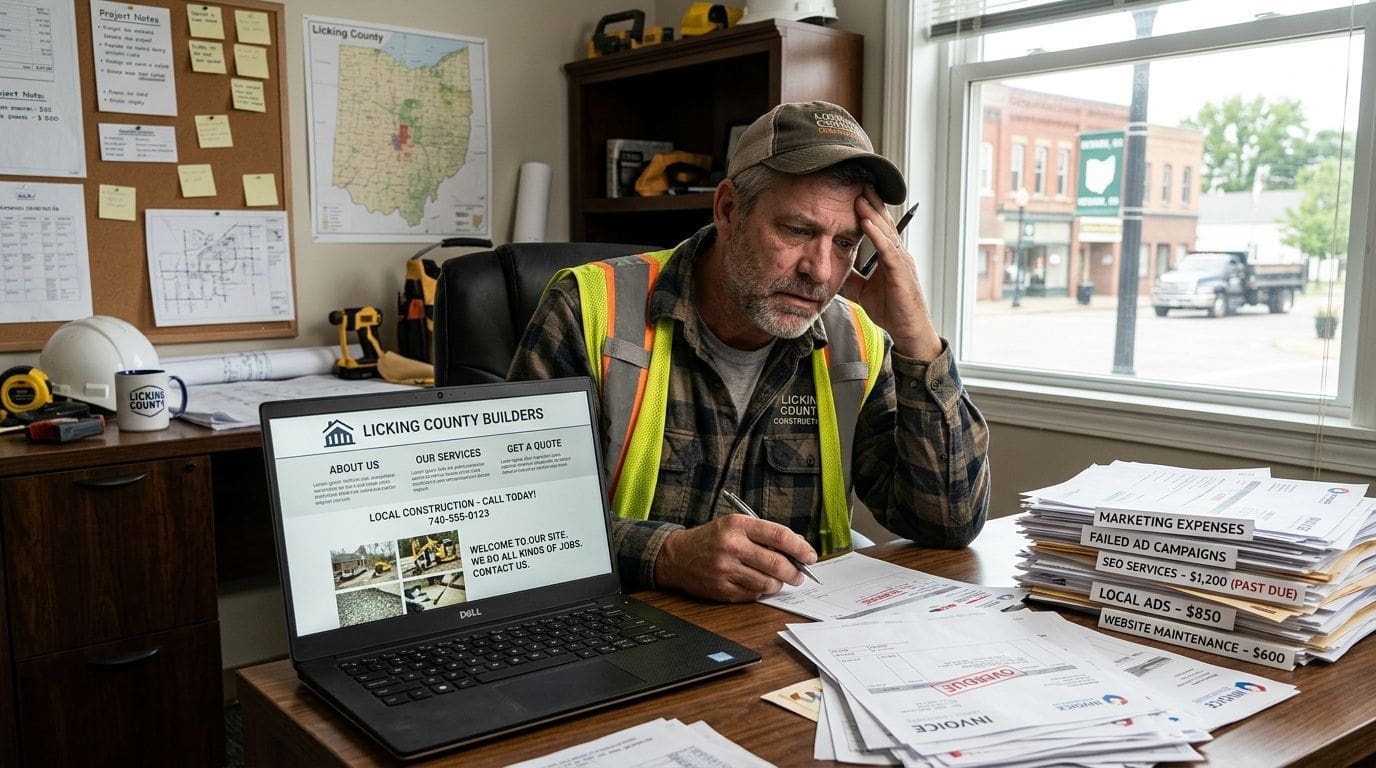
A lot of web designers sell a homepage, a few service pages, and a bunch of talk about colors, fonts, and “branding.” That sounds fine until you realize none of that creates demand. None of it makes you visible in the towns where you want jobs.
According to The Cherubini Company’s small business website design page, 35.1% of website designers quote small business sites between $1,000-$1,500, and many contractors still end up with zero new leads. That’s the trap. Cheap enough to say yes. Useless enough to cost you far more later.
What contractors get sold
Most bad website deals look like this:
- Pretty layout: Looks modern. Says almost nothing.
- Generic service copy: Could belong to any contractor in any town.
- No city targeting: Great if you only want to be found on your own street.
- No lead plan: The site goes live and then just sits there.
That last one is where the money gets wasted.
Practical rule: If the proposal talks more about design than calls, it’s the wrong proposal.
A website doesn’t create traffic. It waits for traffic.
That’s why so many contractors say, “We had a website before and it didn’t work.” They’re right. It didn’t work. But not because websites are useless. It failed because nobody built it to support visibility and lead flow.
What you should ask instead
Stop asking, “What will the site look like?”
Start asking, “How will this bring me calls from the towns I want to work in?”
If a designer can’t answer that clearly, move on.
If you want to see what a contractor-focused structure looks like, review examples of websites for contractors. Look for one thing above all else. Does the site feel built to attract jobs, or built to impress other designers?
Those are not the same thing.
Your Business Is Invisible Where It Matters Most
Here’s where contractors get blindsided.
You think customers can find you because you have a website, a Google profile, maybe a Facebook page, and your trucks are around town. In your hometown, that may be true.
Outside your hometown, it usually isn’t.

A homeowner in Granville doesn’t search your business name if they’ve never heard of you. They search for the service. Google then matches that search to the place they’re in.
If your business is in Newark, and your online presence mostly talks about Newark, Google has no strong reason to show you in Granville, Heath, Pataskala, Johnstown, or the next town over.
That’s the visibility gap.
Why “near me” doesn’t mean “everywhere”
Contractors hear “near me” and think Google will figure it out.
It won’t.
If someone searches for excavation, septic installation, grading, plumbing, or heating and cooling “near me,” Google reads that as a local city-based search. If you haven’t clearly shown that you work in that city, you’re easy to skip.
You’re not losing because people hate your company.
You’re losing because they never saw you.
Customers don’t hire the contractor they never found.
This matters even more in a growing area. The Columbus Region reports that Licking County has grown to 183,308 residents with a median age of 40.8, and that growth along the Interstate 70 corridor creates a larger local market for service businesses that need visibility beyond one town, as noted in the Licking County county profile from the Columbus Region.
What this means for your business
If your online presence only supports your home base, you’re boxed in.
You stay busy, but with the wrong kind of work.
- Too many small jobs: You take what comes in.
- Not enough bigger jobs: Better buyers never reach you.
- Constant competition: You keep fighting over the same local scraps.
- No control: Some weeks are packed. Some weeks are dead.
That’s why the issue isn’t whether customers can find you if they really try.
It’s whether they do find you when they need your service right now.
Big companies buy visibility. Small contractors often rely on hope, referrals, and old momentum. Hope is not a growth plan. It’s a stall tactic.
A website designer in Licking County should understand this without needing it explained to them.
How to Spot a Lead Generator from a Website Decorator
Most local web design talk stays shallow. It covers mobile-friendly layouts, search basics, and nice visuals. It skips the hard part. Multi-city growth.
That gap matters. According to this page on website design in Licking County, most local web design content doesn’t address how contractors can expand across multiple cities, even though that’s a critical need for site-prep contractors and other service businesses managing leads across scattered service areas.
So don’t hire based on taste. Hire based on structure.
Ask questions that expose the truth
A website decorator wants to talk about style.
A lead generator wants to talk about where your next jobs should come from.
Ask these questions:
- How will you make me visible in towns where my office is not located?
- Show me a contractor site you built that targets multiple cities.
- How do you handle service areas when a company wants jobs from several towns?
- What are you building for calls and quote requests, not just looks?
- What happens after the site launches?
If the answers are fuzzy, you’re talking to the wrong person.
Red flags you should take seriously
Use this quick screen.
| What they say | What it usually means |
|---|---|
| “We build beautiful custom websites” | They’re selling design first |
| “We’ll optimize it for search” | No clear plan for where leads come from |
| “Your site will represent your brand” | Fine, but that doesn’t bring calls |
| “We can add pages later” | They haven’t planned your territory |
A lead-focused builder starts with your service area, not your color palette.
They ask where you want work. They ask which towns are worth going after. They think about the jobs you want more of, not just the photos on your homepage.
If they can’t explain how your business gets found outside your hometown, they are decorating a website, not building a sales tool.
One simple filter
Go look at their portfolio.
Don’t stare at the homepage. Check the depth.
Do their contractor sites have clear service pages and city coverage, or is everything stuffed into one generic page? Do they seem built for a company that wants to grow, or a company that wants to look nice?
If you want a plain explanation of the difference, read about what is a Lead Machine. The idea is simple. A site should be built to capture work from the places you want to serve.
That’s the standard. Anything less is risk.
Demand a Contract That Promises Results Not Just a Website
A standard web design contract is usually a polite way to hand you all the risk.
They promise pages. They promise revisions. They promise launch.
They do not promise a path to leads.
That’s backwards.
The biggest missing piece in this industry is accountability. As noted in this Licking County web design market view on Thumbtack, many local web designers avoid talking about lead cost or time-to-return, which leaves contractors unable to judge value and exposed to vendors who sell a design but deliver no leads.
What a weak contract looks like
It lists deliverables, not business outcomes.
You’ll see things like:
- Five-page website
- Responsive design
- Contact form
- Basic search setup
- Stock photo placement
None of that tells you whether the thing will help your business grow.
A website by itself is just an asset. If nobody sees it, it has no value to you.
What to demand before you sign
You need clear answers to plain questions:
- What is the traffic plan?
- How will this help me get found in the places I want work?
- What happens if the site launches and nothing changes?
- Are you selling a website, or a system built to produce calls?
If they dodge those questions, they’re protecting the sale, not your business.
The right contract doesn’t need hype. It needs clarity. You should understand what you’re paying for, what problem it solves, and how the work connects to lead flow.
That’s not being difficult. That’s basic due diligence.
The Difference Between a Website and a Lead Machine
A website is a thing.
A Lead Machine is a system.
That’s the difference most contractors never get told.
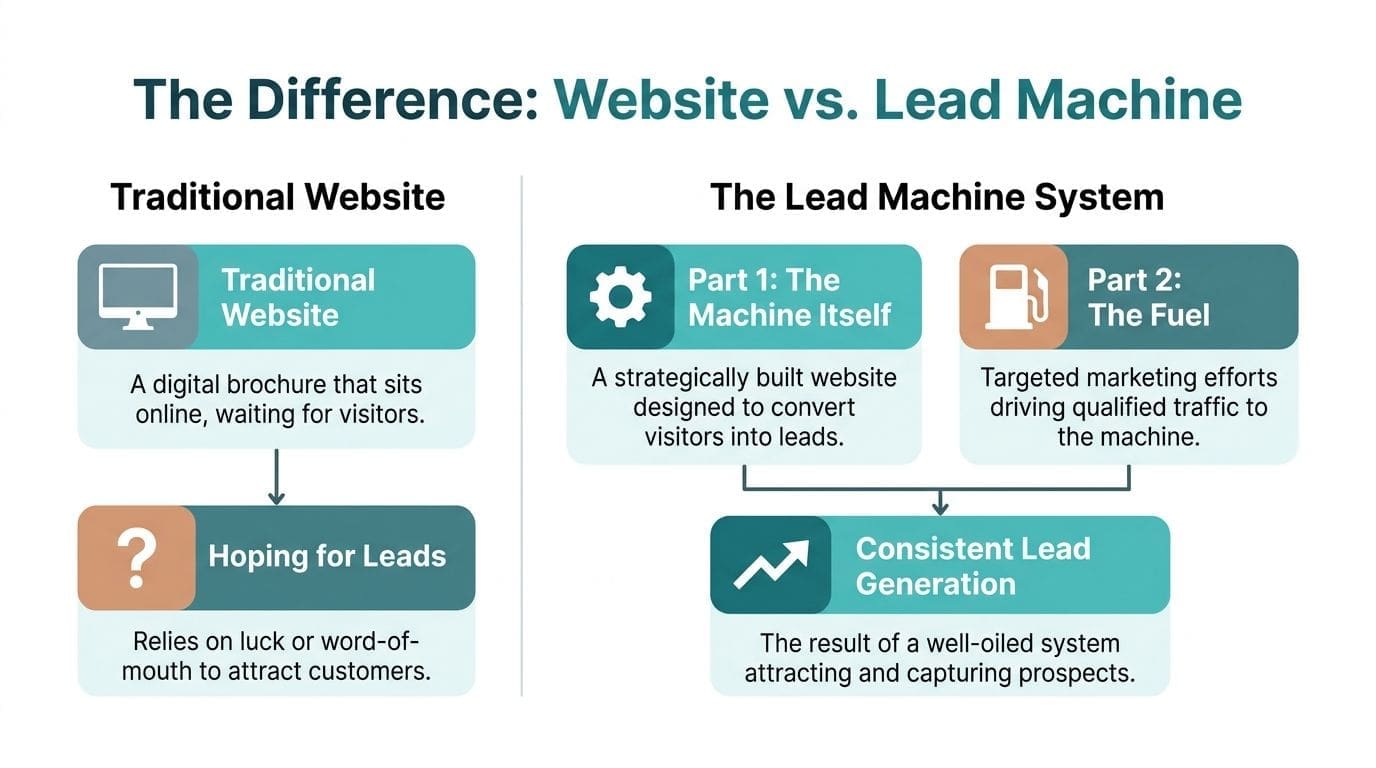
One sits there and hopes. The other is built to turn visibility into calls.
According to The Cherubini Company’s guide on choosing a website designer, a properly built Lead Machine paired with ads can increase calls by 80-90% within 60 days, while over 90% of standalone small business websites generate zero organic traffic because they ignore the traffic plan.
That should reset how you think about this.
A plain-English comparison
| Website | Lead Machine |
|---|---|
| Online brochure | Built for calls |
| Focus on appearance | Focus on service areas and conversion |
| Waits for traffic | Gets fueled with ads |
| Limited to home base visibility | Built for multiple towns |
| Easy to launch | Useful after launch |
A lot of contractors were told the site itself was the strategy.
It isn’t.
The site is the machine. The ads are the fuel.
Without fuel, nothing moves. Without a machine that converts, fuel gets wasted.
What the system should do
At a minimum, the setup should support these basics:
- Show where you work: Not just your office town.
- Match the services you sell: Not vague “solutions.”
- Make it easy to call: Especially on mobile.
- Support paid visibility: So buyers can find you now, not someday.
- Track what matters: Calls, form fills, and lead flow.
One practical extra check is accessibility. Before launch, run the site through a website accessibility checker. It’s a simple way to catch barriers that can frustrate visitors and hurt usability.
A website without traffic is a parked truck. Ads without a conversion system are fuel poured on the ground.
For contractors who want a factual example of this type of setup, The Cherubini Company builds Lead Machines as contractor-focused websites paired with ad-driven visibility. That’s one model. The important part is not the label. The important part is that the site and the traffic work together.
That’s what creates control.
Your Hiring Checklist for Predictable Growth
If you’re hiring a website designer in Licking County, keep the decision simple.
Don’t get impressed. Get specific.
Use this checklist.
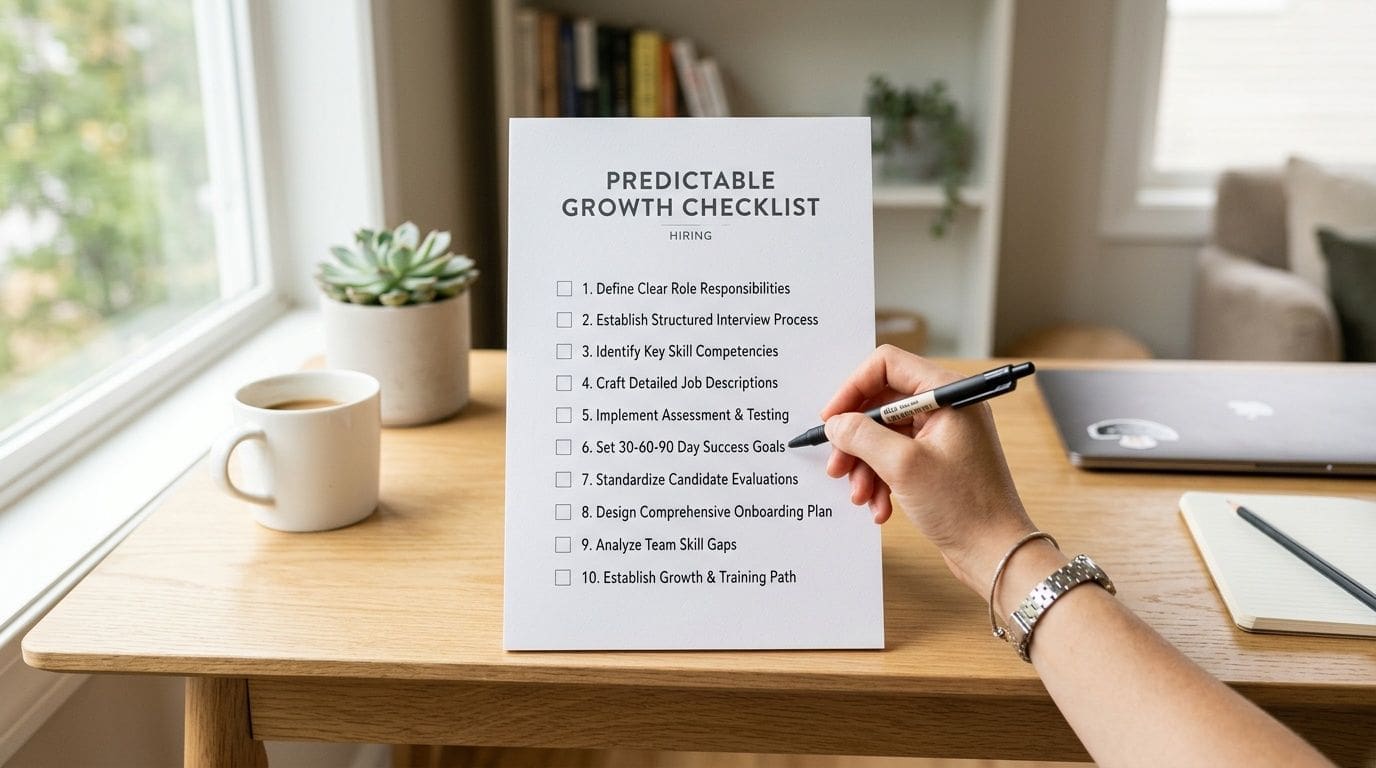
The checklist
- Do they understand service areas? If they only talk about your office location, they don’t understand your growth problem.
- Can they show multi-city work? If every example is a basic local site, keep looking.
- Do they talk about leads or design? Design matters. Leads matter more.
- Do they include a traffic plan? Websites don’t create traffic on their own.
- Do they speak clearly? If they hide behind jargon, they’re usually hiding weak strategy.
- Does the contract explain business value? If it only lists pages and features, that’s not enough.
- Can they help you grow beyond your hometown? That’s the key test.
One last filter before you sign
If you want more questions to use in a vetting call, this list of 44 questions to ask before hiring a web design company is useful. You don’t need every question. You need the ones that force clear answers.
You can also review a local example of a web designer in Licking County and compare what they talk about. Are they talking about visibility, cities, calls, and growth? Or are they still selling a prettier brochure?
Predictable leads give you control. No control means a fragile business.
You think that customers “can” find you but, if customers “don’t” find you, nothing else matters. Lead Machines are built to fix that.
If you want a straight answer about whether your current site is helping or hurting, talk to The Cherubini Company. They’re a family-owned Newark agency that builds contractor-focused Lead Machines and visibility systems for businesses that need more calls, more reach, and less guessing.