Stop chasing marketing tricks. Your real problem is simpler and more expensive. People outside your hometown do not see you.
That is why so many contractors get frustrated with advertising. You were told to post more, tweak the website, boost a few posts, and try some ads. Then nothing changed. You got motion, not control. You got clicks, not steady quote requests.
The pattern is predictable.
“We tried ads and they didn’t work.”
“That’s what the last agency said.”
“We’ve been burned before.”
“I don’t believe you.”
That reaction is earned. Contractors have been sold random tactics for years. Random tactics do not fix visibility.
You may be known in your town. People recognize the trucks. They know the company name. But a buyer in the next town does not care what people in your town know. They open Google and search for the service they need in the city where they need it. If you do not appear there, you are out of the running.
That is the fundamental problem.
People looking for excavation, plumbing, restoration, HVAC, grading, septic work, or well drilling rarely start with your business name. They search by job and location. Websites do not create traffic on their own. They wait. Ads create visibility. A site built for leads turns that visibility into calls.
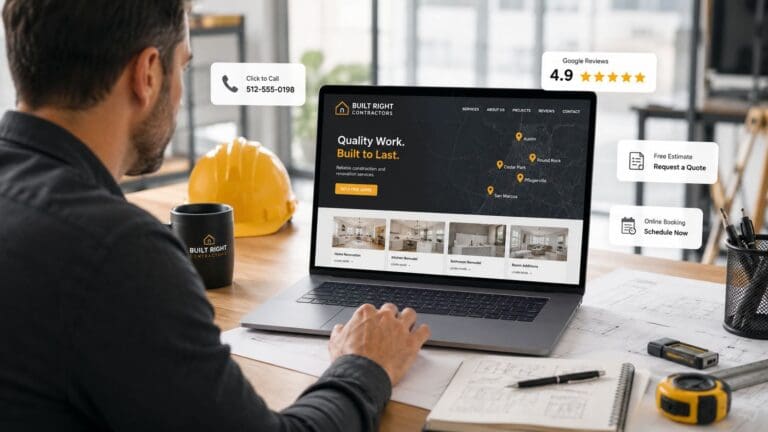
That is why the only logical fix is a system. Build a site designed to produce leads, not sit there looking nice. If you want the simple version, read how a Lead Machine website is built to get calls. Then add ads that put you in front of buyers now. Support it with reviews, a strong Google Business Profile, and city-by-city expansion. That is how contractors stop guessing and start controlling lead flow.
Your competitors are not standing still. They are buying attention in the places you want to grow. If you want better jobs, more inbound calls, and less revenue anxiety, fix visibility first.
1. Lead Generation Websites (Lead Machines)
Contractors do not have a website problem first. They have an visibility problem.
A regular website sits there and waits. A Lead Machine is built to pull in calls from the cities and services you want. That difference decides whether you stay boxed into your hometown or start getting found in the next county.
That is the main job of this site. Make your business visible beyond the places where people already know your name.
A buyer searching for septic repair in one town or land clearing in another does not care about your company history page. They want proof that you do that job in that location, and they want an easy way to call. If your site is vague, broad, or centered on your home base, you disappear in every market outside it.
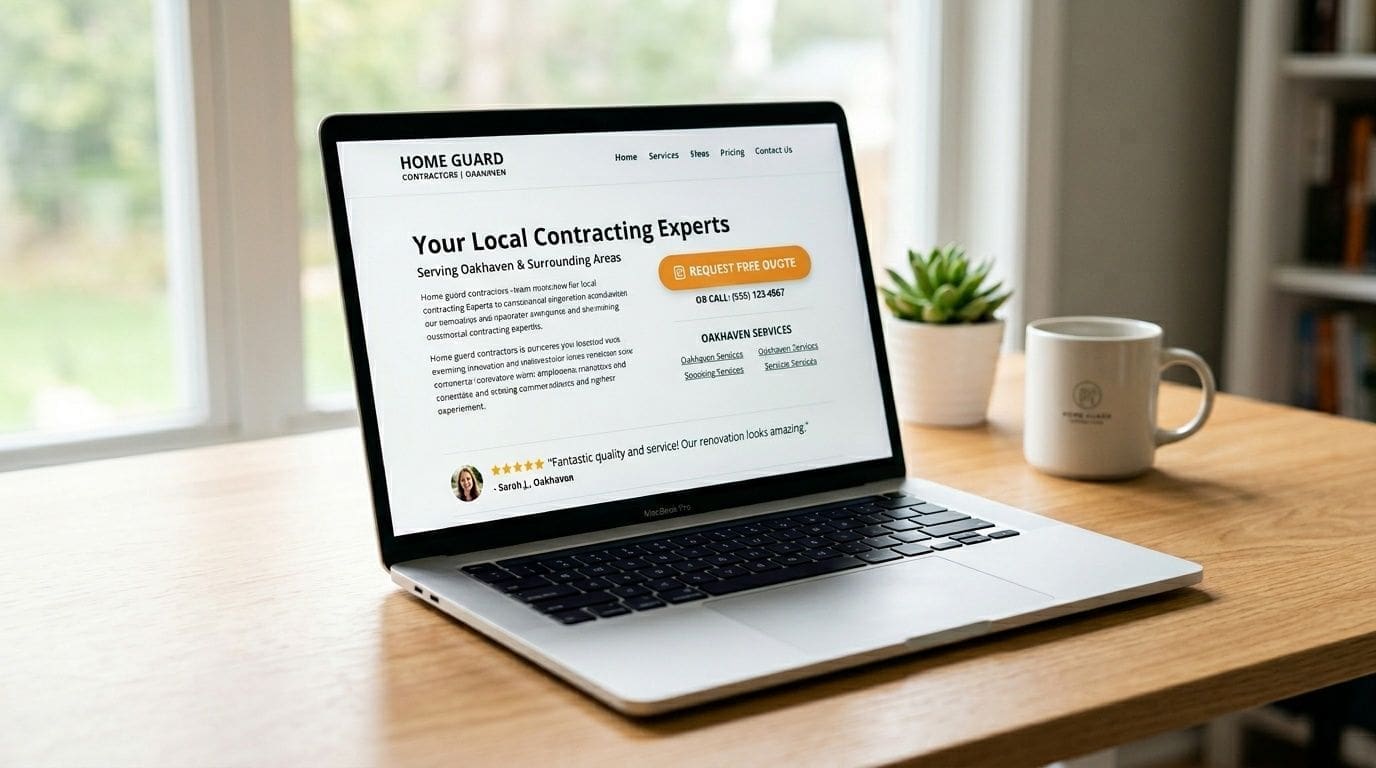
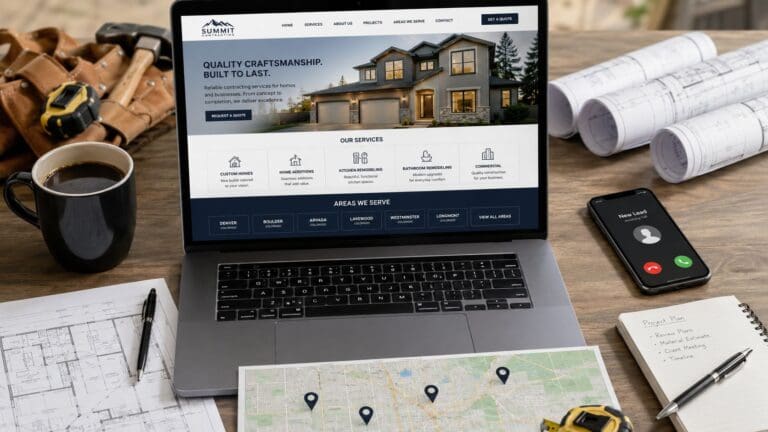
A Lead Machine fixes that with structure. Separate service pages. Separate city pages. Clear internal paths between them. Every important job gets its own page. Every target market gets its own page. That is how Google understands your territory, and that is how buyers know they are in the right place.
What makes a Lead Machine different
The site has one job. Turn attention into calls and quote requests.
That means fast mobile load times, click-to-call buttons, short forms, real project proof, and pages matched to the exact service and area searched. It is built for buyers who need help now.
If you want the simple version, read what a Lead Machine is. It is a website built to rank, convert, and capture demand across multiple service areas. If you plan to drive traffic from social campaigns too, follow these Facebook advertising best practices for local contractors so the clicks land on pages built to convert.
Practical rule: If your website does not clearly say what you do and where you do it, your business stays hidden.
For a restoration company, that means separate pages for water damage, fire cleanup, and mold remediation in each target city. For an excavation contractor, it means distinct pages for grading, trenching, site prep, and land clearing across the counties you want to serve. Generic copy does not win regional work. Specific pages do.
Don’t send traffic to a weak site
A weak site wastes every marketing dollar you put behind it.
If an ad click lands on a generic homepage, the buyer has to hunt for the service. If the city is missing, trust drops fast. If the page does not match the search, they leave. You paid for that click and got nothing back.
This is why small business advertising strategies fail for contractors. The problem is rarely a lack of tactics. The problem is a broken system. Visibility gets the click. A Lead Machine gets the call. Without both, growth stays random.
2. Local & Regional Visibility Ads
Good contractors do not lose work because they lack skill. They lose it because buyers in the next town never see them.
That is the primary job of ads. Buy visibility where your organic reach is weak. Put your company in front of people searching right now. Send them to the exact service page that matches the job and the location. A Lead Machine handles the conversion. Ads create the exposure.
Owners who say ads do not work usually paid to send traffic into a bad system. Broad targeting. Generic headlines. Clicks sent to a homepage. No city match. No service match. No clear call button. That is not advertising. That is waste.
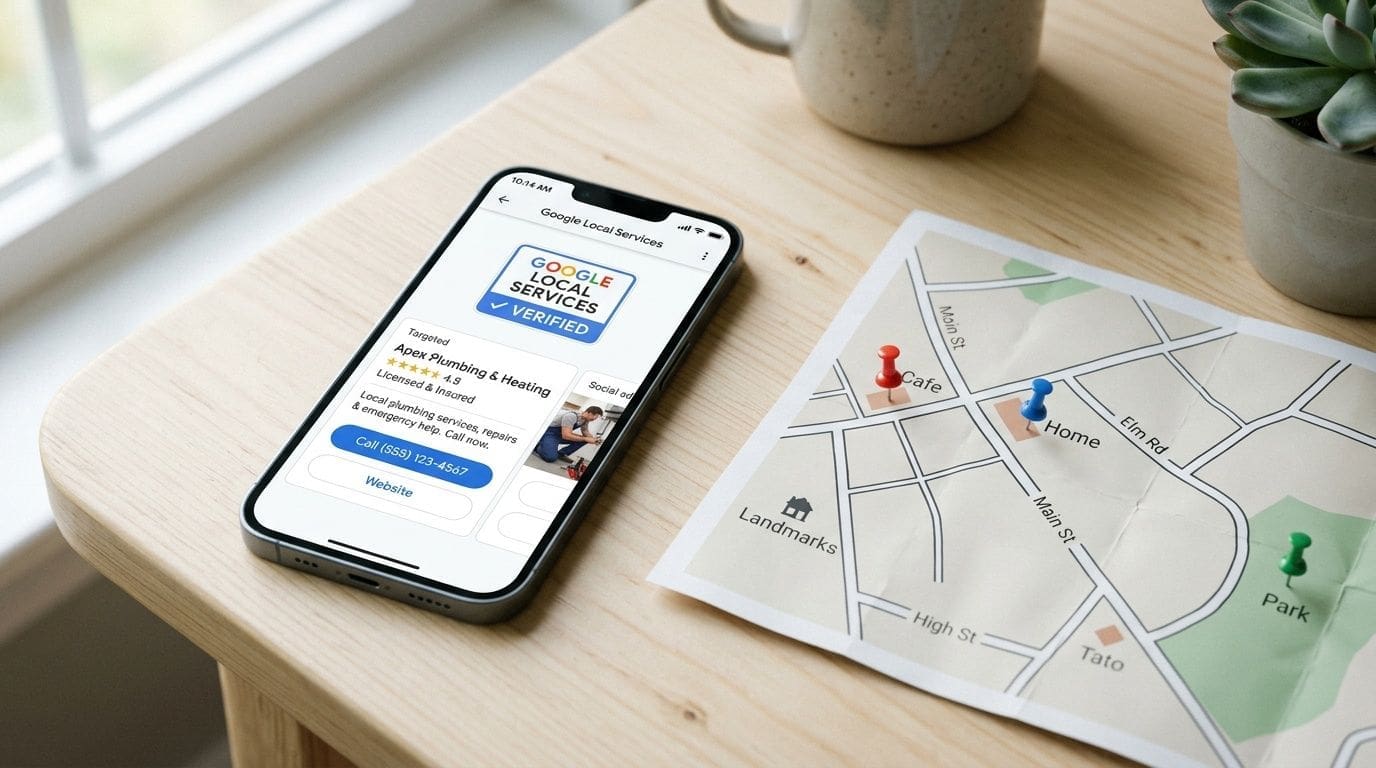
Ads solve the visibility gap
Contractors hit a ceiling when all their leads come from referrals and their home ZIP code. The minute you want jobs in nearby towns, you need deliberate coverage. Ads give it to you fast.
Search ads work best when the buyer already knows the problem. Local Services Ads help on high-trust, high-urgency searches. Social ads keep your name in front of people who visited but did not call. Each one has a job. None of them should run in isolation.
If your business barely shows up outside your core area, fix that first. Start with the search terms and service areas where revenue is highest. Then build campaigns around city-specific intent. If you are still asking why your business doesn't show up on Google in the first place, the answer is usually weak coverage, weak signals, or both.
Visibility is not optional. If buyers cannot find you in the towns you want to serve, your growth stays local and random.
Local first. Regional second.
Own your base market before you spread out. Then expand one city, suburb, or county at a time.
A plumbing company should not run one campaign for an entire metro and hope Google sorts it out. Build separate campaigns or ad groups for the base city and each surrounding area. Match the ad to the service. Match the click to the page. Track calls by market so you know where budget should increase.
An excavation contractor can do the same thing by county. A restoration company can push emergency search terms in priority markets and use retargeting to stay visible after the first visit. For social campaigns, use these Facebook advertising best practices to keep targeting tight and traffic pointed at pages built to convert.
One more point. Paid visibility works better when your map presence is credible. These Google Business Profile tips to grow your business locally support ad performance because buyers check your listing before they trust your ad.
Ads are not a trick. They are the distribution layer of the system. The Lead Machine captures demand. Ads expand your reach beyond the people who already know your name.
3. Google Business Profile Optimization
Your Google Business Profile decides whether a stranger trusts you in 10 seconds.
Before they read your website, they scan the map result. They check your reviews, photos, categories, phone number, hours, and whether the profile looks maintained. If the listing looks half-finished, you lose credibility fast.
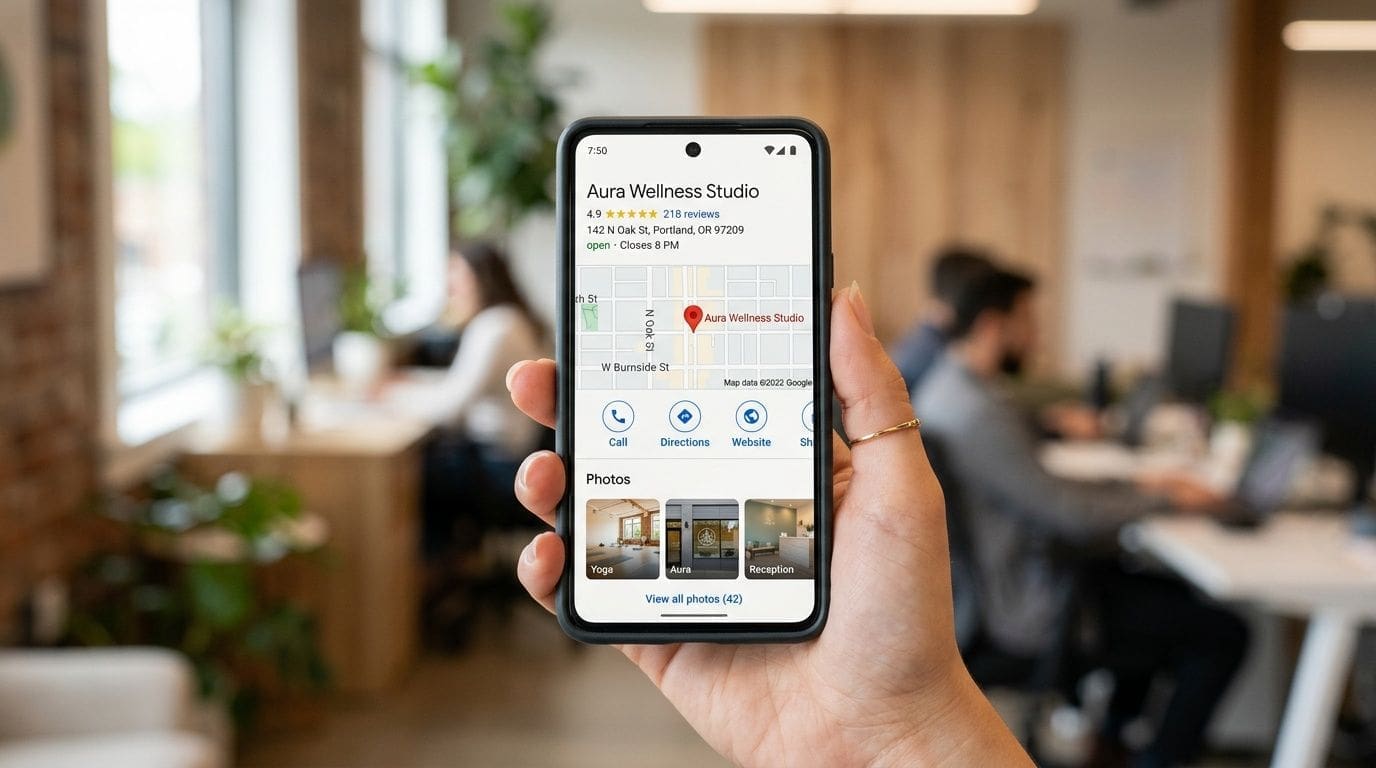
Contractors treat this like admin work. It is sales work.
A weak profile hurts branded searches, map visibility, and conversion after the click. It also drags down the rest of your system. If ads get the search and the Lead Machine gets the visit, the profile still has to confirm that you are real, active, and worth calling.
Your listing has one job
It must remove doubt.
That means accurate services, correct categories, clear service areas, recent jobsite photos, a working phone number, and reviews that sound like real customers. If someone searches for excavation, roofing, or restoration in a nearby town, Google needs enough location and service signals to connect your business to that demand. If those signals are thin, you disappear.
If you need the blunt version, this guide on why your business doesn't show up on Google explains the usual causes clearly.
Complete profiles win more calls
Use every field that helps a buyer decide. Add services. Write a real business description. Upload before and after photos. Keep hours accurate. Answer reviews. Post updates from actual jobs. None of this is complicated. It just needs to be done consistently.
For practical ideas, these Google Business Profile tips to grow your business locally are useful.
Buyers do not separate your profile from your business. If the profile looks neglected, they assume the company is too.
A strong profile will not fix a weak website. A strong website will not fix a weak profile. Contractors need both working together. That is the point. Predictable lead flow comes from a system, not scattered fixes.
4. Multi-City Territory Expansion
Here, most contractors lose money and don’t realize it.
You know your hometown. Your trucks are seen there. Your address is there. Your website talks about it. Your social posts mention it. So Google connects you to that place. That’s fine until you want work in the next city, the next county, and the next stretch of territory where the bigger jobs are.
If you never clearly tell Google and buyers that you work in those places, you stay invisible there.
That’s the visibility gap.
Stop acting like one-town businesses
A lot of small business content still talks like every company serves one town. That advice doesn’t fit contractors who work across counties. Site prep, septic, land clearing, grading, concrete, and well drilling companies often travel for jobs. Their marketing should do the same.
One underserved industry angle points out that most content ignores scalable regional strategy for heavy equipment businesses and multi-city contractors, according to this piece on underrated marketing strategies for small businesses. That’s exactly why many owners stay stuck with small local jobs while larger regional work goes elsewhere.
A territory expansion system fixes that. Build city pages for the places you serve. Match ads to those cities. Create a clean path from search to page to call.
Expand in a controlled way
Don’t try to dominate everywhere at once. Pick nearby cities that fit your work, your crews, and your travel reality.
Use a simple order:
- Start next door: Pick the closest towns and counties where you already take jobs.
- Match page to place: Give each city its own page tied to the services you want to sell there.
- Back it with ads: Run local visibility ads into those pages so buyers see you.
- Track by market: Watch which towns produce calls, quotes, and quality jobs.
A septic installer might start with five nearby towns where crews already run. A concrete contractor might build pages around county seats and growing suburbs. A restoration company might claim neighboring service areas where storm and water loss calls already come in.
This is how regional growth happens. Not by opening random offices. By making your business visible where buyers search.
5. Review Generation & Reputation Management
Reviews decide whether a stranger calls you or skips you.
That matters even more once you push beyond your hometown. In nearby cities, people have never heard of you. They cannot judge your trucks, your yard sign, or your reputation at the supply house. They judge the proof they can see online. If that proof is thin, your ads cost more to convert and your website has to work harder than it should.
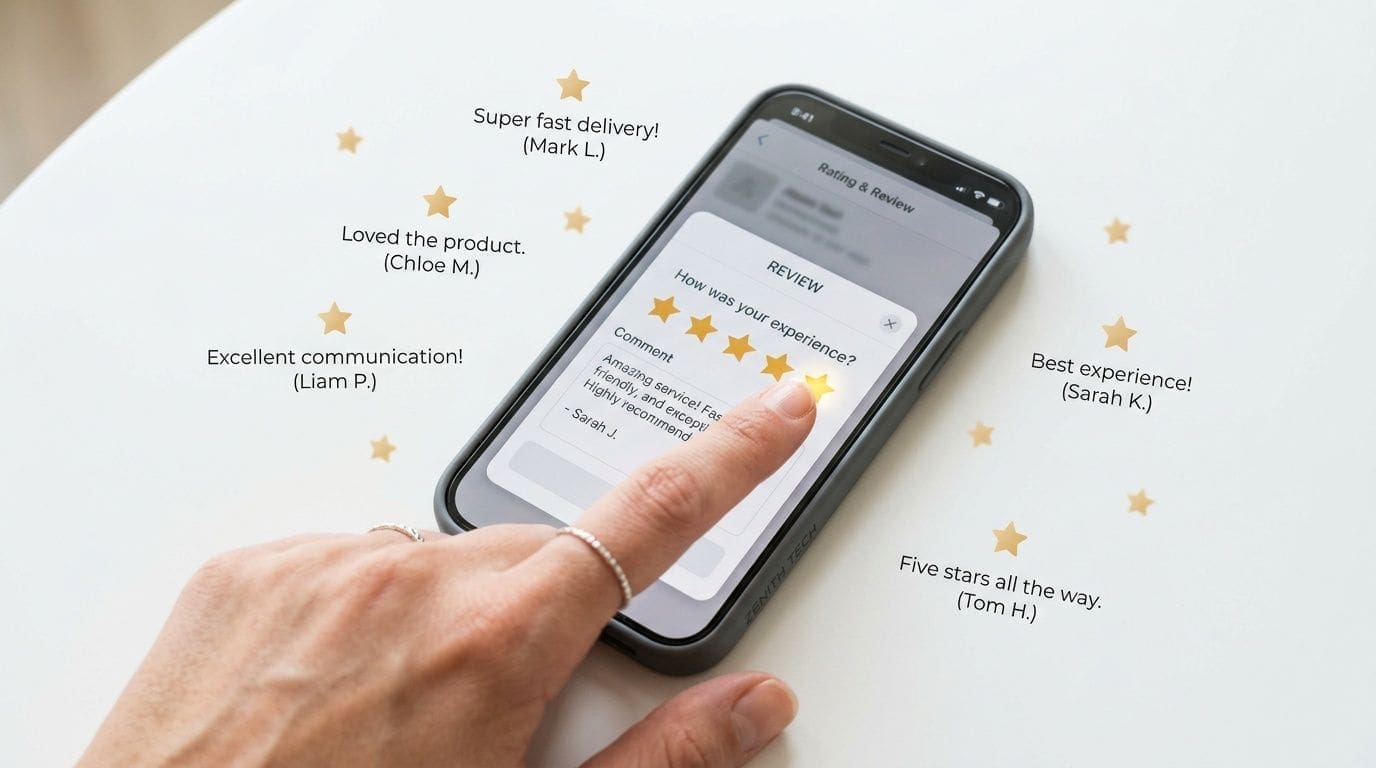
Reviews make your visibility believable
A Lead Machine gets you found. Reviews help buyers believe what they found.
That is a primary function of reputation management. It turns visibility into trust. Without it, you look unproven outside your home base, even if you do excellent work every day. A contractor with fewer years in business but better public proof will win jobs in the markets you want to enter.
The fix is simple. Stop treating reviews like a bonus. Treat them like part of job closeout.
For a plumber, that means asking after the leak is fixed and the customer is relieved. For an excavation contractor, it means getting reviews that mention reliability, cleanup, and communication. For a restoration company, speed, professionalism, and follow-through matter because stressed customers look for those signals first.
Build a review system your team can repeat
Do the same four things on every completed job.
- Ask while the result is fresh: Send the request right after the customer confirms the work is done.
- Send a direct link: Remove every extra step. Friction kills follow-through.
- Guide the proof you need: Ask customers to mention the service, the city, and what stood out.
- Respond to every review: A short, professional reply shows you are active and accountable.
One good review helps. A steady flow changes how your company looks in every market you target.
Use the best reviews where buyers hesitate. Put them on service pages, quote request pages, and city pages. Match the review to the job type. If you want foundation repair leads in a nearby county, show reviews from foundation repair customers, not generic praise.
Bad reviews need a process too. Reply fast. Stay calm. State what happened, what you did, and how you tried to fix it. Future buyers read those responses. They are judging your professionalism as much as the complaint itself.
Strong reputation management is not about vanity. It is sales support. If your Lead Machine and ads create visibility, reviews provide the proof that gets the call.
6. Helpful Content That Answers Questions
Contractors do not have a content problem. They have a visibility problem.
If buyers in the next city cannot find clear answers on your site, they call the company they can find. That is how good contractors stay stuck inside one hometown. Helpful content fixes that. It gives your Lead Machine more ways to show up, support your ads, and turn search traffic into calls.
Publish pages that remove doubt
Start with the questions buyers ask before they are ready to hire. Cost. Timing. Process. Repair versus replacement. Warning signs. Permit questions. Service area questions.
Answer them in plain language. Be specific. A vague paragraph does nothing. A direct page does the job.
Good topics look like this:
- How much does septic installation cost in this county?
- Do I need foundation repair or drainage correction?
- What happens during emergency water cleanup on day one?
- How long does land clearing take before a build starts?
- What permits are usually needed for a new well or utility trench?
These pages are not blog filler. They are sales tools. They help you appear for searches that happen before a buyer searches your company name. That matters if you want leads outside your immediate area.
Write for the buyer who is comparing options
A homeowner searching “signs my AC system needs replacement” is not looking for clever branding. They want a straight answer from someone who knows the work. Give them that answer, then show them the next step.
A strong page does three things.
- Uses the exact question: Pull wording from sales calls, estimate requests, and field staff notes.
- Adds local context: Mention soil, weather, permit rules, lot size, drainage issues, or county conditions that affect the answer.
- Ends with action: Tell the buyer what to do next. Schedule an inspection. Request a quote. Send photos. Call for urgent service.
That structure helps in two places at once. It gives Google more relevant pages to index, and it gives buyers enough clarity to stop shopping around.
Build content into your lead system
Do not treat helpful content like a side project. Tie it to the services and markets you want to grow.
If you want excavation leads in two neighboring counties, publish pages that answer excavation questions for those counties. If you want more restoration jobs, answer the urgent questions people ask right after damage happens. If you want higher-value foundation work, create pages around drainage failure, cracking, settling, and inspection timing.
This is how a contractor stops relying on referrals alone. Your Lead Machine creates the structure. Your ads create reach. Helpful content fills the gaps between first search and first call.
Content for content’s sake is useless. Content that answers real questions gets you found, gets you trusted, and helps you win outside your hometown.
7. Video Proof Before and After Showcases
Contractors lose work because buyers cannot see the difference between your bid and the next guy's.
Video fixes that fast. A before and after gallery proves you do real work, on real properties, with real results. That matters even more outside your hometown, where people have never heard your name and have no reason to trust you yet.
Use simple job footage. Use your phone. Get the trench, the damage, the install, the cleanup, and the finished result on camera.
Show proof that removes doubt
A good before and after video answers the buyer's unspoken question. Can this company do the job I need done?
Show the starting problem clearly. Show the crew working. Show the finished result from the same angle if possible. Add a short voiceover or captions with the service, town, and outcome. Keep it plain.
A site prep contractor can film a rough lot, grading work, drainage corrections, and the final ready-to-build surface. A restoration company can show the damaged room, drying setup, cleanup, and restored space. A septic contractor can document access problems, excavation, install, and final grade. That kind of proof beats generic marketing copy every time.
Put video where it helps you win
Video should support your lead system. It should help your website convert better and help your ads get attention in markets where you are still invisible.
Use it in a few specific places:
- Service pages: Match the video to the exact service the buyer wants.
- Ads: Use short clips that show a clear problem and a clear result.
- City pages: Feature jobs from that area or nearby markets to build local trust.
- Sales follow-up: Send a relevant project video when a prospect stalls or questions your experience.
If you need a fast way to turn job footage into ad-ready clips, use ShortGenius AI video ad maker.
Keep every video focused on one job, one problem, and one result. Do not try to entertain people. Show proof. Make the next step obvious. Request a quote. Book an inspection. Call now.
That is how video helps a contractor grow beyond referrals and beyond one familiar zip code. It makes your Lead Machine stronger. It makes your ads more believable. And it gives buyers a reason to choose you before they ever meet you.
8. Strategic Referral & Partnership Programs
Referrals should support your lead system, not run your business.
Too many contractors treat word of mouth like a growth plan. That keeps you stuck in the same hometown loop. You get mentioned when someone remembers you, not when you need leads. That is not control.
Build referral relationships on purpose. Pick partners who already see the exact problems you solve and send them to a page that makes the next step easy.
A roofer should know two or three siding contractors. A plumber should have steady relationships with HVAC companies, remodelers, and restoration firms. An excavation contractor should stay close to builders, septic installers, concrete crews, and surveyors. These are not casual connections. They are active channels.
Build a referral program people can actually use
Referral programs fail when the ask is fuzzy. Your past customers and partner businesses need clear instructions. They need to know who to send, what jobs fit, and how to hand them off without wasting time.
Set it up like this:
- Define the job: Name the services, service area, and project size you want.
- Use one contact path: Give partners one phone number, one form, or one dispatcher.
- Reply fast: Slow follow-up kills trust with both the lead and the referral source.
- Close the loop: Tell the partner you received the lead and thank them for it.
Keep it simple enough that someone can refer you in under a minute.
You can also strengthen these relationships with short job clips, case summaries, and follow-up assets. ShortGenius AI video ad maker can help you package that proof into simple creative your team can send to partners or prospects.
Value is not the referral itself. It is what happens after the handoff. If the lead lands on a weak page, sees thin proof, or has to hunt for a phone number, you lose the job. If the lead lands on your Lead Machine, the referral becomes far more likely to turn into booked work.
That is the point. Referrals are not the system. They feed the system.
Small Business Advertising: 8-Point Strategy Comparison
| Item | Implementation Complexity 🔄 | Resource Requirements ⚡ | Expected Outcomes 📊 | Ideal Use Cases | Key Advantages ⭐ | Quick Tips 💡 |
|---|---|---|---|---|---|---|
| Lead Generation Websites (Lead Machines) | 🔄 High, custom build, multi-city pages & SEO setup | ⚡ Medium–High, dev, copy, photos; $3k–$15k+ upfront; ongoing maintenance | 📊 High, steady qualified leads, measurable ROI via call tracking | Centralized lead funnel for contractors serving multiple cities | ⭐ High conversion design; builds local authority; 24/7 lead gen | 💡 Optimize city+service pages; test click-to-call placement |
| Local & Regional Visibility Ads | 🔄 Medium, campaign setup, LSA verification, ongoing optimization | ⚡ High ongoing spend, $500–$5k+/mo; creative & management time | 📊 Immediate visibility and targeted traffic; pay-per-lead possible | Urgent lead capture, competitive or time-sensitive services | ⭐ Fast demand capture; highly measurable & targetable | 💡 Link ads to specific Lead Machine pages; monitor LSA quality |
| Google Business Profile Optimization | 🔄 Low–Medium, setup and regular updates | ⚡ Low, time-based (5–10 hrs setup; 3–5 hrs/mo); no ad spend | 📊 Improved local rankings, free calls, credibility on Maps | Local businesses relying on map-pack and organic visibility | ⭐ Excellent ROI (free); boosts trust and local ranking | 💡 Upload many photos; respond to reviews within 24 hrs |
| Multi-City Territory Expansion | 🔄 High, coordinated multi-city pages, GBPs and ads | ⚡ High, $15k–$50k+ to establish; more staff/management | 📊 Large market reach and diversified revenue across territories | Businesses planning regional growth without new offices | ⭐ Scales presence and captures multi-city projects | 💡 Start with 5–7 adjacent cities; track metrics per city |
| Review Generation & Reputation Management | 🔄 Medium, automation, monitoring and response workflows | ⚡ Low–Medium, $0–$500/mo for tools; staff time for follow-up | 📊 Strong uplift in conversion and local ranking from fresh reviews | Service businesses needing social proof and higher conversions | ⭐ Directly increases conversion (20–50%) and local SEO | 💡 Request reviews within 24 hrs; provide direct mobile links |
| Helpful Content That Answers Questions | 🔄 Medium, strategy, research and regular production | ⚡ Medium, $0–$3k+/mo or in-house time; ongoing publishing | 📊 Long-term organic traffic and authority; lower CAC over time | Businesses aiming for inbound leads and educational touchpoints | ⭐ Builds trust and ranks for informational queries | 💡 Answer customer questions; publish 2–4 useful pieces monthly |
| Video Proof: Before & After Showcases | 🔄 Medium, capture/edit workflow and distribution plan | ⚡ Variable, $0 DIY to $500–$2k+/mo for pro production | 📊 Higher engagement, stronger conversions and social shareability | Visual trades (restoration, concrete, HVAC) that show transformations | ⭐ Highly persuasive visual proof; boosts engagement and trust | 💡 Film start/end of projects; use captions and clear CTAs |
| Strategic Referral & Partnership Programs | 🔄 Medium, partner outreach, tracking and agreements | ⚡ Low–Medium, $0–$500/mo management; referral fees 10–20% per job | 📊 Predictable, high‑quality leads with superior conversion rates | Businesses with complementary local partners and repeat work | ⭐ Best lead quality and cost-effective acquisition | 💡 Formalize terms, keep referral process simple and trackable |
Predictable Leads Give You Control
Random tactics create a fragile business.
That’s the big lie in most small business advertising strategies. Owners are told to do a little of this, try a little of that, post more often, spend a little here, and hope something clicks. That approach creates activity, not control. It keeps you busy, but it doesn’t fix the underlying problem.
The primary problem is visibility.
If people in the next town don’t see you when they search, you won’t get that job. It doesn’t matter how good your crew is. It doesn’t matter how long you’ve been in business. It doesn’t matter that people in your hometown know your name. Buyers who don’t know you can’t hire you if you never show up.
That’s why a system beats random marketing every time.
A Lead Machine gives you a site built to turn traffic into calls. It tells buyers and Google what you do and where you do it. It gives every service and every city a place to exist. It turns your website from a passive brochure into a working asset.
Ads create the visibility. They put you in front of people who are searching now. They stop you from waiting around and hoping someone stumbles across your business. They create the traffic your website cannot create by itself.
Your Google profile strengthens trust. Reviews give buyers proof. Helpful content answers doubts before they become objections. Video shows the work. Referral partners widen your reach. Multi-city pages and regional ads let you grow outside your home base without staying invisible in every surrounding market.
None of these pieces should stand alone.
A website without traffic sits there.
Ads without a strong site waste money.
A strong site without reviews loses trust.
A good hometown presence without city expansion keeps you trapped.
That’s why the answer isn’t a trick. It’s a complete lead system.
For contractors, control comes from predictable lead flow. Predictable lead flow helps you choose better jobs. It helps you stop chasing every small project just to keep crews moving. It gives you room to say no to bad-fit work. It lowers the stress that comes from wondering where the next call is coming from.
No control means a fragile business.
If your phone only rings when referrals happen, your business is fragile. If leads depend on one city, your business is fragile. If your website looks fine but doesn’t produce calls, your business is fragile. If you’ve been burned by agencies that sold fluff, your business is still exposed until you fix the visibility problem.
The contractors who grow are not always the best craftsmen. Often, they are the ones who are easiest to find, easiest to trust, and easiest to contact in the exact cities they want work from.
That’s what this comes down to.
You think customers can find you. But if customers don’t find you, nothing else matters.
Lead Machines are built to fix that.
If you're tired of guessing and want a real visibility system, talk to The Cherubini Company. They build Lead Machines and run visibility ads for contractors who want more calls, better jobs, and stronger reach outside their hometown. No fluff. No confusing dashboards. Just a clear system built to make your business show up where buyers are already looking.