You’re probably in this spot right now.
You do solid work. People in your town know your name. Your trucks are seen. Your past customers refer you. But the jobs you want in the next town over are not coming in fast enough.
So you try what everybody tries.
“We ran ads and they didn’t work.”
“That’s what the last agency said.”
“We got burned before.”
“I don’t believe any of this stuff anymore.”
Fair enough. Most marketing advice is fluff.
The core problem is usually simpler than that. You do not have an effort problem. You have a visibility problem. You are known where you are known, and invisible where you want more work.
That is why this matters. If you want to learn how to get more jobs in nearby cities, stop thinking about trying harder. Start thinking about where buyers can see you when they search.
The Invisibility Problem Costing You Jobs
A lot of contractors think customers can find them if they need them badly enough.
That is backwards.
Customers do not search for your company name unless they already know you. They search for the service and the city they are standing in. If you do not show up there, you are out.
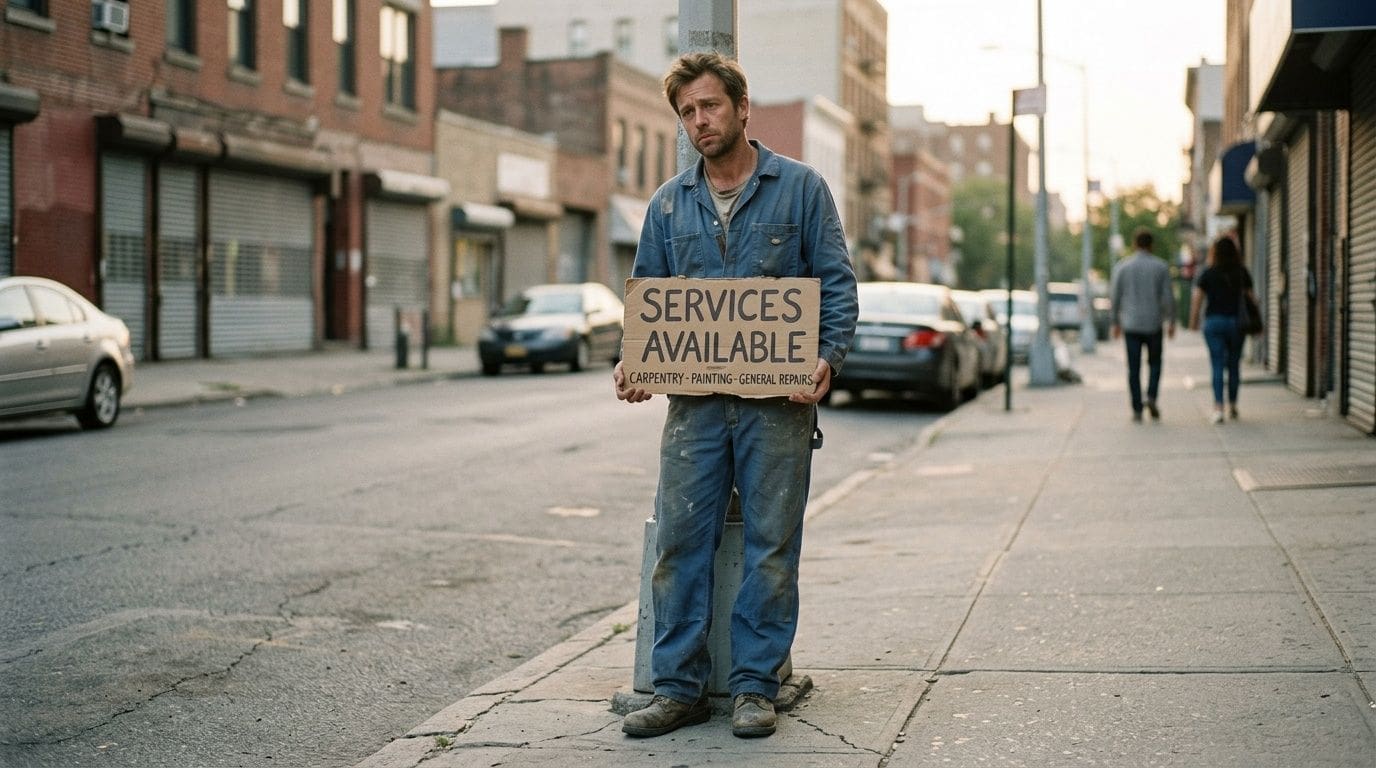
Your hometown is not your market
You may be visible in your hometown. Good. That does not mean you are visible in the towns around you.
When somebody types “excavation near me” or “concrete contractor near me,” the search engine ties that search to the city they are in. If your website and business presence only talk about your home city, then the search engine has no reason to connect you to the next city over.
It is obvious once you hear it.
If you never say you work in Newark, Granville, Heath, Pataskala, or Zanesville, why would a search engine assume you do?
The gap is real
There is a known problem called spatial mismatch. It is the gap between where jobs are and where workers live. The Census Bureau notes that when jobs are far from residential areas, unemployment rates climb, which directly affects service and construction work across suburban and urban markets in different areas (spatial mismatch and job access).
That same kind of gap shows up in lead flow.
The work is there. The buyers are there. But the connection is broken because you are not visible where those people are looking.
Key takeaway: It is not that people cannot find you. It is that they do not find you when they search by service and city.
Why most contractors miss this
Contractors usually think the fix is more referrals, more posting, or a nicer website.
Wrong target.
The issue is that you are a ghost outside your core town. Ten miles away, twenty miles away, one county over, you disappear.
If you want a better framework for thinking through that problem, this piece on how to build an online presence that gets results is useful because it pushes past vanity and focuses on visibility that leads to action.
And if you want the no-fluff version of what lead generation should look like for contractors, look at https://cherubinicompany.com/just-leads-co/.
You can be the best contractor in the region and still lose jobs to companies doing worse work than you.
Why?
Because they showed up. You didn’t.
Why Trying Harder and Pretty Websites Fail
A pretty website does not fix invisibility.
It just gives you a cleaner place to be invisible.

Websites do not create traffic
Here, contractors get misled.
Some agency sells a fresh design. Nice colors. Drone shots. A few service pages. Maybe a form that barely works on a phone. Then they act surprised when the phone stays quiet.
Websites do not create traffic. They sit and wait for traffic.
That is all they do unless something is actively putting buyers in front of them.
A regular website is like building a clean office on a back road with no signs and no traffic. It may look good. Nobody sees it.
The market moved outside your home base
This part matters if you want more jobs in nearby cities.
Job growth has not stayed centered in the core city. In data from 92 metropolitan regions, 82% of central cities lost private employment market share to their suburbs, which means growth opportunities often sit outside your home city limits (Brookings analysis of city and suburban job competition).
That lines up with what contractors already feel on the ground.
The work spreads out. New builds spread out. Commercial growth spreads out. Homeowners move farther out. Service areas stretch. But many contractors still market like everything happens inside one town.
That is why “trying harder” fails. You are pushing on the wrong door.
A brochure site is not a lead system
Here is the difference:
| Type | What it does | What happens |
|---|---|---|
| Brochure website | Shows who you are | People may look if they already know you |
| Lead system | Gets found and turns visits into calls | New buyers contact you in the cities you want |
A lot of contractors are busy, but busy with small jobs.
They chase weak leads.
They compete with too many other bids.
They stay stressed because the flow is uneven.
That does not mean they are lazy.
It means the setup is weak.
Hard truth: More effort poured into the wrong setup still gives you the wrong result.
If your website is not part of a system that makes you visible in nearby cities, then it is not helping you grow. It is just sitting there.
The System Big Companies Use to Buy Visibility
Big companies do not sit around hoping somebody finds them.
They buy visibility on purpose.
Small contractors often do the opposite. They wait. They lean on referrals. They boost a post. They tweak a homepage. Then they wonder why nothing changes.
That is not a strategy. That is hope.
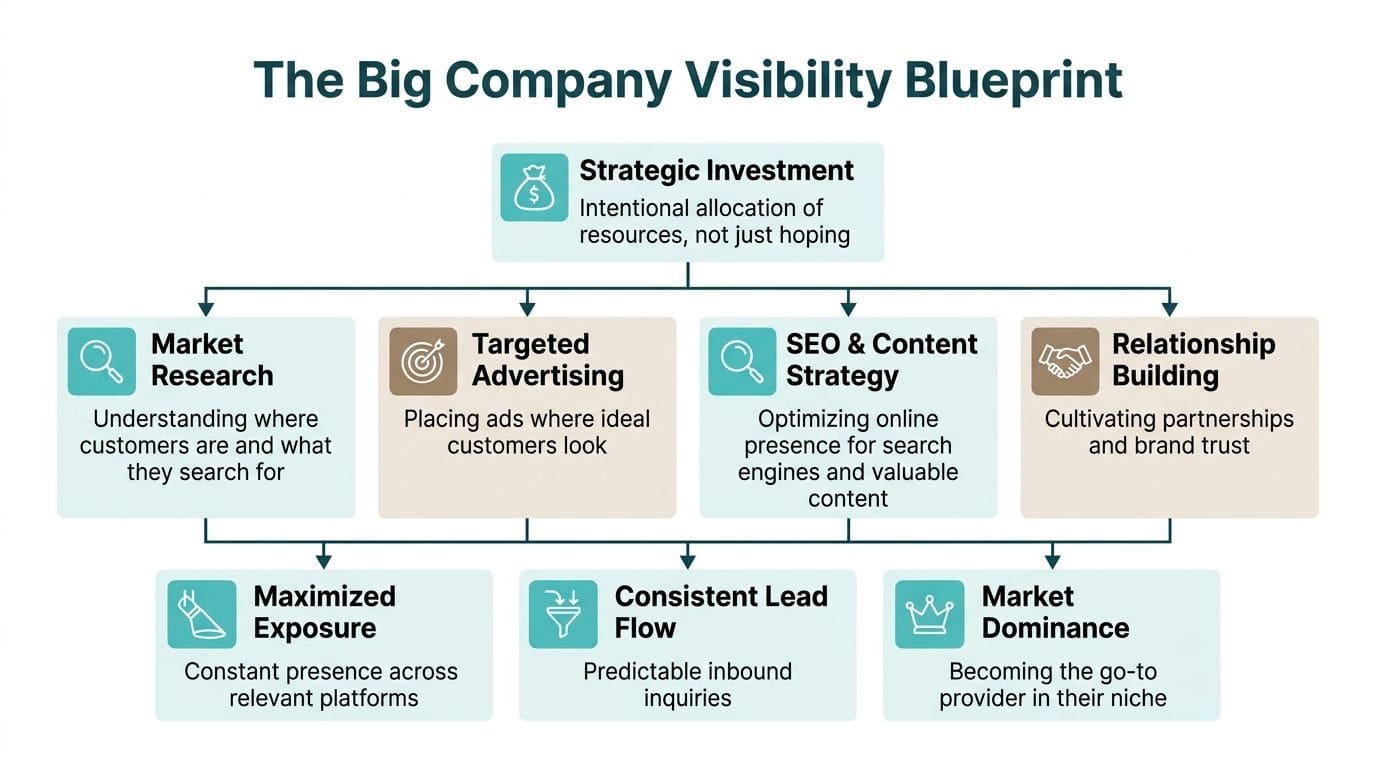
Big companies speak clearly to each market
One of the simplest parts of a visibility system is also the one most contractors skip.
They create pages for the cities they want, not just one homepage for the whole business. Creating city-specific landing pages can raise local ranking probability by about 35% because it signals relevance for each place you target (city-specific landing pages and local ranking probability).
That is not some fancy trick. It is basic clarity.
If you want jobs in five nearby cities, your online presence needs to clearly say you work in those five nearby cities.
Big companies use systems, not random acts
They do a few things well and keep doing them:
- They target specific markets instead of talking to “everybody.”
- They put money behind visibility instead of waiting on luck.
- They build separate paths for separate areas so each city has a real chance to produce leads.
- They measure what produces calls and cut what does not.
That is why they keep showing up.
A useful read on that side of the equation is this article about a performance creative platform. The value is not the buzzwords. It is the reminder that serious businesses treat visibility like an operational system, not a side project.
What contractors should copy
Do not copy the corporate budget. Copy the structure.
You need:
- A real presence in each nearby city you want work from.
- A way to put buyers in front of that presence now.
- Tracking so you can see which cities are worth pushing harder.
That is the shift.
Stop asking, “Why aren’t people calling?”
Start asking, “Where am I invisible, and what system fixes that?”
Because that is the game. Not hustle. Not guesswork. Visibility.
Building Your Lead Machine to Capture Demand
A Lead Machine is not a pretty website.
It is a website built to turn traffic into calls.
That is the whole point.

What makes it different
A regular website says, “Here we are.”
A Lead Machine says, “We do this service in this city. Call now.”
That difference is everything.
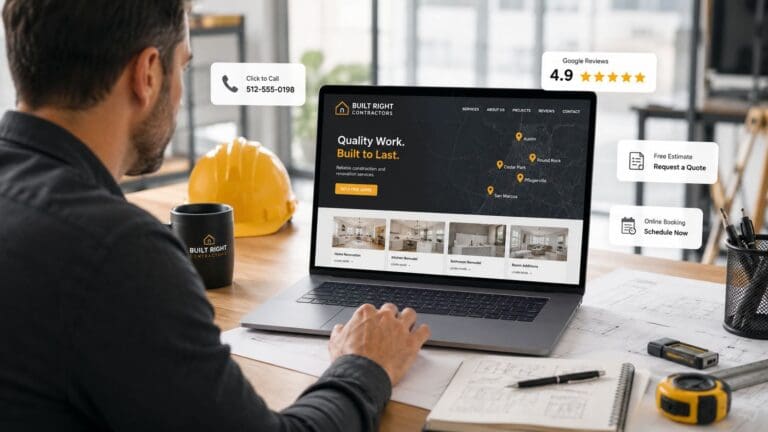
A Lead Machine is built around buyer intent. It is structured by service and city. It gives the person one clear next step. Call. Request a quote. Send the form. It works on a phone. It loads fast. It does not make people hunt for basic information.
If you want a deeper look at what that means, this page explains how to turn your website into a lead machine: https://cherubinicompany.com/turn-your-website-into-a-lead-machine/
What it needs to do
A Lead Machine should do these jobs well:
Match the way buyers search
People do not search for “quality craftsmanship since 2009.” They search for septic repair, excavation, grading, concrete, land clearing, and other services in the city they are in.Cover more than one city
If you want nearby work, your site cannot be built like you only exist in one town.Push the visitor to act
Every page should move people toward a call or form submission. Not wandering. Not reading your life story.Support bigger jobs
Better visibility helps you stop living off scraps. More of the right calls means more chances to take stronger jobs and turn down the weak ones.
This is the asset you own
This matters more than people think.
A Lead Machine is the asset. It is the engine. It is where your traffic goes. It is where buyers decide whether to call you or bounce to the next contractor.
Without that asset, every ad click is fragile. Every referral is less valuable than it should be. Every nearby city is harder to break into.
One option in this space is The Cherubini Company, which builds Lead Machines for contractors with service pages, city pages, calls to action, mobile design, tracking, and alignment with Google Business Profile so the site can capture demand from multiple nearby cities.
That is the right idea.
Not a digital brochure.
Not a vanity project.
Not a “brand refresh.”
A machine.
Think of it this way: The website is not the marketing. The website is the tool that turns visibility into a lead.
Fueling Your Machine with Visibility Ads
A Lead Machine without traffic is like a truck with no fuel.
It may be built right. It is still not moving.
That is where ads come in.
Ads create visibility now. They put you in front of people looking for your service in the places you want to work. Not someday. Not after months of waiting around. Now.
Ads solve the waiting problem
Most contractors hate waiting.
They do not want vague promises. They do not want to hear that traffic might build over time while payroll, equipment, and overhead keep coming due.
Paid traffic solves that because it puts your business in the path of active buyers.
That is why the system works as a pair.
- A Lead Machine without ads waits around.
- Ads without a Lead Machine waste money.
- Lead Machine plus ads gives the buyer a clear path from search to call.
You do not need separate campaigns for every town
Contractors often overcomplicate things here.
Modern ad platforms can target a primary city and cover a pretty wide radius of 15 to 25 miles, which lets one campaign reach multiple nearby towns without splitting everything into redundant campaigns (geo-targeted ad radius for nearby cities).
That matters because your service area probably already crosses city lines. A good job usually justifies some travel. The marketing should reflect that.
You do not need a mess. You need control.
If you want to see how paid traffic fits into that kind of setup, this page breaks down the idea of fueling leads with Google Ads: https://cherubinicompany.com/fuel-your-leads-with-google-ads/
What ads are really doing
A lot of contractors think ads are magic or a scam.
They are neither.
They are just a visibility tool.
They do three simple things:
- They put you in front of buyers searching right now.
- They give nearby cities coverage fast.
- They feed traffic into the Lead Machine so it can do its job.
That is why this is a system, not hustle.
You are not crossing your fingers and hoping referrals save the month. You are creating a repeatable way to get seen where you want jobs.
And that changes how you run the business.
From Guessing to Control and Predictable Growth
The point of all this is not “more marketing.”
The point is control.
Right now, a lot of contractors are stuck in guessing mode. They do some work. They wait on referrals. They spend money here and there. They stay busy enough to survive, but not steady enough to feel in control.
That is a fragile business.
Control changes what jobs you take
When leads are uneven, you take what you can get.
You say yes to small jobs you do not really want.
You chase weak estimates.
You let your schedule get filled with work that does not move the company forward.
When lead flow gets stronger, you get options.
You can choose better jobs.
You can push into better cities.
You can stop acting desperate.
That is the fundamental value of knowing how to get more jobs in nearby cities. It is not just more calls. It is better control over the whole business.
Predictable lead flow calms the chaos
A business without control stays tense.
You wonder if next month will be soft.
You wonder if the ads were a waste.
You wonder if the website is doing anything.
You wonder whether you need to cut prices just to keep crews moving.
That stress wears people down.
A Lead Machine paired with visibility ads gives you a way out of that cycle. You have an asset built to convert. You have traffic going into it. You have a system that can expand into the cities around you instead of leaving them to competitors.
Bottom line: Predictable leads give you room to think like an owner instead of reacting like a guy trying to survive the week.
You think that customers “can” find you but, if customers “don’t” find you, nothing else matters. Lead Machines are built to fix that.
If you want a straight answer on what is making you invisible in nearby cities, talk to The Cherubini Company. They build Lead Machines and run visibility ads for contractors who want more calls, more reach, and more control without the usual agency nonsense.