
You know the feeling.
You’re busy. Your crew is working. People in your town know your name. But the phone still isn’t ringing the way it should. Not for the better jobs. Not from the towns you want to work in. Not from the customers who are searching right now.
That isn’t a talent problem. It isn’t a work ethic problem. It’s a visibility problem.
A lot of contractors ask what is geo vs seo like it’s some marketing debate. It isn’t. It’s a business question. It comes down to one thing. Where do you show up when buyers look for your service?
If you only show up in your home town, you’re boxed in. If you don’t show up in nearby cities, you lose jobs before you ever get a chance to bid them. If your website just sits there waiting for traffic, it isn’t a lead system. It’s a brochure.
Here’s the straight answer. Search engine optimization helps your website show up in search results. Generative engine optimization helps your business get included in AI answers. For a local contractor, both matter. But neither means much if your visibility stops at your office address.
Use this simple comparison to keep the issue clear.
| Topic | SEO | GEO |
|---|---|---|
| Main job | Help pages rank in search engines | Help brands get mentioned or cited in AI answers |
| What success looks like | More rankings, clicks, and traffic | More mentions, citations, and share of voice in AI results |
| What a contractor actually needs | Visibility in the cities you serve | Visibility when buyers ask AI tools who to hire |
| Common weakness | Can stay too broad or too tied to one location | Can ignore the website and conversion side if used alone |
| Best use | Build your search foundation | Add visibility where zero-click search is growing |
| Real business point | Get found | Get recommended |
For contractors, the right move isn’t picking one side like it’s a cage match. The sensible move is building a system that makes you visible in the places you want work from, then turning that visibility into calls.
Losing Jobs You Never Knew Existed
You’re probably known in your home town.
If someone says your company name out loud, people know who you are. Maybe you’ve wrapped trucks, yard signs, referrals, church connections, supplier relationships, and years of solid work behind you. That works well close to home.
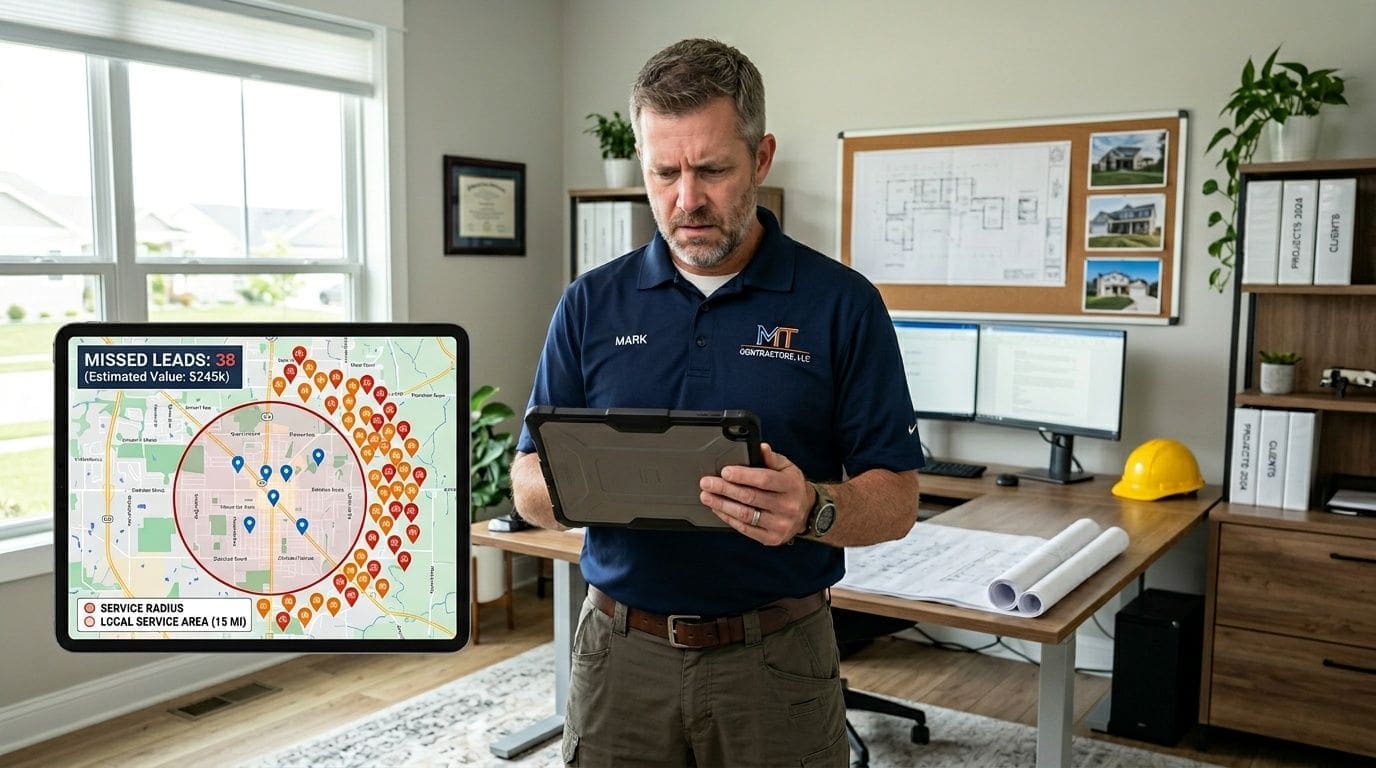
Then a homeowner or builder ten miles away searches for your service, and you don’t show up. You just want a lead generation system for contractors.
The real problem isn’t leads
Most contractors say they need more leads.
That’s true, but it misses the main point. You don’t get the lead if you never get seen. The customer isn’t refusing to hire you. They don’t know you exist.
That’s the visibility gap.
You may be the best septic installer, excavator, concrete contractor, or grading company in your area. It doesn’t matter if Google, Maps, and now AI tools don’t connect your business to the city where the buyer is searching.
If customers don’t find you when they search by service and city, you were never in the running.
A lot of owners miss this because they think “near me” means nearby in a human sense. It doesn’t work that way. A search for your service “near me” gets tied to the searcher’s location. If you’re not clearly connected to that city online, you’re invisible there.
Your website isn’t a lead source by itself
At this point, contractors get sold nonsense.
Someone builds a nice website. It has drone shots, a clean logo, maybe a paragraph about quality and integrity. Then everybody waits for leads. Nothing happens, or not enough happens, and the owner thinks online marketing doesn’t work.
The website didn’t fail because it’s ugly or because you picked the wrong font. It failed because websites don’t create traffic. They wait for traffic.
That’s why so many contractor sites sit there like digital brochures collecting dust. No traffic in means no calls out. A website without visibility is like putting your sales office in the woods and hoping people wander in.
Invisible outside your hometown means fragile revenue
This is why feast or famine keeps happening.
When referrals slow down, the gap gets exposed. You find out fast that being well known in one town is not the same as controlling demand across your service area. The jobs are still out there. Other contractors are getting them. You just never saw the opportunity.
That should bother you.
Because the jobs you lose without even seeing them are often the jobs that would have helped you smooth the month, keep crews busy, and say no to the small headaches.
Here are the hard truths:
- Word of mouth is not control. It’s helpful, but it leaves your pipeline in somebody else’s hands.
- A one-town web presence is not growth. It’s a ceiling.
- A pretty website is not visibility. It’s an asset waiting for traffic.
- No visibility means no chance. You can’t quote jobs you never appear for.
The question isn’t whether customers can eventually find you.
The question is whether they do find you when they’re ready to buy.
Why SEO Isnt Enough for Local Contractors
Most contractors hear SEO and think it means “getting found on Google.”
That’s close enough for plain talk. SEO is about helping your website show up in search results.
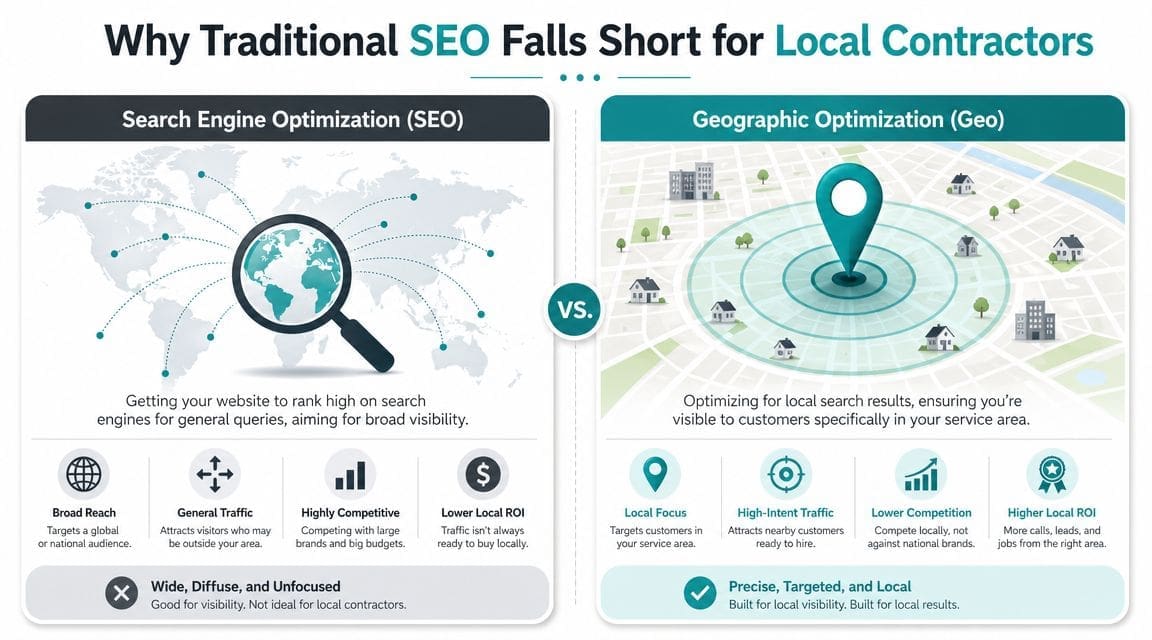
But local contractors usually don’t need broad internet fame. They need to show up in the exact towns, counties, and service areas where they want work. That’s where the usual SEO pitch falls apart.
Traditional SEO often solves the wrong problem
A lot of agencies sell SEO like this: more blog posts, more keywords, more rankings, more traffic.
Fine. But traffic from where?
If you’re an excavation contractor in Newark and you want jobs in Heath, Granville, Zanesville, and the towns around them, broad traffic doesn’t fix the problem. Ranking for a general term is not the same thing as being visible where buyers are located.
That’s why the better question in what is geo vs seo isn’t “which one is better?” It’s “which one solves your visibility gap?”
SEO tries to improve your presence in search engines.
GEO focuses on getting your business understood and surfaced in the places people now get answers, including AI-generated results. For contractors, that matters because local search isn’t just a list of blue links anymore.
According to this review of geo vs seo in local search, 30%+ of queries now trigger AI summaries, and that can reduce clicks to websites by up to 50% for local businesses that aren’t optimized for GEO.
Home town visibility is not service area visibility
In this scenario, owners get blindsided.
Google sees patterns. It sees your address. It sees where your business is mentioned. It sees what cities your site talks about. If you only talk about your home town, don’t be shocked when search engines assume that’s your main area.
Why would Google assume you do work in cities you’ve never mentioned?
That sounds obvious once you hear it. But most contractor marketing ignores it.
Practical rule: If your online presence doesn’t clearly tie your services to every city you want work from, those cities are open territory for your competitors.
This is why many contractors say SEO didn’t work. What they often mean is this: they paid for generic search work, but they never built visibility in the actual places they wanted calls from.
If you want a plain-English breakdown of that local problem, this guide on local SEO for contractors gets to the point.
GEO matters because buyers don’t always click
A homeowner might ask ChatGPT who installs septic systems nearby. A property owner may use Perplexity to compare local grading contractors. A buyer can get a short list without visiting ten websites.
That changes the game.
You still need search visibility. But now you also need to be the company that gets named, cited, or pulled into those answers. That’s what GEO is really about. Not magic. Not trendy marketing language. Just another layer of visibility where buying decisions are now happening.
Comparing Goals Channels and Costs
Let’s keep this simple. Contractors don’t buy marketing because they want rankings. They buy marketing because they want calls, estimate requests, and better jobs.
That’s why the cleanest way to understand what is geo vs seo is to compare what each one is trying to produce.
The side by side business view
| Business question | Traditional SEO | GEO |
|---|---|---|
| What is it chasing | Website clicks from search results | Mentions and citations inside AI answers |
| Main scorecard | Traffic, rankings, click rate | Brand mention frequency, citation rates, share of voice |
| How it feels to an owner | Slow build, hard to connect to jobs | Less obvious on the surface, but often closer to buyer intent |
| Risk if used alone | Plenty of visits, weak local spread, or low intent traffic | Good visibility in answers, but weak site conversion if the website is poor |
| Best role | Build the base | Win zero-click visibility and recommendation value |
Traditional SEO became huge for a reason. It built an $80 billion+ industry by 2025, based on traffic, rankings, and related metrics, according to a16z’s breakdown of GEO over SEO. But search behavior changed. That same source says 80% of users answer 40% of their queries without clicking links. That’s the crack in the old model.
What each channel actually does
For a contractor, SEO usually points back to the website. The goal is to get pages into Google results and earn clicks.
GEO is different. The goal is to get your business included in an answer, even if the user never clicks. That sounds strange until you remember what the buyer really wants. They want a name they can trust, fast.
So the channels serve different jobs:
- Website pages: Good for showing services, cities, proof, and calls to action.
- Search results: Good for catching buyers who still compare options by clicking.
- AI answers: Good for buyers who want a short list or a direct recommendation.
- Maps and local business signals: Good for proving where you work.
If you want broader context beyond contractor marketing, these enterprise search strategy insights from Algomizer do a good job showing why visibility now stretches across more than one type of search surface.
Costs matter, but wrong costs hurt more
Owners usually ask which one costs less.
Wrong question.
The expensive option is the one that doesn’t make you visible where the money is. A cheaper campaign that leaves you trapped in one city is not cheap. It’s costly because of the jobs you never see.
SEO is usually trying to win the click. GEO is trying to win the mention. A contractor needs both only if both support local visibility and real calls.
A slow build can still be useful if it strengthens your footprint in the right service areas. But if you need work from specific towns, broad traffic by itself won’t solve that fast enough.
The bottom line is simple. General SEO chases presence. Visibility strategy chases revenue. Those are not the same thing.
Introducing the Contractor Lead Machine
The geo vs seo debate gets stupid when people act like one tactic is the whole answer.
It isn’t.
A contractor needs a system. One part has to convert attention into calls. The other part has to create the attention in the first place. If either piece is missing, the whole thing breaks.
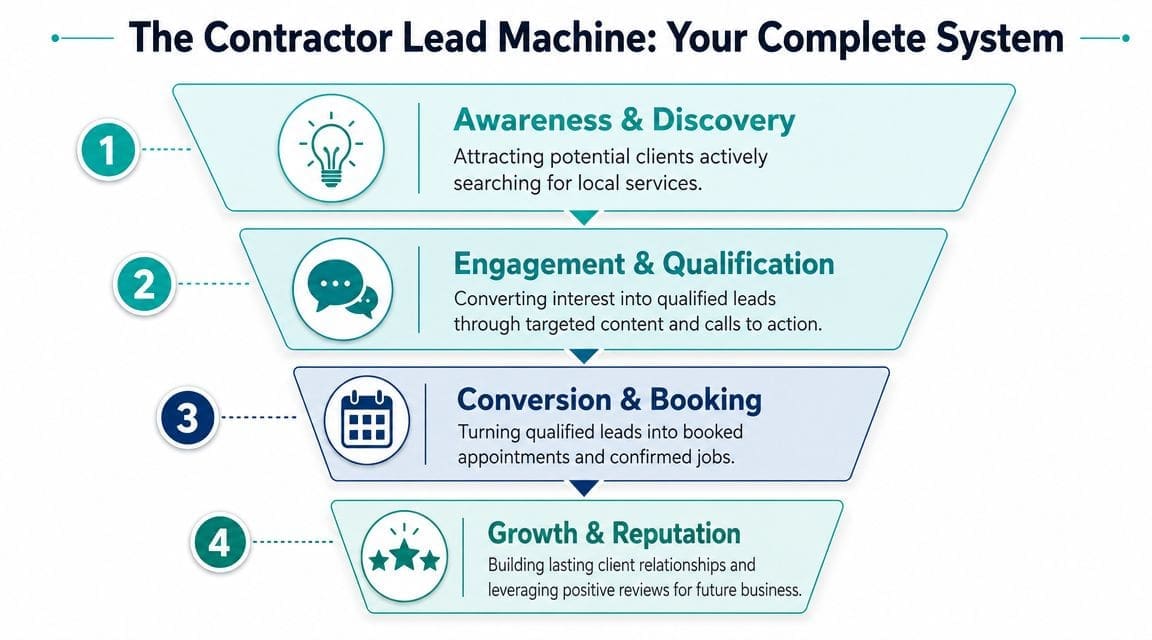
The website is the machine
A real lead website is not there to impress your friends.
It’s there to turn search traffic and ad traffic into calls and form fills. That means it needs to be built around your services, your cities, and your next step. Not around vague company talk.
For a contractor, that means the site should reflect where you work and what you do. If you want jobs in multiple cities, the system has to support visibility in multiple cities. If you want calls, the calls to action need to be obvious. If you’re paying for traffic, the site needs to convert that traffic instead of wasting it.
That’s the machine.
If you want a plain explanation of the concept, this page on what a Lead Machine is lays it out clearly.
Ads are the fuel
The website does not go out and hunt for customers.
Ads do that.
Ads create immediate visibility in front of buyers who are already searching for your service. Then they send those buyers to the machine. This is why the “just build a website” advice fails so often. It leaves out the fuel.
And this is also why “just run ads” fails. If the traffic lands on a weak site, the money burns off.
That two-part system is the only sensible setup:
- Build the asset so it can convert traffic into calls.
- Buy visibility so the right people see it.
- Match service and city intent so you’re not paying for random attention.
- Track what happens so you’re not guessing.
Why this works better now
Search has changed in a way that favors stronger intent.
According to Zeo’s comparison of SEO and GEO, traditional SEO traffic converts at about 2.8%, while GEO-driven AI referrals convert around 14.2%, which is a 5x improvement. That’s a big deal for contractors because low-quality clicks waste time. Better intent means better calls.
This shift also changes how content should be planned. Not because you need to become a marketer, but because your visibility system should be built around clear service and city intent. If you’re curious how teams structure prompts and topics around local demand, this AI content brief generator is a useful example of the thinking behind better planning.
A website without traffic is dead weight. Ads without a conversion system are a leak. Together, they become a lead system.
That is the whole idea. No fluff. No mystery.
When to Invest in Visibility vs General SEO
Most contractors don’t need more theory. They need a decision.
So here’s the decision.
If your business depends on local jobs, and you want calls from the next town over, visibility comes first. General SEO only matters after it supports that goal.

Choose based on the job you need done
Use this filter.
If you need more work in specific cities this month or this season, invest in visibility. That means a site built around service areas and traffic pointed at it. If you only invest in broad SEO and wait, you’re solving a slower problem than the one you have.
If you’re already getting plenty of the right calls from your service area, then broad SEO can help strengthen your foundation over time. But that’s not the situation most contractors are in. Most are known in one pocket and weak everywhere else.
Here are the simple calls:
- Need jobs in the next county over: Put money into visibility.
- Need to fill a slow month: Put money into visibility.
- Need bigger jobs, not more tire kickers: Put money into visibility tied to intent.
- Already dominate your service area and want wider authority: Then layer in broader SEO.
Quality matters more than raw traffic
Owners waste money chasing more visitors instead of better buyers.
According to Semrush on GEO vs SEO, GEO-driven traffic boasts 23x higher conversions, with longer dwell times and stronger intent. That tracks with what contractors want. Not random clicks. Not website vanity. They want serious buyers.
So if you’re deciding where to spend next, ask one question.
Do you want more people on your website, or more qualified people calling your business?
Those are different outcomes.
A contractor rule worth keeping
If someone tells you your website alone will generate leads, read this short piece on why websites don’t generate leads. It says what more owners need to hear.
General SEO has a place. But for local contractors, it is not the first lever to pull when revenue depends on showing up in the right towns. The first lever is visibility in the markets you want.
Your Implementation Checklist for Gaining Control
You don’t need a pile of marketing terms.
You need a way to judge whether your current setup is built to make the phone ring in the places you want work from. Use this checklist like an owner. Not like a marketer.
What a real visibility system must include
-
Clear coverage of every target city
If your system only talks about your home town, it is incomplete. Buyers search by service and location. Your visibility has to match that. -
A website built for calls, not compliments
The site should make it easy to call, request a quote, and understand what you do. If it mainly looks polished but doesn’t push action, it isn’t doing its job. -
Strong alignment between services and service areas
A general company page won’t carry the load. Your visibility has to connect what you do with where you want to do it. -
A traffic source that creates immediate visibility
Waiting around for organic traffic is not a growth plan. You need a way to get in front of people who are searching now. -
Tracking that shows what is working
If you can’t tell where calls and form fills came from, you’re still guessing.
Questions to ask any agency or provider
Take these into every sales call.
- How will you make us visible outside our home town?
- How will this system turn traffic into calls?
- What creates traffic right away, not someday?
- How will we know which cities are producing leads?
- If clicks drop because buyers use AI answers, how will we still stay visible?
If they can’t answer those clearly, keep walking.
The standard is not complicated
A contractor lead system should do three things well:
| Must-have outcome | Why it matters |
|---|---|
| Show up in the cities you serve | Because work doesn’t only come from your office zip code |
| Turn visibility into calls | Because traffic without conversion is wasted |
| Give you control over lead flow | Because hope is not a business model |
The right question is not “Are we doing marketing?” The right question is “Are we visible where buyers are looking?”
That’s the whole game.
You think customers can find you. But if customers don’t find you, nothing else matters. Lead Machines are built to fix that.
If you’re tired of guessing and want a simple visibility system that makes your business show up in the cities where you want work from, talk to The Cherubini Company. They build Lead Machines for contractors who want steady calls, better jobs, and more control over revenue.