
You’re probably busy right now.
The crews are moving. The phone rings some weeks. Other weeks it goes quiet. You’ve got work, but not always the work you want. Too many small jobs. Too much driving. Too much quoting. Not enough of the bigger jobs that move the business forward.
That’s the pain behind how to grow a construction company. Most contractors aren’t lazy. They’re not bad at the work. They’re stuck in a system that keeps them busy and keeps them small.
A lot of them rely on word-of-mouth, an old website, and hope.
Hope is not a growth plan.
The hard truth is simple. You do not have a work ethic problem. You have a visibility problem. If people can’t find you in the cities where you want jobs, you don’t exist to them. And if you don’t exist when they search, you never even get a shot at the bid.
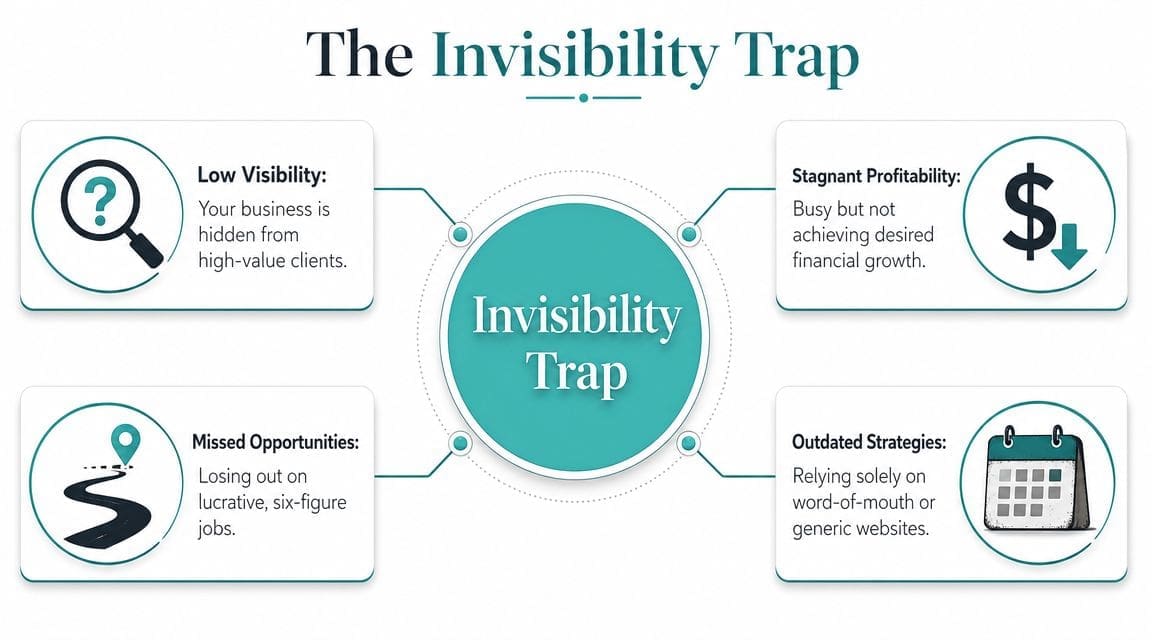
The Invisibility Trap Costing You Six-Figure Jobs
The biggest lie contractors tell themselves is this:
“We’re known around here.”
That may be true in your home town. It usually is. People know your trucks. They know your family name. They’ve heard of you. But drive ten miles out, twenty miles out, one county over, and it’s a different story.
There, you’re a ghost.
That’s the invisibility gap. You work in those towns. You’ll gladly take jobs there. But when people search for your service, you don’t show up because you have never clearly told Google that you serve those places.
When someone searches for “excavation contractor near me” or “septic installer near me,” Google doesn’t read that like a human. It turns “near me” into the city the searcher is standing in. If your business only talks about your home town, Google has no good reason to put you in front of that buyer in the next city.
Why would it?
Busy does not mean growing
A lot of contractors are slammed and still frustrated.
They stay buried in smaller jobs because those are the only jobs making it to them. The better jobs often go to companies that show up first and look established across the whole service area. That’s not because those companies are better builders. It’s because they are more visible.
Here’s the part most owners miss. Strong operations matter. Planning, scheduling, and risk management matter. According to a review of internal growth factors in construction, high-trust firms with strong oversight save up to $4 million yearly, and the U.S. Bureau of Labor Statistics projects 4.7% growth in construction employment from 2023 to 2033. But that same analysis makes the bigger point plain: operational excellence is wasted if you don’t have a steady flow of opportunities people can find you for (construction growth and project management findings).
So no, the answer isn’t “just run tighter jobs.”
If nobody in the next city sees you, your clean schedule doesn’t matter.
Practical rule: If a buyer searches for what you do in a city you serve, and you don’t show up, that lead was never yours to lose. You were never in the game.
The jobs you never bid are the ones hurting you
Most contractors obsess over the jobs they lost.
Wrong focus.
The jobs crushing your growth are the jobs you never knew existed. The property owner searched. Your competitor showed up. You didn’t. End of story.
That’s why so many owners feel like growth is random. They think demand is soft, or the market is weird, or everybody’s shopping price. Sometimes that’s true. A lot of the time, they’re invisible outside their own zip code.
You can see this same pattern in public work too. If you want another lane for growth, it helps to study strategies for public sector construction, because those jobs also go to firms that show up clearly, respond clearly, and position themselves where buyers are looking.
The point is bigger than one channel. Visibility wins.
If this sounds familiar, read more about why contractors don’t get enough leads. The short version is simple. Most contractors think they have a lead problem. What they really have is a market presence problem.
What the invisibility trap looks like
Here’s how it usually plays out:
- You’re strong at the work: Your jobs get done, clients are happy, and referrals come in.
- Your online presence is stuck in one town: Your site, listings, and messaging mostly point back to your address city.
- Your service area is wider than your visibility area: You drive farther than Google thinks you do.
- Your pipeline stays uneven: Good months feel great. Slow months feel personal.
That cycle keeps owners trapped.
They don’t need another lecture about hustle. They need to fix the part of the business that decides whether buyers even see them in the first place.
Why Your Website and Word-of-Mouth Guarantee Stagnation
Let’s kill two bad ideas right now.
First, your website does not generate traffic.
Second, word-of-mouth is not a growth system.
A website without traffic is like a billboard in the woods. It exists. That doesn’t mean anybody sees it. Contractors get sold the fantasy that if they buy a new site, leads will somehow appear. That’s nonsense. A website sits there and waits. It does nothing on its own.

Your website is an asset, not a traffic source
A website has one job. When traffic lands on it, it should turn that traffic into calls and form fills.
That’s it.
If nobody is being sent there, it’s just a digital brochure. Maybe it looks nice. Maybe your cousin says it’s sharp. None of that matters if it doesn’t get seen by people searching for your work in the cities you serve.
Contractors often get burned. They pay for a site. Then they wait. Then they decide “online marketing doesn’t work.”
No. Passive websites don’t work.
Word-of-mouth is good, but it can’t scale on command
Referral work is great. Keep it. Protect it.
But don’t confuse “valuable” with “reliable.”
Word-of-mouth comes when it comes. You can’t turn it up because you hired another crew. You can’t point it at a new county because you bought another machine. You can’t use it to smooth out a slow season with any control.
That’s why referral-only contractors live in feast or famine.
Word-of-mouth is a bonus. It is not a system for controlling revenue.
Here’s the plain comparison:
| Approach | What happens |
|---|---|
| Website only | It waits for traffic |
| Word-of-mouth only | It depends on other people talking |
| Both together with no traffic plan | You stay reactive |
| Visibility system | You create demand flow you can control |
Why this keeps you stuck
A contractor can stay alive like this for years.
That’s the problem.
You get just enough work to keep going. Not enough control to make smart decisions. Not enough consistency to hire with confidence. Not enough selectivity to say no to jobs that waste time and equipment.
If you want to know how to grow a construction company, stop asking whether your website looks professional. Ask whether it is part of a system that gets you found outside your home town.
If it isn’t, you are standing still.
The Growth System Big Companies Use to Dominate Markets
Big companies don’t wait to be discovered.
They buy visibility.
That’s one of the clearest differences between a small contractor and a company that keeps taking over more territory. Small contractors hope people hear about them. Bigger companies put themselves in front of buyers on purpose.
That’s not luck. That’s a system.
Hope is not a system
A lot of owners are running random acts of marketing.
They try a website. They boost a post. They buy a mailer. They hire somebody to “do marketing.” Nothing connects. Nothing compounds. Nothing gives them control.
That kind of hustle feels busy, but it doesn’t build a machine.
A real growth system has two parts:
- A lead capture asset built to turn attention into calls.
- A visibility source that puts your company in front of buyers searching right now.
When those two parts work together, you stop guessing.
What big companies understand
Big companies know something a lot of local contractors ignore. Visibility is not fluff. Visibility is distribution.
If buyers don’t see you, they can’t call you.
If they can’t call you, they can’t hire you.
If they can’t hire you, you can’t grow.
That’s why the right model is simple. Build the machine. Then fuel it.
The website is the asset. The traffic is the fuel. One without the other leaves you stuck.
The Lead Machine mindset
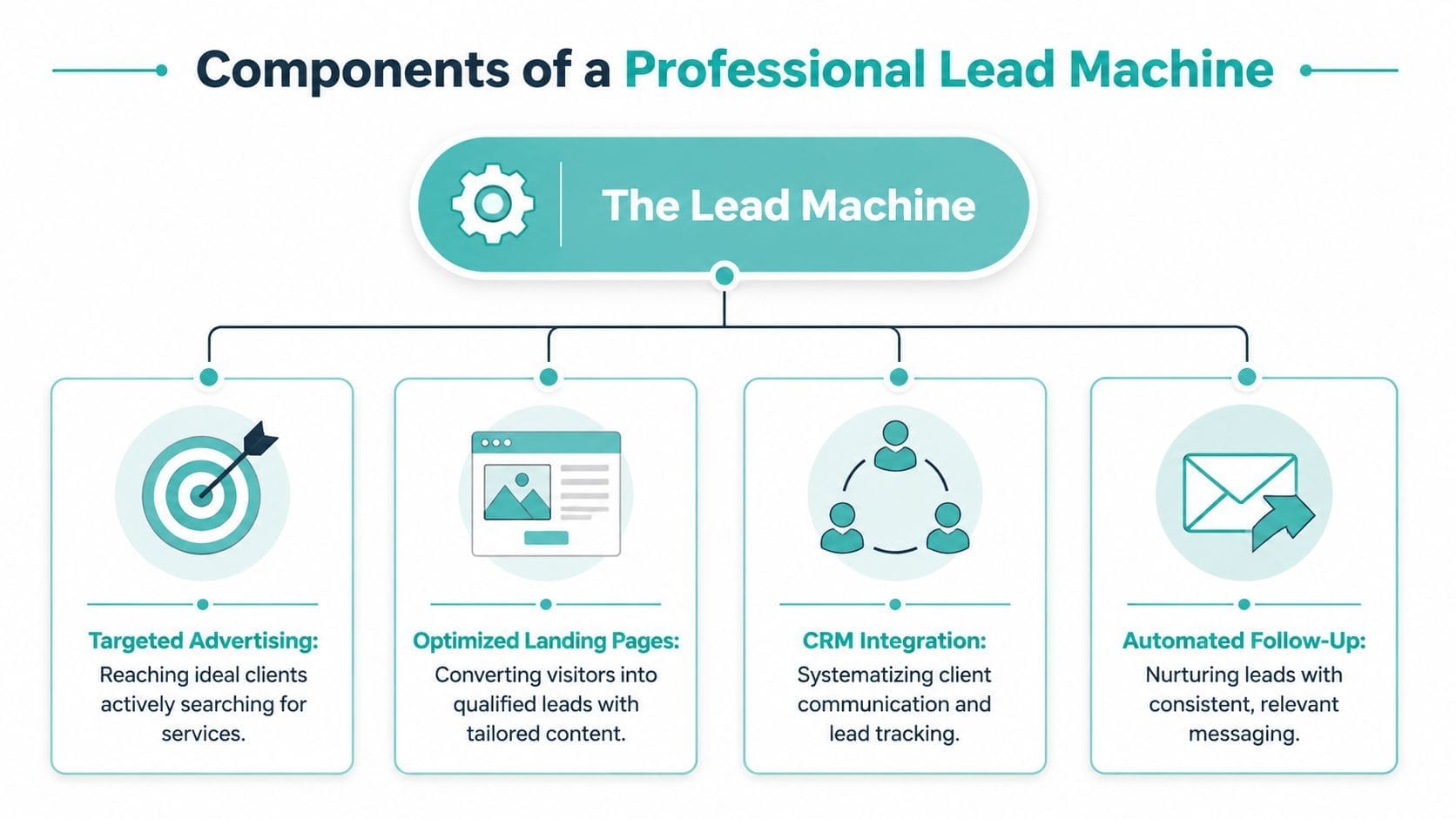
Think of a Lead Machine like a piece of equipment, not a design project.
You wouldn’t buy an excavator because the paint looks nice. You buy it because it does a job. Same thing here. The machine exists to turn local search demand into real calls, quote requests, and booked work.
Then you add fuel. That’s visibility on demand. Buyers search. You show up. They click. The machine does its job.
This is why big companies pull away from smaller contractors. They don’t just work hard. They build systems that make growth repeatable.
The shift matters. Once you stop treating marketing like art and start treating it like operations, the whole business changes. Growth stops being a mystery and starts becoming mechanical.
Building Your Lead Machine for Total Service Area Control
Most contractor websites are built to look acceptable.
That’s too low a bar.
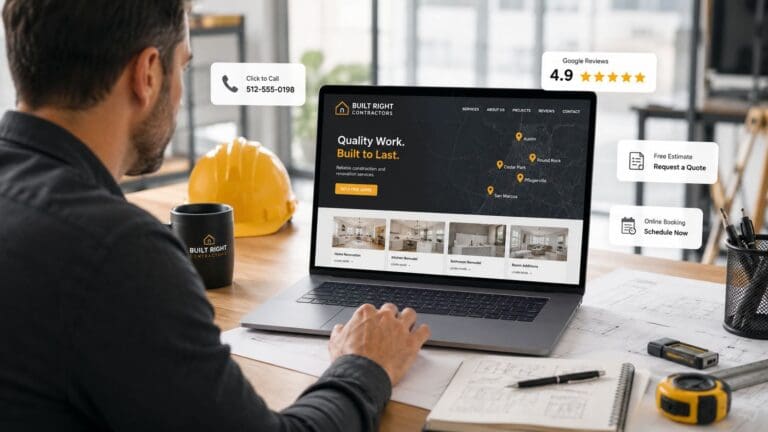
A Lead Machine should be built to do one thing well. Turn traffic into calls across the full area you want to serve. Not just your address city. Not just the town where your sign sits. Your real service area.
That means structure matters. Speed matters. mobile use matters. Tracking matters. Calls to action matter. The thing has to work like a tool.
A pretty site is not the job
A lot of web designers still build contractor sites like online brochures.
Home page. About page. Contact page. A few photos. Maybe a services page if you’re lucky.
That setup won’t give you service area control.
If you do excavation, grading, septic, land clearing, concrete, or well drilling in multiple cities, your site needs to reflect that reality. It should clearly connect what you do with where you do it. That is how you close the invisibility gap.
A proper Lead Machine includes pieces like these:
- Service and city structure: Separate pages that connect your core services with the actual cities and counties you want work from.
- Clear calls to action: Click-to-call, quote forms, and next steps that are obvious on every key page.
- Fast load speed: Slow pages lose buyers. Local buyers won’t wait around.
- Mobile-first design: A majority of contractor searches occur on a phone.
- Tracking built in: If you don’t know what city, service, or page created the lead, you’re still guessing.
Why structure changes the business
This isn’t just a marketing issue. It affects operations.
Many growth guides miss this. For site-prep contractors, heavy equipment can account for 30% to 50% of project costs, and a predictable lead system helps owners make smarter decisions about ownership versus leasing when expanding into new areas without crushing working capital (equipment costs and growth gap in contractor planning).
That matters because you cannot plan equipment, crews, or territory expansion on random lead flow.
You need clarity.
If one county keeps producing good excavation work and another mostly sends price shoppers, that should shape your decisions. If septic leads from one city turn into better jobs than general dirt work from another, that should shape your focus. A Lead Machine gives you a way to see that.
Owner mindset: Stop asking, “Do we have a website?” Ask, “Do we control visibility by service and city?”
What a complete machine looks like
A complete system is not just a home page and some photos.
Here’s the difference:
| Weak website | Lead Machine |
|---|---|
| General message | Service-specific and city-specific pages |
| Looks decent | Built to convert calls and quote requests |
| No real tracking | Tracks where leads come from |
| Covers one town well | Built for multi-city visibility |
One option contractors look at when they want this kind of structure is what a Lead Machine is. The idea is simple. Build a site as a lead system, not as an online brochure.
That foundation matters because traffic without conversion is waste, and growth without service area control is sloppy. If you want to grow on purpose, the machine has to be built right first.
Fueling the Machine with Predictable High-Intent Traffic
A lot of contractors tense up at this stage.
They hear “ads” and think wasted money, junk leads, and some agency sending a report nobody understands. Fair enough. A lot of ad campaigns are trash.
But ads are not the main problem.
The core problem is that most contractors sent paid traffic to a weak site that couldn’t convert. That’s like pouring water into a bucket with holes in it, then blaming the water.

Ads are fuel, not magic
A Lead Machine on its own is still waiting.
Paid traffic fixes that. It creates visibility now. It puts your company in front of people actively searching for the service you sell in the places you want to work. Not someday. Not after months of hoping. Now.
That’s the proper role of ads.
Not branding fluff. Not vanity. Not “getting your name out there” in some vague way. The job is simple. Put buyers in front of the machine so the machine can turn them into leads.
Why good traffic changes growth decisions
This matters even more when you expand geographically.
Growing into new cities usually raises customer acquisition cost and can cut short-term profit if you do it blindly. A systematic visibility approach lets contractors compare acquisition cost against customer value by city or service line, which is the kind of hard-nosed view owners need before pushing into a new market (visibility and market expansion economics for contractors).
That’s a much smarter way to think.
Not “Should we advertise in the next county?”
Instead ask, “Does this county produce the kind of jobs worth paying to be visible for?”
That question protects profit.
The right way to think about traffic
Don’t think of ads as gambling.
Think of them like fuel for a truck. If the truck is sound, fuel makes it move. If the truck is broken, fuel gets blamed for the wrong problem.
That’s what happened to a lot of contractors who say, “We tried ads and they didn’t work.”
Usually what they tried was this:
- Bad destination: Traffic landed on a weak site with no clear city and service focus.
- No tracking: Nobody could tell which leads were real and which were junk.
- No system: Ads were treated like a campaign, not part of an engine.
- No patience for data: Decisions got made from emotion instead of lead quality.
A stronger approach is to send high-intent traffic to a conversion-focused asset and judge results by calls, form fills, job quality, and city-level performance. That’s why some contractors explore Google Ads for contractors as part of a broader visibility system instead of as a stand-alone experiment.
If your site can’t convert, traffic gets blamed. If your site can convert, traffic becomes leverage.
That’s the shift.
Once traffic is predictable, lead flow stops feeling random. And once lead flow stops feeling random, you can run the company with a lot more nerve.
Scaling Operations to Handle Your New Flood of Leads
A better lead system solves one problem first. Not enough good opportunities.
Then it exposes the next problem. Can your business handle growth without turning into chaos?
That’s where a lot of contractors blow it. They wanted more leads. They got more leads. Then they kept bidding everything, kept saying yes to the wrong work, and kept running the company with the same loose habits that were barely good enough when volume was lower.
Growth punishes sloppy operators.

First, get selective
When the pipeline gets stronger, your first move is not “take more jobs.”
Your first move is take better jobs.
Consistent lead flow lets you stop acting desperate. You can turn down the tiny work that clogs the schedule. You can stop sending crews all over the map for weak margins. You can start targeting jobs that fit your equipment, crew skill, and profit goals.
That’s real growth. Not more chaos. Better work.
Use a filter like this:
- Keep the jobs that fit your best service lines: Double down where your team is already strong.
- Favor work in target areas: Tight service zones usually create better control.
- Watch lead quality by market: Some cities produce stronger buyers than others.
- Bid for margin, not ego: Revenue that drags down profit is a bad deal.
Tighten your money before you expand your footprint
More work can break a company fast if cash flow is loose.
To scale profitably past $1M, rigorous financial management matters. Poor cash flow is the top mistake and causes 70% to 80% of growth failures. The fix is not complicated, but it does require discipline: use precise job costing, invoice right after milestones, and keep a rolling 90-day cash flow forecast. Contractors who do that give themselves a shot at the 20%+ net margins top-quartile firms reach instead of just getting bigger and staying stressed (financial controls for scaling a construction company).
That’s the difference between scaling revenue and scaling problems.
If you need a plain-English resource on cash discipline, this guide on optimizing construction project finances is useful because it keeps the focus where it belongs. Cash in. Cash out. Timing. Control.
More leads without money control will bury you faster than a slow month will.
Use predictable demand to make better equipment decisions
Once lead flow becomes steady, equipment choices get cleaner.
You can look at territory demand and decide whether a machine should be owned, leased, or rented based on actual opportunity instead of gut feel. You can match asset decisions to the kind of jobs coming in. You can avoid tying up working capital in iron you don’t have enough demand to keep busy.
This is one of the biggest hidden benefits of predictable visibility. It helps you make operating decisions with less fear.
The same goes for labor.
Build capacity on purpose
Don’t hire in a panic. Don’t add crews because one good month made you emotional.
Build capacity in layers.
A smart contractor usually grows operations like this:
-
Clean up estimating and job selection first
Bad jobs chew up good crews. -
Standardize communication and follow-up
If leads sit too long, you waste the visibility you paid for. -
Vet subcontractors before you need them
Desperation is how bad subs get into the business. -
Add labor where bottlenecks are obvious
Not where your gut is loudest. -
Tie every expansion move back to lead quality
More volume only helps if the work is worth doing.
Here’s a simple view:
| If this improves | You can do this next |
|---|---|
| Lead consistency | Bid more selectively |
| Job costing | Protect margin on larger jobs |
| Cash flow planning | Finance growth with less risk |
| Market visibility | Expand into new cities with control |
This is the part many agencies never talk about because they only understand clicks.
Contractors don’t need more clicks. They need a business that can use a stronger pipeline to become more profitable, more selective, and less fragile.
That is how to grow a construction company the right way. Not by doing ten random marketing tasks. Not by posting more on social media. Not by waiting for referrals to save you.
You fix the visibility gap first.
Then you use the lead flow to tighten operations.
Then you grow with control.
If customers “don’t” find you, nothing else matters. Lead Machines are built to fix that.
If you’re a contractor and you’re tired of guessing, The Cherubini Company builds Lead Machines and visibility systems for businesses that need to be found in the cities they serve, not just the town where their office sits. If you want predictable leads instead of hope, start there.