You’re out there every day. Crews to manage. Quotes to send. Trucks to keep moving. Customers calling about changes, delays, and one more thing they forgot to mention.
And still, the phone isn’t ringing enough.
Not with the right jobs anyway.
You might be busy, but busy isn’t the same as stable. A full week of small cleanup work can still leave you stressed. Word of mouth helps, but it doesn’t give you control. Old customers call when they call. Referrals come when they come. That’s not a lead system. That’s hope.
A lot of landscaping owners already know this. They’ve tried a website. They’ve tried ads. They’ve hired an agency that talked big, showed charts, and blamed the market when nothing happened. So now they don’t trust any of it.
That part makes sense.
But usually, the actual problem isn’t that advertising for landscaping “doesn’t work.” It’s that most contractors are invisible where buyers are searching. They show up in their hometown. Then they disappear ten miles away. That gap costs jobs every week, and most owners never even see it happen. Even when you need drainage and grading work.
Your Phone Should Be Ringing More
You know the pattern.
Spring hits. The schedule fills up fast. Then the wrong work starts clogging the calendar. Small jobs. Price shoppers. People who want a full design plan on a bargain budget. Meanwhile, the bigger install jobs, hardscape jobs, and irrigation leads seem harder to get than they should be.
That’s when the stress starts.
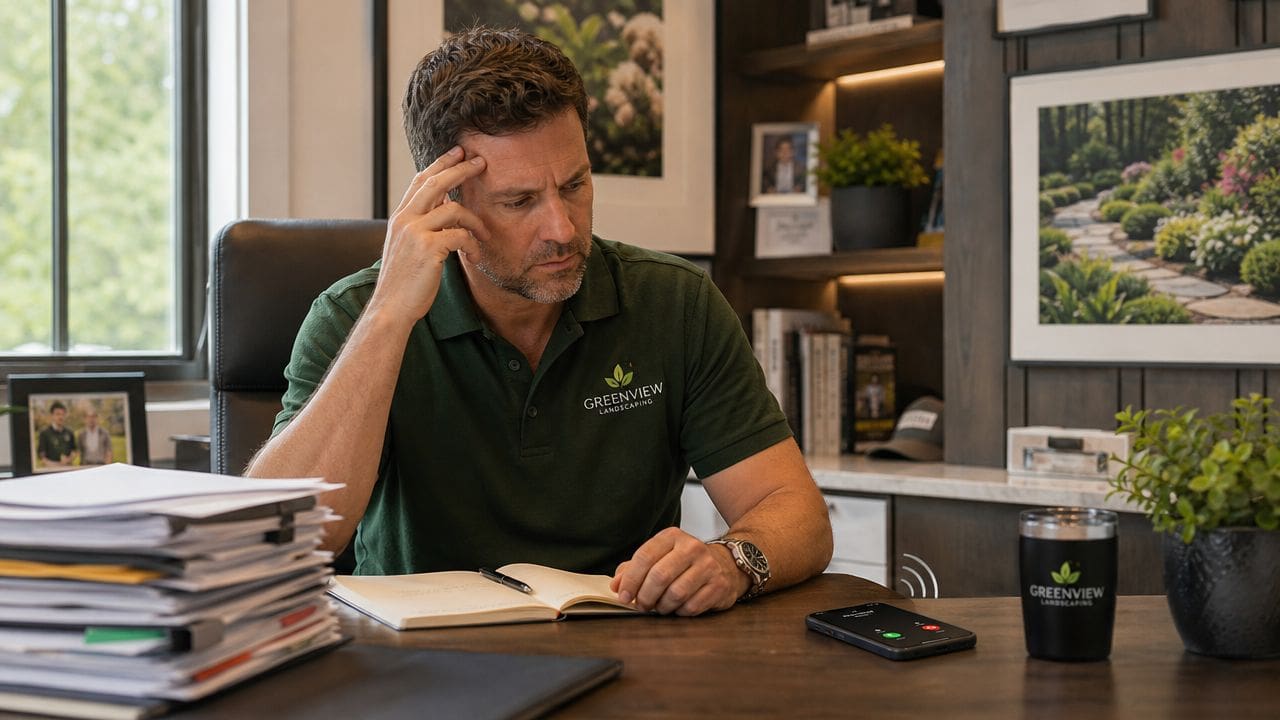
Busy doesn’t mean secure
A lot of landscaping companies look fine from the outside. The trucks are moving. The crew is working. Money is coming in.
But behind the scenes, it’s shaky.
- Referrals are uneven: One good month makes you think things are fixed. Then things go quiet.
- Small jobs eat your time: You stay busy doing work that doesn’t move the business forward.
- You’re guessing: You don’t know what brought the lead in, why one week was strong, or why the next week dropped off.
If that sounds familiar, your problem isn’t effort. You’re already working.
Your problem is control.
You don’t need more hustle. You need more visibility in the towns where people are already searching.
The old marketing pitch burned a lot of owners
Most contractors have heard the same lines before. Better branding. More traffic. More impressions. Better reach.
That stuff sounds nice. It also means nothing if it doesn’t turn into calls.
A website by itself won’t save you. Social posts won’t save you. And random ads sent to a weak website won’t save you either. If you want a useful example of how businesses are trying to tighten up response and follow-up, look at tools built around AI-powered lead generation. The point isn’t the tech. The point is speed, tracking, and making sure leads don’t slip away.
Your site has to do one job. Get the visitor to call, fill out a form, or request a quote.
That’s why a lot of owners start rethinking what they need from a site. A brochure site is dead weight. A lead-focused site is a tool. This is the difference behind website design for lawn contractors.
What’s really going wrong
Most landscaping owners don’t have a lead problem first. They have a visibility problem first.
That’s the hard truth.
If people don’t see you when they search, they can’t call you. If the wrong people see you, you get junk leads. If your business only shows up in one town, your service area on paper means nothing.
That’s why your phone should be ringing more than it is.
The Invisibility Problem Costing You Jobs
Most contractors think, “People can find us if they need us.”
No. They can find you only if you show up where they’re looking.
That’s a huge difference.
When someone searches for an outdoor service professional near them, Google ties that search to the city that person is in. If your business has only been clearly tied to your home city, then you may be a complete ghost in the next town over. You can do work there all day long. Google doesn’t care what you meant. It looks at what you’ve made clear online.
The visibility gap is where jobs disappear
This is why so many owners say, “We do work all over the county,” but their leads still come mostly from one place.
The web doesn’t reward assumptions. It rewards clarity.
If you never clearly show that you work in Newark, Heath, Granville, Pataskala, or the next town over, then those searches can pass right by you. Your competitor shows up. They get the call. You never know the job existed.
The market is crowded. The U.S. landscaping services market is projected to reach $176.7 billion in 2026, with 556,000 businesses competing, according to IBISWorld’s landscaping services industry report. In a crowded local market, invisible businesses lose to visible ones.
If you don’t show up in the city where the buyer is searching, you’re not in the running.
Why this hits harder than most owners realize
This isn’t just about one missed phone call. It’s about a pattern.
You lose the install lead in the next town. You miss the hardscape quote in the nearby suburb. You never get asked to bid the irrigation job in the newer development. Over time, that changes your whole job mix. You stay stuck with whatever work happens to drift your way.
Here’s what invisibility usually leads to:
| Problem | What it causes |
|---|---|
| Only visible in your home city | Thin lead flow outside your core area |
| No clear city coverage online | Buyers assume you don’t serve them |
| Weak follow-up systems | Good leads go cold fast |
And follow-up matters too. If you’re emailing estimates and hearing nothing back, it’s worth checking whether messages even land where they should. This guide on how to check if emails are going to spam is useful because missed communication can kill a good lead after you already paid to get it.
The big problem still comes first though. They can’t hire you if they never see you.
Why Your Website and Past Ads Failed
A lot of landscaping owners got sold the wrong idea.
They were told the website would generate leads. It won’t. A website does not create demand. It waits for demand. It sits there until somebody lands on it.
If nobody sees it, it does nothing.

Your website was probably a brochure
Most contractor websites are built to look decent, not to produce calls.
They have a home page, a gallery, an about page, and a contact page. That’s nice. It’s also weak. It doesn’t line up with how buyers search. It doesn’t match service to city. It doesn’t guide the visitor to one clear action.
So the owner says, “Our website doesn’t work.”
They’re usually right.
That kind of site won’t carry the load. If you want a plain-English breakdown of why this happens, lead gen websites suck in leads only when they’re built for that job. Most are not.
Your ads may have sent traffic into a dead end
Then the agency runs ads to that same site.
Now you’ve got a second problem. You’re paying for visibility, but sending people to pages that don’t match what they searched for. That wastes money fast. The visitor came in looking for one thing and landed on something generic.
That’s where a lot of ad budgets die.
Industry guidance for outdoor service professionals is clear on this point. Effective advertising should focus on high-profit services like outdoor feature installation, hardscaping, or irrigation systems, and the ad and landing page need to match that buyer intent, as noted in this landscaping advertising guidance.
If your ad talks about paver patios but dumps the visitor onto a generic home page about “all our services,” you lose relevance. If your ad attracts maintenance shoppers when you want install work, you fill your calendar with lower-margin work.
A bad website doesn’t prove ads failed. It proves the traffic had nowhere useful to go.
Why owners end up blaming the wrong thing
They blame Google. They blame the agency. They blame the season.
Sometimes they should.
But a lot of times the setup was broken from the start. The site wasn’t built to convert. The ads weren’t built around the right service. The traffic wasn’t tied to the right city. Nobody tracked what turned into real jobs.
That’s why the whole thing felt fake.
The answer isn’t to stop advertising for landscaping. The answer is to stop doing it halfway.
The System That Creates Predictable Leads
The fix is simple to understand.
You need a site built to turn traffic into calls. Then you need ads that put the right buyers in front of that site. That’s it. Website plus visibility. Asset plus fuel.
That’s the system.
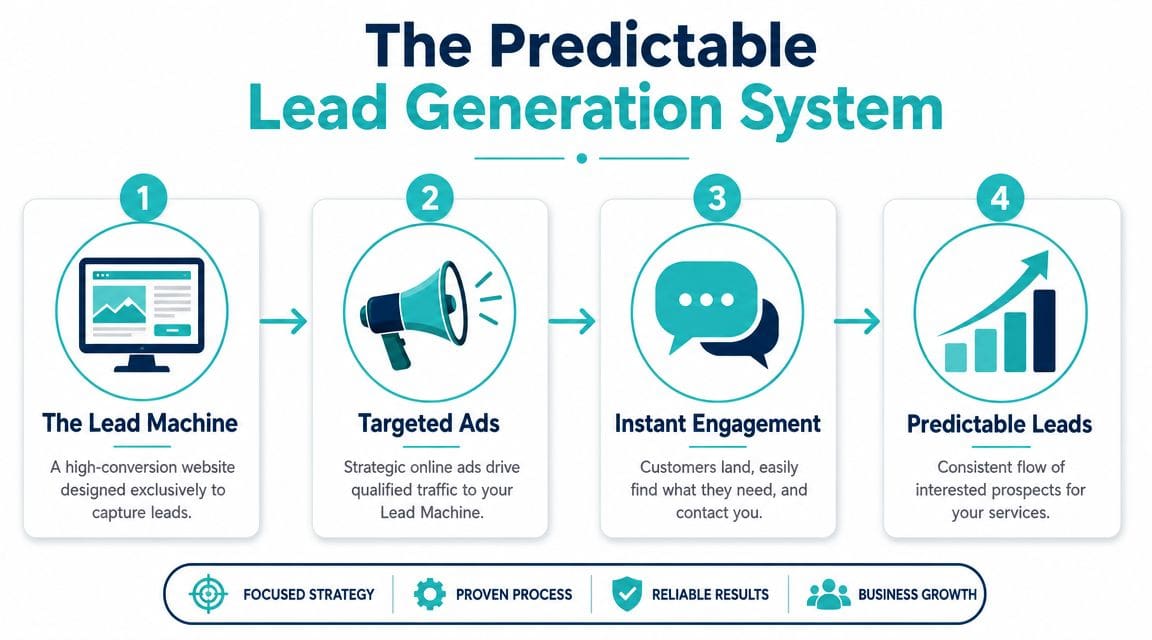
The site is the machine
A real lead machine is not a pretty online brochure.
It’s built around service and city. It gives each buyer a clear path. Someone looking for drainage work should hit a page about drainage work. Someone looking in a nearby town should hit a page that makes it obvious you serve that town.
That kind of structure matters because modern outdoor service advertising depends on measurable local targeting. Guidance for these service providers recommends Google Ads with precise location targeting by city or zip code and dedicated landing pages for each service so you can track what produces booked jobs, not just clicks, as outlined in this marketing framework for landscapers.
That’s how you stop guessing.
The ads are the fuel
Ads do one job. They create visibility right now.
Not next year. Not whenever search rankings happen to improve. Right now.
A good ad system puts your business in front of buyers when they are already looking. It doesn’t rely on them stumbling into you. It doesn’t wait for a referral. It puts you in the conversation at the moment the buyer has intent.
Here’s the clean version:
- Build pages by service and city: So the visitor lands in the right place.
- Run ads to those pages: So the right buyer sees the right offer.
- Track calls and forms: So you know what is producing real work.
- Cut what wastes money: If it doesn’t turn into good leads, it goes.
The same logic shows up in other local industries too. If you want a simple outside example, online lead generation for agents works on the same basic truth. Visibility matters. Fast response matters. Conversion matters.
One option that fits this model
One company that builds this kind of setup is The Cherubini Company. Their Lead Machine model combines a search-focused website built around services and cities with paid traffic that drives local buyers to those pages. That’s the right shape for a contractor who wants visibility beyond the home city.
Big companies don’t wait and hope. They build systems that keep them visible.
Small contractors need to start doing the same.
Taking Control of Your Service Area
Once you have a real system, the game changes.
You stop acting like your service area is whatever circle you drew on a truck wrap. You start treating it like territory that has to be claimed online. That means showing up in the cities you want, not just the city where your shop sits.
That’s how you get control back.
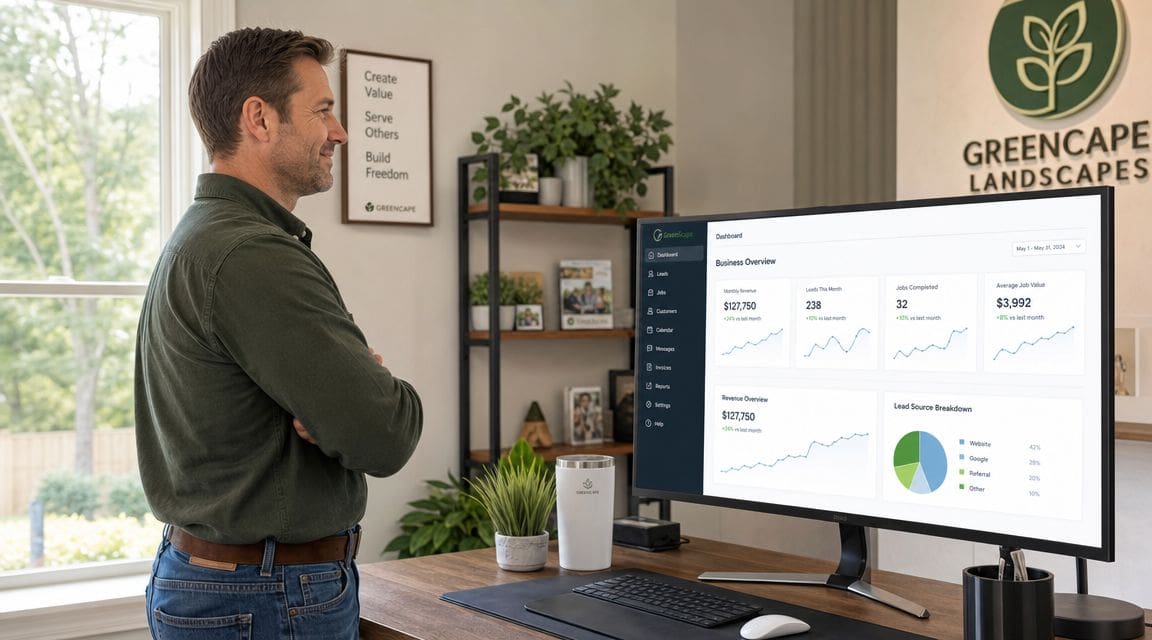
Growth comes from planned visibility
A lot of contractors can do work in nearby towns. Very few are visible there.
That’s the opening.
For contractors who want to dominate more than one town, a geographic expansion strategy matters. Standard local ads aren’t enough. You need a system that builds visibility in adjacent towns where people don’t know you yet, as explained in this article on marketing a landscaping business across markets.
That’s the difference between staying local by accident and expanding on purpose.
What control actually looks like
Control doesn’t mean every lead is perfect. It means you stop relying on luck.
It means:
- You choose the towns: Instead of waiting for random referrals.
- You push the right services: Instead of taking whatever comes in.
- You build a steadier pipeline: Instead of riding feast or famine.
- You make smarter growth moves: Because you can see where leads come from.
If your goal is to move beyond your home turf, this matters a lot. A service area doesn’t expand just because you’re willing to drive farther. It expands when buyers in those towns can actually find you. That’s the logic behind expanding your contractor service area online and getting more leads.
Strong businesses don’t just work in more towns. They show up in more towns.
Stop treating advertising like a gamble
A lot of owners spend freely on equipment because they know what it does. Advertising feels riskier because they’ve seen money disappear into junk.
Fair enough.
But that’s exactly why the system matters. You don’t throw money at random campaigns. You build a machine that can take traffic and turn it into calls. Then you feed that machine in the cities and services that matter most.
That’s how advertising for landscaping stops being a gamble and starts becoming an advantage.
You think that customers “can” find you but, If customers “don’t” find you, nothing else matters.
Lead Machines are built to fix that.
If you’re tired of guessing and want a straight answer, talk to The Cherubini Company. They build Lead Machines for contractors who need more visibility, more calls, and a real system for getting found outside their hometown.