
You know the feeling.
You check your phone. New Google review. Then your gut drops. It's a one-star hit job from somebody you don't know, or worse, somebody who sounds half real and half made up. Now you're angry, distracted, and thinking about that review while you're trying to run crews, answer calls, and get estimates out.
That's why people search for how to have a Google review removed.
Fair enough. Sometimes you should fight it.
But here's the hard truth. If one review can shake your business that much, the bigger problem isn't the review. The bigger problem is that your visibility is weak, your reputation is fragile, and too much of your lead flow depends on too little control.
That Sinking Feeling of a Bad Google Review
A bad review doesn't just sit there. It gets in your head.
You start thinking about the jobs you did right. The weekends you gave up. The callbacks you handled. The stuff you fixed even when it wasn't your fault. Then some stranger drops a one-star review and acts like your whole company is a joke.
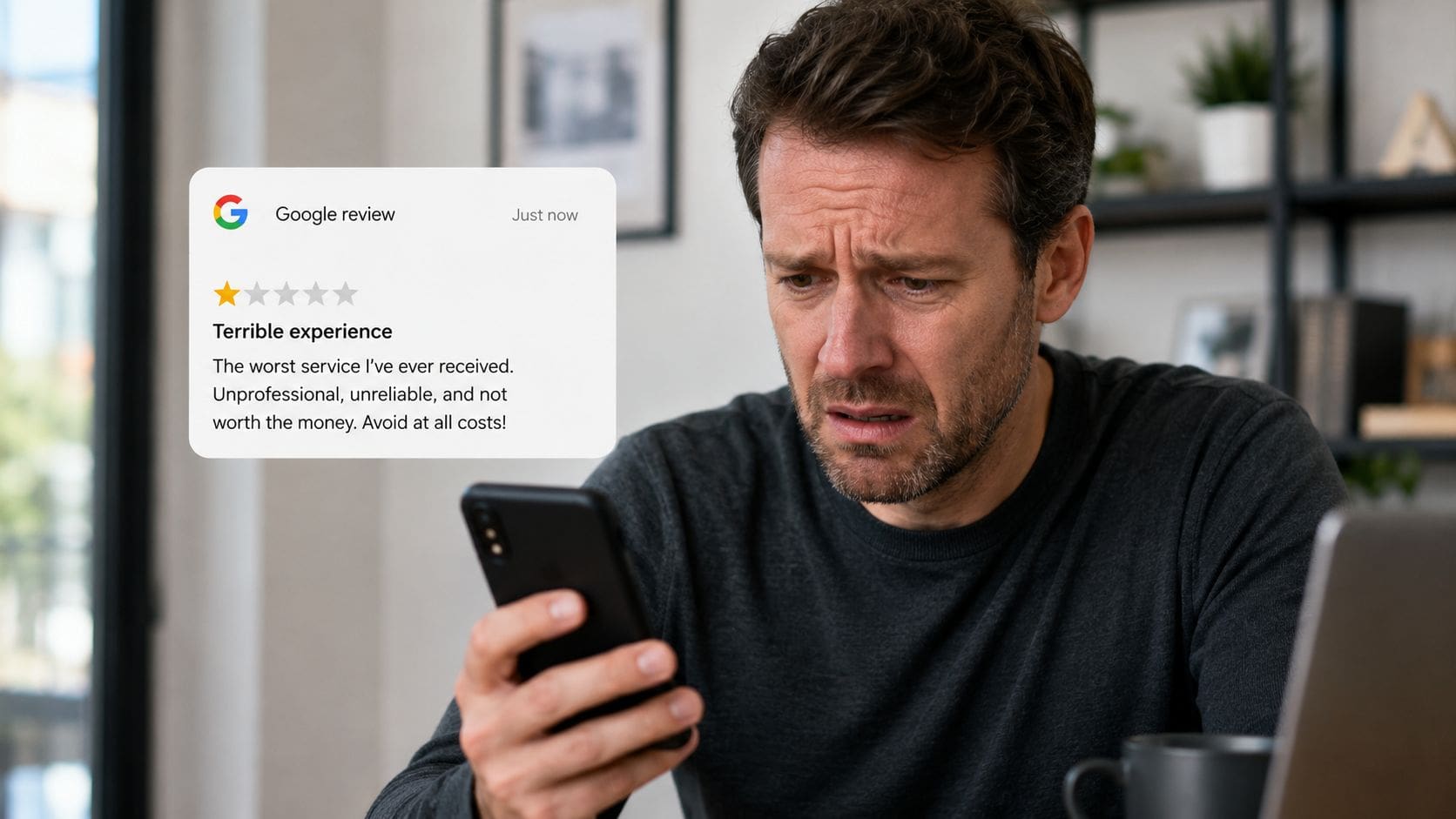
For contractors, this hits harder than many realize. Your name is on the truck. Your guys wear your shirts. Your family knows what you built. So when somebody takes a cheap shot in public, it feels personal.
Why this stings so much
It's not just the review itself. It's what it does to your sense of control.
You start wondering who saw it. You wonder if it cost you a call. You wonder if somebody in the next town searched for your service, compared you to two other contractors, and picked the other guy because of one stupid review.
That's the pain. You can't see the jobs you lost.
A bad review feels bigger when your lead flow already feels shaky.
A lot of contractors are already running on word of mouth and hope. They're known in their hometown. People at the gas station know them. Old customers know them. But online, in the towns nearby, they barely exist.
So when a bad review lands, it carries too much weight.
The review is the trigger, not the disease
If your phone was already ringing from multiple cities, one bad review wouldn't own your day.
If you had a steady stream of fresh good reviews, one clown review wouldn't feel like a punch in the throat.
If your website and ads were built to create visibility where you want work, you wouldn't be hanging so much on one listing and one comment.
That doesn't mean you ignore bad reviews. It means you stop treating them like the whole game.
You can fight the review. Sometimes you should. But chasing one review at a time is a weak business model. You need a system that makes one bad review matter a lot less.
The Rules of Google's Game
Before you waste time on this, learn the rules.
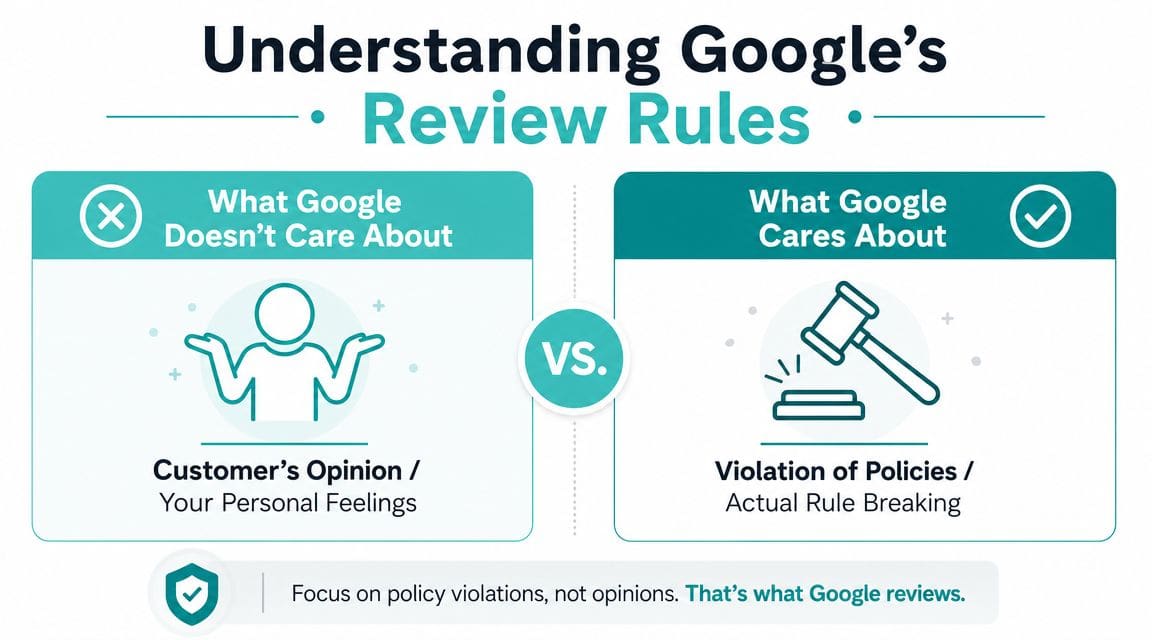
Google doesn't care whether a review feels unfair. Google cares whether the review breaks a policy. That's the line. If you miss that, you'll burn time and get nowhere.
What Google cares about
Google may remove reviews that break its content rules. That includes things like spam, fake content, conflicts of interest, hate speech, harassment, and off-topic content. That's also why Google review removal is policy-based, not preference-based. A business can't delete a review itself, and the strongest cases usually include proof, while unsupported “unfair review” complaints usually fail, as explained in this guide on negative reviews and how to remove Google reviews.
Here's the plain version:
- Fake reviewer: The person was never a customer.
- Conflict problem: It looks like a competitor, ex-employee, or somebody with an agenda.
- Spam pattern: The review is garbage, copied, irrelevant, or part of a coordinated attack.
- Abusive content: Hate speech, threats, harassment, or banned content.
What Google does not care about
Google usually won't remove a review just because:
- You hate it: That means nothing to them.
- The customer sounds unreasonable: Still not enough.
- It cost you money: Google doesn't judge the business impact.
- The opinion feels false: If it still reads like a customer opinion, it may stay up.
Practical rule: Don't argue that a review is unfair. Prove that it breaks a rule.
That's the difference.
A review that says, “They were slow and too expensive,” usually stays. Even if you know the customer is twisting the story. Even if they were a pain in the neck. Even if you bent over backward for them.
Don't fight the wrong battle
If you're serious about trying to have a Google review removed, your first move is not emotion. It's classification.
You need to look at the review and ask one question. Which policy does this break?
If you can't answer that clearly, your chances drop fast.
Also, if your business profile itself is weak, that creates more problems than one review ever will. Tighten up your listing basics with this guide on how to optimize your Google Business Profile.
The Official Process for Fighting Back
If the review breaks policy, report it. Keep it simple. Keep it factual. Don't write a novel.
Google gives business owners a reporting path inside Google Maps and Google Search. You flag the review, choose the violation, submit it, and wait. That's the actual process. There's no magic back door.
What to do
Use this order:
Find the review in Google Maps or Search
Open your business profile and locate the review.Click the three-dot menu
Choose the option to report the review.Pick the right violation reason
Be exact. Don't guess.State the fact, not your frustration
Example: this reviewer does not appear in our customer records.
Another example: this review discusses services we do not offer.Save your proof
Keep screenshots, job records, messages, or anything else that supports your claim.
What happens next
The timeline isn't always quick. Many valid removal requests are decided within about 3 business days, while some can take up to 14 days before a false review is removed, based on guidance summarized here by Whitespark on removing fake Google reviews.
That delay matters.
If the review is visible during that window, it can still affect calls and buying decisions while you wait. That's why this whole process is frustrating. You're spending time fixing a problem you didn't create, and the review may still be doing damage while Google decides.
Your best shot is a short report with solid proof. Long emotional explanations usually hurt more than they help.
What to avoid
Don't do these things:
- Don't ramble: Google moderators aren't grading your passion.
- Don't claim fraud without support: If you can't back it up, your report gets weaker.
- Don't report honest negative opinions as fake: That usually goes nowhere.
- Don't expect instant action: This is a queue, not a favor.
If you want a broader executive-level look at how to think through the problem, this Google review removal strategy is worth reading.
There's also a newer reporting and appeal flow beyond the old “flag it and hope” method. Coverage is often behind the current process, which is one reason business owners get confused. The point is simple. Use the official path, be specific, and bring evidence.
You Are Asking the Wrong Question
You searched for how to have a Google review removed.
I get it.
But that's still the wrong question.
The better question is this. Why does one review have this much power over your business in the first place?

The real problem is invisibility
Most contractors are known where they live. That's not the issue.
The issue is the town ten miles away. Or twenty. Or the county next door where you would gladly take work, but Google has no strong reason to show you there. If somebody searches for your service “near me,” Google turns that into the city they are standing in. If you've never clearly shown Google that you work in that city, why would Google assume you do?
It won't.
That's the visibility gap. You think customers can find you. But if they don't see you when they search by service and city, you have zero shot at that job.
Why one review feels so heavy
A weak visibility system makes every bad review feel larger.
Google says it blocks or removes over 100 million policy-violating reviews from Google Maps each year, which tells you review moderation is a massive automated program, not a careful hand-built process for your specific situation, as discussed in this write-up on Google deleting reviews.
That means you're playing inside a huge machine. Google is not slowing down to understand your side like a local referee.
So if your business already has:
- thin visibility outside your hometown
- too few fresh reviews
- a website that just sits there
- no steady traffic coming in
then one bad review can feel like a wrecking ball.
If your business only gets found in one place, every negative signal in that place matters more.
The fix is not more hope
A lot of contractors still think the website should somehow generate business by itself. It won't. Websites don't create traffic. They sit there and wait.
Big companies buy visibility. Small contractors often rely on luck, referrals, and old momentum. Then they wonder why they disappear in nearby towns.
If you want another plain-English look at the money side, this piece on understanding Google Ads worth is useful because it explores the key issue. Visibility costs money, but invisibility costs jobs.
And if your review profile is thin, that makes the problem worse. Building a steady stream of legit customer feedback matters. This guide on how to get Google reviews is a good place to start thinking about the bigger picture.
This isn't really a review problem. It's a control problem.
Building a Lead Machine That Protects You
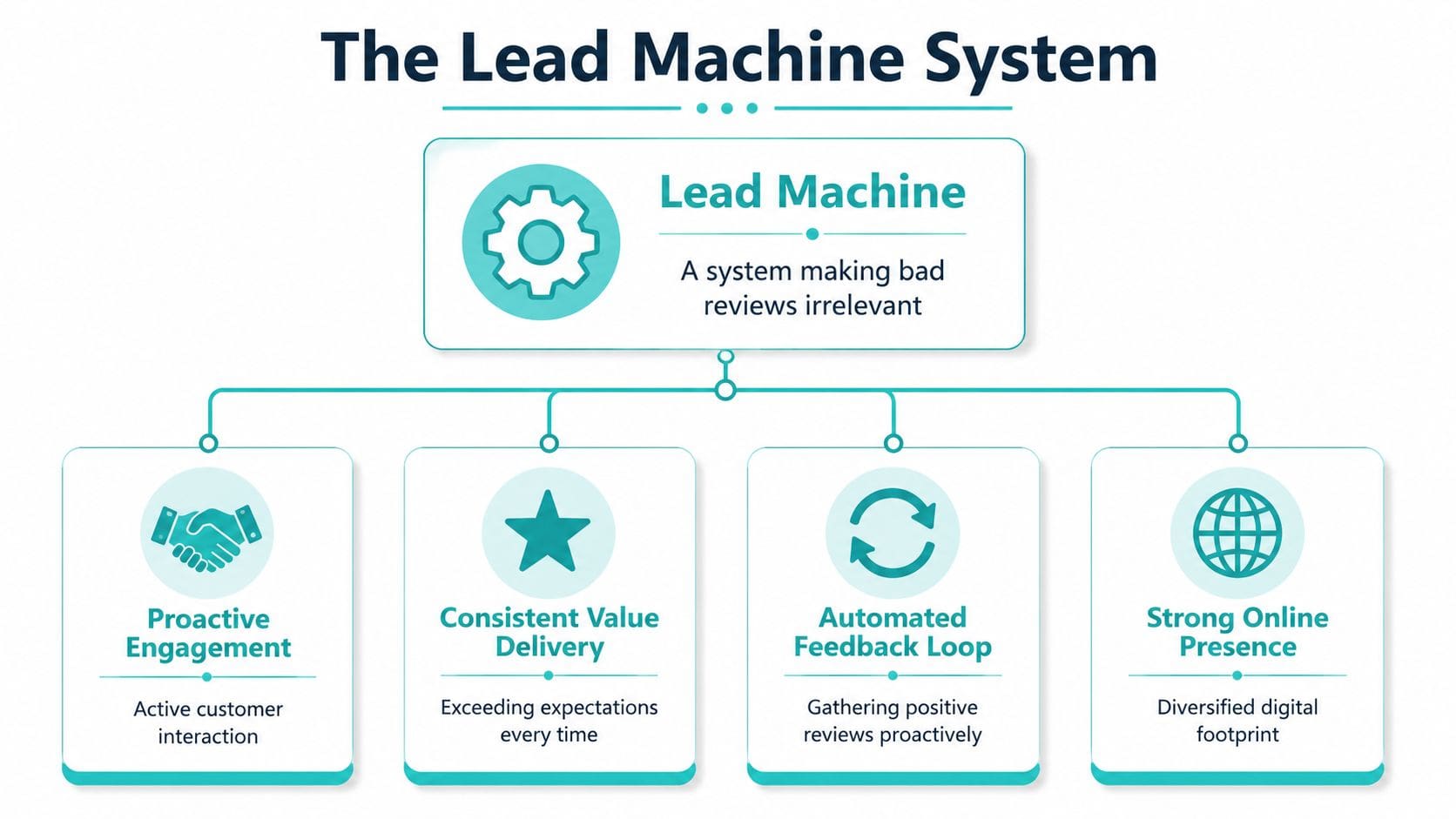
The smart move isn't getting better at chasing bad reviews. The smart move is building a system that makes one bad review less important.
That system is a Lead Machine.
What it actually does
A Lead Machine is not a pretty online brochure. It's a website built to turn traffic into calls.
It is built around the places you want to work and the services you want to sell. That means your business is not just talking about your hometown. It's clearly showing where you work, what you do, and how people contact you.
That matters because Google needs that clarity.
When your site only talks about one city, your business looks local to one city. When your site clearly supports multiple service areas, your visibility can expand with it.
Why this protects your reputation
A stronger lead system helps in three ways:
- Broader visibility: You're not depending on one town, one map result, or one review thread.
- Better lead flow: More serious buyers find you when they search.
- More review stability: Happy customers have a clear path to leave feedback, so the good reviews keep coming.
That last one matters a lot. If your business gets regular positive feedback from real customers, one bad review loses weight.
An independent analysis even claims that roughly 70% of deleted reviews are 5-star ratings, often tied to Google spam filters catching patterns like shared internet connections, similar wording, or burst posting, as covered in this article on why 5-star reviews are being removed. That tells you something important. Even good reviews can disappear if your review activity looks unnatural.
So don't play games. Build a clean system.
What a contractor actually needs
Not more marketing talk. Not more dashboards. Not another agency promise.
You need:
| Need | What matters |
|---|---|
| Service area visibility | Show up in the cities where you want jobs |
| A site built for leads | Clear calls, clear services, clear locations |
| A steady review flow | Real customer feedback coming in consistently |
| Paid traffic | Buyers searching right now need to see you |
A contractor with visibility, traffic, and fresh reviews can absorb a bad review. A contractor running on hope cannot.
If reputation management is part of the gap, this page on review management services lays out the kind of support contractors usually need when they're tired of reacting all the time.
The point is simple. The website is the asset. Ads are the fuel. Reviews strengthen trust. Together, that system protects you better than playing defense all day.
Control Your Visibility Control Your Business
Chasing one bad review is reactive work.
Sometimes you have to do it. Fine. Report it. Document it. Move on.
But if that's your whole strategy, you're stuck. You're still depending on word of mouth, luck, and whether Google happens to treat you kindly this week.

A business built on hope is fragile. A business built on visibility is stronger.
That means a website built to get calls, not just sit there. It means showing up in the cities around you, not just your hometown. It means using ads to put your company in front of people searching right now. And it means building enough real review momentum that one bad review stops feeling like the end of the world.
The bottom line
The contractors who grow don't just do good work. They control where and when buyers see them.
That's the difference.
When you control visibility, you control lead flow. When you control lead flow, you get more say over the jobs you take, the markets you expand into, and how much stress you carry into every week.
You think that customers “can” find you but, If customers “don't” find you, nothing else matters. Lead Machines are built to fix that.
If you're tired of guessing and tired of getting burned, talk to The Cherubini Company. They help contractors fix the core problem, which is invisibility. Their Lead Machines are built to help you show up in the cities you want work from, turn traffic into calls, and stop depending on hope.