
You've probably said some version of this already.
“We tried ads and they didn't work.”
“That's what the last agency said.”
“We've been burned before.”
“I'm busy. I just need the phone to ring.”
Fair enough. A lot of contractors have paid for websites, ads, and “marketing packages” and got nothing but reports, excuses, and a lighter bank account. That frustration is real.
But most of the time, the actual problem wasn't just a bad agency. It was a bad diagnosis.
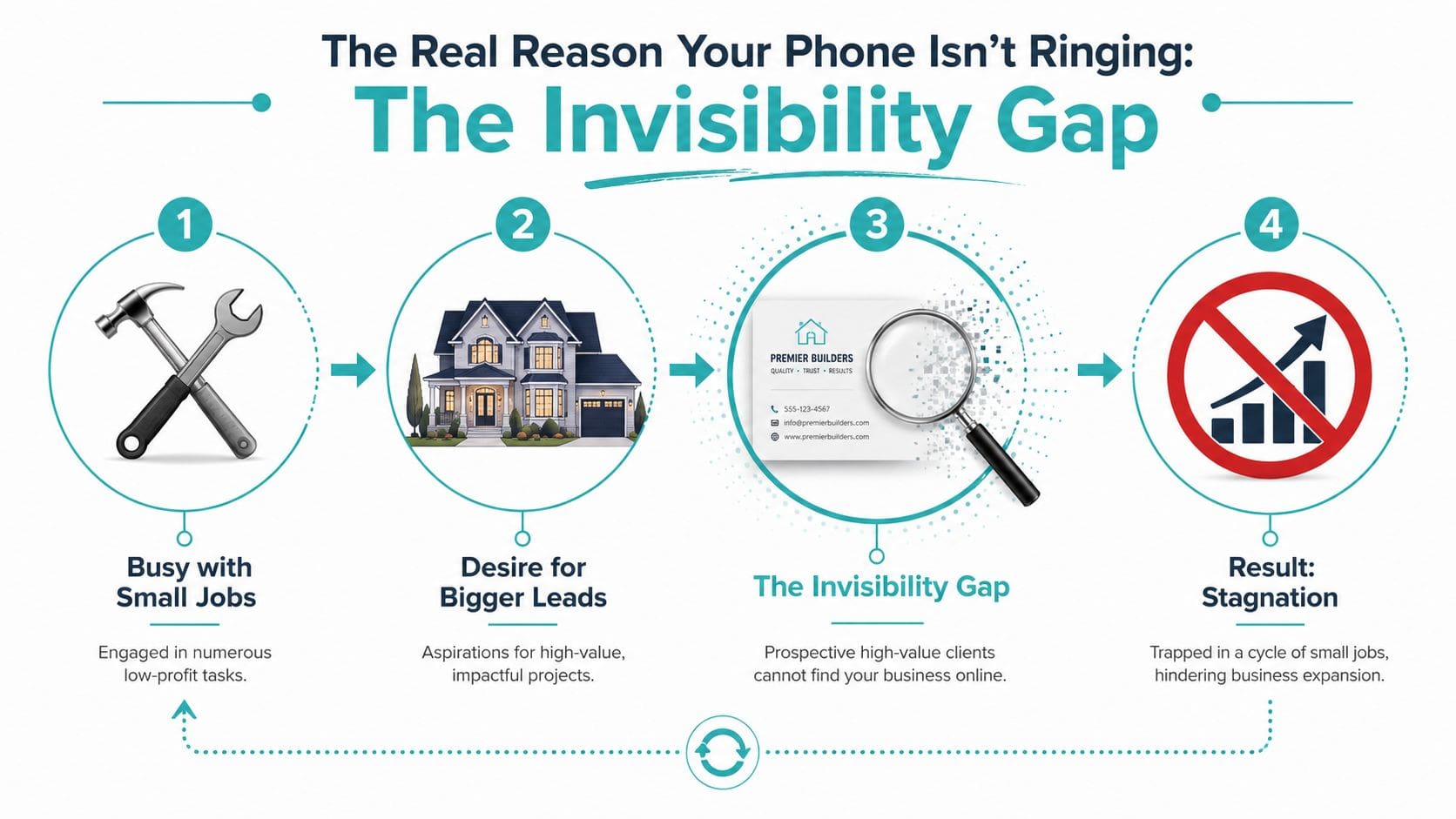
You weren't dealing with a mysterious marketing problem. You were dealing with a visibility problem. If people don't see you when they search for the work you do, in the city they're standing in, you lose before the job even starts. That's why some contractors stay slammed with little jobs and still feel stuck. They're active, but they're not visible where the better jobs are being searched.
That's what this comes down to. Websites don't create traffic. Ads create visibility. A Lead Machine turns that visibility into calls.
Tired of Getting Burned by Marketing Promises
A contractor gets sold the same junk over and over.
A slick website. A monthly package. Some vague talk about exposure. A few charts. A few clicks. No real answer when the phone still doesn't ring.

That's why so many owners stop trusting anybody who talks about online advertising specialists. They assume it's all fluff. I don't blame them.
You weren't crazy to be skeptical
You probably got promised leads.
What you got instead was activity.
- A pretty site: It looked fine, but it didn't help you show up where buyers were searching.
- A stack of reports: Lots of numbers. No clear tie to calls, quotes, or jobs.
- A long contract: They got paid whether your business grew or not.
- A blame game: Slow season. Bad market. Your photos. Your reviews. Your budget. Everything except the actual problem.
That anger usually points in the right direction. Something was wrong. But the mistake is thinking the problem was “marketing” as a whole.
The real miss was simpler than that
Most failed campaigns chase the wrong target.
They try to make you look better instead of making you easier to find.
That sounds small. It isn't.
If your business is known in your hometown, but invisible in the next town over, then you don't have a reputation problem. You have a reach problem. A visibility problem. That's why the work feels random.
Practical rule: If the plan doesn't explain how your business will be found in the cities you want work from, it's not a lead plan.
A lot of owners don't need another pitch. They need a straight explanation of why money was spent and jobs didn't come in. Usually, the answer is this. The website sat there waiting, and the ad traffic, if there was any, had nowhere useful to go.
If that sounds familiar, read this breakdown of contractor marketing mistakes that cost you money. It gets right to the point.
What matters now
Don't waste time trying to figure out whether the last agency was lazy, confused, or both.
Figure out whether your business is visible where potential customers are looking right now.
That's the whole game.
The United States generated about $317 billion in digital advertising revenue in 2024, which made it the largest digital advertising market in the world, according to Statista's online advertising market overview. That matters for one reason. This is not some side channel anymore. Businesses are putting serious money into being seen first.
Big companies buy visibility.
Small contractors usually hope word of mouth stretches far enough.
It doesn't.
The Real Reason Your Phone Isnt Ringing
Your phone might ring some.
That doesn't mean your lead problem is solved.
A lot of contractors are busy, but busy with the wrong mix of work. Too many small jobs. Too many tire kickers. Too much driving. Too much quoting. Not enough of the bigger jobs that move the business forward.
Here's the reason.
The visibility gap is killing you
Let's keep this simple.
If someone in a nearby town searches for “excavation contractor near me,” Google doesn't read that as “near your office.” It reads it as “excavation contractor in the searcher's current city.”
That means if your website and business only keep talking about your hometown, Google has no strong reason to show you in the next city over. Or the next county. Or the better zip code where the bigger jobs are.
It seems obvious once you hear it.
Why would Google assume you work in a town you never mention?
The problem isn't that customers can't find you. The problem is that they don't find you at the exact moment they need the work done.
That's the gap. You may serve those towns every week. Your trucks may be there. Your crew may know the roads by heart. But if your online presence doesn't clearly say that, you disappear from the search.
What that costs you
You don't just lose leads you can see.
You lose jobs you never even knew existed.
That's what makes this painful. There's no missed call to review. No quote request to chase. No second chance. The customer searched, saw somebody else, and moved on.
Here's what that usually looks like:
- You stay stuck in your home area: You get the same type of calls from the same places.
- You keep filling the schedule with smaller work: Because that's what you're visible for.
- You miss better buyers in nearby cities: Not because they rejected you. Because they never saw you.
- You think demand is slow: But demand may be there. Visibility isn't.
If this hits close to home, read why your phone isn't ringing and what it's costing you. It lays out the loss in plain English.
More effort won't fix hidden
A lot of owners respond the wrong way.
They post more on social media. They ask for more referrals. They tweak a headline. They wait for spring. They blame the economy. None of that fixes the basic issue if buyers in nearby cities never see you in the first place.
Online advertising specialists who understand lead generation don't start by asking how to make your logo prettier. They start by figuring out where you're invisible and how to fix that.
And there's one more truth contractors need to hear. More data is not always better. The University of Washington summarized research showing that in online advertising markets, more detailed audience and context data can help agencies coordinate bids, while less disclosure can sometimes strengthen a publisher's position, as explained in this University of Washington research summary on online advertising markets. The point for you is simple. Don't let anybody tell you “more data” is automatically good. Good specialists know what information helps get better jobs, and what information just helps somebody else optimize against you.
Why Your Website and Past Ad Campaigns Failed
A website is not a lead source by itself.
That belief has wasted a lot of contractor money.
Your website sits and waits
A website is like a storefront.
If it's on a dead road, nobody walks in.
That's the first hard truth. Websites don't create traffic. They don't wake up in the morning and go find buyers. They sit there and wait. So when a contractor says, “I paid for a site and it didn't generate leads,” the answer is usually simple. Of course it didn't. It was never built into a full system.
Some sites look polished and still fail because they act like digital brochures.
They tell your story.
They show a few photos.
They list a phone number.
Then they sit there collecting dust.
Ads didn't fail by themselves
The second bad belief is this. “We ran ads and ads don't work.”
No. Bad systems don't work.
Ads do one job. They create visibility. They put you in front of people searching now. That's valuable. But if those people click and land on a weak site, the money burns fast.
This is the easiest way to understand:
| Problem | What happens |
|---|---|
| Ads with no strong website | People show up and leave |
| Website with no traffic | Nobody shows up |
| Both working together | Visibility can turn into calls |
That's why so many past campaigns fell apart. The ad side and the website side were treated like separate things.
They are not separate.
Sending paid traffic to a weak website is like paying to fill a store with buyers while the front desk is empty.
If you want the blunt version of that problem, this page on why lead gen websites suck in leads is worth your time.
Why serious specialists work differently
A technically strong online advertising specialist usually handles paid campaigns and the measurement around them, and often works across Google Ads, Meta, LinkedIn, analytics, and related website tools, as outlined by MIU's digital specialist overview. That matters because the function isn't simply “run ads.” Instead, it is to connect traffic, tracking, and improvement so your money isn't thrown into the wind.
And for some contractors, digital only still isn't enough in every market. Some rural and underserved areas respond better when online visibility is paired with offline reach, which is why this analysis of out-of-home advertising for underserved populations matters. If your buyers are spread out across counties, the right channel mix matters. But the core point stays the same. Visibility has to come first.
The System That Turns Visibility into Jobs
Many individuals often overcomplicate a simple problem.
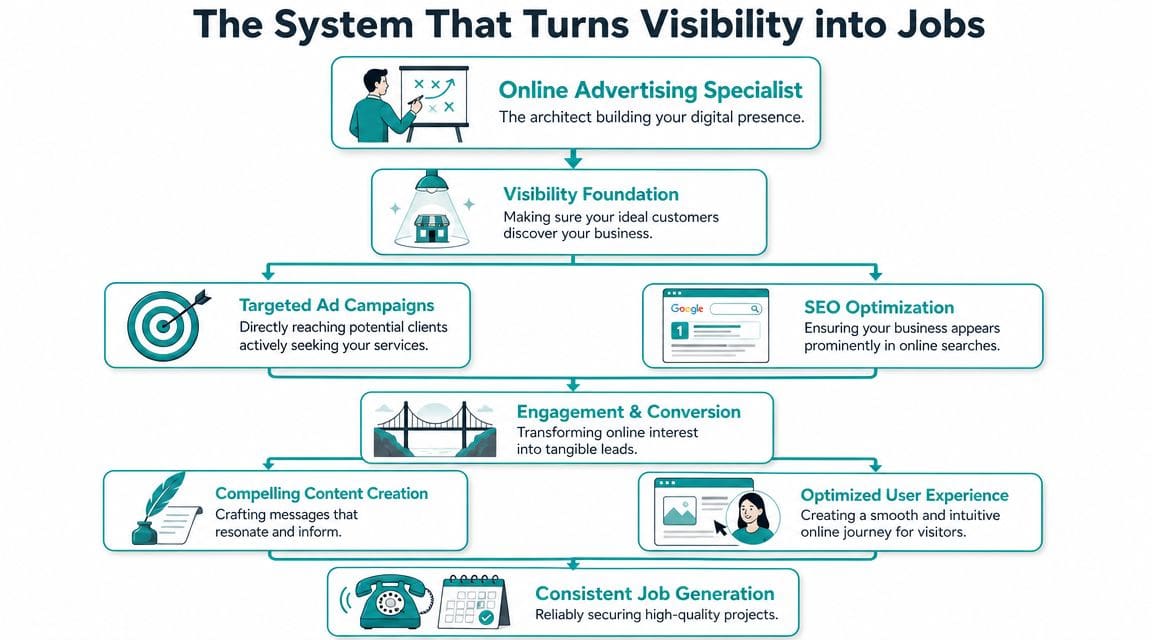
You don't need a pile of buzzwords. You need a system that does two things well. Get seen and turn that attention into calls.
That's what online advertising specialists should be hired to build.
Part one is the Lead Machine
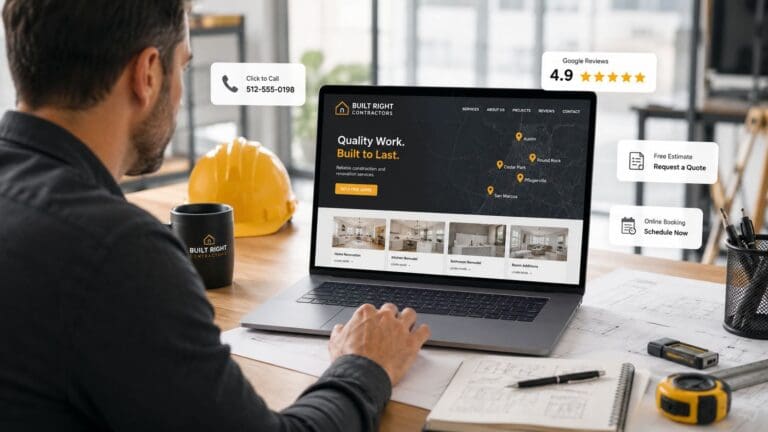
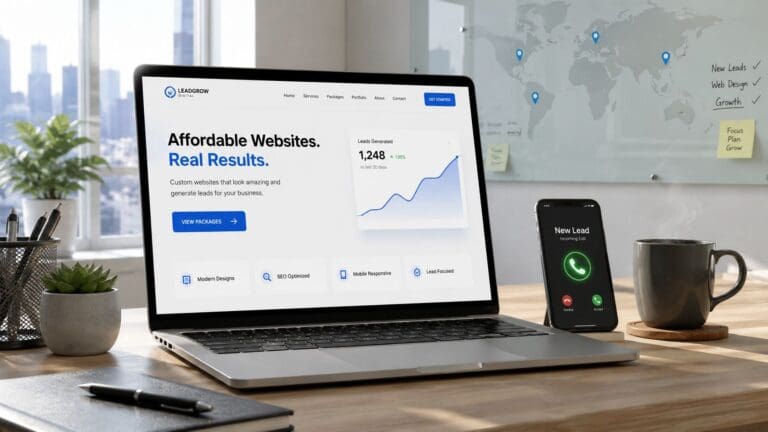
A Lead Machine is not a pretty website.
It's a website built for one job. Turning traffic into calls and quote requests.
That means it has to be built around your services and the cities you want to work in. Not just your hometown. Not just your office address. The work area.
A real Lead Machine does this:
- Shows up for service plus city searches: It gives search engines clear signals about where you work.
- Makes it easy to call: The path from visit to phone call should be obvious.
- Captures leads fast: Quote forms, call paths, and clear action points matter.
- Matches what the buyer searched for: If they searched for a service in a city, the page should fit that intent.
That site becomes an asset you can use to grow.
Part two is the fuel
Then you add ads.
Ads don't replace the Lead Machine. They feed it.
Paid traffic puts your business in front of buyers who are looking right now. Not next month. Not “someday.” Right now. That's the value. You don't sit around hoping someone stumbles across your website. You create visibility on purpose.
A true online advertising specialist operates as a data-driven campaign manager. Their job is to design audience targeting, bidding, and testing systems across paid channels. The key advantage comes from tracking and continuous optimization, which allows them to reallocate budget toward higher-intent traffic and improve return on ad spend over time, as explained by Toptal's guide to Google Ads specialists.
That's a long way of saying this. The right person watches what's producing real buyer intent and shifts money toward what works.
Hard truth: Ads without a Lead Machine waste money. A Lead Machine without ads waits around. Together, they become a lead system.
This is about control
Global digital ad spend is projected to rise 10.1% in 2025 to more than $765 billion, and 60% of specialists plan to increase ad spend in 2025, with the average planned increase at about 15%, according to Invoca's digital marketing statistics roundup. The same source reports an average cost per action of $49 in paid search and $75 for display ads. That means every weak click path costs real money.
So stop thinking in terms of “buying leads.”
Think in terms of building a machine you control.
If you want a plain-English example of that setup, what a Lead Machine is explains the model. One option in this space is The Cherubini Company, which builds lead generation websites structured by service and city, then pairs them with managed visibility ads so contractors can target work outside their home base.
Hiring Someone to Fix Your Lead Problem
Let's make this practical.
Say you own an excavation company. You do solid work. You've got machines, crew, insurance, and jobs on the board. Most of your calls come from people who already know your name, past customers, or referrals from your home county.
Then work slows down.
You call a marketing company. They talk about traffic, impressions, branding, and reach. Three months later, you still don't know if any of it helped.
That's where contractors get trapped. They hire based on confidence instead of clarity.
Ask better questions
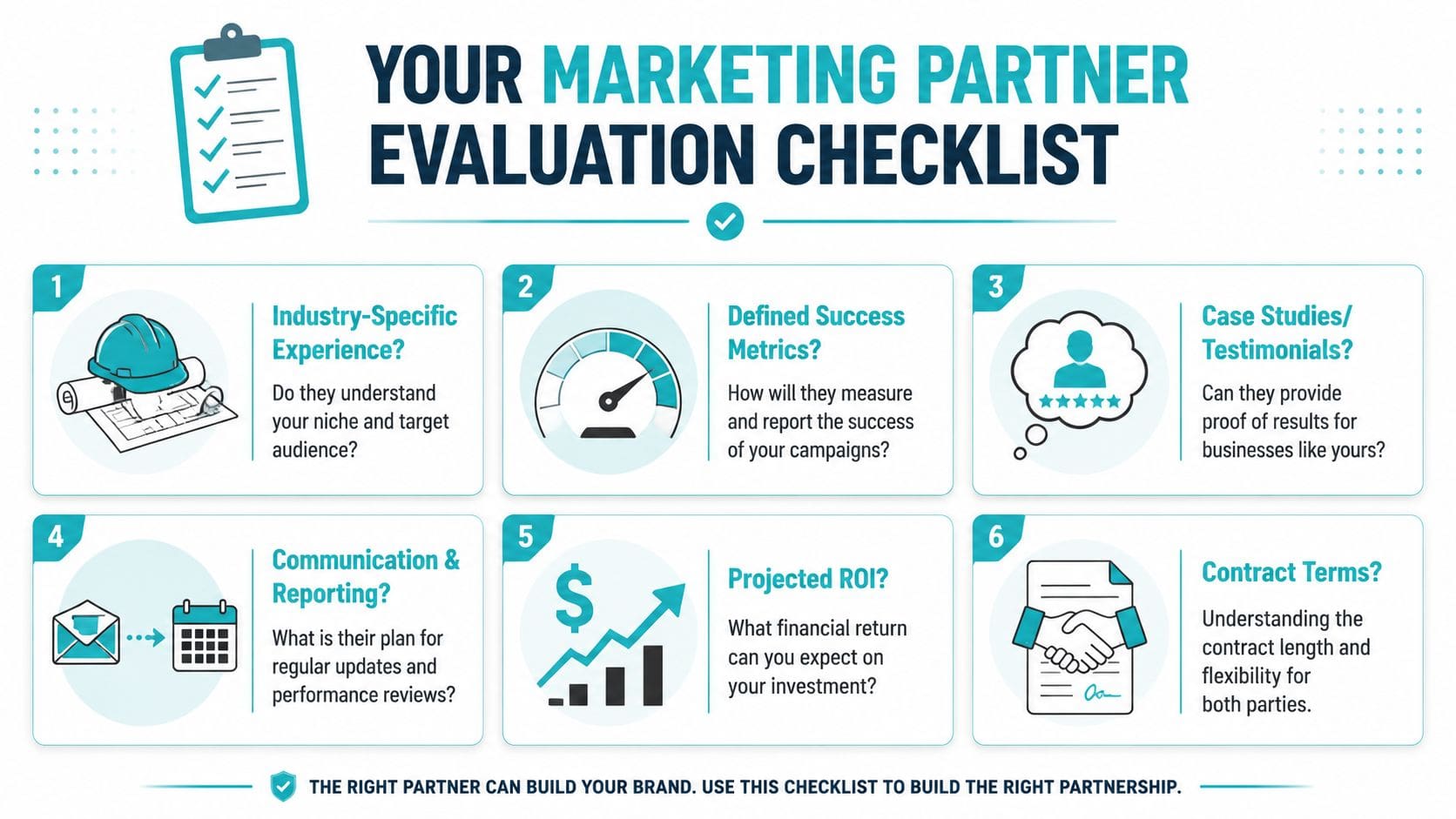
If somebody wants your money, make them answer direct questions.
Not theory. Not fluff. Actual questions.
- How will you make me visible in towns where I don't show up now? If they can't answer that clearly, move on.
- What happens after somebody clicks? If they talk only about traffic and not about calls, forms, and conversion, move on.
- How do you measure success? If success sounds like clicks, views, or “engagement,” keep your wallet shut.
- What do I own? If the website, pages, tracking, or core assets are vague, be careful.
- How clear are your fees? If the pricing is muddy, the relationship will be muddy too.
A good partner should be able to answer those in plain English.
Watch for the red flags
Bad fit usually shows up early.
Here's a quick filter:
| Red flag | What it usually means |
|---|---|
| Long contract before trust is earned | They need protection from their own results |
| Talk about clicks more than calls | They care about activity, not outcomes |
| No clear city visibility plan | They don't understand your real problem |
| Messy reporting | You'll be guessing the whole time |
| One-size-fits-all package | They're selling a template, not solving your market |
If they can't explain how they'll help you get found outside your hometown, they're not fixing the lead problem. They're renting your attention.
If you're building support around the owner and office side too, this guide to effective strategies for hiring marketing VAs from Phone Staffer is useful. It helps clarify what work should be delegated and what should stay tied to revenue decisions.
Pick people who solve the right problem
A contractor doesn't need a “marketing team” in the abstract.
He needs somebody who can fix hidden.
That means the proposal should answer simple things:
- Where are you invisible now
- How will that be fixed
- How will traffic become calls
- How will results be tracked without smoke and mirrors
That's the standard you should use when finding the right marketing agency.
Not personality.
Not promises.
Not polished slides.
Take Control of Your Visibility and Your Business
Here's the truth.
Guessing is the problem.
A lot of contractors are still running the business like this. Hope referrals keep coming. Hope the website somehow does something. Hope the phone picks up next month. Hope the last ad failure means all ads are bad.
Hope is not a lead system.
Word of mouth is great. It's also fragile. It doesn't give you control over where leads come from, when they come in, or how far your business can reach. If you want bigger jobs, steadier calls, and less panic when a slow stretch hits, you need a system.
Control comes from visibility
Predictable leads start with being visible in the places you want work from.
Then they depend on sending that traffic to something built to convert.
That's it. Not magic. Not hype. Not tricks.
When you control visibility, you get more control over revenue. You can choose better work. You can stop chasing every small job that comes along. You can build a schedule instead of reacting to one.
Stop paying for confusion
If a proposal makes your head hurt, it's probably built that way for a reason.
You should be able to understand exactly what you're buying and why it matters. A website that acts like a Lead Machine. Ads that create visibility. Tracking that tells you whether it's turning into calls.
Simple.
If you're tired of guessing, get clear on where you're invisible first. That's the part most contractors never see until somebody maps it out for them.
You think that customers can find you but, if customers don't find you, nothing else matters. Lead Machines are built to fix that.
If you want a straight answer on where your business is invisible and what it will take to fix it, talk to The Cherubini Company. They'll walk you through the problem, show you the visibility gaps, and explain what a Lead Machine system would look like for your service area.