
You’ve probably felt this already.
You’re busy in your hometown. People know your name. Referrals still come in. So it’s easy to think the lead problem isn’t real.
Then work slows down, or the wrong jobs keep showing up. Small jobs. Price shoppers. Tire kickers. Meanwhile, better jobs in the next town over go to somebody else.
That’s not bad luck. That’s a visibility problem.
A Website Visibility Score sounds like marketing talk. Most of the time, it is. But the core issue is simple. When somebody searches for the work you do in the city they live in, do you show up or not?
If you don’t, you’re losing jobs before the phone ever has a chance to ring.
The Real Reason You’re Losing Jobs to Competitors
A lot of contractors think they have a lead problem because they need better ads, a nicer site, or more reviews.
That’s not the root problem.
A significant problem is that customers in nearby towns never see you in the first place. Your reputation is strong where people already know you. Outside that area, you’re invisible. A homeowner with a genuine project searches online, sees three other companies, and hires one of them. You never even know the job existed.
Busy doesn’t mean visible
A full schedule can hide a weak pipeline.
You can stay busy on repeat customers, referrals, and small local jobs for a long time. But that doesn’t mean your business is visible where new demand is happening. It just means your hometown still remembers you.
You’re not losing because your work is bad. You’re losing because your competitors are showing up where buyers are searching.
That’s why some contractors feel blindsided. They know they do good work. They know people trust them. Yet jobs keep slipping away in nearby areas they already drive through every week.
The job was there. You just weren’t.
Many owners suffer negative consequences. They think, “If someone needs us, they can find us.”
That sounds reasonable. It’s also dead wrong.
People who already know your business name can find you. That’s not the issue. The biggest financial gains come from the people who don’t know your name yet. They search by service and city. If your business isn’t visible there, you have no shot.
If this sounds familiar, this breakdown of how contractors lose jobs to competitors online will hit close to home.
What Website Visibility Score Means for Your Business
Forget the dashboard nonsense.
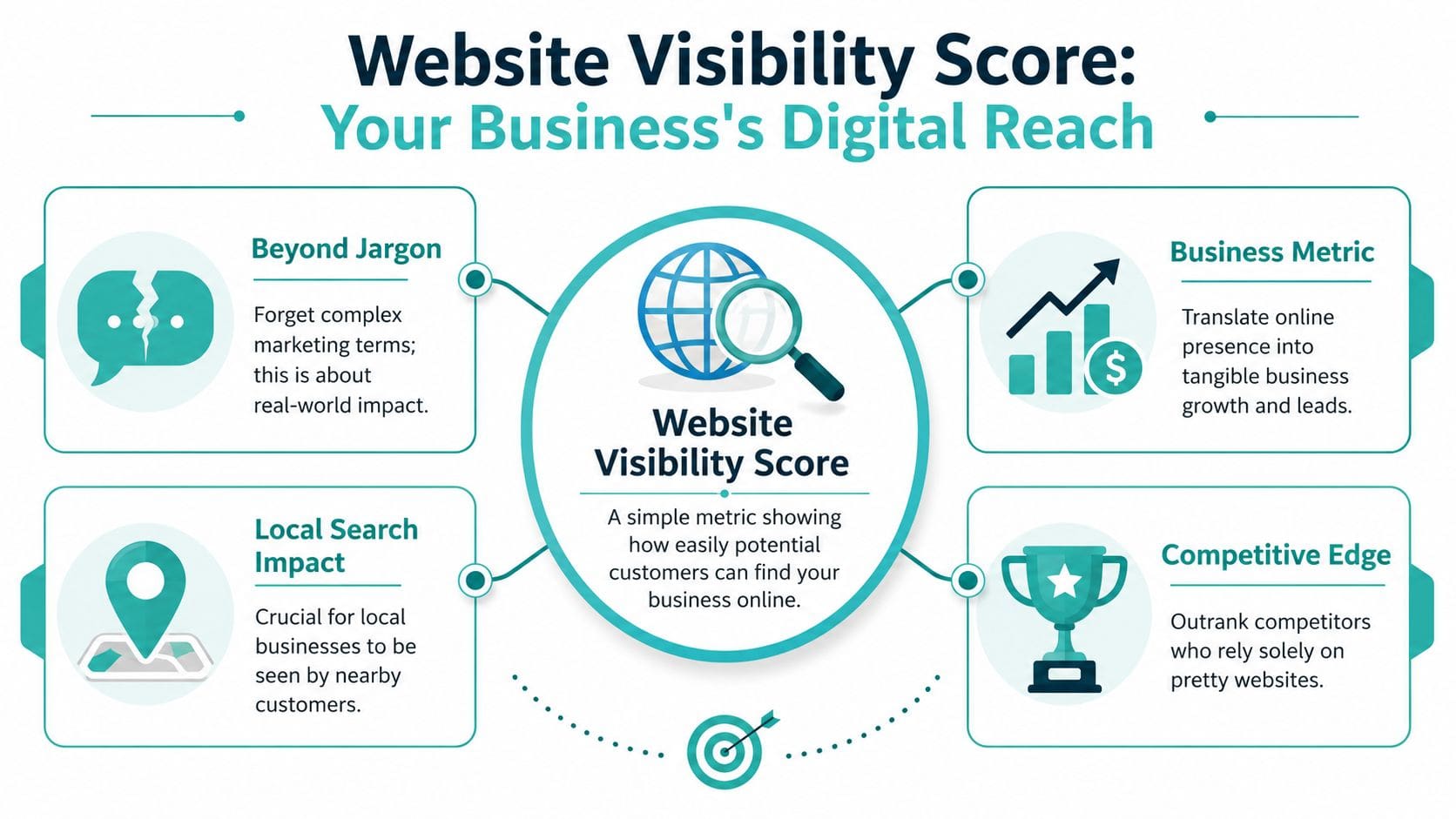
A Website Visibility Score is supposed to measure how visible your site is in search. In plain English, it tells you whether your business shows up when buyers look for what you do. That’s the only part that matters.
The score is not the truth
Here’s the hard truth. The score itself is not a universal standard.
Advanced Web Ranking says its Visibility Score uses a proprietary formula based on keyword rankings, and Semrush defines SEO visibility as the percentage of visibility you have for a chosen set of target keywords, where 100% means ranking #1 for all tracked terms in that selected set, which is why scores can’t be compared blindly across tools, as explained by Advanced Web Ranking’s visibility score guide.
That matters because agencies love to wave around one pretty number as if it proves something. It doesn’t. Different tools use different math. So one company can show you a score and make it sound amazing, while another tool would grade the same site differently.
Practical rule: Don’t ask whether your score looks good. Ask whether real customers in real cities can find you.
What the number is actually trying to measure
One explanation of website visibility says 32% to 35% visibility or higher is generally very strong, while even 9% to 10% can still produce good results depending on the market and the keyword set, according to Digital Kings Networking’s explanation of website visibility.
Another source says strong performance can sit in the 35% to 45% range, while 51%+ may be considered excellent, but only in relation to the market and tracked query set, based on WhatArmy’s guide to a good SEO visibility score.
That tells you something important. This score is relative. It depends on what keywords are tracked and who you’re competing against. If an agency doesn’t explain that, they’re selling smoke.
For a deeper look at why raw dashboards don’t answer the core business question, this piece on understanding data sufficiency for SEO teams is worth your time.
- Good use of the score: Checking whether your visibility is improving in the cities and services that matter.
- Bad use of the score: Treating one tool’s number like it’s your business value.
- Best use of the score: Using it as a warning sign that you’re invisible where buyers are searching.
The Visibility Gap Why You Are Invisible 10 Miles Away
This is the part most contractors never get told.
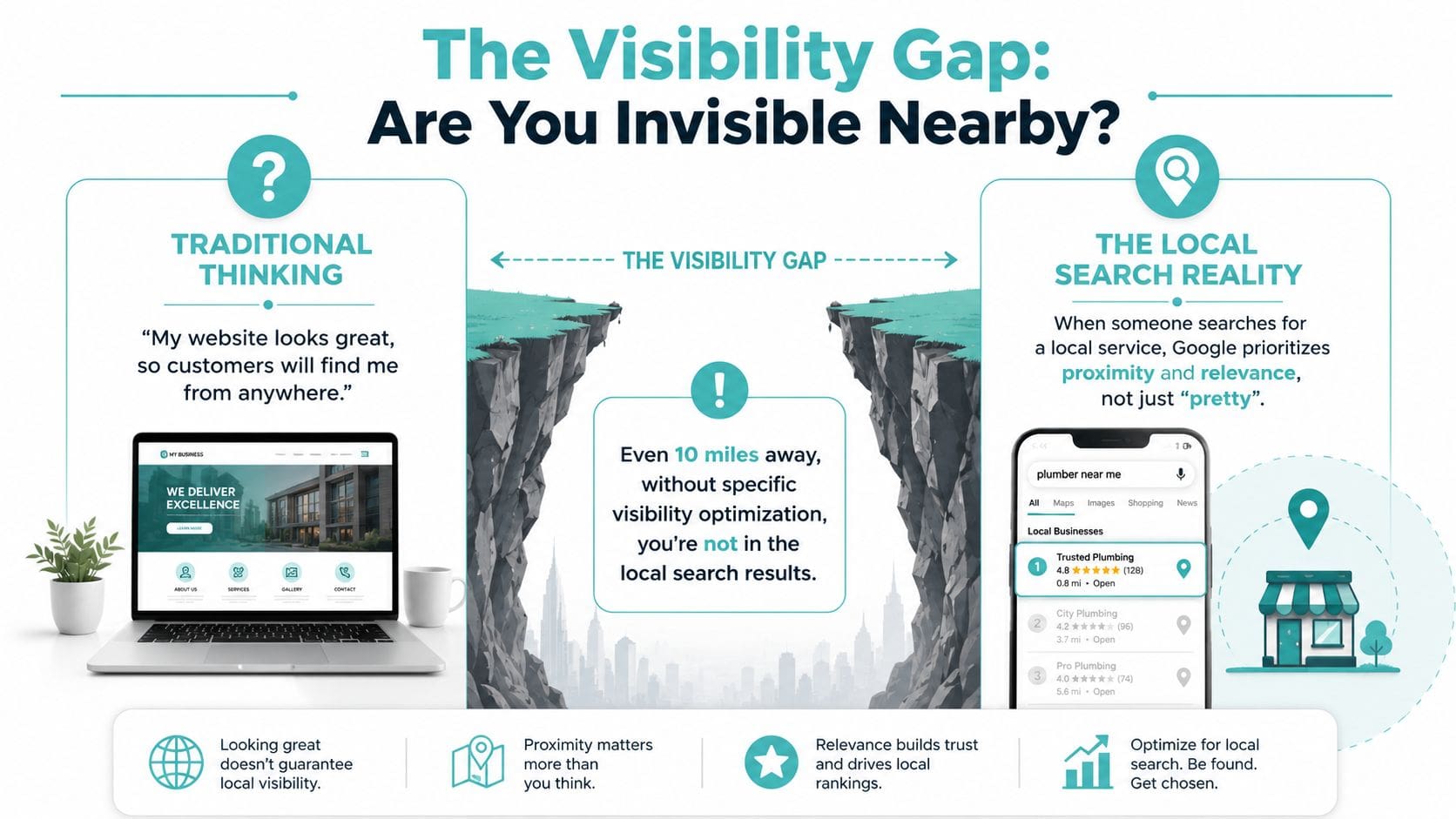
You may be easy to find in your hometown and almost impossible to find in the next city over. Not because Google hates you. Not because your work isn’t good. Because you never clearly showed Google that you work there.
What near me really means
When someone searches for your service “near me,” Google reads that as a local search tied to where that person is standing.
So if a homeowner in the next town searches for your service, Google is not thinking about your office address. It is trying to show businesses connected to that town and that search.
That’s the gap.
You’ve probably told Google about your hometown over and over. Your address is there. Your website mentions it. Your profiles point there. Your business is tied to that place.
But the towns around you? The counties you drive to? The places where you’d gladly take a profitable job?
If your business does not clearly show up in those places online, Google has no reason to assume you serve them.
Why good contractors stay hidden
Most local contractors build a website once and then leave it alone. It talks about the company in general terms. It may look fine. It may even rank for branded searches.
That still won’t make you visible across your service area.
A Website Visibility Score is usually a weighted percentage of a domain’s estimated organic clicks across tracked keywords. Tools estimate click-through rate by ranking position, apply search volume, and normalize that into a 0% to 100% score, which is why a few better positions on important terms can move visibility fast, as described in Amicited’s visibility score glossary.
You don’t need to obsess over that math. You do need to understand the business meaning. If you are missing in the places people search, your score is just another way of saying you’re absent.
For contractors who want a plain-English breakdown of this local problem, this guide on local SEO for contractors connects the dots without the fluff.
What this costs you
This isn’t just a marketing issue. It hits your revenue.
Here’s what the visibility gap creates:
- Lost bigger jobs: Higher-value work in nearby cities goes to companies that show up first.
- More small filler work: You keep taking the jobs that happen to come through, not the jobs you want.
- More competition on every lead: When you finally do get found, you’re often one of several bids instead of the obvious choice.
- More stress in slow seasons: Your pipeline depends on luck, timing, and referrals.
If you want another straight view of why local search matters for inbound calls, this article on get more calls with local SEO adds useful context.
Your Website Does Not Create Leads
In this context, contractors get sold a lie.
A website does not create traffic. It does not go out and hunt down buyers. It sits there and waits.

If nobody sees it, it does nothing.
That’s why so many owners feel ripped off after paying for a “nice new website.” The site looked better. The phone did not ring more. They were sold the wrong expectation from the start.
A website is an asset, not an engine
Think of your website like a brochure in a box.
If nobody hands it out, it stays in the box.
Your website can help turn traffic into calls. It can make it easier for the right buyer to trust you and contact you. But by itself, it doesn’t create demand. It doesn’t create visibility. It doesn’t force Google to put you in front of the right customer.
A pretty website with no visibility is just a more expensive brochure.
That’s why contractors need to stop asking, “Do I need a better website?” and start asking, “Do I have a system that gets buyers to it?”
If you want to see what a site looks like when it’s built around lead flow instead of looks alone, this page on lead generation website design for home services contractors lays it out clearly.
The System That Turns Invisibility Into Phone Calls
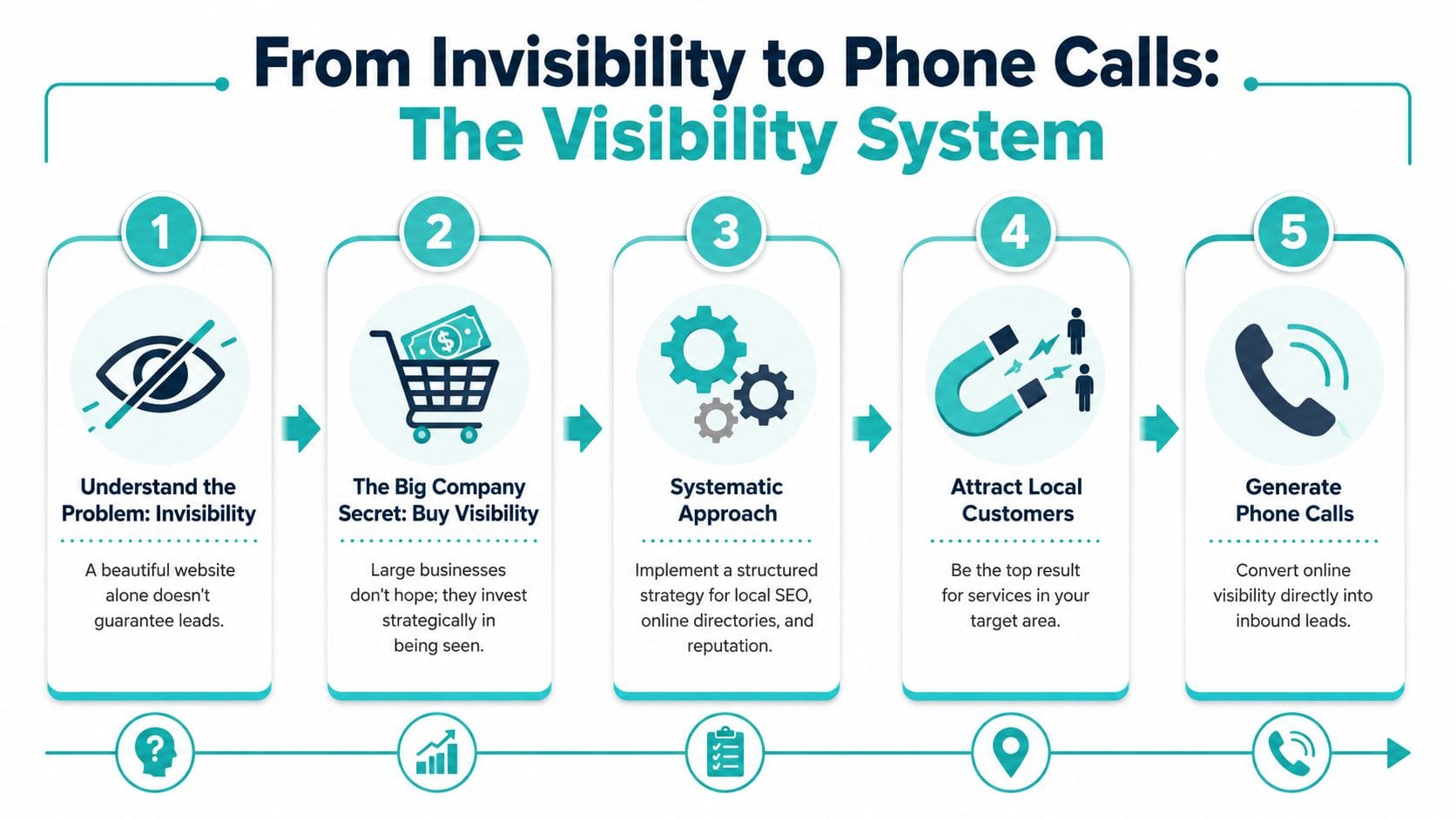
Big companies don’t sit around hoping somebody finds them.
They buy visibility.
That’s the part small contractors avoid because it sounds risky, confusing, or expensive. But the actual risk is staying invisible and pretending that’s a strategy.
The system has two parts
A working lead system for a contractor has two pieces.
First, you need the asset. That’s the website built to turn traffic into calls. It has to match the services you sell and the cities where you want work. Not just your home base.
Second, you need the fuel. That’s paid visibility. Ads put you in front of people who are searching right now. They create attention on demand instead of waiting around for luck.
Why both parts matter
A website without traffic won’t produce consistent leads.
Ads without a strong site waste money because they send buyers to a weak page that doesn’t convert.
Put both together and you have a system. The website captures demand. The ads create demand visibility. One without the other breaks down fast.
Here’s the simple version:
| Part | What it does | What happens without it |
|---|---|---|
| Website asset | Turns visitors into calls and quote requests | Traffic leaks out and does nothing |
| Paid visibility | Puts you in front of active local buyers | Nobody sees the website |
| Tracking and routing | Shows what’s working and where calls come from | You guess and hope |
What a Lead Machine actually is
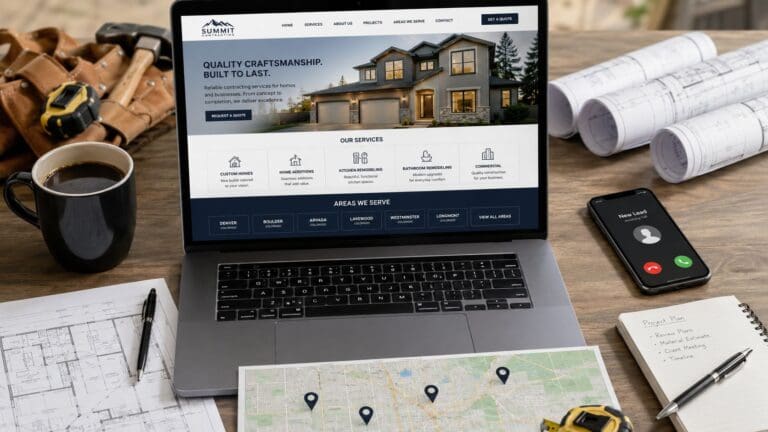
A Lead Machine is a website built around services, cities, calls, forms, and real lead flow. Then ads drive the right people to it.
That’s the model. Not mystery. Not hype.
One example is The Cherubini Company’s Lead Machine approach, which combines a service-and-city website structure with paid visibility to help contractors show up beyond a single hometown.
If your marketing isn’t built as a system, you don’t have marketing. You have disconnected expenses.
Take Control of Your Leads and Your Revenue
The feast-or-famine cycle isn’t random.
It happens when you don’t control visibility.
If leads depend on referrals, seasons, and luck, your business is fragile. You might stay busy for a while, but you won’t have control. And without control, you can’t plan growth, hire with confidence, or choose better jobs.
Control changes everything
When you control visibility, you stop waiting.
You decide where you want work. You build presence there. You drive traffic there. You create a path from search to call instead of hoping your name comes up in conversation.
That changes the business.
- Better jobs: You can go after the work you want, not just the work that happens to show up.
- Less panic: Slow weeks stop feeling like a surprise attack.
- Cleaner decisions: You can see what’s producing calls and what’s wasting money.
A long-running visibility benchmark also shows this isn’t some passing fad. SISTRIX says its Visibility Index has measured website success in Google search results since 2008 and is built on many millions of data points, which is why visibility scoring has become a mature way to track search presence over time, not just a dashboard novelty, as shown in SISTRIX’s Visibility Index overview.
If you want broader reach across more than one area, this page on multiple Lead Machines shows what a multi-city visibility system looks like.
You think that customers “can” find you but, If customers “don’t” find you, nothing else matters. Lead Machines are built to fix that.
If you’re tired of guessing, The Cherubini Company helps contractors fix the problem. Invisibility. They build Lead Machines and pair them with ads so your business can show up in the cities where customers are searching, then turn that visibility into calls.