
You know the feeling.
The phone is busy for a while. Crews are moving. Then it slows down and everybody starts asking the same question. What’s next?
So you call old contacts. You wait on referrals. You blame the season. Maybe you blame the website. Maybe you blame the last agency that sold you a shiny promise and gave you nothing but reports and excuses.
That isn’t a lead problem first.
It’s a visibility problem.
You may be known in your town. You may even have a solid name. But if you work outside that town and people searching in nearby cities don’t see you, you are invisible where the money is being searched for. That means you’re losing jobs before the phone ever has a chance to ring.
If you want to learn how to get high ticket construction jobs consistently, stop thinking like a guy who just needs more referrals. Start thinking like an owner who needs a system.
The Real Reason Your Pipeline Is Unpredictable
Most contractors don’t have a work problem. They have a control problem.
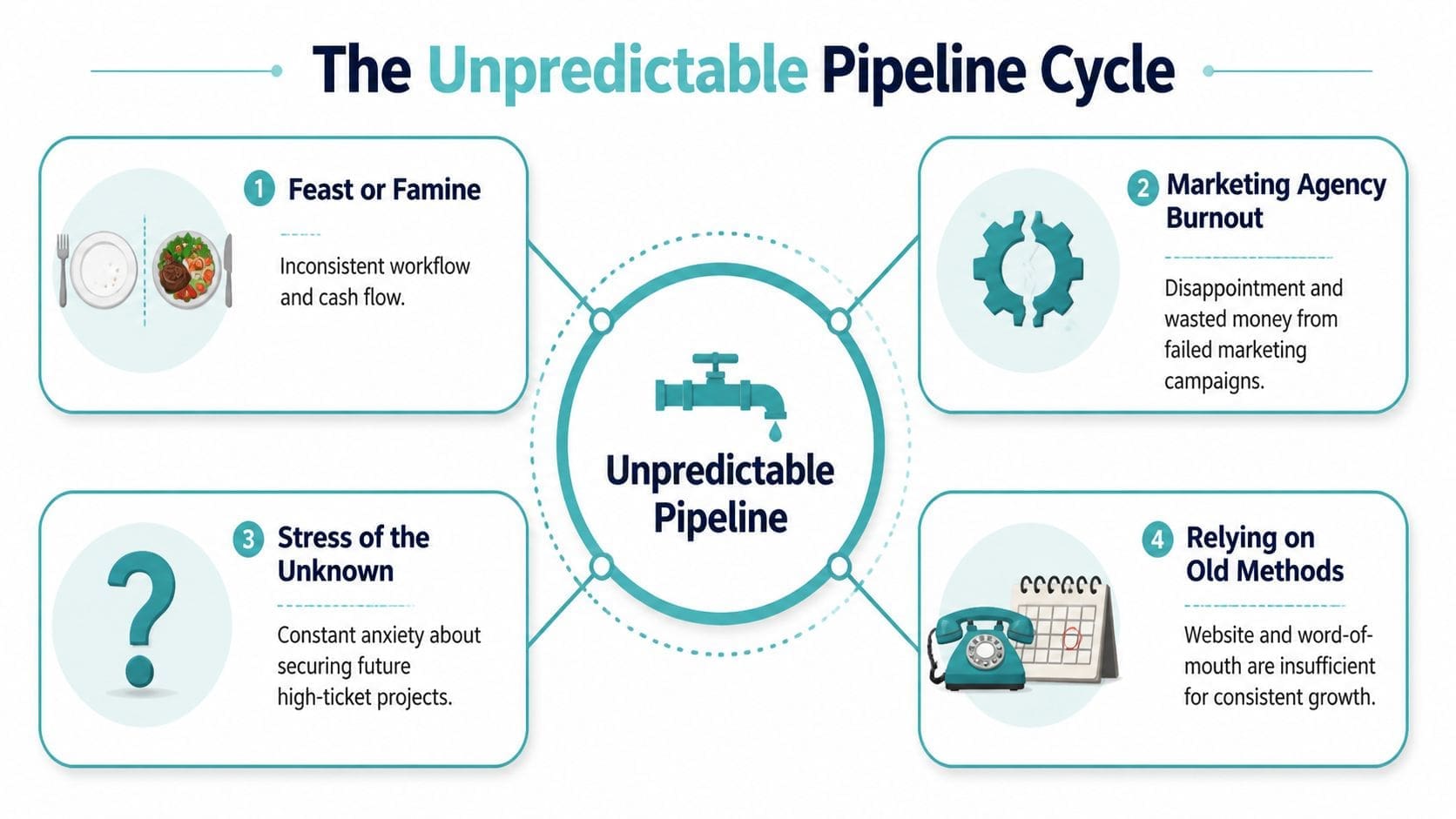
They rely on word of mouth, old contacts, and whatever comes in. That works just enough to keep the business alive. It does not work well enough to keep the pipeline steady. So the year turns into swings. Busy. Slow. Busy again. Then panic.
That cycle gets worse when you’ve been burned by marketing companies. You spent money. You got jargon. You got a website that looked nice and did nothing. Now you trust nobody and keep doing what you’ve always done.
That’s why the same problem keeps showing up.
The visibility gap is what hurts you
If somebody in your hometown searches for your service, maybe you show up.
If somebody ten miles away searches for that same service, maybe you don’t.
That is the gap. And it costs you jobs.
When a buyer searches “excavation contractor near me” or “grading contractor near me,” Google ties that search to the city where the buyer is standing. If your business only talks about your home city, your address, and your local service area there, Google gets a simple message. You are relevant there, and maybe nowhere else.
That means people don’t “fail” to find you. They don’t see you.
You think customers can find you. The real problem is they don’t.
Why this is getting more serious
Bigger companies buy visibility. Smaller contractors often buy equipment and hope the phone rings.
That’s backward.
There is a real opening here. Data cited by I Am Builders on regional visibility for contractors points to a 25% increase in regional visibility ads driving larger contracts for heavy equipment firms, and it also says 70% of site-prep firms rely on word-of-mouth, which leaves a large chunk of search demand on the table. The same source says specialized lead systems with 100+ city pages can help generate high-value jobs for contractors expanding across multiple cities.
Those firms are not winning because they work harder.
They’re winning because buyers see them first.
What an unpredictable pipeline usually means
A shaky pipeline usually comes from a few basic failures:
- You depend on referrals: Good when they come in. Useless when they slow down.
- You only show up in one city: You work a wider area, but the web presence doesn’t reflect it.
- You don’t track where jobs come from: So every decision becomes a guess.
- You wait instead of creating visibility: That always puts you behind the contractor who shows up first.
If you don’t control visibility, you don’t control revenue.
That’s the core problem.
Why Your Website and Word-of-Mouth Arent Enough
A lot of owners still believe the website is supposed to “generate leads.”
It doesn’t.
A website by itself is a parked truck. If nobody drives it, it sits there.

Your website is probably a brochure
Most contractor websites are built to exist, not to produce calls.
They say who you are. They show a few photos. They list services. They may even look clean. But they don’t create demand, and they don’t expand your reach into the cities where you want work.
That’s why this point matters so much. Websites don’t generate leads. They wait for traffic. If nobody sends traffic, nothing happens.
A lot of owners learned the wrong lesson from a bad website project. They think websites don’t work. Most websites were never built as lead systems in the first place.
Word-of-mouth is good, but it’s not a growth plan
Referrals are fine. Keep them.
But if referrals are your whole pipeline, you handed control of your sales to other people.
That means your future work depends on whether somebody remembers you, mentions your name, and happens to know a buyer at the right time. That is not a system. That is luck with a business card attached to it.
Here’s what word-of-mouth can’t do well:
| Problem | What happens |
|---|---|
| It’s passive | You wait for other people to send you work |
| It’s narrow | It usually stays close to the town where people know you |
| It’s uneven | Good months fool you. Slow months punish you |
| It’s weak for expansion | New cities don’t know your name, so they don’t search for you |
The wrong belief that keeps owners stuck
A lot of contractors say, “We get most of our jobs from referrals.”
That sounds good, but it often hides a weak pipeline.
It usually means this:
- You aren’t visible enough in search
- You don’t have a repeatable flow of buyers coming in
- You take what shows up instead of choosing the jobs you want
- You stay overworked on small jobs because bigger jobs aren’t coming in steadily
A referral-based business can survive for years and still be fragile.
If you want high-ticket work consistently, you need more than a decent reputation. You need to be visible to people who need your service right now, in the cities where they’re searching, even if they’ve never heard of you before.
That is the difference between a business that hopes and a business that hunts.
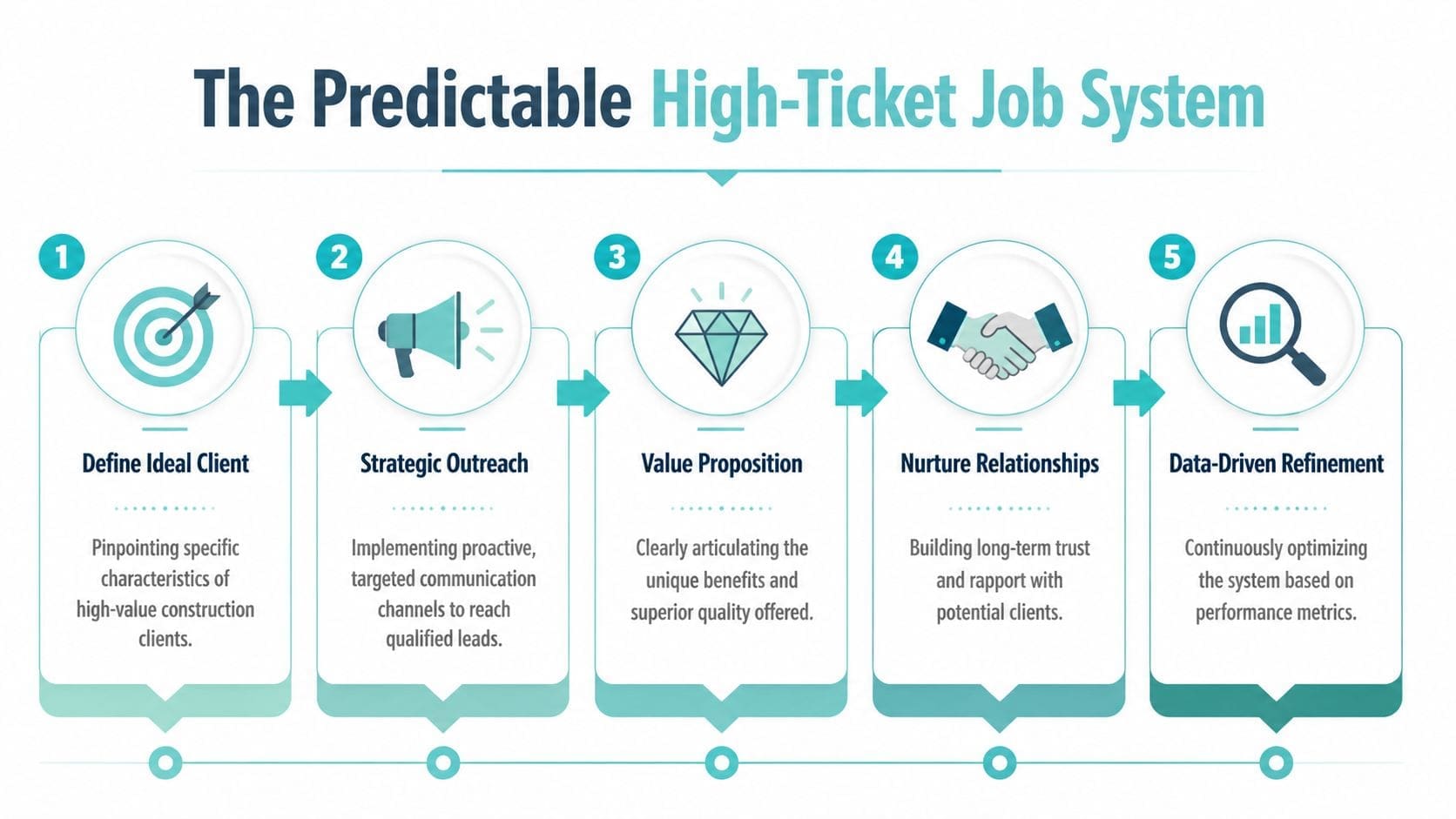
The System That Creates Predictable High-Ticket Jobs
You don’t need more random marketing.
You need a machine.
The simple version is this. Lead Machine + ads.
One part captures demand. One part creates visibility. Together, they give you a repeatable way to get in front of serious buyers.
The website is the asset
A Lead Machine is not a pretty homepage.
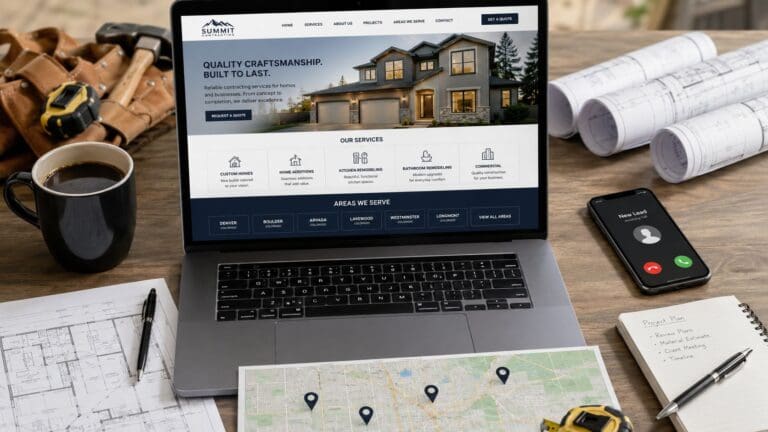
It is a website built for one job. Turn local search traffic into calls and quote requests. That means the site has to match how buyers search. Service by service. City by city. With clear next steps.
If you want work in multiple cities, the site has to clearly tell search engines and buyers that you serve those places. If it doesn’t, you stay boxed into your home area.
A proper lead system includes things like:
- Service pages: One clear page for each main service you want to sell
- City pages: Separate pages for the towns and counties where you want visibility
- Call-focused layout: Fast paths to call, request a quote, or reach your office
- Tracking: So you know what is producing calls and what is dead weight
That’s why a Lead Machine is different from a brochure site. It is built to rank, convert, and capture demand.
Ads are the fuel
A lot of contractors say ads didn’t work for them.
Most of the time, ads didn’t fail. The destination failed.
If ads send traffic to a weak site, money gets burned. If the site is built to convert but nobody sends traffic to it, it sits idle. You need both parts working together.
Ads create visibility. They put you in front of buyers who are searching now. Then the Lead Machine does the hard part. It turns that attention into action.
Practical rule: Ads without a conversion system waste money. A website without traffic wastes time.
For contractors who want a done-for-you option, The Cherubini Company’s construction lead generation system is built around that model. It uses city-focused lead websites and paid traffic together, so the site isn’t left sitting there waiting.
Predictable work needs business control, not just lead flow
Getting more calls is only part of it.
If you land bigger jobs but your numbers are sloppy, you can still lose money while staying busy. That’s why owners going after high-ticket projects need a clean back office too. Good estimating, tight job tracking, and clear cash handling matter just as much as visibility. Such useful resources like job costing and retainage guidance can help owners protect margin after the work is won.
Here’s the simple chain:
- Get seen in the right cities
- Drive buyers to a call-focused site
- Track calls and quote requests
- Bid the right work
- Protect margin after the sale
No guessing. No waiting on luck. No pretending a weak website is a lead source.
That’s how to get high ticket construction jobs consistently. Build a system that creates visibility, captures demand, and gives you control over what comes in.
Qualifying and Bidding to Win the Best Jobs
Once the phone starts ringing, a new problem shows up.
Bad leads waste time.
If you answer every call the same way, chase every quote, and bid every project that looks possible, you’ll stay busy and still feel broke. High-ticket work does not come from saying yes to everybody. It comes from filtering hard and bidding smart.

Start with a simple filter
The first job is not selling. The first job is qualifying.
You need to know a few things fast. What do they need. Where is the job. When are they starting. Are they the decision-maker. Are they serious, or are they just collecting numbers.
A short phone filter can save hours of wasted site visits and estimate work.
Ask things like:
- Type of project: Is this the kind of work you want?
- Location: Is it in a city you serve and want more of?
- Timeline: Are they ready, or just kicking tires?
- Decision control: Are you talking to the owner, builder, or someone with no authority?
- Budget fit: Can the project support your kind of work?
If a lead fails that basic screen, move on.
For owners dealing with junk inquiries, this guide on how to stop getting tire kicker leads lines up with the same idea. Better filtering saves your team from chasing people who were never going to buy.
Bid from strength, not fear
When work is thin, contractors bid scared.
They cut price. They accept bad terms. They take weak-fit jobs because payroll is staring at them. That is exactly how margin gets destroyed.
When lead flow is steady, you can finally act like a business owner instead of a hostage.
ConstructConnect reports that top performers achieve win rates of 20% to 30% compared to the industry average of 10% to 15%, and that firms that focus on projects aligned with their expertise and good leads from trusted networks can double their success rates. It also notes that tracking your bid-to-win ratio is foundational for landing high-ticket work consistently, according to ConstructConnect’s guidance on winning more construction bids.
That matters because the goal is not more bids.
The goal is better bids.
A blunt way to handle incoming opportunities
Use this decision table when a lead comes in:
| Lead type | What to do |
|---|---|
| Strong fit, clear scope, right location | Visit fast and pursue it |
| Good project, weak decision-maker | Slow down and confirm who approves the job |
| Bad fit service or small budget | Decline it |
| Price shopper with vague details | Don’t clog your schedule with it |
Track every estimate and every win. If you don't know your bid-to-win ratio, you're not managing sales. You're reacting to it.
The point of better visibility is not to flood your office with noise.
The point is to create enough opportunity that you can choose profit.
Building a Referral and Partnership Engine
There’s a big difference between referrals and a referral system.
Most contractors have referrals. Few have a system.
Passive word-of-mouth means you did a good job and hope somebody mentions your name later. A referral engine is different. It is built on purpose. It creates repeat chances to get in front of the right people before the next project is even out for bid.
Build a list of people who can feed you big jobs
You want relationships with people who already serve the kind of client you want.
That might include architects, general contractors, developers, designers, engineers, and real estate people who work around higher-value projects. These people can send better jobs than random homeowners because they are closer to the buying decision and often closer to repeat work.
The work here is simple. Make a target list. Stay in touch. Be useful. Do not disappear.
According to eSUB’s construction sales guidance, firms that dedicate 25% of the owner’s time to business development achieve 2 to 3x higher win rates. The same source says this includes building a target list of 20 to 200 prospects and scheduling regular touchpoints, while proactive follow-up boosts close rates by 35% versus passive waiting.
What a real follow-up rhythm looks like
This does not need to be fancy.
It needs to be consistent.
- Quarterly check-ins: A quick call or visit is enough if it’s useful
- Project updates: Let good partners know what work you’re focused on
- Fast follow-up after bids: Don’t vanish after you send a number
- Finished-job touchpoints: Use completed work to reopen the conversation
Good partnerships rarely die because of one mistake. They die because you stopped showing up.
Turn finished jobs into future jobs
Every solid project should create at least one of these:
- A review
- An introduction
- A repeat opportunity
If it creates none of them, you left value on the table.
At this stage, many owners get lazy. They finish the work and move on. Smart owners use that finish line to open the next door. If you want a basic example of how a referral process can be made clear and easy for partners, this page on how to refer property restoration business is useful because it shows how simple a formal referral path can be.
The point is not to beg for referrals.
The point is to make referring you easy, obvious, and normal.
That turns a one-time win into a compounding asset.
The Only Metrics That Matter for Consistent Growth
You do not need a giant dashboard.
You need a few numbers that tell the truth.
Most owners get lost because they track junk. Clicks. Impressions. Activity. None of that tells you if the business is getting stronger. If you want steady high-ticket work, track the numbers tied to money and control.

The short list you actually need
Here are the numbers worth watching:
- Qualified leads: Not every call. Only the genuine opportunities that fit your work
- Bid-to-win rate: How many serious bids turn into signed jobs
- Average job value: Are you moving toward larger, better work or staying stuck in small jobs
- Lead source: Which city pages, ads, and channels are producing actual buyers
- Sales speed: How long it takes from first contact to signed work
These numbers show whether you are gaining control or just staying busy.
What each metric tells you
A short table keeps this simple:
| Metric | Why it matters |
|---|---|
| Qualified leads | Shows whether visibility is attracting the right buyers |
| Bid-to-win rate | Shows whether you are pursuing the right work and closing it |
| Average job value | Shows whether your pipeline is improving in quality |
| Lead source | Shows where good jobs actually come from |
| Sales speed | Shows whether your process is helping or slowing deals |
Stop guessing and start managing
If qualified leads are weak, you have a visibility or targeting problem.
If qualified leads are solid but wins are weak, you have a filtering, sales, or bidding problem.
If wins are strong but profits are thin, you have an operations problem.
That is why these numbers matter. They tell you where the leak is.
The business gets easier when you stop asking, “How do we get more leads?” and start asking, “Where are we invisible, and what part of the system is failing?”
You don’t need more hope. You need better visibility, a site built to turn that visibility into calls, and simple numbers that tell you whether the machine is working.
If customers don’t find you, nothing else matters.
Lead Machines are built to fix that.
If you want to stop guessing, The Cherubini Company helps contractors fix the fundamental issue of visibility. They build Lead Machines and run ads that put your business in front of buyers in the cities where you want work, so your website stops sitting there and starts producing calls.