You’ve probably said some version of this already.
“We have a website.”
“We’ve tried ads.”
“That’s what the last agency told us.”
“We get some calls, but not the right jobs.”
That’s the trap.
A lot of contractors are busy, but they’re not in control. Crews stay moving. The phone rings just enough. But the work is patchy, margins are tight, and the better jobs keep going to companies that show up first online.
This is the core debate behind lead generation website vs regular website for contractors. It’s not about design taste. It’s not about having a site versus not having one. It’s about whether your website helps you control visibility and turn that visibility into booked jobs.
Most contractor websites don’t do that.
They sit there. They look decent. They say who you are. They list services. They wait.
That’s not a lead system. That’s a brochure.
Your Website Is a Brochure Not a Salesman
You might be booked out right now and still have a problem.
A full calendar doesn’t always mean a healthy pipeline. A lot of contractors stay busy with smaller jobs, low-margin work, and referrals that come in whenever they feel like it. Then a gap opens up, and everyone starts wondering where the next month of work is coming from.
That’s when the website gets blamed, even though it was never built to do a real job in the first place.

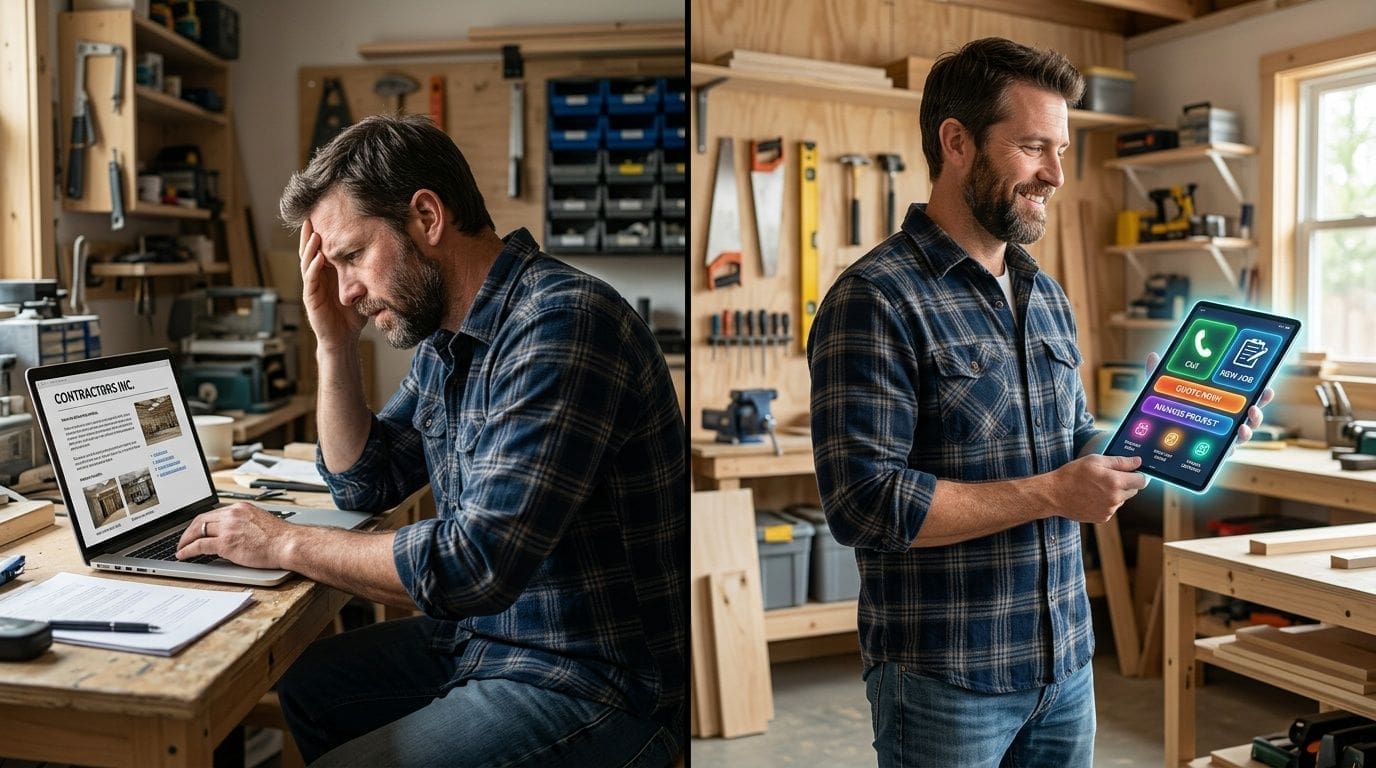
Most contractor websites are digital business cards. They have a home page, an about page, a service list, a few photos, and a contact form nobody watches closely. If that sounds familiar, you don’t have a sales tool. You have an online flyer.
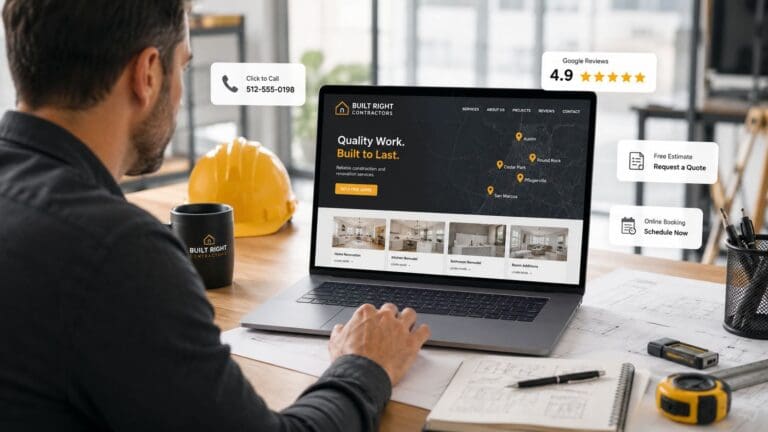
A real lead system has a different job. It needs to help strangers trust you fast, understand what you do, and contact you without hunting around. That’s the whole point behind a lead generation website for home service contractors.
What a brochure site actually does
A brochure site usually does three things:
- Lists your business: Name, phone number, service list, maybe a gallery.
- Looks acceptable: Clean enough to avoid embarrassment.
- Waits for someone to care: It depends on traffic from somewhere else.
That last part is where contractors get burned.
Most websites don’t fail because they look bad. They fail because they ask the visitor to do all the work.
Why that costs you jobs
A homeowner doesn’t give you extra credit because your company has been around a long time. If they search for a contractor and your site doesn’t guide them to call, they leave.
They don’t tell you they left.
They just hire somebody else.
That’s why so many owners feel confused. They assume the website is “there,” so it must be helping. But if it only describes your company and doesn’t move people to act, it’s not helping much at all. It’s just sitting online collecting dust while better-built competitors take the calls.
The Real Problem Is Invisibility Not Effort
Most contractors don’t have an effort problem.
They have an invisibility problem.
You already know how to do the work. You answer calls. You bid jobs. You manage crews. You solve problems all day. None of that matters if buyers in the next town never see you when they search.
Your website does not create traffic. It sits and waits.
If someone searches for your service “near me,” Google turns that into a city-based search tied to where that person is standing. If your business only signals your home city, then in the nearby city where you also work, you may as well not exist.
The hometown trap
A lot of contractors are known in their hometown. Their address is there. Their trucks are there. Their jobs are there. Their website talks about that town over and over.
So Google learns one simple thing. This company works there.
That sounds harmless until you realize what’s missing.
If you do jobs 10, 20, or 30 miles away, but your online presence never clearly says that, Google has no reason to assume you serve those places. Why would it? You never told it.
Here’s what that means in real life:
- A homeowner in your town finds you
- A homeowner two towns over never sees you
- A competitor with better visibility gets the quote request
- You lose a job you never even knew existed
That’s the visibility gap. It kills growth insidiously.
Hope is not a system
Big companies buy visibility. Smaller contractors often rely on referrals, memory, and luck.
That works until it doesn’t.
You can keep posting on social media if you want, and tools like PostPlanify social media scheduling can help a contractor stay consistent there. But social posting does not fix the core issue by itself. People looking for a contractor usually search by service and city when they need help, not by scrolling around hoping to discover one.
Practical rule: If people in nearby cities don’t see you when they search, your market is smaller than you think.
The hard truth is simple. You’re not losing because you don’t work hard enough. You’re losing because buyers can’t choose a company they never see.
Why this turns into a lead problem
Contractors say they need more leads.
Usually, they need more visibility in the right places first.
A lead problem is often just an invisibility problem wearing a different shirt. If you only show up in one city, you only have a shot at the buyers in one city. If your competitors show up in five or ten nearby markets, they get more chances to win without being better at the actual work.
That’s why a regular website doesn’t solve much. It doesn’t expand your reach on its own. It doesn’t make you visible. It just waits for traffic that may never come.
Regular Website vs Lead Machine A Direct Comparison
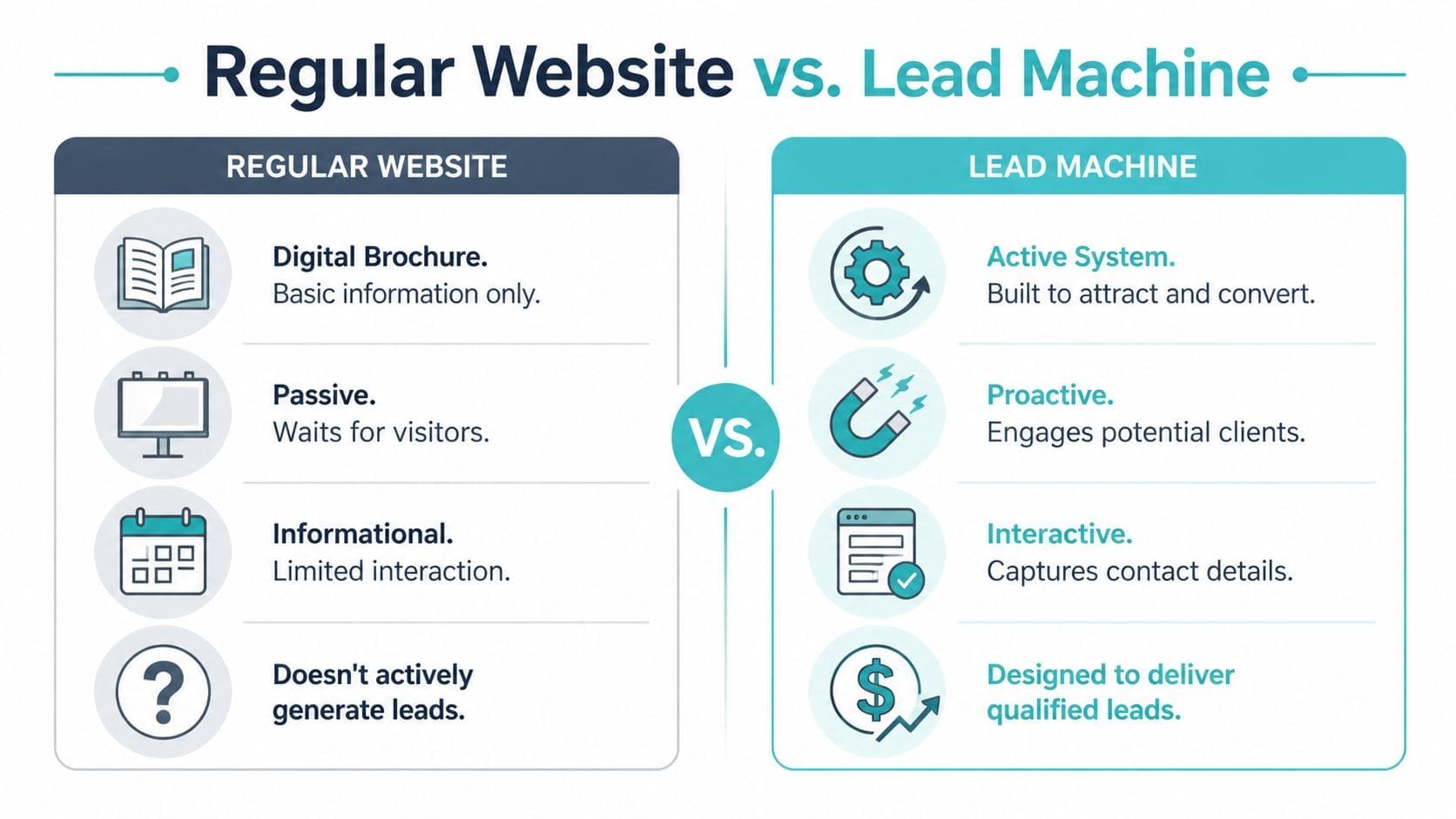
A regular website gives a contractor an online address. A lead machine gives the business a way to control revenue.
That is the actual comparison.
If your site only explains who you are, it behaves like a brochure. If it is built to turn traffic into calls, quote requests, and booked estimates, it behaves like part of your sales system. Owners who miss that distinction keep paying for websites that look fine and produce almost nothing.
| Criterion | Regular “Brochure” Website | Lead Machine Website |
|---|---|---|
| Primary goal | Explain the business | Turn traffic into calls and form leads |
| Role in marketing | Passive asset | Active part of a lead system |
| Structure | A few general pages | Built around services and service areas |
| Message | “Here’s who we are” | “Here’s what we do and how to contact us now” |
| Calls to action | Often weak or buried | Clear and obvious from the start |
| Mobile experience | Often treated as secondary | Built for phone users first |
| Speed focus | Often ignored | Treated as a conversion issue |
| Trust building | Basic testimonials or none | Trust signals placed near action points |
| Traffic readiness | Waits for visitors | Prepared to convert paid and organic traffic |
| Business outcome | Inconsistent results | More control over lead flow |
The gap shows up in revenue
The earlier conversion benchmarks make the point clearly. Average contractor sites convert far below the best lead-focused sites. That means two companies can get the same traffic and end up with completely different sales results.
One gets a trickle of calls. The other fills the calendar.
That difference has nothing to do with luck. It comes from structure, intent, and follow-through. A lead machine is built to catch demand the moment it arrives, not just display information and hope a visitor decides to hunt for your phone number.
Why brochure sites keep losing
A brochure site is usually built from the owner’s point of view. It talks about the company, the years in business, the team, and the services in broad terms. It often looks respectable. It also asks the buyer to do too much work.
A lead machine is built from the buyer’s point of view. The visitor lands on a page that matches the exact service and area they searched for. The page answers the immediate question, shows proof, removes doubt, and pushes toward one action. Call, request a quote, book an estimate.
That is a sales process, not web decoration.
If you want to see what that setup looks like in practice, review this guide on how to turn your website into a lead machine.
Mobile and ad traffic punish weak sites fast
A contractor rarely loses the lead because the site was ugly. The lead is lost because the site was slow, confusing, or weak at the moment the buyer was ready to act.
That gets more expensive when you run ads. Paid traffic has a meter running on it. Every click that lands on a weak page costs money and produces nothing. Owners who spend on traffic before fixing conversion usually blame the ads, even though the problem is the page people hit after the click. If you are investing in paid traffic, learn the basics of mastering lead generation ads and pair that traffic with pages built to convert.
A regular site treats traffic like a visitor count.
A lead machine treats traffic like incoming revenue that needs to be captured.
How a Lead Machine Turns Visibility Into Jobs
A contractor can spend thousands on a decent-looking site and still have dead days on the calendar.
That happens because a website by itself does not control lead flow. It just sits there until someone finds it. If nobody sees it, nobody calls. If the wrong people see it, you get tire-kickers, price shoppers, or nothing at all.
The fix is a system. One part gets you seen. One part turns that attention into booked estimates.
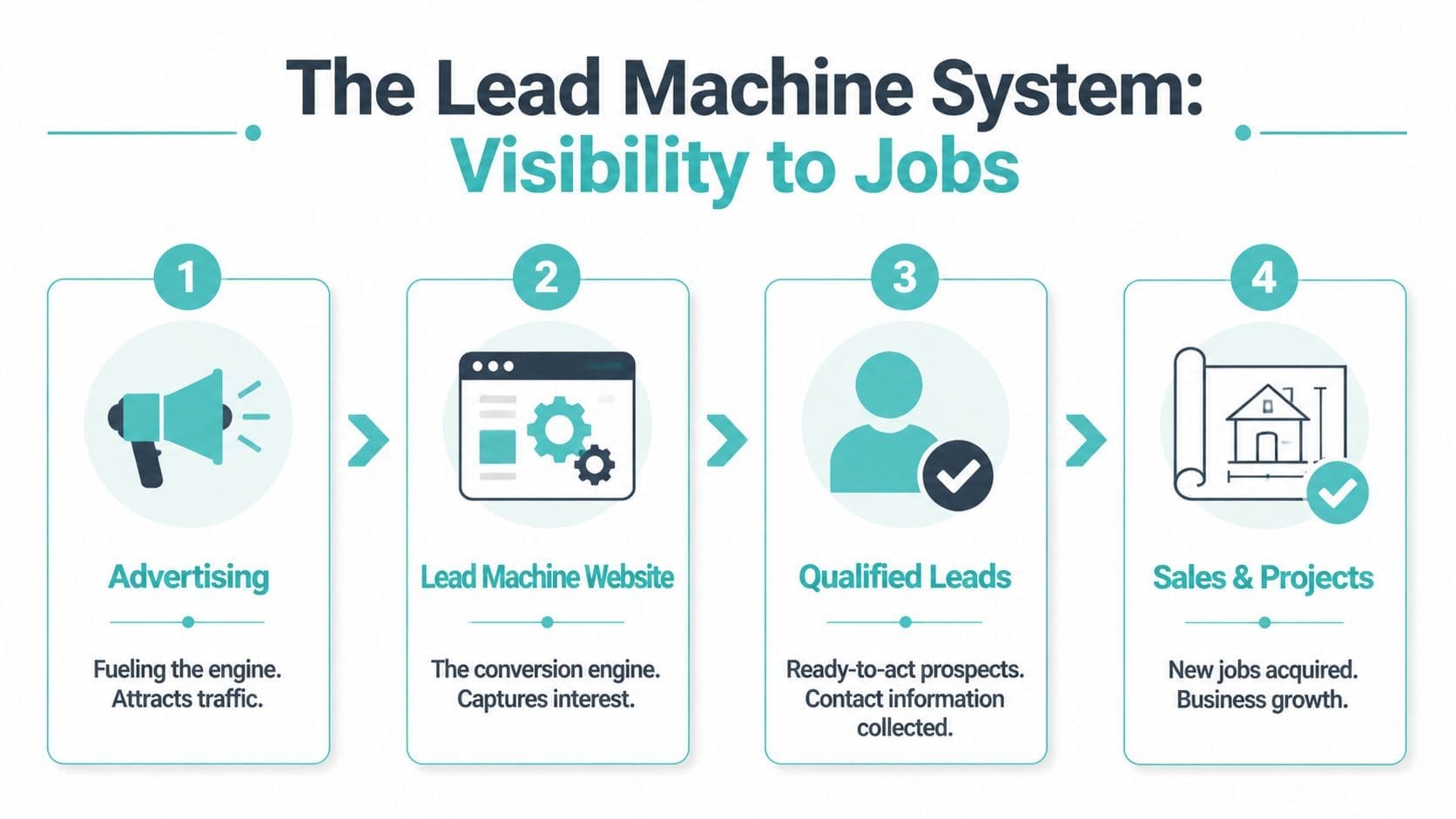
Part one is the machine
The site has one job. Convert attention into action.
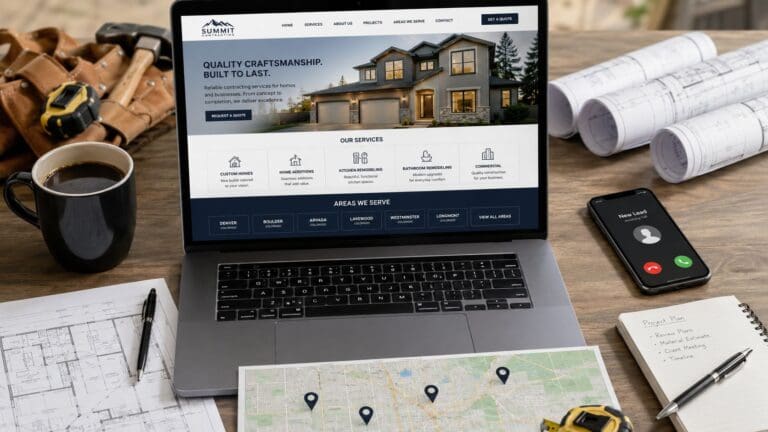
That means clear service pages, city-specific pages, proof, fast load times, obvious calls to call or request a quote, and a layout that works on a phone without friction. A weak site leaks demand. A conversion-focused site captures it. As noted earlier, the gap in performance between average contractor websites and conversion-focused lead generation sites is not small. It is the difference between getting a few inquiries from your traffic and getting enough to shape your month.
If you want to see the structure in plain English, study what a website built to become a lead machine looks like.
Part two is the fuel
Visibility has to be intentional.
Ads put your company in front of buyers who are already searching for your service in the areas you want to own. That gives you control regular websites do not. You can push into the zip codes that matter, fill slow weeks, test offers, and stop relying on referrals to carry the business.
If you want a simple outside resource on messaging and offer structure, mastering lead generation ads is worth reading. The lesson is straightforward. Paid traffic sent to a weak page burns money.
Why contractors stay stuck
Owners usually blame the wrong thing.
They say Google Ads failed. They say SEO takes too long. They say the market is too competitive. Often, the problem is simpler. They paid to get seen, then sent that attention to a site that did not do enough to win the job inquiry.
A lead machine fixes the handoff between visibility and action. The search happens. The click happens. The page matches the job. The visitor sees proof, trusts what they see, and takes the next step.
That is how visibility turns into revenue control.
One option in this space is The Cherubini Company, which builds contractor Lead Machines and pairs them with visibility ads aimed at the cities a contractor wants to reach. The point is not the brand name. The point is the model. Build a system that gets you found and gives that traffic a clear path to become calls, estimates, and jobs.
A regular website waits and hopes. A lead machine gives you a way to steer demand.
Calculating the Real Cost of a Regular Website
Most contractors ask the wrong cost question.
They ask, “How much does a better website cost?”
The sharper question is, “How much is my current website costing me every month I keep it?”

If you’re invisible in the towns around you, you’re not just missing clicks. You’re missing jobs, estimates, referrals from those jobs, and repeat business that could have started there.
A regular website creates hidden loss because it makes owners think they are covered online when they are not.
The number that matters
A lot of agencies talk about cost per lead because it sounds cheap.
That number can fool you.
The critical metric is Cost Per Booked Job, not Cost Per Lead. Leads from owned websites and targeted ads bring in buyers with higher intent, which leads to 40% shorter sales cycles compared with leads from third-party sites where people are often shopping for the lowest price, according to lead quality and cost per booked job analysis.
That source also makes a point contractors need to hear. A better lead closes faster and often leads to better-value work. That means the cheapest lead on paper can be the most expensive lead in your business.
Shared leads feel easy but cost control
Third-party lead platforms can get the phone to ring. That’s why contractors use them.
But they don’t give you control.
The same lead often goes to multiple contractors. The buyer may trust none of you. They compare price first because your brand has no room to do the heavy lifting. Your team chases the lead, follows up, and competes in a race you didn’t set up.
Here’s the practical difference:
- Shared lead model: You buy access to a prospect.
- Owned lead machine model: You build the asset that attracts and captures the prospect.
That’s why small business website cost should be weighed against lost booked jobs, not just the upfront design bill.
If your website cannot help you win better jobs, the cheap option gets expensive fast.
The real financial drain
The drain is not only bad leads. It’s weak control.
When your website is passive, you depend on referrals, platforms, and word of mouth to do the hard work. When any of those slow down, your pipeline gets shaky. That’s why so many contractors feel stress even when the business looks fine from the outside.
Control comes from owning the system that brings buyers to you and helps them take action.
Without that, you’re renting your demand from somebody else or waiting for it to show up.
Real Contractor Scenarios When to Upgrade
Most owners don’t need a lecture. They need to know if this sounds like their shop.
If it does, it’s time to stop treating your site like a checkbox and start treating lead flow like a business system.

Scenario one you live on referrals
Referrals are great until they dry up.
If most of your work comes from word of mouth, then your revenue depends on other people remembering you at the right moment. That is not control. That is luck with a time delay.
A lead machine gives you another channel you own.
Scenario two you get calls but the wrong kind
The phone rings, but the leads are weak. People ask for prices. They compare you with several others. They disappear.
That usually means your marketing is attracting shoppers, not serious buyers.
According to a 2020 industry report, 100% of contractors found jobs on third-party lead generation platforms. But organic traffic from an owned website converts at 4.1%, compared with 2.7% for paid search, and owned traffic avoids the competition of shared lead platforms, according to contractor lead platform and organic conversion data.
That doesn’t mean lead platforms are useless. It means they should support your business, not become your business.
Scenario three you work a wider area than Google shows
This one is common.
You’ll drive across counties for a profitable job, but online you only show up around your office location. So the markets you want are open, but you are not visible there in a way that brings steady calls.
That’s a sign your current site was built to exist, not to expand.
Scenario four you’ve been burned before
You paid for a redesign. You ran ads. You got reports. Nothing changed.
That makes contractors skeptical, and they should be skeptical.
But past bad marketing doesn’t change the math. If buyers don’t see you, they can’t hire you. If they land on a weak site, they leave. The answer isn’t to stop building visibility. The answer is to build a system that connects visibility to action.
Your Next Steps to Control Your Lead Flow
You don’t need more marketing talk.
You need a decision.
If your current website acts like a brochure, call it what it is. It is not a lead system. It is not controlling visibility. It is not helping you expand into nearby cities in a reliable way.
The practical path forward
-
Be honest about the current site
If it mostly lists information and waits, it’s passive.
-
Stop expecting the website to create traffic by itself
It won’t. It needs visibility from search presence, ads, or both.
-
Build for the cities and services you want
If you want jobs outside your hometown, your system has to reflect that.
-
Measure booked jobs, not vanity numbers
Calls that don’t close are noise.
-
Talk to a specialist who builds contractor lead systems
Not a general designer. Not a brand studio. Not a marketer selling fluff.
You think customers can find you. But if customers don’t find you, nothing else matters.
That’s the whole issue.
A regular website makes you feel like you’re doing marketing.
A lead machine helps you control lead flow.
If you want predictable revenue, stop guessing and build a system that creates visibility and turns it into calls.
Lead Machines are built to fix that.
If you’re tired of wondering why the phone isn’t ringing from the towns you want work in, talk to The Cherubini Company. They help contractors fix the main problem, which is invisibility, by building lead generation websites and ad systems designed to turn local searches into calls and quote requests.