You've probably said some version of this already.
We tried ads. They didn't work.”
“That's what the last agency said.”
“We spent money and got junk.”
“We're busy, but not with the jobs we want most.
That frustration makes sense. Most contractors don't have a work ethic problem. They have a visibility problem.
You may be known in your home town. You may get referrals. You may even have a decent website. But if someone in the next town searches for your service and you don't show up, you lose that job before you ever knew it existed.
That's the issue.
If you want to understand how to run Google Ads for contractors without wasting money, stop thinking about ads as a magic trick. Ads are only fuel. First you need something worth sending traffic to. Then you need a system that puts you in front of buyers in the towns where you want work.
Why Your Google Ads Keep Failing
A contractor hires an agency. The agency talks big. They launch ads. Calls come in, but most are bad fits, low intent, or people looking for something else. A few weeks later, the contractor decides Google Ads are a scam.
Usually, Google Ads wasn't the problem. The setup was.

Most failed contractor campaigns break for simple reasons. The wrong searches trigger the ads. The ad sends people to a generic page. Nobody tracks what turned into a call or form. If you're not clear on that last part, this guide to mastering GA4 conversion tracking helps explain what should be measured.
Ads don't fix a broken setup
Many contractors get burned by Google Ads because they treat it as the first step. A better approach is to handle the foundation first. Build the website, Google Business Profile, and reviews, then use ads to scale a working system instead of trying to fix a broken one with traffic, as explained by Adapt Digital Solutions.
Practical rule: If your website and local presence are weak, ads will just help you fail faster.
That's why so many contractors feel lied to. They were sold clicks when what they needed was visibility plus conversion.
The real leak is usually before the click
Google Ads for contractors works best when it's built around high-intent search behavior. Contractor guidance recommends service-specific and location-specific searches like “HVAC repair in Kingwood” or “construction companies near me,” then using Google's Keyword Planner before launch. It also says each service should have its own ad group and matching landing page so the page lines up with the search term, which improves lead quality and reduces wasted clicks, according to ServiceTitan.
If your painting ad and your drywall ad send people to the same page, that's sloppy. If your ad for one city sends traffic to a page that only talks about your home city, that's sloppy too.
That kind of mismatch is one of the contractor marketing mistakes that cost you money. It's also why the platform gets blamed for a strategy problem.
Your Business Is Invisible and You Don't Know It
Most contractors think they're visible because they can find their own business online.
That's not the test.
A key test is whether a stranger in the next town can find you when they search for the service you do. If they can't, you're invisible there.
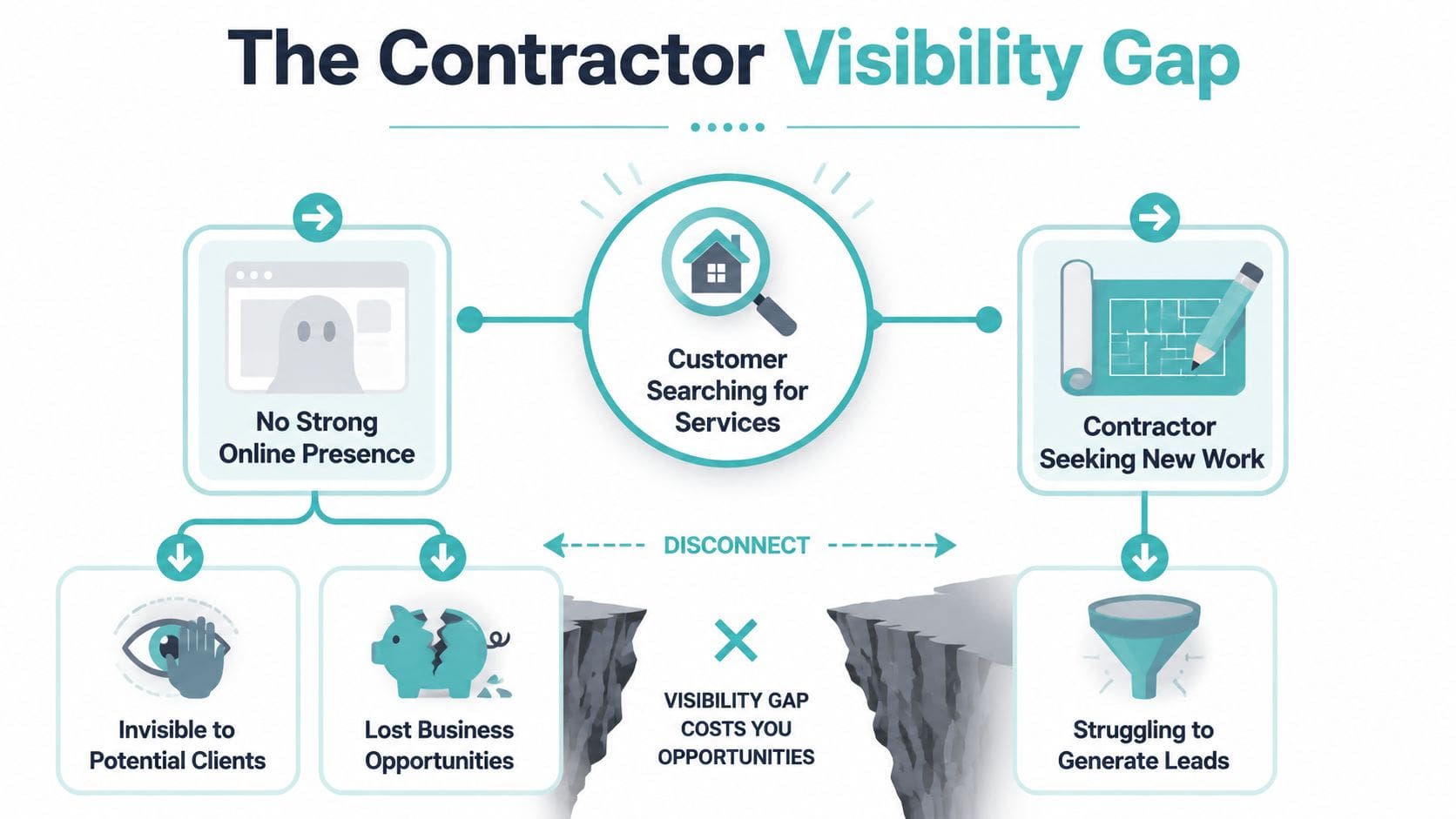
Near me doesn't mean near your office
When a customer searches for “[your service] near me,” Google reads that as the city where the searcher is standing or sitting. If that person is in the next town over, Google is not thinking about your shop address. It's thinking about their location.
So if your address, website, and online mentions mostly point to your home city, Google has no reason to believe you work elsewhere.
That's the visibility gap.
You know you'll drive for the right job. Google doesn't know that unless your online presence makes it obvious.
If you never tell Google you work in a city, don't act surprised when Google stops showing you there.
The jobs you lose are the ones you never see
This is why contractors get stuck in a weird spot. They're busy enough to survive, but not visible enough to grow. They do jobs twenty miles away, sometimes more, but online they only exist in one place.
A major challenge for contractors is using Google Ads for multi-city territory expansion. Most guides stay generic and don't show how to structure campaigns to win work across multiple towns or a regional footprint, even though that matters for contractors who can profitably travel farther for bigger jobs, as noted by STACK Construction Technologies.
That missing piece matters most for contractors with larger job sizes. If a bigger project makes travel worth it, your visibility should extend beyond your home town.
A simple way to look at it
| Searcher | What they do | What happens if you're not visible |
|---|---|---|
| Homeowner or property manager in your town | Searches your service | You might show up |
| Buyer in the next town | Searches the same service | Competitor gets the click |
| Buyer in a city you already serve | Looks for help now | You never enter the race |
That's why the question isn't “Can customers find you?”
The question is “Do customers find you when they search where they live?”
If the answer is no, start with this explanation of why your business doesn't show up on Google. It gets to the heart of the problem fast.
Your Website Is a Brochure Not a Machine
A website does not create traffic.
It sits there and waits.
That's why so many contractors feel disappointed by their site. They paid for something that looks decent, but it doesn't produce much. That's not because websites are useless. It's because most contractor websites are built like brochures, not lead systems.
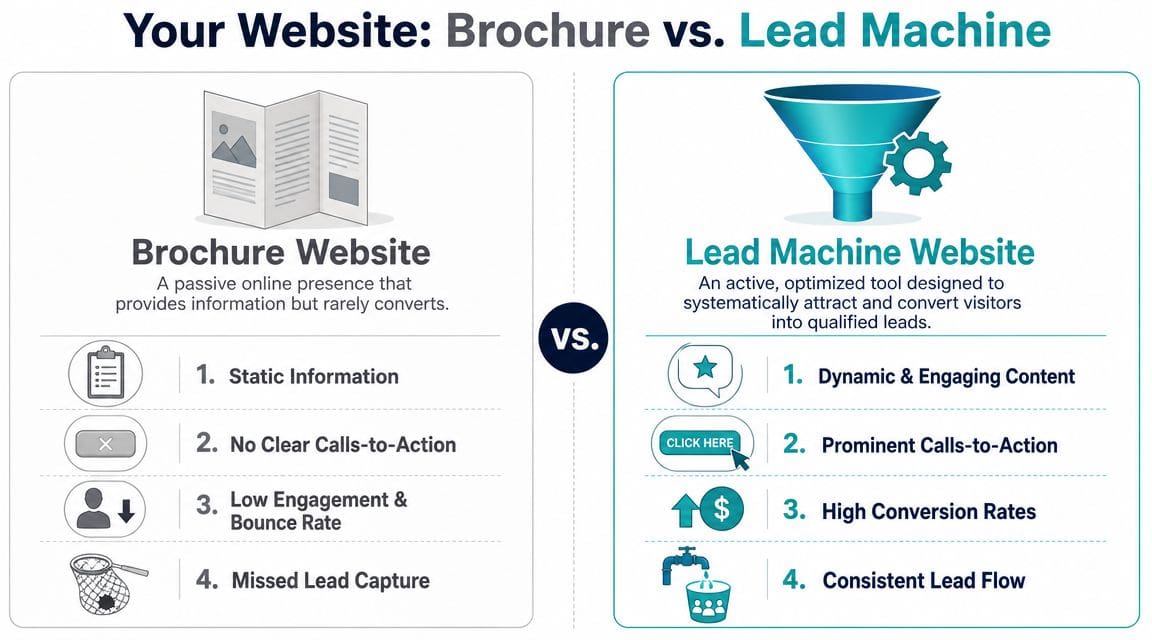
A brochure tells. A machine converts.
A brochure site says who you are. It lists services. It shows a few photos. It may even have a contact page buried in the menu.
That's fine for someone already sold on you.
It's bad for paid traffic.
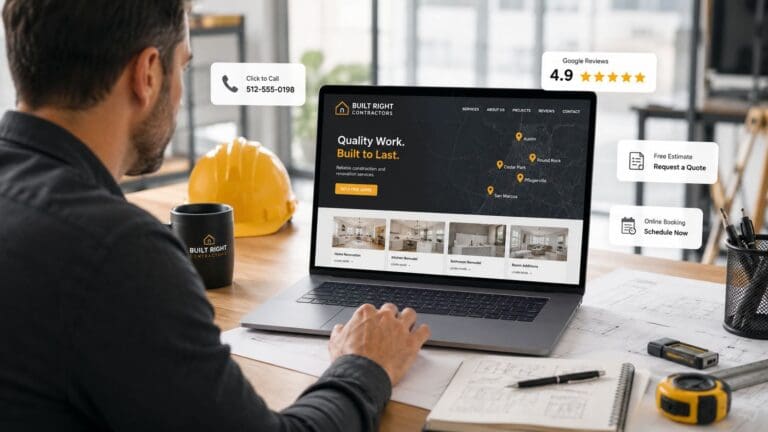
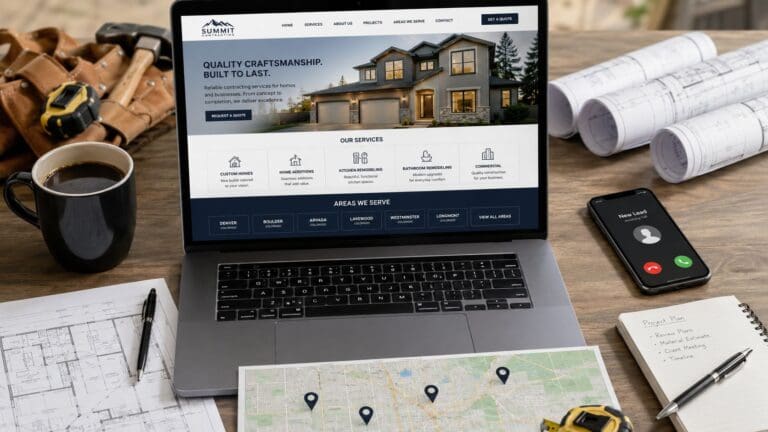
A Lead Machine is different. It's built around one goal, getting the visitor to call, message, or request a quote. That means the pages match the service. The city is clear. The action is obvious. The site loads fast and works on a phone.
What a contractor site must have before ads hit it
Search-only campaigns for contractor lead generation work best when they are tightly segmented by service line, with each ad group mapped to one matching landing page and backed by negative keywords to block low-intent searches such as DIY or irrelevant residential terms, according to Sona.
That only works if the website itself is ready.
A solid contractor lead site needs:
- Service-specific pages that speak to one job type at a time
- City-specific pages so Google and the customer both know where you work
- Clear calls to action so the next step is obvious
- Fast mobile pages because most buyers won't wait
- Simple quote forms that don't ask for nonsense
If you want to see what stronger intake looks like, this guide for contractor lead forms is useful because it focuses on forms that help turn interest into actual inquiries.
Your homepage is not the answer to every search. A buyer looking for concrete work in one town should land on a page about concrete work in that town.
Don't buy traffic before you build the asset
Contractors often waste money. They run ads to a weak site and then decide ads don't work.
Ads don't fix confusion. They don't fix generic pages. They don't fix a site that never clearly says where you work and what you want the visitor to do.
A Lead Machine does.
If you want a clearer picture of that difference, read about how to turn your website into a lead machine.
How to Buy Visibility the Right Way
A homeowner searches for “roof repair near me” after a storm. A property manager searches for “commercial electrician” because a tenant is down. Those jobs go to the contractor they see first and trust fast enough to contact.
That is what you are buying with Google Ads. Visibility with intent behind it.
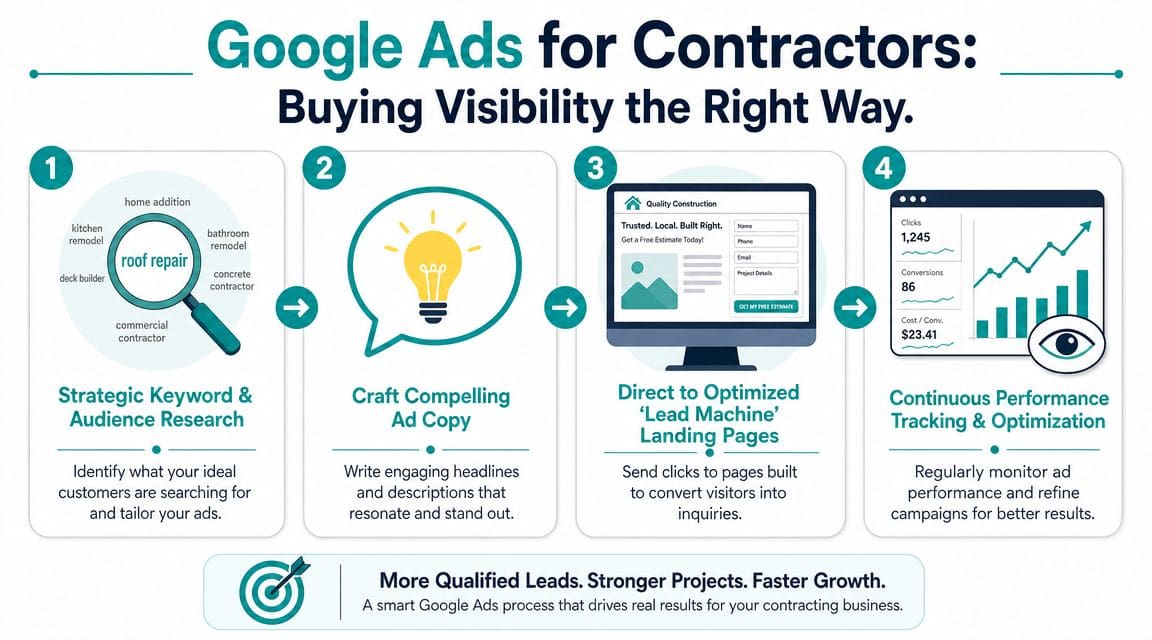
What good Google Ads for contractors actually does
Good ads put your business in front of people who are already looking for the exact service you sell in the exact area you want. Then they send that person to the right page and track whether the click turned into a call or form submission.
That is the whole job.
If your campaign cannot tell you which service, which city, and which search produced a lead, you do not have a lead system. You have ad spend.
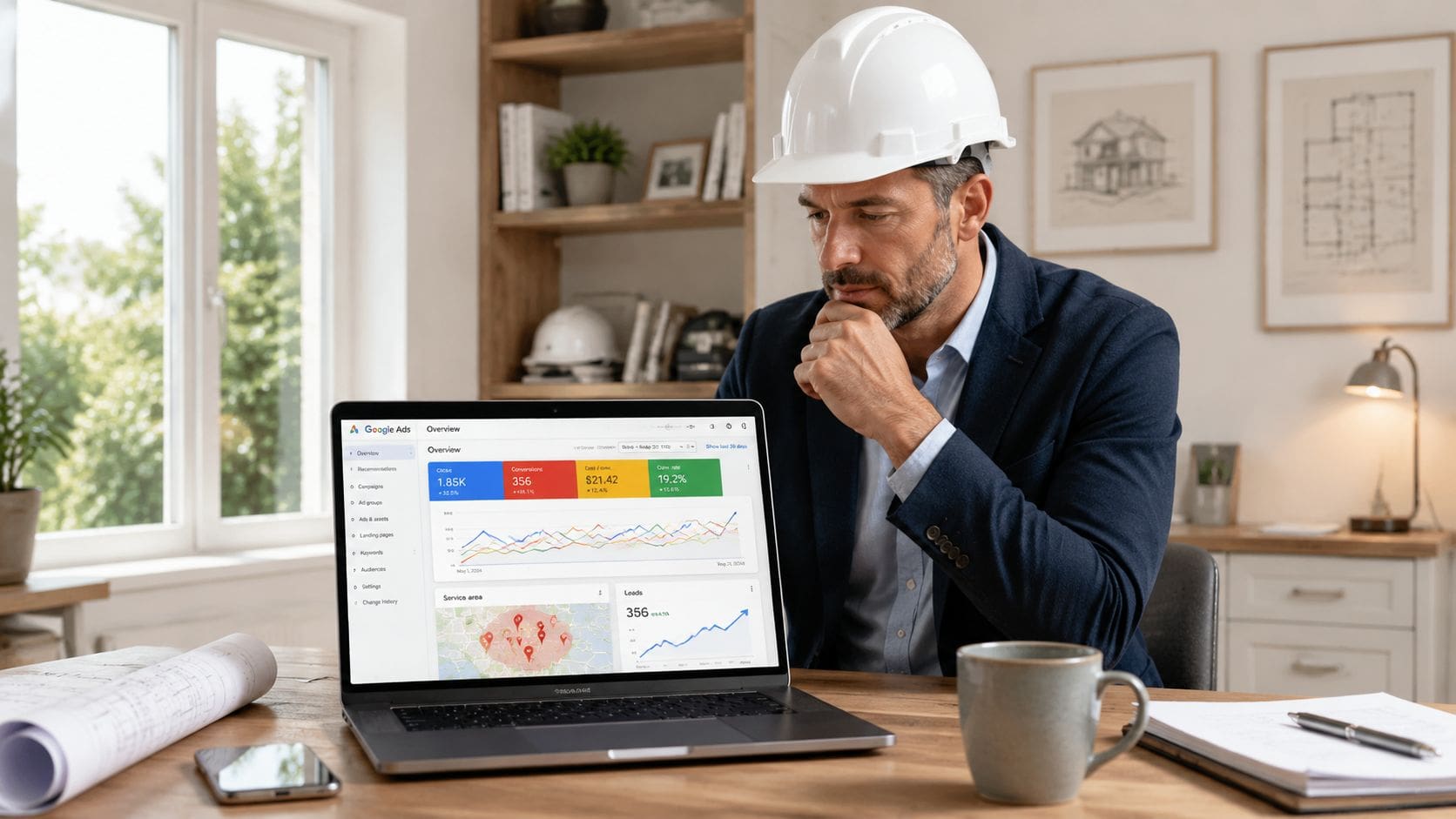
Use simple performance checks. Are you showing up for the right searches? Are people clicking? Are they contacting you after they land? Is the cost per lead low enough to support the job mix you want? Google explains the core reporting for these questions in its Google Ads conversion tracking documentation.
Search first. Keep it tight.
Search campaigns give contractors the most control because they let you show up when someone is actively looking. Keep each service line separate. Keep location intent clear. Send every ad group to the closest matching page. Cut junk traffic with negative keywords from day one.
This is not about getting more clicks. It is about getting the right clicks and refusing to pay for the rest.
If you want outside help, AI ads for service businesses is one example of how service companies can manage ad execution without turning marketing into a full-time side job.
A stronger option is to connect ads to a real lead asset. Google Ads to fuel your lead machine shows what that looks like when ad traffic is tied to service and city pages built to convert.
You are not buying traffic for the sake of traffic. You are buying visibility at the moment revenue is looking for a contractor.
That is the right way to run Google Ads for contractors. Buy attention where demand already exists, connect it to a page built to convert, and measure every step so the system gets stronger over time.
Build a System Not a To-Do List
Most contractors don't need more marketing tasks.
They need a system.
A to-do list sounds like this. Fix the website. Ask for reviews. Try ads. Post on social media. Maybe update the Google profile. Maybe redo the logo. None of that creates control.
A system creates control.
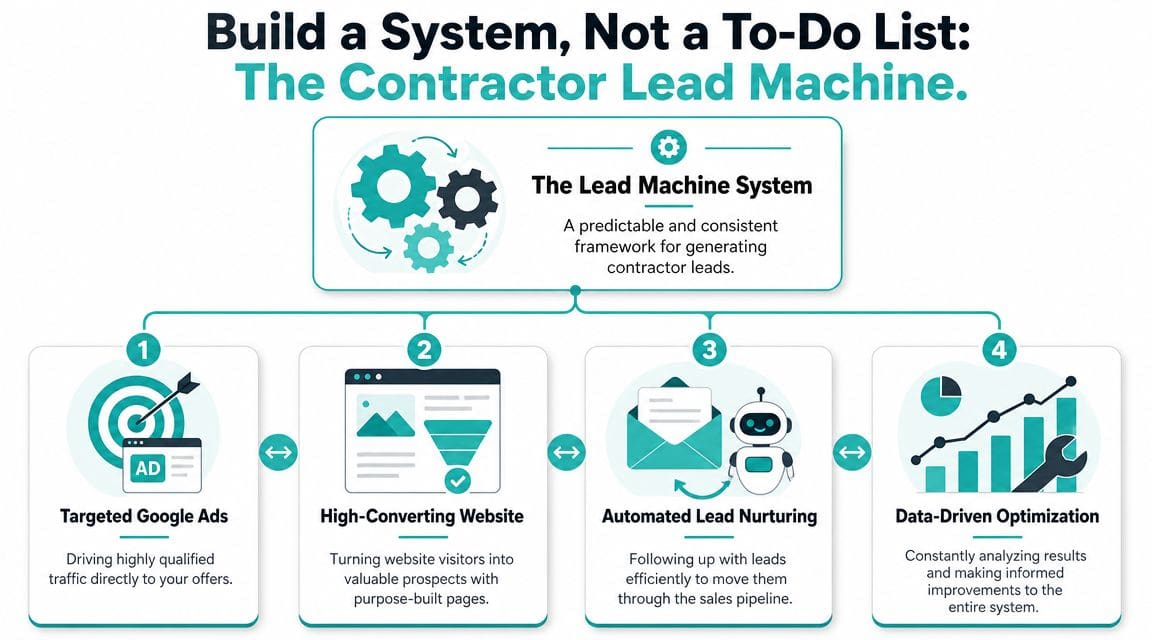
What control looks like
A Lead Machine is the asset. Google Ads is the fuel. Together they create a repeatable way to turn search demand into calls and form submissions.
That matters because word of mouth is not control. Referrals are great, but they don't scale on command. Hope is not a plan either.
When your system is working, you can:
- Choose better jobs instead of chasing every small one
- Expand into more towns without guessing where demand will come from
- See where leads came from instead of wondering
- Stabilize slow periods with active visibility
Fragile businesses guess
A business gets fragile when it depends on luck, memory, and referrals alone. The phone gets quiet. Crews sit. Revenue drops. Then the owner scrambles.
A stronger business knows how leads are generated. It has a site built for conversion. It uses ads to create visibility where buyers are searching. It improves over time because the setup is built to be measured.
If you want the simple version, this is what a Lead Machine is supposed to do. It gives your business a real lead asset instead of an online brochure.
Predictable leads give you control. No control means your business is always one slow stretch away from stress.
You think that customers "can" find you but, if customers "don't" find you, nothing else matters. Lead Machines are built to fix that.
If you're tired of guessing and want a straight answer, talk to The Cherubini Company. They build Lead Machines for contractors and pair them with visibility ads so your business can show up in the cities where you want work, turn that traffic into calls, and stop relying on hope.