You’ve probably said this before.
We tried ads and they didn’t work.
That’s what most contractors say after they got bad leads, no calls, or a pile of clicks that turned into nothing. Then they go back to referrals, yard signs, and hoping the phone rings.
That’s the trap.
If you’re already in business, your problem usually isn’t that people don’t want what you do. It’s that people in the towns around you don’t see you when they search. You may be known in your home city. Go a few miles out, and you disappear.
That’s why so many contractors feel stuck. They spend money with no control. They get busy, then slow down. They chase small jobs because the bigger jobs never call. They think they have a lead problem, but the underlying problem is visibility.
A website alone won’t fix that. Websites don’t create traffic. They wait for it.
If you want to run contractor ads yourself, stop thinking like an ad manager. Start thinking like an owner who needs a system that turns visibility into calls.
Why Your Ads Probably Failed (It’s Not Your Fault)
Most ad campaigns fail for one simple reason.
The ads did their job. The website didn’t.
A paid ad is just traffic. It gets someone to click. That’s all. If that click lands on a slow, vague, brochure-style site with weak calls to action, poor mobile layout, and no clear next step, your money burns fast.

A lot of contractors blame the ad platform. Wrong target. Wrong market. Wrong season. Sometimes that’s true. Most of the time, the bigger problem is what happens after the click.
Traffic is not the same as leads
If you send people to a generic site that says “welcome,” lists ten services, and hides the phone number in the corner, don’t expect calls.
Guidance for contractors makes this plain. High-intent clicks don’t create leads if the page is slow, unclear, or missing trust signals like reviews. Fixing the landing page and lead-handling process should happen before increasing the ad budget according to contractor Google Ads guidance from ServiceTitan.
That should change how you think about running ads.
You do not have an ads problem first. You have a conversion problem first.
Practical rule: Don’t pay for traffic until the page is built to turn a stranger into a caller.
That also means answering the phone matters more than most owners admit. If your ads finally work and the office misses calls, you still lose. If missed calls are hurting you, read about solving the 62 percent call issue. It gets to the main point fast.
Most contractor websites are built to look decent, not to produce leads
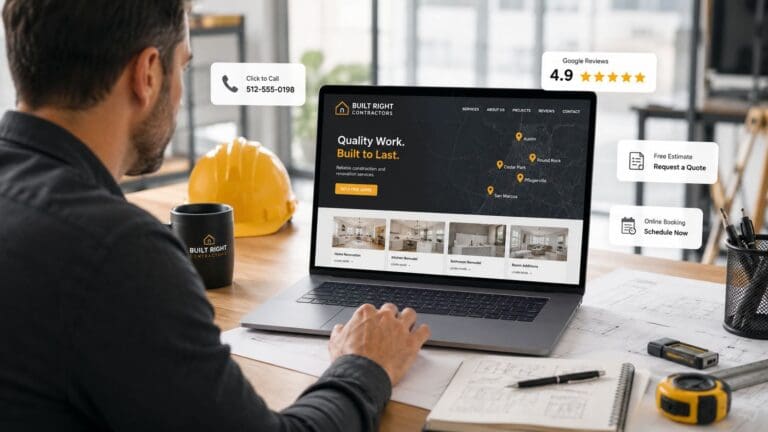
A normal website acts like an online brochure.
It talks about your company. It shows some photos. It lists services. It waits.
That’s not enough when you’re paying for every click. Paid traffic needs a page that tells the visitor three things right away:
- What you do in plain language
- Where you do it in the city they live in
- What they should do next such as call now or request a quote
If those pieces are missing, the ad spend goes nowhere.
A lot of this waste comes from the same mistakes over and over. If that sounds familiar, review these contractor marketing mistakes that cost you money. Most of them have nothing to do with fancy tactics. They come from weak visibility and weak follow-through.
You weren’t wrong to try ads.
You were wrong if you sent those ads into a system that couldn’t convert them.
The Real Problem Is Invisibility Just a Few Miles Away
Most contractors think customers can find them if they really want to.
That’s not how search works.
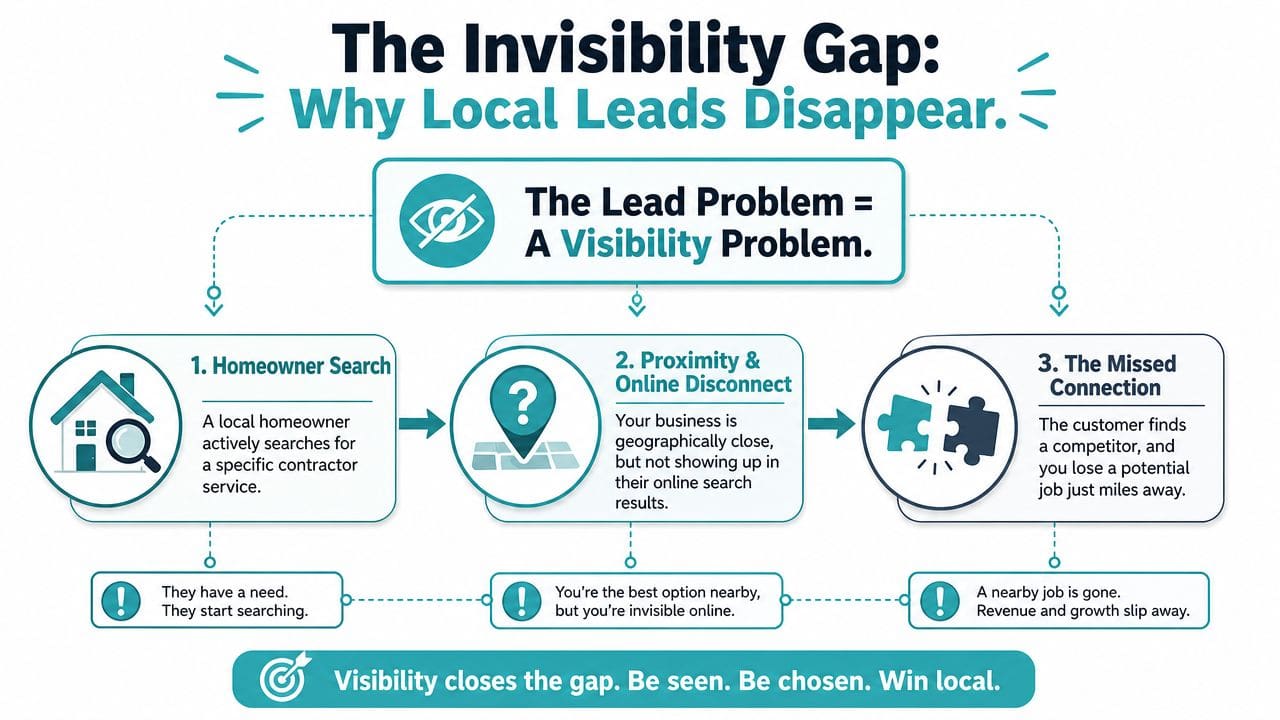
When a homeowner searches for your service “near me,” Google reads that as the city where that person is standing. So if you’re based in one town, but the searcher is in the next town over, Google is not thinking about your shop address. It is thinking about their city.
Being close is not the same as being visible
You may work all over the county.
You may drive thirty minutes for a solid job.
You may already have trucks in those towns.
None of that means Google will show you there.
If your site and business presence mostly talk about your hometown, Google takes the hint. It assumes that’s where you work. So when someone in the next city searches for your service, your company often doesn’t show up. A competitor does. The lead is gone before you even knew it existed.
People don’t search for your company name first. They search for what you do and where they need it.
That’s the visibility gap.
You think customers can find you. In reality, many of them don’t.
Lost visibility turns into lost revenue fast
Contractors fool themselves here.
They say, “We stay busy.” But busy with what?
Often it’s small jobs, filler work, and whatever comes in through referrals. Meanwhile, bigger projects in nearby towns go to companies that show up first. You lose jobs you never got a chance to bid on.
If you want more control, stop looking at marketing as a monthly expense and start tying it to job value. One clear example shows how to do that. To book an extra $500,000 in work with an average project value of $25,000, you need 20 projects. At a 20% close rate, that means 100 qualified leads. At $200 per lead, the annual ad budget comes out to $20,000, or about $1,600 to $1,700 per month according to this contractor ad budget model.
That math matters because it forces the core question.
Are you visible in the places where those jobs come from?
If not, the budget is not the issue. Invisibility is.
The fix is wider local visibility, not more guessing
The answer is not to keep stuffing your homepage with your own town name.
The answer is to build visibility in the cities where you want work. That means your online presence needs to clearly support each service area, not just the address on your truck wrap. If you want a plain-English breakdown of how businesses help businesses get found locally, that resource explains the basic local search problem well.
If your lead flow feels thin, there’s a good chance your service area online is much smaller than your real service area in the field. That gap is exactly why many contractors don’t get enough leads.
This is not about effort.
It’s about whether you show up where buyers are searching.
Your Website Is Not a Lead Machine (It’s a Brochure)
Most contractor websites are built to be looked at.
They are not built to get the phone to ring.
That’s the blunt truth.
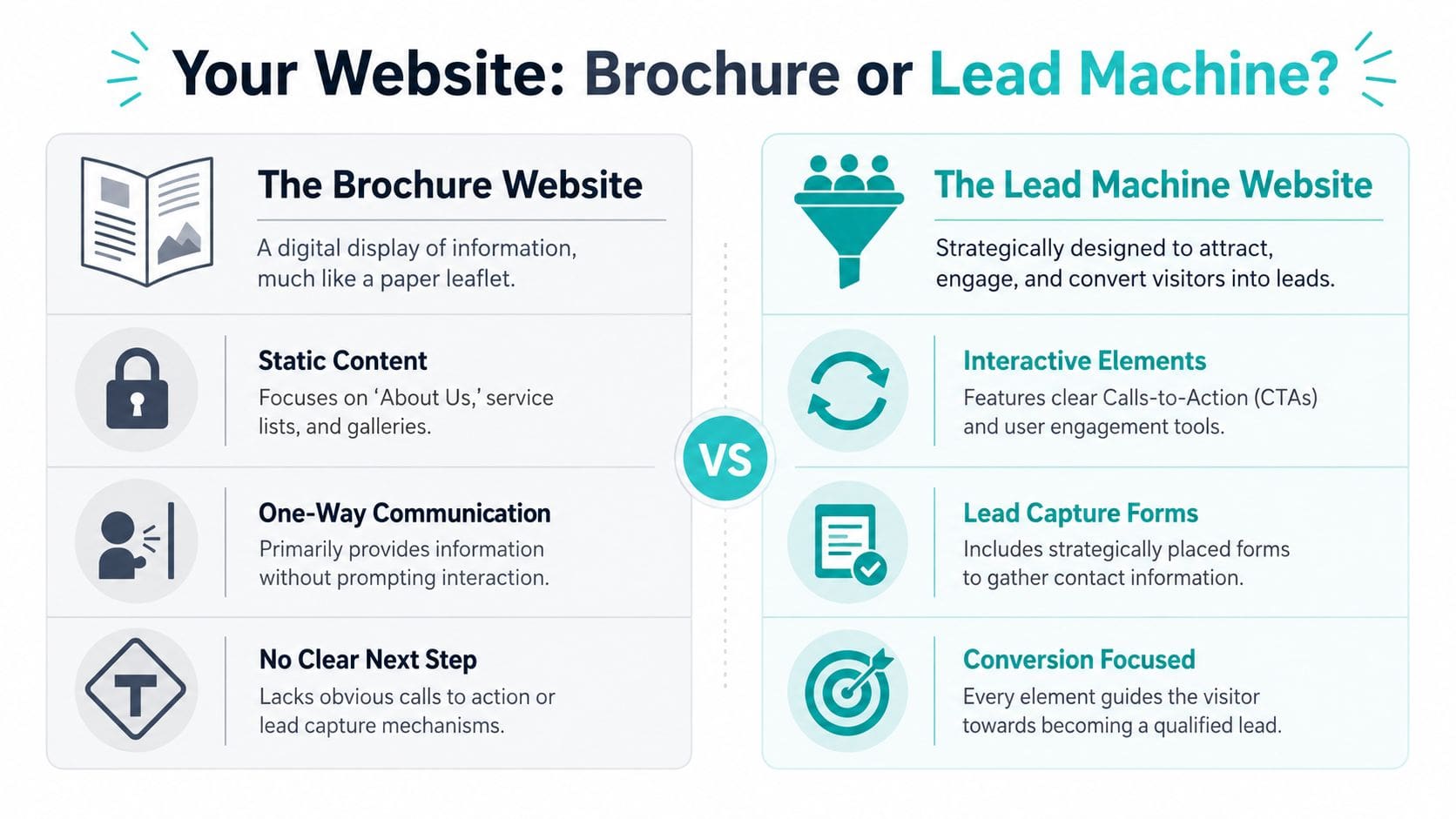
A brochure website says, “Here’s who we are.” A Lead Machine says, “Here’s the service, here’s the city, here’s why you should trust us, and here’s how to contact us right now.”
Those are not the same thing.
A brochure site waits
Most sites contractors already have share the same problems:
- They talk too much about the company and not enough about the customer’s problem
- They lump services together instead of giving each service its own focused page
- They ignore nearby cities where good jobs are available
- They make mobile users work too hard to call or request a quote
- They don’t track clearly what is producing calls and forms
That kind of site can exist for years and still leave the owner guessing.
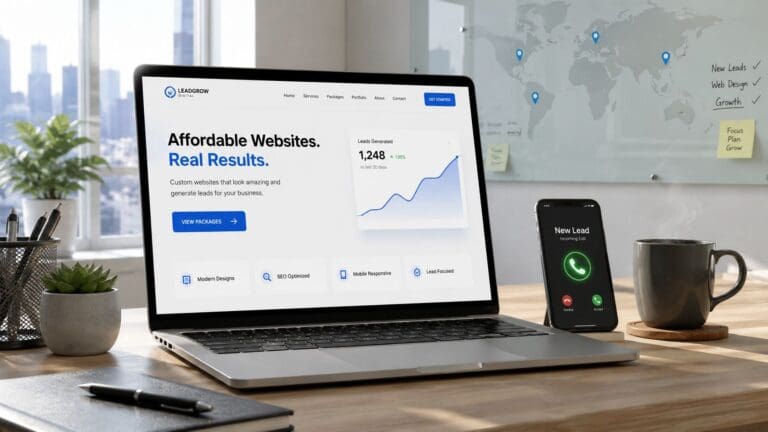
A Lead Machine is different because it is built for one job. It turns traffic into action.
A Lead Machine guides the visitor to one next step
You don’t need a fancy website.
You need a useful one.
For contractors running their own campaigns, setup guidance is simple in principle. Pick a clear service area, set one conversion goal, keep keywords tightly grouped by service, use a dedicated landing page for each service, and install phone and form tracking before launch. It should also include negative keywords from day one and weekly search term reviews, based on contractor paid search guidance from Clicks Geek.
That advice matters because it points to the same conclusion. The page behind the ad has to match the search. If someone wants excavation in one town, don’t send them to a general homepage about your whole company.
A click is a chance. A Lead Machine is what turns that chance into a call.
Here’s the cleanest way to look at it:
| Website type | What it does |
|---|---|
| Brochure website | Sits there, gives general information, waits for people to figure it out |
| Lead Machine | Matches the service, matches the city, builds trust fast, asks for the call |
If your site isn’t built that way, ads won’t save it.
That’s why a lot of owners who think they want to “run contractor ads yourself” need to turn their website into a Lead Machine first.
Because the website is not decoration.
It is the thing doing the selling after the click.
The Right Way to Run Ads Is to Own the System
If you want to run contractor ads yourself, don’t turn yourself into a part-time ad technician.
That’s not the job of an owner.
Your job is to own the system.
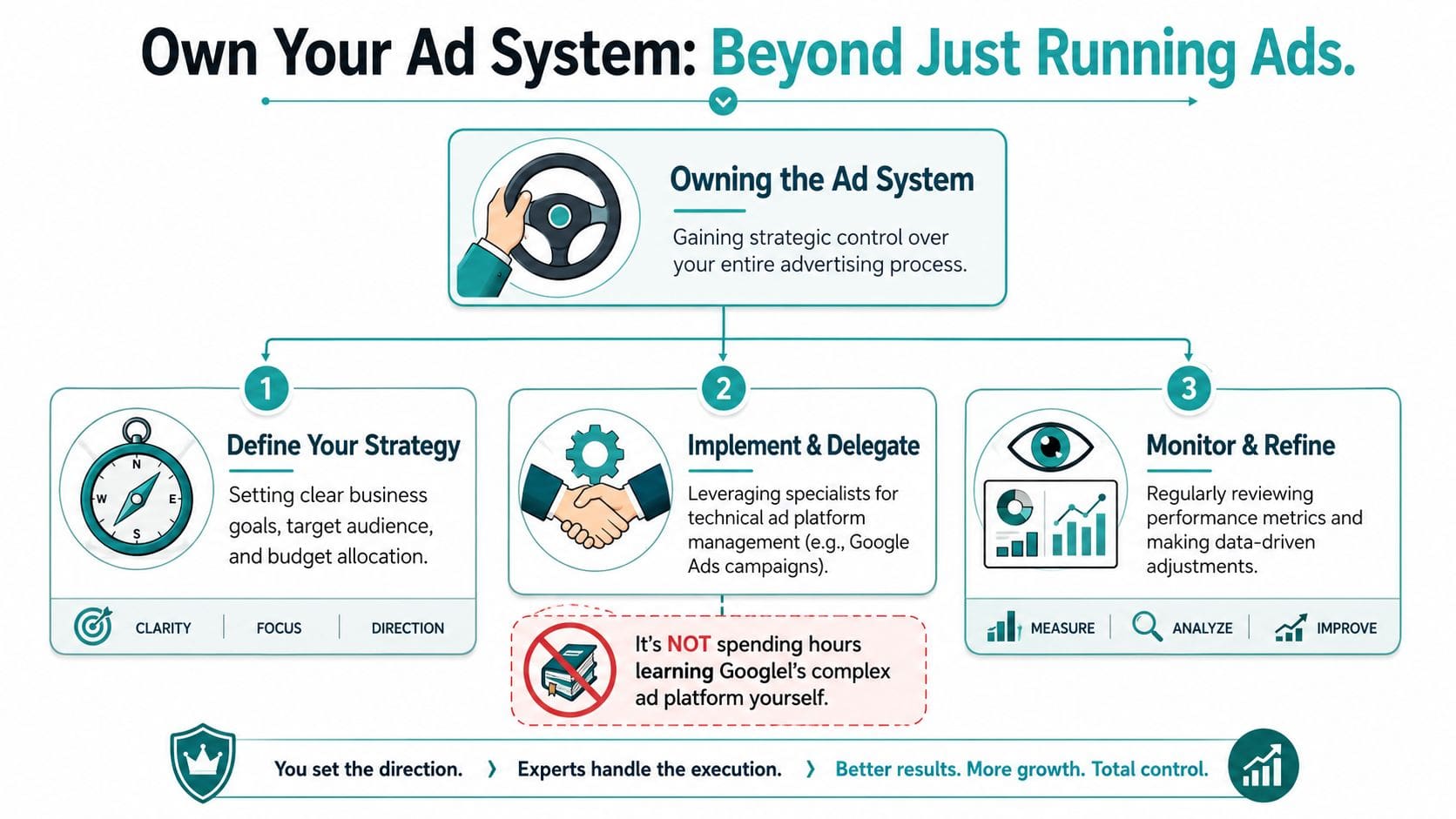
Ownership means control
A real lead system has two parts:
-
The Lead Machine
This is the asset. It is the website built to convert traffic into calls and quote requests. -
The ads
This is the fuel. Ads create visibility and send buyers to the machine.
That’s the model that gives you control. You own the thing that captures demand. Then you choose how much traffic to send into it.
This is the part many contractors miss. They think “doing it yourself” means learning every ad setting and every dashboard. That’s a bad use of your time. Owning the system means you know what the system is supposed to produce, you can see what’s working, and you are not trapped inside some black-box agency setup.
Control does not mean doing every task yourself
You probably don’t rebuild your own transmission just because you own the truck.
Same idea here.
You need visibility. You need a conversion asset. You need tracking. You need lead handling that doesn’t waste opportunities. If your team also needs tighter call handling across office and field, an enterprise-grade communication suite can help support that side of the system.
What matters is this:
- You own the website asset
- You know what cities and services it targets
- You know what counts as a lead
- You can measure calls and form submissions
- You can increase or reduce ad spend based on business needs
That is real control.
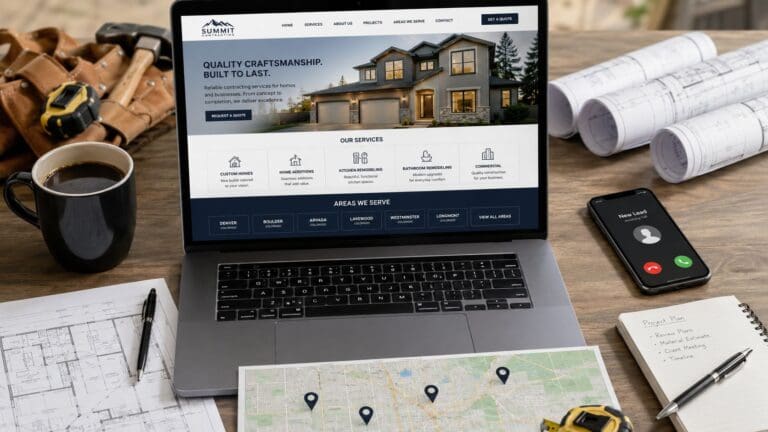
One contractor-focused option is Lead Machines for contractors, which are built as service-and-city-based websites designed to convert traffic into leads while ads drive visibility to them. Whether you use that model or build your own version, the structure is what matters.
Don’t confuse platform access with business control. Real control comes from owning the asset and the process behind it.
That is the right way to think about running ads.
Not as a hobby.
As an owned lead generation system.
Plan Your Ad Budget and Targeting for Real Jobs
Most contractors set ad budgets the wrong way.
They pick a number that feels safe and hope it works.
That’s backward. Start with the jobs you want, then work back to the budget.
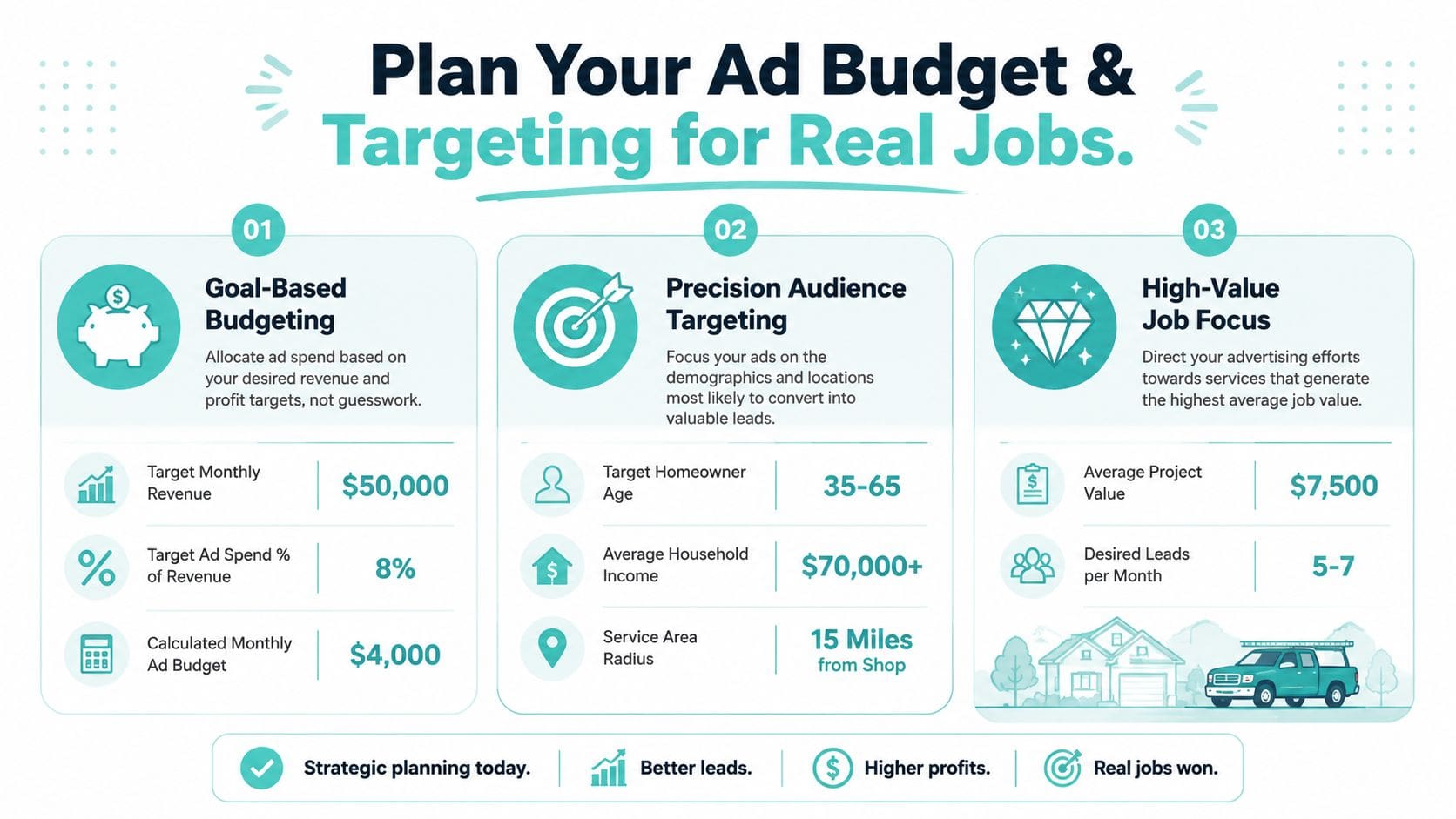
Budget from revenue, not from fear
The cleanest budget model starts with three things:
- Your revenue goal
- Your average job value
- Your close rate
From there, you can estimate how many leads you need and what you can afford to pay for them. That keeps your budget tied to business results instead of guesswork.
Lead costs are not the same for every trade. One industry source estimates plumbers and HVAC companies typically pay $75 to $200 per lead, electricians $50 to $150 per lead, and general contractors $100 to $300 per lead according to this contractor lead cost breakdown.
That spread matters.
It shows why generic advice is junk. A campaign for emergency service calls is not the same as a campaign for larger general contracting work. The lead price, job value, and sales cycle are different.
Target the jobs you actually want
Too many contractors advertise everything to everyone.
Then they complain that the leads are weak.
You’ll get better results when your targeting matches the kind of work you want more of. If you want bigger jobs, target the cities and services tied to bigger jobs. If you want fewer price shoppers, your message should speak to quality, trust, speed, and the specific problem you solve.
For Facebook lead generation, contractor-focused guidance says to use one service offer, keep the form simple, exclude low-quality placements like Audience Network, and reserve roughly $5 to $10 a day for awareness and about $20 to $100 a day for lead generation, with the higher end usually needed for larger companies or broader goals, based on this contractor Facebook ads setup guidance.
That doesn’t mean you should run every kind of ad.
It means you should stop thinking in terms of “more traffic” and start thinking in terms of better-fit leads.
Keep your service area honest
If you work in ten towns but only market one, your budget is aimed at the wrong map.
Your targeting should follow your real service area and your best opportunities, not just your office address. If you’re looking at options for Google Ads for contractors, the important part is not the dashboard. It’s whether the campaign is pointed at the cities and services that produce profitable work.
The budget matters.
But the map matters just as much.
Predictable Leads Give You Control of Your Business
Word of mouth is fine until it isn’t.
Referrals dry up. Seasons change. Crews slow down. Then the panic starts and owners throw money at random marketing because they waited too long.
That’s not a lead strategy. That’s survival mode.
The better model is simple. You build visibility in the places you want work. You send that visibility to a website built to convert. You track what produces calls. Then you adjust from a position of control.
Control changes how you run the business
When leads are predictable, you make better decisions.
You can choose which jobs to take. You can stop chasing every small job that comes through the door. You can fill gaps before they become emergencies. You can grow on purpose instead of reacting to whatever happened this week.
That’s what most contractors want when they say they want more leads.
They want control.
The phone ringing isn’t the goal by itself. The goal is knowing why it’s ringing and being able to repeat it.
The business is fragile when visibility is weak
If people only find you through luck, referrals, or your own hometown reputation, your business is exposed.
You don’t control your pipeline.
You don’t control your market reach.
You don’t control the next slow season.
Running contractor ads yourself should mean taking charge of your visibility and your lead system. It should not mean spending your nights trying to become a marketing technician.
You think that customers “can” find you but, if customers “don’t” find you, nothing else matters. Lead Machines are built to fix that.
If you’re tired of guessing, The Cherubini Company helps contractors fix the problem: invisibility. They build Lead Machines and pair them with ads so your business can show up in the cities you want, turn traffic into calls, and give you a lead system you can control.