You’ve probably said some version of this already.
“We’ve tried running ads and they didn’t work.”
“That’s what the other agencies said.”
“We’ve been burned before.”
“I don’t believe you.”
Fair enough. Most contractors don’t hate marketing because they’re stubborn. They hate it because they paid for it and got nothing back but excuses.
Meanwhile, the core problem keeps getting worse. You stay busy, but not always with the jobs you want. You take small work because the bigger jobs aren’t steady enough. You compete with too many other contractors for the same lead. You spend money with no control. Then you wonder why the phone goes quiet in the towns right outside your home base.
That’s not a work problem. It’s a visibility problem. If people don’t see you when they search, you lose before the call ever happens.
Why Your Marketing Has Failed and What to Do About It
Most failed contractor marketing follows the same script.
You hire someone. They promise rankings, leads, and growth. A few months later, you’ve got reports, jargon, and a thinner bank account. The phone didn’t ring enough. The leads were weak. Nothing felt clear.

A lot of owners think the problem was the ad platform, the website, or timing. Usually it was none of those by themselves. The problem was that nobody built a system. They sold you pieces.
One shop built a pretty site. Another one ran some ads. Somebody else posted on social media. None of it worked together. So you got random activity instead of a lead flow.
What contractors actually tell me
The pattern is always blunt.
- The ads got clicks, not jobs: Traffic showed up, but it didn’t turn into calls.
- The website looked nice, but sat there: It acted like an online brochure, not a lead tool.
- The agency hid behind reports: You got charts instead of work.
- The owner had to chase the marketing: You became the unpaid manager of people you hired to solve the problem.
That’s why so many contractors are skeptical. They should be.
You don’t need more marketing activity. You need something that makes the phone ring from the cities you want.
The hard truth
Your business can be solid and still have a lead problem.
You may have a good name in your town. You may do great work. Your referrals may be strong. None of that guarantees steady leads in nearby cities where people don’t know your name yet.
That gap is where most marketing fails.
If your last agency never explained that clearly, they missed the point. A contractor doesn’t need “more online stuff.” A contractor needs visibility in the exact places buyers are searching. That’s the only thing that matters first.
If this sounds familiar, these small business marketing challenges probably aren’t random. They’re connected. They all come back to the same issue. You aren’t showing up where the work is.
The Real Problem Is Invisibility Not Effort
You’re not losing because you don’t work hard enough.
You’re losing because people in the next town over don’t see you.
That’s the part contractors miss. In your hometown, people know your trucks, your yard sign, your name, maybe even your family. But someone ten miles away doesn’t know any of that. They open Google and search for the service they need in the place they need it.
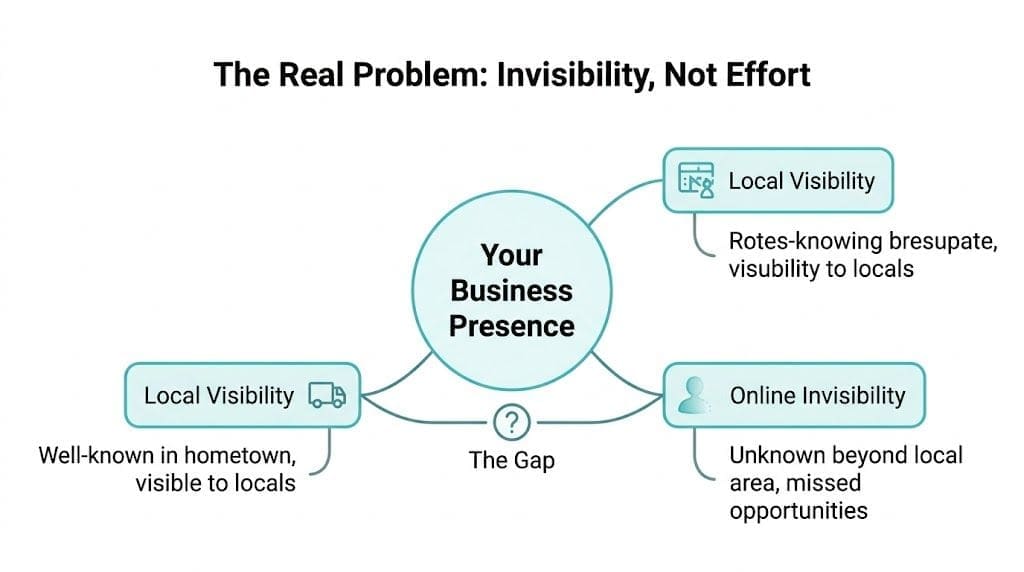
If they search for “excavation contractor near me” or “plumber near me,” Google reads that as the city they’re standing in. If your business doesn’t clearly show that you work in that city, you won’t show up there. It’s that simple.
Your website isn’t the problem. Your visibility is.
A website doesn’t create traffic. It waits for traffic.
That’s where contractors get fooled. They think having a website means they have marketing. They don’t. They have a digital business card sitting on the internet hoping somebody finds it.
That’s not a plan.
More than 50% of all website traffic comes from organic search, and 76% of consumers check a company’s online presence before visiting or hiring them, according to these online presence statistics. If you want to manage online presence the right way, you have to accept what those numbers mean. Buyers search first. They judge fast. If you aren’t visible where they’re looking, you don’t get picked.
The visibility gap that kills lead flow
This is what the gap looks like.
| What you think is happening | What’s actually happening |
|---|---|
| People can find us | People who already know your name can find you |
| We serve that whole area | Google only sees the places you clearly show online |
| Our website should help | Your website helps only after someone gets to it |
| We just need more time | You need better visibility in target cities |
That gap explains why a contractor can be busy and still feel stuck.
You get enough work to survive. Not enough control to grow. You stay booked with small jobs because the bigger jobs don’t come in often enough. That creates stress because every slow patch feels like a warning sign.
Practical rule: If a buyer searches for what you do in the city they live in and you don’t show up, you have zero chance at that job.
Why effort won’t fix this
A lot of owners respond by trying harder.
They ask for more referrals. They boost a post. They tweak the homepage. They call another agency. None of that solves the core issue if your business still looks tied only to your hometown online.
Managing online presence is not about being active everywhere. It’s about being visible in the right places for the right searches.
That means your service area has to be obvious. Your offer has to be obvious. Your call path has to be obvious. If those things aren’t in place, effort turns into noise.
Big Companies Buy Visibility You Rely on Hope
The big regional contractors aren’t smarter than you.
They’re not tougher. They’re not better at the work. They just stopped relying on hope.
They buy visibility. They build systems that keep them in front of buyers all the time. While you’re waiting for the next referral, they’re showing up in search, showing up in ads, and catching demand the second it appears.

That’s why they keep taking market share. Not because they deserve it more. Because they’re easier to find.
What they do differently
Big companies treat lead flow like infrastructure.
They don’t run random campaigns. They build local search coverage, city targeting, clear service paths, and conversion pages that move people to call. A digital success blueprint for online presence says well-structured local sites can see a 40 to 60% improvement in click-through rates within 90 days when properly optimized. That’s what a system does. It gives buyers a cleaner path from search to action.
Small contractors usually do the opposite.
They wait. They hope referrals hold. They assume their website should somehow pull traffic out of thin air. Then they panic when work slows down and throw money at scattered tactics.
Hope creates a fragile business
Hope sounds harmless. It isn’t.
Hope means your schedule depends on luck, old customers, and whoever happened to mention your name last week. That’s not stability. That’s exposure.
Here’s the contrast in plain terms:
- Big companies build coverage: They make sure buyers in target areas can find them.
- Small contractors wait for demand to drift in: Then they wonder why the jobs feel inconsistent.
- Big companies use structure: One system handles visibility and lead capture.
- Small contractors stack random pieces: A website here, some ads there, no real control.
If your lead flow depends on referrals alone, your business is one quiet month away from stress.
You don’t need to become a marketer
Many owners find themselves at a standstill. They think the answer is learning more marketing.
It isn’t.
You don’t need to become the guy managing websites, ads, reviews, pages, and tracking. You need a system that does its job without turning you into a part-time marketing employee.
That’s the lesson big companies learned early. Visibility isn’t optional. It’s purchased, built, and maintained on purpose. If you want to manage online presence in a way that grows your business, you need to stop acting like showing up is accidental.
Your Playbook to Manage Online Presence and Get Leads
There’s a right way to manage online presence for a contractor. It’s not a pile of tips. It’s not a checklist you ignore by next month. It’s one system with two parts.
Part one is the Lead Machine.
Part two is the fuel that sends buyers into it.
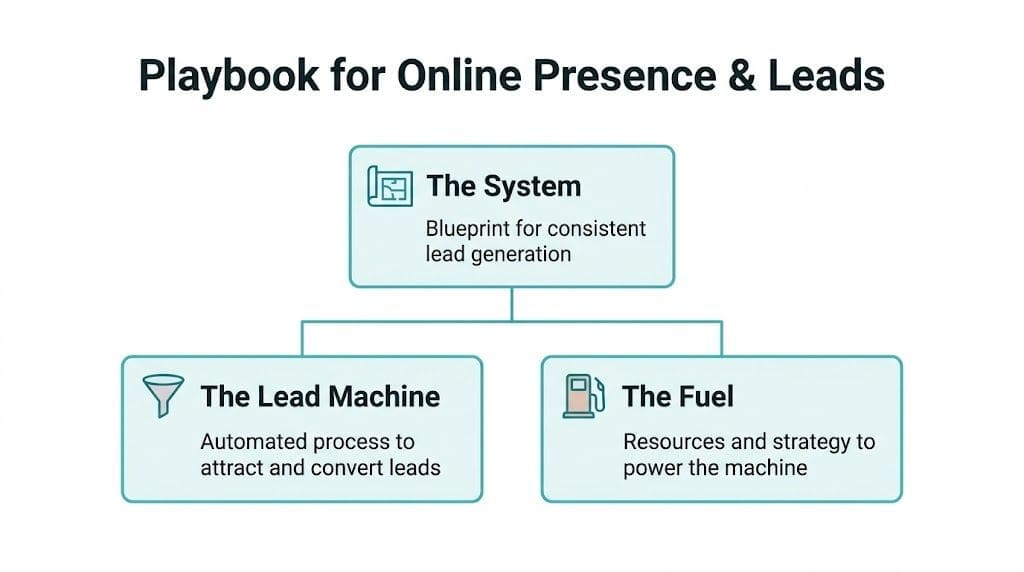
That’s the whole playbook. Simple. Clear. Effective.
The Lead Machine fixes the visibility gap
A Lead Machine is not a pretty website.
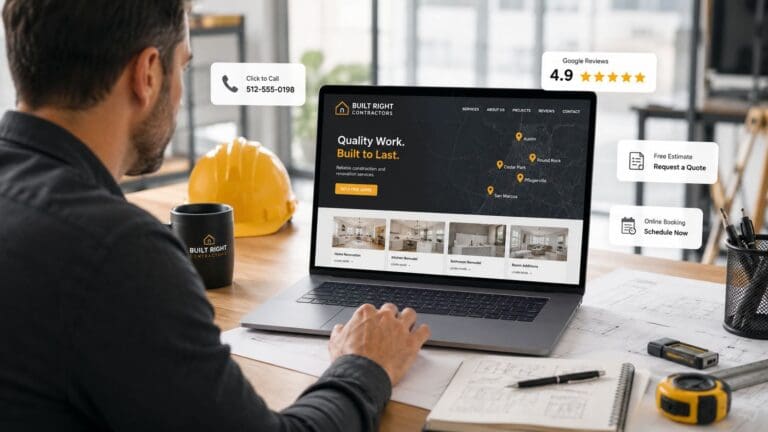
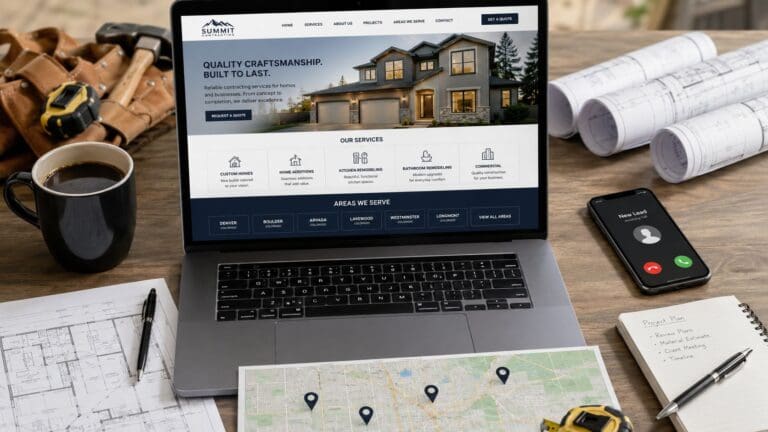
It’s a lead system built around the places you want work from and the services you want to sell. That means it needs pages for your services and pages for your target cities. Otherwise, you’re still invisible outside your home base.
A contractor who wants jobs in five, ten, or twenty nearby cities cannot rely on one generic homepage. That setup leaves too much to chance. Buyers search by service and location. Your online presence has to match that.
So the Lead Machine does a few things at once:
- It matches your service area: It tells search engines and buyers exactly where you work.
- It speaks to real demand: It lines up with the way people search.
- It pushes action: Calls and quote requests are the point, not compliments on the design.
It must convert, not just exist
A contractor site has one job. Turn interest into contact.
That means clear calls to action. Strong phone visibility. Easy quote forms. A clean mobile experience. Fast loading. No clutter. No dead ends. No forcing someone to hunt for how to reach you.
You don’t need a site that wins awards. You need one that makes a homeowner or property manager call now instead of “checking a few more companies.”
A website that doesn’t create calls is not an asset. It’s overhead.
You also need consistency between your site and your business profile. If that setup is sloppy, buyers hesitate. Search visibility suffers. Trust drops before you ever get the chance to talk to them. If you want a clear example of what stronger local alignment looks like, this guide on how to optimize a Google Business Profile shows why local consistency matters.
Reviews are part of the machine
A lot of contractors treat reviews like a bonus. That’s a mistake.
Reviews qualify leads before they call. They help a buyer decide whether you feel safe, credible, and worth contacting. According to this review and reputation analysis, 79% of consumers trust online reviews. That makes reputation a direct part of lead generation, not some side task you get to later.
If your online presence is weak on reviews, the buyer keeps scrolling.
If your reviews are strong, recent, and visible, the buyer moves faster.
That’s why the system needs a built-in way to gather reviews from happy customers and show them where buyers are already looking. Not someday. As part of normal operation.
Ads are the fuel
Now the blunt part.
Websites wait. Ads create visibility.
That’s why so many contractor sites underperform. They were built and then left alone, like traffic was supposed to magically appear. It doesn’t work like that.
Ads put your business in front of buyers searching right now. They create reach in the cities you care about. They drive traffic into the Lead Machine, where that traffic can turn into calls.
Here’s the simple breakdown:
| Piece | What it does | What happens without it |
|---|---|---|
| Lead Machine | Turns traffic into calls and quote requests | Traffic leaks out and money gets wasted |
| Ads | Put you in front of active buyers | Your site waits around for visits |
| Review system | Builds trust before the call | Buyers hesitate and choose someone else |
Why both parts matter
A lot of contractors try to choose one.
They either buy ads and send traffic to a weak site, or they build a site and expect it to somehow carry the business. Both are broken setups.
Ads without conversion waste money.
A website without traffic sits there.
A Lead Machine plus ads works because each part handles a different job. One gets attention. The other captures it. Together, they produce lead flow you can build around.
What this changes in real life
When the system is right, your business stops acting reactive.
You stop taking every small job because you’re scared to say no. You stop wondering which city is producing work and which one is dead. You stop guessing whether your money is doing anything.
Managing online presence should give you control, not chores. The point is not to teach you how to become your own agency. The point is to put a machine in place that makes visibility turn into calls.
How to Know the System Is Working
You don’t need a giant dashboard to know if your marketing is healthy.
You need proof that the system is creating calls and quote requests from the places you want to work. That’s it. If you can’t see that clearly, then you’re back in guessing mode.

Most contractors got burned because nobody made the results easy to verify. They got reports full of noise. Traffic numbers. impressions. clicks. Fancy language. None of that matters if the phone isn’t ringing from the right cities.
The simple checks that matter
You should be able to answer a few basic questions fast.
- Are calls increasing: Not random calls. Real calls from people asking about your services.
- Are quote requests coming in: The site should produce direct contact.
- Are leads coming from the target cities: If the wrong areas dominate, the system is pointed wrong.
- Are the right services getting attention: If you want bigger jobs, the lead mix should reflect that.
That’s how an owner should review performance. Clean. Direct. No fluff.
Owner check: If you can’t tell where your leads came from and what service they wanted, you don’t have control.
Verify the machine, don’t babysit it
There’s another mistake owners make. They think they need to personally manage every moving part.
You don’t.
You just need to verify that the right pieces are live and working together. This matters even more for contractors covering multiple cities. A multi-location online presence problem analysis points out the gap clearly. Mainstream advice doesn’t solve brand consistency plus localized messaging across large service areas. That requires a true multi-location system.
So your checks should stay practical:
| Verify this | Why it matters |
|---|---|
| City pages are live | You need visibility beyond your hometown |
| Service pages are clear | Buyers must land on exactly what they need |
| Ads are active in target areas | Visibility has to be intentional |
| Reviews keep coming in | Trust must stay current |
| Call and form tracking works | You need direct proof, not assumptions |
A useful outside view can help if you’re not sure what’s broken. A proper digital marketing audit should show whether your current setup is producing visibility and leads, not just activity.
Control beats confusion
A working system changes how the business feels.
You stop waking up wondering where next month’s work will come from. You stop making hiring and equipment decisions in the dark. You stop getting trapped in random marketing experiments because somebody pitched a shiny new idea.
That’s the true value of tracking. Not more data. More control.
Stop Guessing and Take Control of Your Leads
You can keep piecing this together if you want.
You can keep hoping referrals fill the gaps. You can keep trying a website alone, ads alone, or another agency that talks big and explains nothing. That path stays stressful because it never gives you control.
A contractor without predictable leads has a fragile business. Every slow week creates pressure. Every bad month changes your decisions. You take work you don’t want because you don’t trust what’s coming next.
A contractor with a working system has options.
You can choose better jobs. You can grow into more cities. You can make hiring decisions with confidence. You can stop acting like lead flow is some mystery nobody can solve.
That only happens when you manage online presence like a system, not a side project.
It is simple: your website alone won’t save you. Random ads won’t save you. More hustle won’t save you. You need visibility in the places you want work from, and you need a site built to turn that visibility into calls.
You think that customers “can” find you but, if customers “don’t” find you, nothing else matters.
Lead Machines are built to fix that.
If you’re tired of guessing, The Cherubini Company helps contractors fix the actual problem. Invisibility. They build Lead Machines that make your business show up in the cities you want and turn that visibility into calls. Then they fuel those machines with ads that bring in buyers who are searching right now. Simple system. Clear results. No fluff.