
You’ve probably said some version of this already.
“We tried ads. They didn’t work.”
“That’s what the last agency said.”
“We’ve been burned before.”
“I don’t believe you.”
Fair enough. A lot of contractors have spent money on websites, ads, and marketing retainers and got nothing back but screenshots, excuses, and silence. Meanwhile, the phone still isn’t ringing enough, the schedule is full of smaller jobs you don’t want, and the bigger work keeps going to somebody else.
That doesn’t mean you don’t have demand.
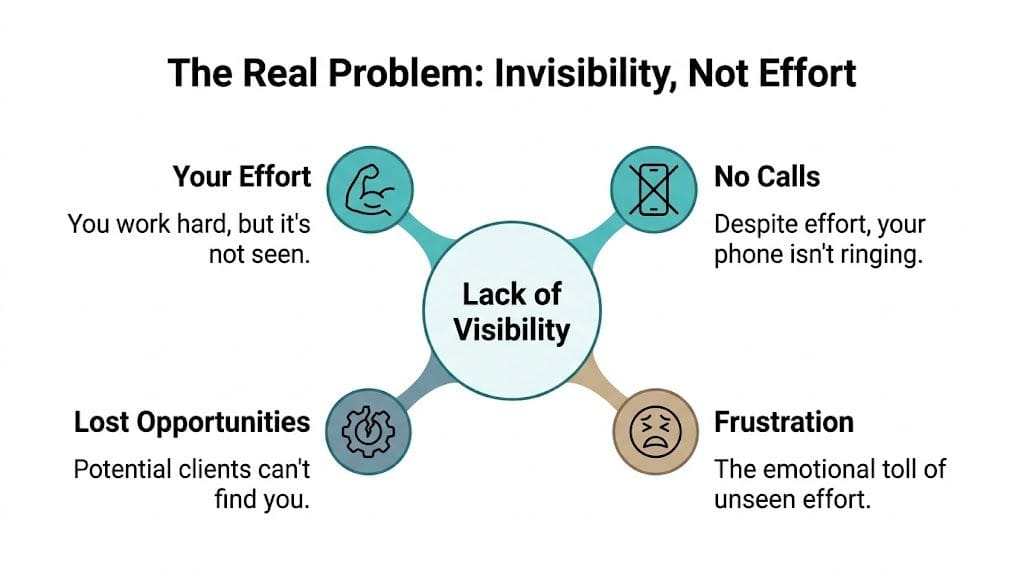
It usually means you have an invisibility problem.
You may be known in your hometown. People who already know your company name can probably find you. But the customer who needs your service right now and has never heard of you is searching for what you do in the city they’re standing in. If you don’t show up there, you don’t exist to that buyer.
That’s why your website isn’t generating calls. Not because websites are magic and yours is broken in some mysterious way. Because your whole lead system is broken. The website sits there. It waits. If nobody sees it, nothing happens. If the wrong people see it, nothing happens. If the right people land on it and can’t call fast, nothing happens.
That's the actual issue. Not effort. Not hustle. Not hope.
Visibility.
Why Your Website Feels Like a Ghost Town
A contractor calls after six months of “marketing.”
He’s got a website. He ran some ads. He paid for help. He even got reports. But his phone isn’t ringing the way it should. He’s still chasing work. He’s still bidding against too many competitors. He’s still taking jobs he’d rather pass on because he doesn’t trust next month’s pipeline.
That story is common because the website is being blamed for the wrong job.
A website does not go out and find customers. It doesn’t knock doors. It doesn’t create demand. It doesn’t force Google to show you in towns you’ve never clearly connected to your business. It just sits there and waits for traffic.
What contractors are really dealing with
The pain usually sounds like this:
- More activity, no control: You’re busy, but not with the kind of jobs you want.
- Too many small jobs: You take work to keep crews moving, not because it’s ideal.
- Too much competition: You’re fighting other contractors for the same scraps.
- Money out, no clarity in: You spend on marketing but can’t tell what’s producing calls.
- Constant stress: Every slow week feels like a warning sign.
You don’t need more marketing talk. You need a system that makes the phone ring from the places you want work.
Why the silence feels personal
When a website gets no calls, owners often assume one of two things.
Either the market is slow, or the website “just doesn’t work.”
Sometimes the market is tough. But a lot of the time, the site is silent for a simpler reason. The people who need your service never see you in the first place. And if they do, the site doesn’t make calling easy enough.
That’s why the whole thing feels so frustrating. You know you do good work. You know people need the service. You know there’s money being spent in your area.
Yet your site feels like a ghost town because it has no working system behind it.
The Real Problem Is Invisibility Not Effort
Most contractors are not lazy.
They work hard. They answer calls. They quote jobs. They build crews. They solve real problems for customers. Effort isn’t the issue.
Visibility is.
The hometown trap
A lot of owners think, “People can find us.”
That’s only half true.
People who already know your name can usually find you. Past customers can find you. Referrals can find you. But that’s not the lead problem. The lead problem is the buyer who wakes up in the next town over, searches for your service, and never sees you.
When somebody searches for “[contractor] near me,” Google turns that into a city-based search tied to that person’s location. If your business only clearly signals your hometown, Google has no reason to assume you work in the surrounding cities too.
That’s the gap.
You might be known at home and invisible ten miles away.
Why a website alone doesn’t fix it
Owners often get bad advice. Someone sells them a “new website” as if the site itself creates customers. It doesn’t. A site without visibility is just a brochure sitting in a dark room.
That’s why websites don’t generate leads on their own. They need to be built around where you want to show up, who you want to reach, and what action you want that buyer to take.
Practical rule: If a customer searches for what you do in a city you serve, and you don’t show up, you have zero chance at that job.
The obvious point most owners miss
Google is literal.
If you never clearly say you work in Newark, Heath, Granville, Zanesville, Lancaster, or the county next door, Google is not going to fill in the blanks for you. It’s not going to reward assumptions. It’s going to show the businesses that made their service area obvious.
That’s why your website isn’t generating calls. Not because customers hate websites. Because your business is not visible where buyers are searching.
Why Your Competitors Get Calls And You Don't
Big companies don’t rely on luck.
They buy visibility. They build for it. They protect it. They make sure their business information is consistent, their presence is clear, and their name keeps showing up where buyers are searching.
Small contractors often do the opposite. They hope word of mouth carries the load. They hope a basic website is enough. They hope Google figures it out.
Hope is not a lead strategy.
Trust decides who gets shown
Google has one job. Show searchers businesses it trusts.
One easy way to lose that trust is messy business information. Inconsistent business information across 70+ online directories erodes Google trust, preventing top search rankings and slashing call volume by up to 40% for local service businesses, according to this breakdown of local call conversion problems.
If your business name, address, phone number, or hours are different across listings, review sites, and directory pages, Google gets mixed signals. Mixed signals lower trust. Lower trust means weaker visibility.
What that looks like in the real world
You might have:
| Problem | What it tells Google |
|---|---|
| Old phone number on a listing | This business may not be reliable |
| Different address format in multiple places | This business may not be clearly established |
| Wrong hours on profiles | This business information may not be maintained |
That sounds minor to an owner.
It’s not minor to search visibility.
If your competitor looks more trustworthy to Google, your competitor gets the chance to win the call before you ever enter the conversation.
The hard truth
Your competitors are not always better than you.
They’re often just easier to find and easier to trust online.
That means the call isn’t going to the best contractor. It’s going to the visible one.
If you’ve been asking why your website isn’t generating calls, start there. The problem may not be your workmanship, your pricing, or even your market. It may be that your online presence is sending weak trust signals while another contractor is sending clear ones.
Your Website Might Be Scaring Away Callers
Even if someone does find your site, you can still lose the call.
A lot of contractor websites fail. They look fine on a desktop in an office. But the customer isn’t sitting at a desk. They’re on a phone, in a driveway, on a lunch break, or standing at a job site trying to solve a problem fast.

Mobile users don’t hunt for your number
Mobile users make up about 60% of website traffic and abandon sites if phone numbers are not prominently visible and clickable within 10 seconds, which directly kills calls, according to this analysis of why websites fail to generate phone calls.
That’s blunt, and it should be.
If your number is buried in the footer, hidden on a contact page, or shown as plain text that isn’t easy to tap, you’re making customers work too hard. They won’t do it. They’ll back out and call the next contractor.
What a caller wants
A buyer landing on your site usually wants one of these things right away:
- A phone number they can tap
- A short path to request a quote
- Proof they’re in the right place
- Confidence you serve their area
That’s it.
They do not want to dig through menu items, read your life story, or play detective to figure out how to contact you.
Friction kills calls
A lot of owners think a “nice-looking” website is good enough.
It isn’t.
A website built for leads needs to remove friction. That means the next step is obvious. The number is visible. The call action is clear. The quote request is simple. If you need a basic reference point for adding a clear contact form, that resource shows the principle well. The point is not fancy design. The point is making it easy for a buyer to act.
You also need a site built around lead flow, not vanity. A proper lead generation website for home service contractors focuses on getting the visitor from search to contact with as little friction as possible.
A pretty website that hides the phone number is not a business tool. It’s a liability.
If your website isn’t generating calls, the site may be doing the opposite of what you paid for. It may be pushing ready buyers away.
Your Traffic Doesn't Want to Hire You
Some owners say, “But people are visiting the site.”
That doesn’t mean much by itself.
Traffic is only useful when it comes from people who want to buy. If your visitors are researchers, students, price checkers, or do-it-yourself types, your phone still won’t ring.

Research traffic and buyer traffic are not the same
A common problem for service contractors is traffic-content misalignment. In simple terms, a site gets visits from informational searches, but those visitors aren’t looking to hire. As noted in this article on why websites don’t generate leads, ranking for terms like “how septic systems work” attracts researchers, not callers.
That difference matters.
Someone searching for basic information is looking to learn.
Someone searching for a contractor in a specific area is looking to act.
Why this fools owners
This problem creates false hope.
You see traffic in a report and assume the site is working. Then no calls come in, and the whole thing feels confusing. It isn’t confusing once you separate interest from intent.
Here’s the simpler way to look at it:
- Informational visitor: Wants answers
- Commercial visitor: Wants service
- Local buyer: Wants service from someone nearby, now
If your site attracts the first group and misses the other two, traffic becomes a vanity number.
More visitors does not always mean more buyers. Bad traffic can keep you busy looking at reports while your competitors take the jobs.
The real job of the site
Your website should not chase random attention.
It should line up with buyer intent. That means the message, pages, and calls to action need to match what the searcher wants next. If somebody is looking for a quote, the page should push toward a quote. If somebody is trying to call, the page should make calling immediate.
If your traffic doesn’t want to hire you, your website isn’t broken in one narrow way. It’s aimed at the wrong audience.
The System That Turns Visibility Into Jobs
You don’t fix this with another random tactic.
You fix it with a system.
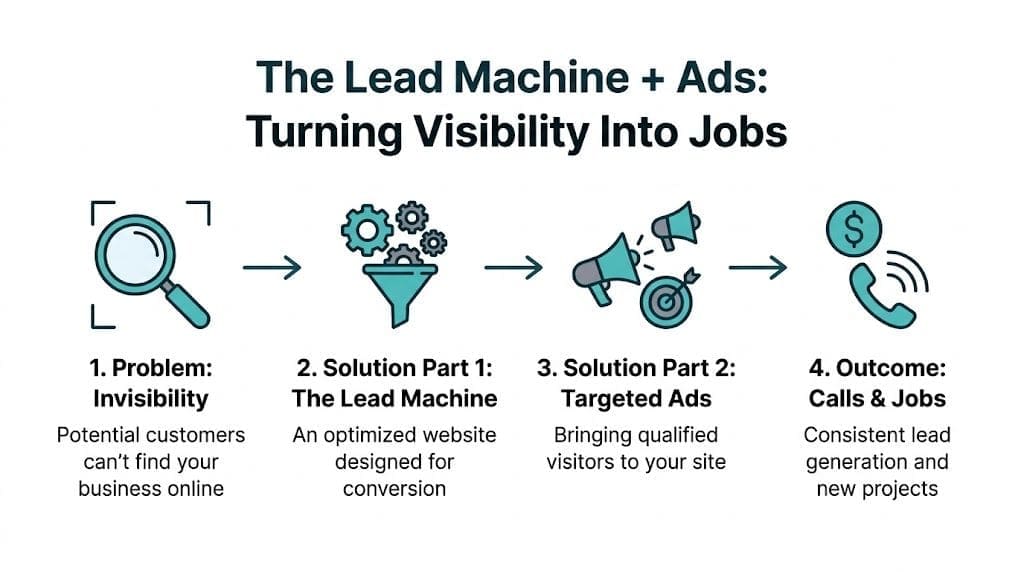
The system is simple. A Lead Machine is the website. Ads are the fuel. One without the other is weak. Together, they create control.
Part one is the Lead Machine
This is not a pretty brochure site.
It’s a website built to turn traffic into calls. It needs to cover the services you sell and the cities where you want work. It needs strong call paths, clear service pages, city pages, quote forms, mobile usability, and business profile alignment.
If you want a plain-language example of the principles behind building websites that convert leads into customers, that resource is useful. The main point is simple. The website must be built for action, not compliments.
One option in this space is The Cherubini Company, which builds Lead Machines and aligns them with local visibility work like Google Business Profile optimization. The important part is not the brand name. The important part is the system.
Part two is ads
Ads create visibility.
They put you in front of buyers who are searching right now. Not next month. Not after they ask a neighbor. Right now.
That matters because websites don’t create traffic. They wait for traffic. Ads solve that by putting the right buyers onto the right pages in the right service areas.
Why both parts matter
Here’s the simplest explanation:
| Piece | What happens without it |
|---|---|
| Lead Machine | Traffic lands and fails to convert |
| Ads | The site sits invisible and idle |
| Both together | Visibility turns into calls and jobs |
A good website with no traffic is an expensive sign in the woods.
Ads sent to a weak website are just wasted money.
You need both if you want steady lead flow across the cities you want to grow in.
Stop Guessing And Start Controlling Your Leads
The cost of guessing is not just wasted ad spend.
It’s the way uncertainty runs your business.
When leads are inconsistent, you take work you don’t want. You keep crews busy with smaller jobs. You make decisions based on fear instead of margin. You feel pressure every time the phone slows down because you know your pipeline isn’t under control.
What control actually gives you
Predictable lead flow changes more than your calendar.
- You choose better jobs: You stop saying yes to everything.
- You protect your margins: Desperation pricing loses its grip.
- You plan growth: Hiring, equipment, and expansion stop feeling reckless.
- You have more control: You’re not waiting around and hoping the next referral shows up.
The business is either fragile or controlled
There isn’t much middle ground.
If your business depends on luck, referrals only, or a website that just sits there, it’s fragile. A slow month hurts more than it should. A competitor in the next town can cut into your work faster than you expect.
If your business has visibility in the right cities, a website built to convert, and paid traffic feeding it, you have something far more useful than “marketing.”
You have control.
The goal is not more random leads. The goal is a business that doesn’t panic when one source dries up.
You think that customers “can” find you but, If customers “don’t” find you, nothing else matters. Lead Machines are built to fix that.
If you're tired of guessing and want a straight answer about why your website isn’t generating calls, talk to The Cherubini Company. They build visibility systems for contractors who need to show up in more cities, get more calls, and stop relying on hope.