
You’ve probably said some version of this already.
“We tried ads. They didn’t work.”
“That’s what the last agency said.”
“We got burned.”
“I don’t believe any of this anymore.”
Good. You shouldn’t believe most of it.
A lot of contractors don’t have a work quality problem. They have a visibility problem. They do solid work. People like them. They’ve built a name in their town. But outside that town, they disappear. When people search, they don’t show up. No visibility means no calls. No calls means no chance at the job.
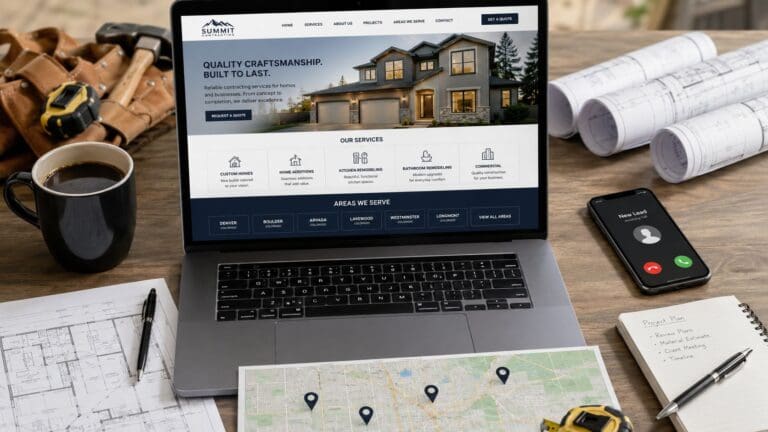
That’s why lead generation website design matters. Not because a website is magic. It isn’t. A website alone just sits there. But a website built to capture demand, paired with traffic, becomes a system that brings in calls instead of excuses.
Why Your Marketing Fails and You Keep Getting Burned
Most contractors aren’t crazy. They’re reacting to bad results.
They paid for a website that looked nice but didn’t produce. They paid for ads that sent traffic nowhere useful. They got reports full of fluff and still had to wonder where the next good job was coming from.

The problem usually isn't effort
Most owners are already doing plenty.
They answer calls. They quote jobs. They ask for reviews. They post now and then. They hire somebody for a website. They try ads once. None of that fixes the underlying issue if buyers never see them in the first place.
You can be the best contractor in the county and still lose to the company that shows up first.
That’s why this keeps happening:
- You stay busy, but with the wrong work. Small jobs fill the schedule while better jobs go elsewhere.
- You compete for scraps. The same few leads get passed around to several contractors.
- You spend money with no control. Marketing turns into guessing.
- You lose trust fast. One bad agency can make every next offer sound like a lie.
A lot of this shows up in common small business marketing problems. The pattern is simple. Bad marketing focuses on activity. Good marketing fixes visibility.
The deeper issue is the visibility gap
You may be known in your hometown. That’s not the same as being visible where people are searching.
That gap is where jobs are lost.
People who already know your company name can find you. That isn’t the hard part. The hard part is the buyer who needs excavation, septic, concrete, grading, plumbing, or heating work right now and has never heard of you. They search by service plus city, not by your business name.
If you don’t show up there, you’re out.
That’s why so many contractors feel burned. They were sold random tactics when they needed a system built around one thing. Being found.
Your Real Problem Isn't Leads It's Invisibility
Contractors say they need more leads.
Sometimes that’s true. Most of the time, the actual problem is simpler. People aren’t seeing them when they search.
How local search actually works
When someone types “contractor near me,” Google doesn’t treat “near me” like some vague idea. It connects that search to the city where that person is standing.
So if a customer is in the next town over, Google reads that search more like “excavation contractor in that town” or “plumber in that town.”
If your business only talks about your home city, Google has no strong reason to think you work in all the other nearby cities.
That’s the part contractors miss.
You may serve ten, twenty, or fifty nearby towns. But if your website and business presence never say that clearly, you stay invisible in those markets.
A website doesn't create traffic
Here, much common advice fails.
A website is not a lead source by itself. It is a destination.
It waits.
If nobody lands on it, it does nothing. If the wrong people land on it, it still does nothing. If the right people land on it but the site is weak, you waste the visit.
Here’s why visibility matters so much. SEO-focused websites deliver a 748% return on investment, SEO leads close at 14.6% versus 1.7% for outbound tactics, and the top 3 search results capture 54% of all clicks according to Cirrus Insight lead generation statistics. That isn’t a design trophy. That is proof that being visible where people search changes what happens next.
Word of mouth isn't enough for growth
Word of mouth is great. It helps. It also has limits.
It works best where you already have a footprint. It doesn’t reliably expand you into nearby cities where buyers don’t know your name yet. It doesn’t fill the map. It doesn’t make you appear when a property owner, builder, or homeowner searches in a place you’ve never clearly claimed.
If a customer knows your name, they can look you up. If they don't know your name, they look up the service. That's where most contractors vanish.
That is the invisibility gap.
You don’t have a lead problem first. You have a being found problem first. Leads come after that.
Stop Hoping For Traffic and Start Building For It
Big companies don’t rely on luck.
They buy visibility. They build pages around the places they want work from. They put money behind demand. They treat lead flow like a system, not a wish.
Small contractors often do the opposite. They launch a site, mention their hometown a few times, and hope Google somehow understands the full service area. It doesn’t.
Hope is not a strategy
A lot of contractor marketing is built on hope:
- Hope the website somehow ranks
- Hope referrals keep coming
- Hope a boosted post does something
- Hope the phone rings next month
That’s fragile.
One slow month, one ad mistake, one market shift, and the whole thing gets shaky. You can’t build a strong company on crossed fingers.
Generic marketing advice doesn't fit contractor reality
Heavy equipment and site work contractors get ignored by mainstream marketing advice. That gap is real. Perfect Afternoon’s guide to lead-generating website design notes that most content ignores the needs of heavy equipment contractors who need multi-city expansion and quoting systems.
That matters because an excavation company is not the same as an online store. A septic installer is not the same as a software company. A concrete contractor doesn’t need vague “brand awareness” talk. They need visibility in the cities where the jobs are.
If you want a useful outside read on why stronger page depth matters for search visibility, this strategic guide to long form content is worth a look. Not because you need to become a writer. Because search needs enough clear information to connect your services to your service area.
The better model is simple
You need two things working together.
A website built to convert.
Traffic built to reach buyers.
That’s it.
Not random posts. Not mystery reports. Not vanity numbers. A system.
When you build for visibility and then pay to expand it, marketing stops feeling like gambling. It starts acting like infrastructure.
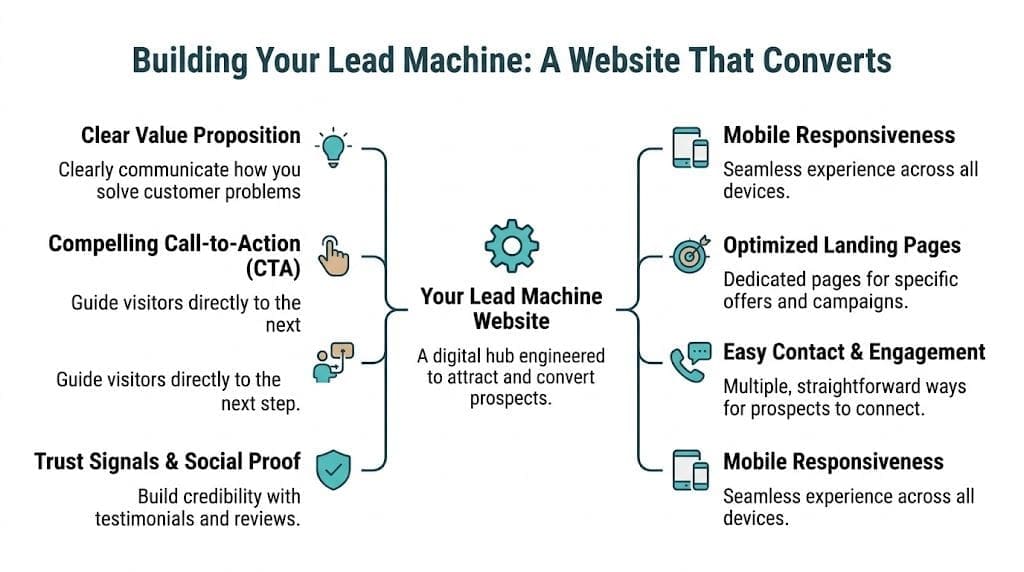
Building Your Lead Machine A Website That Converts
A real lead generation website design for contractors is not a brochure.
It is not there to win compliments.
It is there to turn visits into calls and quote requests.
What the site must do
The job is simple. When someone lands on the site, they should know three things fast.
- What you do
- Where you do it
- How to contact you right now
Anything that gets in the way of those three things is hurting you.
A website’s structure directly affects leads. Design drives 94% of first impressions, responsive design can raise conversions by 11%, and personalized calls to action outperform generic ones by 202% based on these 2025 website design statistics. That means the layout, wording, and mobile experience are not decoration. They decide whether a visit becomes a job.
The parts that matter most
Here’s what a contractor site needs if it’s supposed to perform:
- Service pages that clearly match what people search for. Not one vague page that lists everything.
- City pages that tell search engines and customers where you work.
- Click-to-call buttons that are easy to hit on a phone.
- Quote forms that are simple enough to finish.
- Review proof that shows you’re trusted.
- Google Business Profile alignment so the site and your business presence support each other.
If you want a plain-English look at solid site structure, these website design best practices cover the fundamentals well.
Practical rule: If a visitor has to hunt for your phone number, your site is leaking money.
The site has to match buyer behavior
Most local buyers aren’t studying your company for half an hour.
They’re checking whether you serve their area, whether you look legit, and whether contacting you feels easy. That’s why mobile design matters so much. Calls often come from people standing on a jobsite, in a driveway, or in a damaged basement.
Some contractors also add tools that reduce delay. A simple lead generation chatbot can help capture people who aren’t ready to call but still want fast answers.
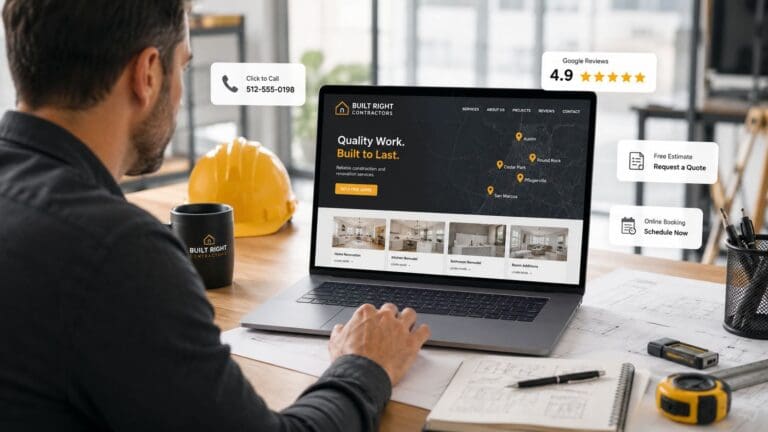
One example of this systemized approach is The Cherubini Company, which builds contractor websites around service pages, city pages, review systems, and call-focused structure. That’s useful because the point isn’t just having a website. The point is owning an asset built to convert traffic into jobs.
A Lead Machine does that. It gives traffic somewhere useful to go.
Fueling the Machine How Ads Create Predictable Calls
A strong website without traffic is parked equipment.
It may be valuable, but it isn’t moving anything.
Ads are what create visibility now. They put your business in front of people already looking for the work you do. Then the website takes over and turns that visit into a call or form fill.

Why ads failed before
A lot of contractors say ads don’t work.
Usually one of two things happened.
The traffic was weak. Or the destination was weak.
If ads send a buyer to a generic homepage, cluttered page, or slow site with no clear path to call, the ad budget gets blamed for a website problem. That happens all the time.
Here’s the hard number. Multi-step forms can increase conversions by 300% over single-step forms. Average landing pages convert at 2.35%, while pages built specifically for lead capture can achieve 11% or more according to Saleshandy’s lead generation statistics. So no, traffic alone isn’t enough. The page has to be built for response.
What ads are really doing
Ads are not magic. They do one very practical job.
They create visibility where there wasn’t any.
That means:
- Showing up in more cities
- Reaching buyers at the moment they need service
- Sending them to a page built for that exact need
- Giving you a more steady flow of calls
If you want a contractor-focused look at that setup, fuel your leads with Google Ads explains the relationship between visibility traffic and conversion pages in plain terms.
A weak website wastes paid traffic. Weak traffic wastes a strong website. You need both working together.
Predictable beats random
This is why the combination works.
The website is the asset. Ads are the fuel.
When both are built around the same cities and services, lead flow becomes more stable. You stop waiting around for referrals or seasonal luck to carry the business. You start creating more chances to be chosen.
That’s how you move from random lead spikes to something you can manage.
Take Control of Your Growth and End the Guesswork
The contractors who struggle most are not always the ones doing the worst work.
They’re often the ones with no system.
They rely on referrals, old reputation, a basic site, and whatever scraps of traffic happen to come in. That works until it doesn’t. Then stress takes over. Cash flow gets tight. Every lead feels high stakes.

Random marketing creates a fragile business
The issue isn’t that owners don’t care.
It’s that guessing doesn’t scale.
Industry data shows 36% of businesses say strategy gaps are their biggest barrier to lead generation, and companies with mature, system-based processes are 3 times more likely to hit revenue goals based on Marketing LTB lead generation statistics. That says the quiet part out loud. Random tactics lose to systems.
Control comes from a built system
A proper lead generation website design gives traffic a place to convert.
Ads create the visibility that brings buyers in.
Together, they give you control over where leads come from and where you want more of them. That control matters. It lets you push for better jobs, wider territory, and steadier growth instead of taking whatever falls through the door.
Here’s the difference in plain terms:
| Approach | Result |
|---|---|
| Website only | You wait |
| Ads only | You waste traffic |
| Lead Machine plus ads | You build a repeatable lead flow |
No control over lead flow means no control over growth.
That’s the bottom line.
You think that customers can find you but, if customers don’t find you, nothing else matters. Lead Machines are built to fix that.
If you're tired of guessing and want a straight answer about why your business isn't showing up, talk to The Cherubini Company. They help contractors fix the problem of invisibility with lead generation websites and ad systems built to turn visibility into calls.