You’re probably living this right now.
Your company has a solid name in your town. People know your trucks. Past customers refer you. Builders call you back. You stay busy enough to think the business is healthy.
Then work thins out, or you try to push into the next town over, and nothing happens.
Not because people there don’t need your service. Not because you suddenly got worse at what you do. Not because your reputation vanished. It’s because you’re not visible where they’re searching.
That’s the hard truth about how to grow a home service business in multiple towns. It isn’t mainly about hustle. It isn’t about posting more on social media. It isn’t about buying another wrapped truck and hoping people notice.
It’s about whether you show up when a buyer in that town looks for what you do.
Most contractors think they have a lead problem.
They usually have a visibility problem.
The Invisibility Problem Just 10 Miles Away
A contractor can be booked out in one town and dead quiet in the next one over.
That sounds stupid until you see how buyers search. A homeowner doesn’t search your company name if they’ve never heard of you. They search for the service. Then Google matches that search to where they are.
So when someone types in “excavation contractor near me,” Google reads that as excavation contractor in their city, not yours.

What Google thinks you do
If your address is in your hometown, and your site mostly talks about your hometown, Google makes the obvious assumption. It assumes that’s where you work.
It does not guess that you also clear land, install septic, pour concrete, or grade lots in six other towns unless your online presence makes that clear.
That’s why contractors get blindsided. They say, “We work there all the time.” Sure. But you know that. Your crew knows that. Google doesn’t know that, and the customer in that town definitely doesn’t know it.
You’re not losing jobs because someone beat you fair and square. You’re losing jobs because you never showed up in the first place.
This is the visibility gap.
It’s the space between the towns you serve in real life and the towns where buyers can find you online.
The jobs you never even knew existed
The ugliest part of this problem is that it’s silent.
You don’t get a notice saying, “Three people in the next town searched for your service today and hired somebody else because you weren’t visible.” Those jobs are gone before you even know they existed.
That’s why contractors keep saying word of mouth feels weaker than it used to. Word of mouth still matters. It just doesn’t cover whole territories by itself.
If you want a useful breakdown of how visibility works with paid search, this guide on local business Google Ads strategies is worth reading because it lines up with how buyers behave when they need service now.
If this nearby-town problem sounds familiar, this breakdown on how contractors get more calls in nearby towns will make the issue even clearer.
Why Your Website Is a Brochure Not a Salesman
A lot of contractors got sold a fairy tale.
Some agency told them they needed a website, so they bought one. It looked sharp. Nice logo. Drone shots. A few service pages. Maybe a quote form. Then they waited for leads.
Nothing much happened.
That’s because a website by itself does not create demand. It does not go out and find buyers. It just sits there and waits.

What most contractor websites really are
Most sites are digital brochures.
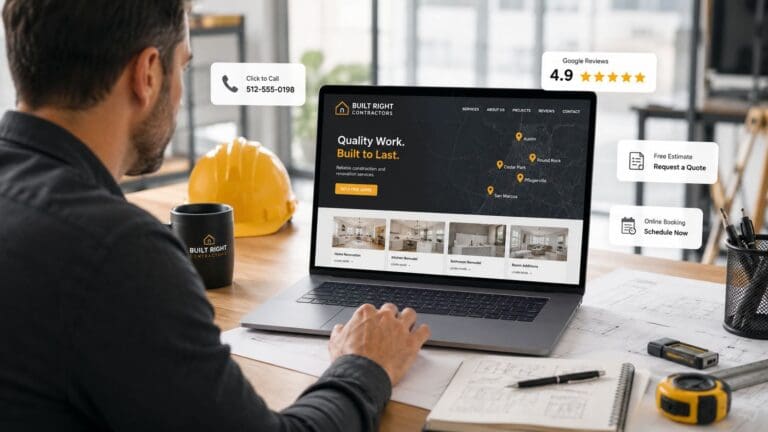
That’s not an insult. It’s just what they are. They explain who you are, list a few services, show some photos, and offer a phone number. That can help once a buyer lands there.
But if nobody lands there from the towns you want, the site doesn’t solve anything.
A brochure in an empty room doesn’t sell. A billboard in the desert doesn’t sell either.
Same problem.
Why this matters more when you expand
When you want work from multiple towns, a basic site gets exposed fast.
If the site doesn’t clearly connect your services to each town you want, then buyers in those places don’t see themselves in the page. Google doesn’t either. So the site sits there like a good-looking piece of furniture.
Here’s the simple difference:
| Website type | What it does |
|---|---|
| Brochure site | Lists your business and waits |
| Lead-focused site | Matches services to towns and pushes people to call |
That’s why so many contractors say, “We already have a website,” like that should settle the issue.
It doesn’t.
Practical rule: Don’t ask whether you have a website. Ask whether that site is built to get calls from each town you want to serve.
A site can be clean and still be useless for growth.
A site can also be ugly and still work better, if it’s built around service areas, clear calls to action, mobile use, and lead capture.
The point isn’t design awards. The point is calls.
You Don’t Have a Lead Problem You Have a Visibility Problem
A contractor in Town A can have a full schedule, solid reviews, and crews ready to work. Then he looks 10 miles over at Town B and says, “Leads are dead there.”
Leads are not dead. He’s just not visible there.
That distinction matters because it changes what you fix. If people in the towns you want to serve do not see you in search, on maps, and on pages tied to their location, lead flow will always feel random. You will call it a lead problem because that is the symptom you feel. The actual problem is simpler. Buyers cannot find you where they are looking.
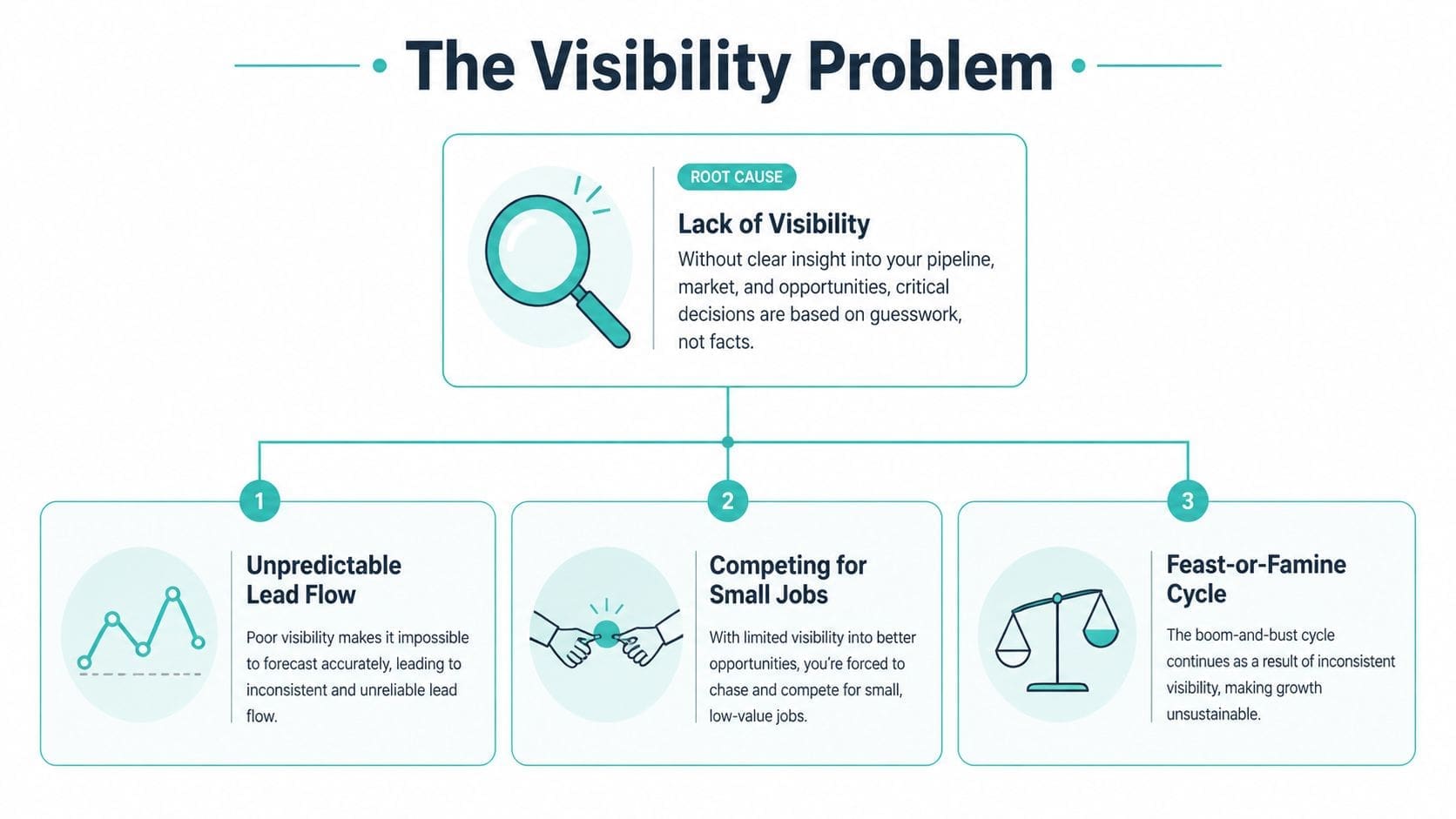
The root cause of unpredictable leads
Look at what contractors complain about after they try to expand:
- Feast or famine. One town stays busy while the next one barely calls.
- Too many low-value jobs. You say yes to filler work because the better jobs are inconsistent.
- Bad-fit callers. Price shoppers and time-wasters find you faster than serious buyers.
- No control. You cannot point to a reliable source of jobs by town.
- Constant pressure. The schedule looks full until it suddenly doesn’t.
Those are not separate issues. They come from the same gap. You are visible in some places and invisible in others.
That is why expansion frustrates good operators. They assume the business has a sales problem, an ad problem, or a staff problem. Usually it has a findability problem. Your company is capable of doing the work. The market in the next town just has no reason to pick you if you barely appear there.
Visibility wins before reputation gets a chance
Bigger companies understand a hard truth that smaller contractors resist. The company that gets seen first gets considered first.
That does not mean they do better work. It means they show up in the exact towns they want to own, over and over. They treat local visibility like territory control.
Smaller operators often trust referrals, yard signs, wraps, and a general website to carry expansion. That works in the town where your name is already circulating. It breaks down fast outside that bubble. A buyer in a neighboring town is not grading your hustle. They are choosing from the companies they can find in two minutes.
If you do not control visibility by town, you do not control revenue by town.
Your Google Business Profile matters because map visibility matters. It also has limits if the rest of your local presence is weak. If you want to tighten that piece up, read our guide on how to optimize Google Business Profile.
Hard work does not fix invisibility
Plenty of contractors work like maniacs and still stay stuck.
They answer calls at night. They chase estimates. They handle crews, suppliers, and callbacks all day. None of that creates demand in a town where buyers never run into your business online.
Effort helps after you get found. It does nothing before that.
So stop measuring the wrong thing. Stop asking, “How do I get more leads?” Start asking, “Where am I invisible, and what has to exist so buyers in that town can find and trust us?” That question gets you to the fix much faster.
Once visibility improves, lead quality improves with it. The right pages attract the right searches. The right local signals pull in buyers from the towns you want. The right follow-up process helps you streamline lead nurturing for conversions instead of letting good inquiries die after first contact.
The System for Multi-Town Growth Lead Machines and Ads
If you want to grow across multiple towns, stop thinking in pieces.
A website by itself won’t carry this. Ads by themselves won’t carry it either. One without the other wastes money or wastes opportunity.
You need a system.
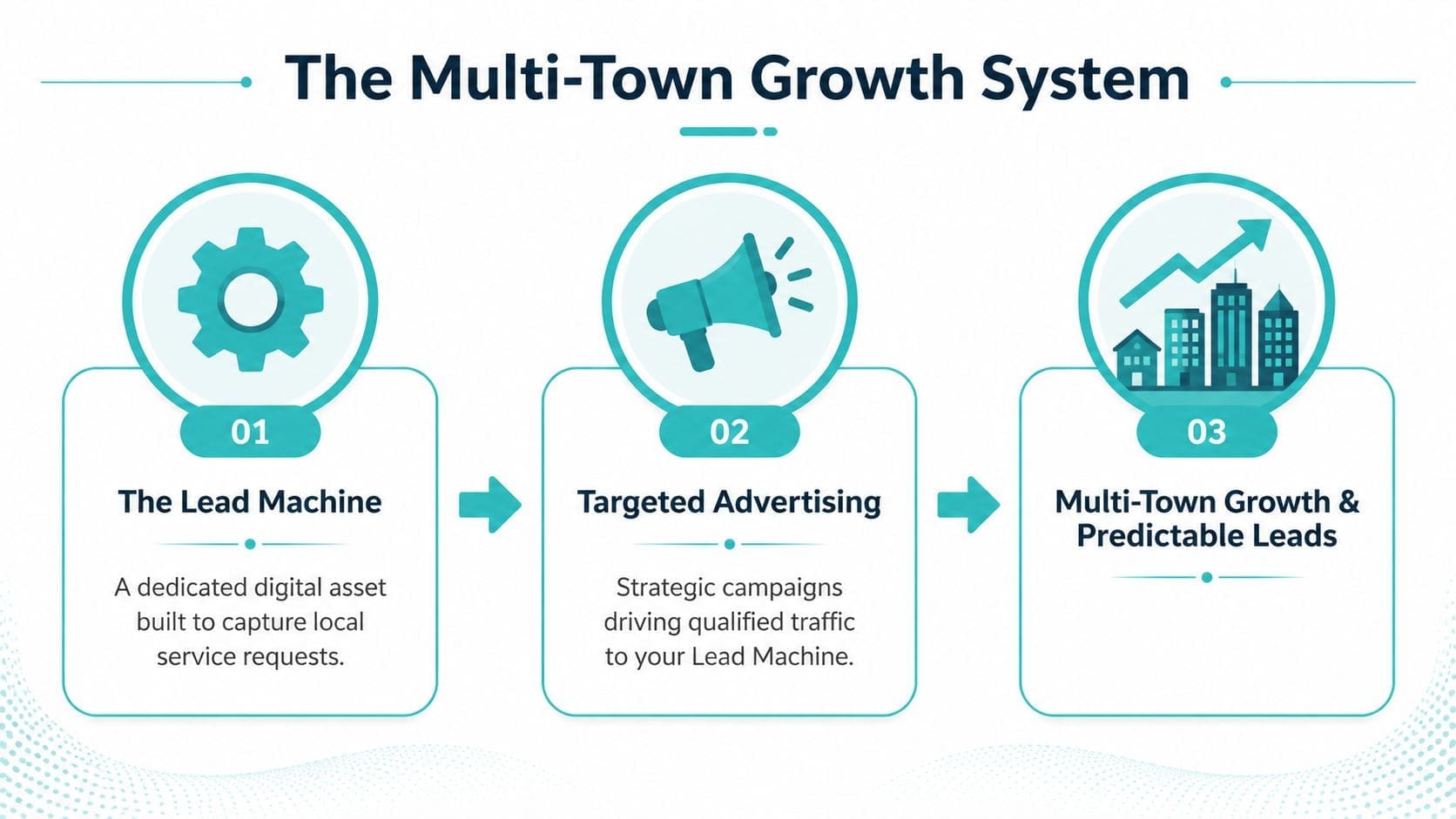
What a Lead Machine does
A Lead Machine is not a pretty website.
It’s a site built for one job. Turn visibility into calls.
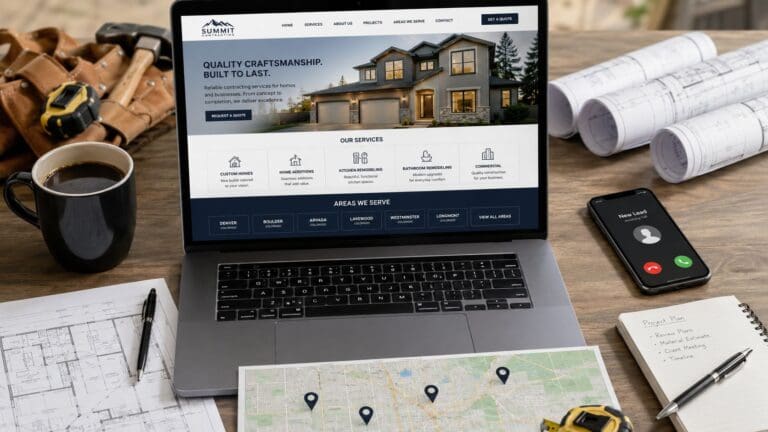
That means it has pages built around the services you offer and the towns you want to win. It gives buyers a clear path to contact you. It makes it easy to call, request a quote, and understand that you serve their area.
The website is the asset.
It’s where your traffic lands. It’s where the buyer decides whether to trust you. It’s where the click becomes a call.
What ads do
Ads create visibility.
That’s their job. They put your business in front of people searching right now in the towns you want. Without that fuel, the site just waits around.
Without the right site, ads send paid traffic to a weak destination and waste money.
That’s why this has to work as one machine.
Here’s the simple version:
- Build the asset. Create a site featuring the services and towns that matter.
- Drive the traffic. Put paid visibility behind those towns.
- Track the response. Watch which services and towns turn into real calls.
A website is the destination. Ads are the delivery system.
Growth takes structure, not hope
Multi-town growth also takes patience. New areas don’t mature overnight. One useful benchmark from Clover is that new locations often follow a 24-month revenue curve, with months 1 to 3 at 10 to 20 percent of mature location revenue, months 4 to 6 at 30 to 50 percent, months 7 to 12 at 60 to 80 percent, and months 13 to 24 reaching 80 to 100 percent or more of mature location revenue according to these multi-location expansion benchmarks.
That matters because contractors quit too early. They expect a new town to act like their hometown on day one. That’s not how expansion works.
If you want a practical example of a territory-based approach, multiple Lead Machines show how one system can be structured around separate towns and service areas. The Cherubini Company uses that model for contractors who need city-based coverage tied to paid visibility.
And once those leads start coming in, you still need a clean follow-up process. This article on how to streamline lead nurturing for conversions is useful because getting the lead is only half the battle.
Taking Control of Your Service Area and Revenue
You add a truck, hire another tech, and tell the team you now serve three more towns. Then the phone stays uneven, the schedule is patchy, and payroll still depends on whatever referrals happen to show up that week.
That is not a growth problem. It is a control problem caused by a visibility gap.
When people in the towns you want cannot find you by service and location, revenue stays random. You keep reacting instead of deciding. You take work you should decline, send crews farther than you want, and let chance set your month.

What control actually looks like
Control shows up in plain, practical ways.
- You pick the towns that matter. You stop claiming a huge service area you cannot support with real visibility.
- You choose better jobs. A fuller pipeline gives you room to pass on low-value work.
- You plan capacity with confidence. Hiring, routing, equipment purchases, and scheduling get easier when demand is not a surprise every week.
- You spot weak territories fast. If one town is quiet, you know where to fix coverage instead of blaming the whole market.
That is how an owner gets out of scramble mode.
Expansion without visibility gets expensive
A bigger map does not make a stronger business. More trucks, more crews, and more drive time only raise your costs if buyers in those towns still cannot find you.
As noted earlier, home services is crowded and getting more crowded. More contractors are pushing into nearby towns and chasing the same searches. If your company is easy to find in two towns and invisible in five others, those five towns belong to somebody else.
That is the hard truth. Revenue follows visibility.
For a related view on location-based search demand, you can discover homebuilder SEO with Sight AI. The industry is different, but the rule is the same. Buyers search by what they need and where they need it. If your business is not clearly connected to both, you do not make the shortlist.
If customers in a town cannot find you, that town is not in your service area in any meaningful business sense.
Lead Machines are built to fix that.
Common Questions About Expanding Your Service Area
Should I just rely on my Google business profile?
No.
It matters, but it won’t solve multi-town growth by itself. Your profile helps with credibility and branded search. It is not a full territory growth plan.
If you want calls from several towns, you need a system that connects your services to those towns and puts visibility behind them.
Isn’t word of mouth enough if our work is good?
No.
Word of mouth is strong in your hometown because people already know you there. It gets weaker as you move into towns where fewer people know your name. Good work helps after people hire you. It does not make strangers search for you by name.
We already have a website. Why isn’t that enough?
Because websites don’t create traffic.
They wait for traffic. If the site isn’t built around the towns you want, and nothing is driving buyers there, it won’t produce steady calls.
Should I expand into every nearby town at once?
No.
Pick the towns that fit your crews, travel range, and job type. Then build visibility there on purpose. Random expansion creates random results.
How long does a new town take to become productive?
Longer than most contractors want.
New areas usually need time to build traction. That’s why owners who expect instant payoff get frustrated and pull back too soon.
What’s the simplest way to think about this?
Like this:
- No visibility means no chance to compete
- A basic website means no real lead system
- Ads alone mean wasted money
- A Lead Machine plus ads means you finally control the process
If you want to know how to grow a home service business in multiple towns, stop chasing random tactics and fix the one problem underneath all of it. Be visible where buyers are looking.
If you’re tired of guessing, Just Leads helps contractors fix the primary issue: visibility. They build Lead Machines and run advertising built around the towns you want work from, so your business can show up where customers are searching.