
You're probably in this spot right now.
You've got a real business. You do solid work. People in your town know your name. But the phone still goes quiet when it shouldn't. Then the panic starts. You lean harder on word of mouth. You try a website. You try ads. Some agency says they've got the answer. You spend money. Nothing changes.
That cycle wears people out.
Most contractors don't have a work ethic problem. They have a visibility problem. They're known in one town and invisible in the next one over. That's why learning how to dominate local search in multiple cities matters. Not because it sounds fancy. Because visibility controls who calls, which jobs you get a shot at, and how much control you have over revenue.
The Real Reason Your Phone Isn't Ringing More
A lot of contractors think the problem is leads.
It's not.
The problem is that people aren't seeing you when they search. If they don't see you, they can't call you. If they can't call you, your schedule depends on luck, referrals, and whoever happens to remember your name that week.

The pain is real, but the cause is simple
You've probably said some version of these things before:
- Word of mouth has kept us going. It works until it doesn't.
- We tried ads already. They sent junk or nothing at all.
- Our website should be helping more. It isn't.
- We got burned by a marketing company. Big talk. Weak results.
- We're busy, but not with enough of the right jobs. Too many small jobs. Not enough big ones.
Those are all symptoms.
They all roll up into one issue. You don't control your visibility. And if you don't control visibility, you don't control revenue.
Practical rule: If your business only gets found when somebody already knows your name, you do not have a lead system.
That's a fragile business. One slow month, one weather shift, one crew opening up, and now you're scrambling.
Your website isn't the hero
A lot of owners expect the website to somehow “generate” leads on its own. That's the wrong job.
A website just sits there until somebody lands on it. That's it. It doesn't knock doors. It doesn't chase buyers. It doesn't force Google to send traffic. It waits.
That's why so many contractors feel lied to. They bought a site and expected results. What they got was a digital brochure.
If that sounds familiar, you'll probably relate to what Just Leads Co. says about lead generation systems. The core issue isn't effort. It's that most businesses never build a system that makes them visible where buyers are already looking.
Big companies buy visibility. Small contractors rely on hope
That's the whole game in plain English.
The bigger companies don't win because they care more. They win because they show up more. They plant their business in front of buyers in city after city. Then they capture the calls.
Meanwhile, smaller contractors hope referrals carry them across town lines.
Hope isn't a system. It's a gamble.
Your Invisibility Is Costing You Six Figures
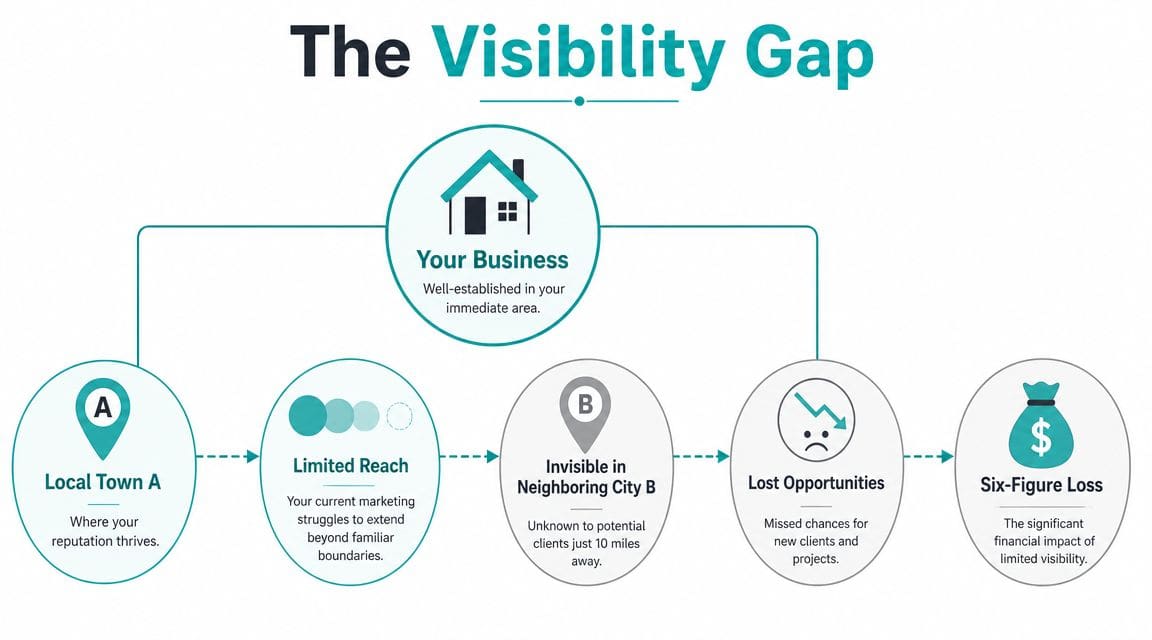
The biggest blind spot for contractors is this. You can be well known in your hometown and still be almost impossible to find ten miles away.
That's the visibility gap.
What buyers are actually doing
When somebody searches for “excavation contractor near me” or “roof repair near me,” Google reads where that person is standing and turns that search into a city-based search.
So if the customer is in Newark, the search becomes about Newark.
If the customer is in Heath, the search becomes about Heath.
If your business has only made it clear that you work in your home city, Google has no good reason to assume you also work in the next city, the next suburb, or the next county. That sounds obvious once you hear it. But most contractors never think about it that way.
Why this matters so much
46% of all Google searches have local intent, and businesses in the top three local results get 126% more traffic than businesses ranked four through ten, according to SOCi's local SEO statistics roundup. For a contractor, that means if you're not showing up in the local pack in nearby cities, you're missing the highest-intent searches.
Those people aren't browsing for fun.
They need work done. They're searching right now. They're comparing options right now. And if your company doesn't show, you don't even make the list.
You're not just losing leads. You're losing jobs you never even knew existed.
The visibility gap in plain language
Here's what it usually looks like:
| Situation | What it means |
|---|---|
| You rank in your hometown | Google understands you belong there |
| You work in nearby cities but don't mention them well | Google has weak signals for those places |
| Buyers search from those nearby cities | Competitors show up instead |
| You think demand is slow | The demand exists. You're just not visible to it |
That gap is where a lot of revenue disappears.
Not because your work is bad.
Not because people don't need your service.
Because they searched in another city, saw somebody else, and called them first.
Most contractors mistake this for a lead problem
It isn't that customers can't find you.
It's that they don't find you.
If they know your company name, sure, they can track you down. But buyers who need your service and don't know your name yet will search by service plus location. Not by your brand.
That means the fight is won or lost before they ever see your homepage.
Stop Treating Your Website Like a Dusty Brochure
A website has one job. Turn traffic into calls.
That's it.
If nobody visits, it does nothing. If the wrong people visit, it still does nothing. If it looks nice but doesn't move people to call, it's just sitting there like a stack of brochures on a front counter.
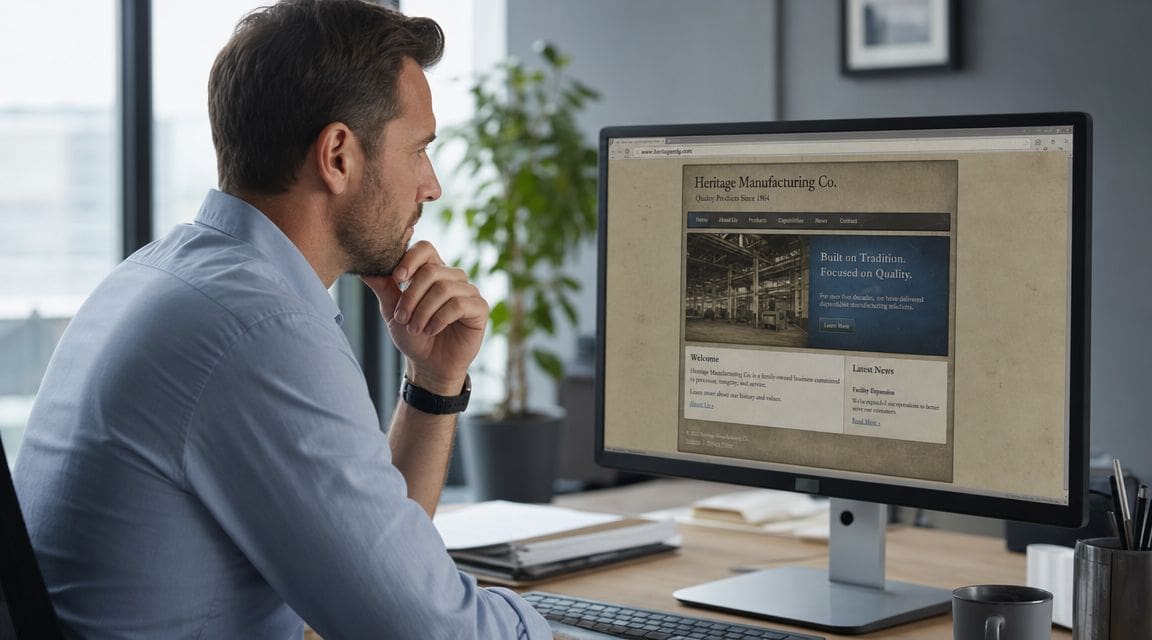
A real website asset works like a sales tool
You need to stop thinking about your site as an online business card.
Consider this instead. Every page is a digital billboard placed in a city where you want work. If the page is built right, it tells Google and the customer the same thing. We do this service in this city. Call us.
That's what a Lead Machine is supposed to be.
Not a pretty design piece.
Not a vanity project.
A working sales asset built to convert local demand into calls, quote requests, and booked jobs.
What a Lead Machine actually does
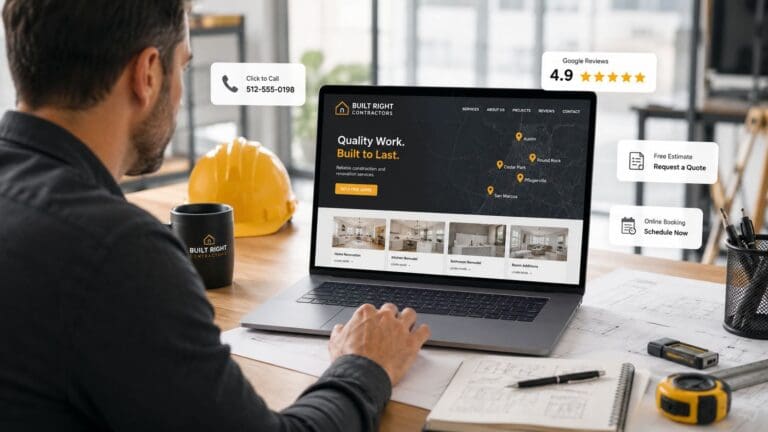
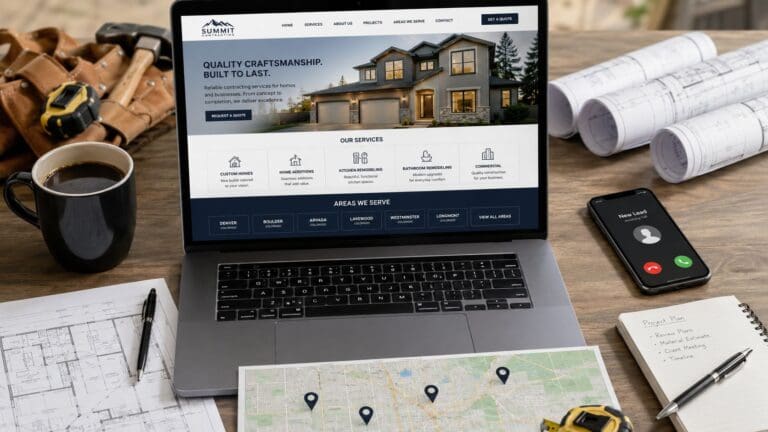
A Lead Machine is a website built around service and city. It is structured to show up in the places you want to work and make it easy for buyers to contact you when they land there.
That means it needs to do a few things well:
- Match the search so the visitor feels they're in the right place
- Show proof that you really work in that area
- Make calling easy on mobile and desktop
- Push action instead of forcing people to hunt for next steps
A website does not create demand. It captures demand after visibility brings people in.
If you want a simple breakdown, this page on a lead generation website versus a brochure website explains the difference clearly.
This same pattern shows up in other local businesses
It's not just contractors. Local businesses in other industries run into the same wall when they depend on a generic site and weak visibility. If you want to see the same idea in a different market, GolfRep's growth system for clubs is a good example of how a website only works when it's part of a larger system built to attract and convert local demand.
The lesson is the same.
A website without traffic is idle.
Traffic without a conversion system is waste.
You need both parts working together.
Building Your Digital Territory City by City
If you want to dominate local search in multiple cities, one generic page won't do it.
You need a structure that matches how people search. That means a unique page for each city you want to win in.
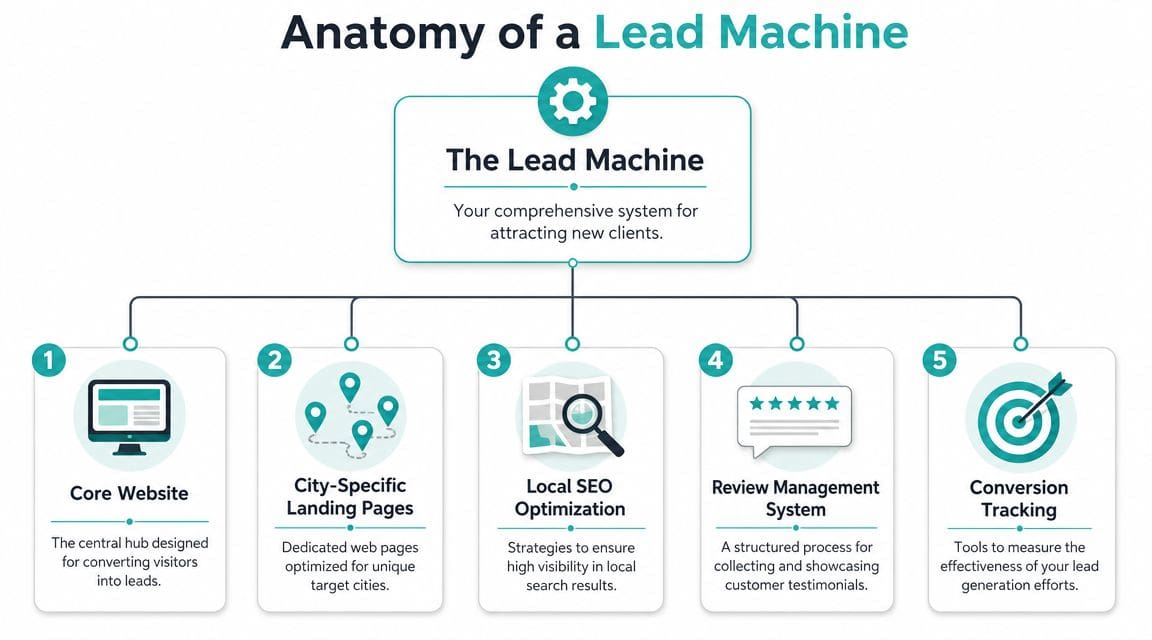
One city page equals one digital billboard
A city page is not filler. It is a claim on territory.
If you serve Newark, Heath, Granville, Pataskala, Zanesville, Lancaster, and Columbus suburbs, then your website should reflect that service area with real pages built for those places. Each page acts like a local sign on the roadside saying, “Yes, we do this work here.”
That's how you close the visibility gap.
What works and what gets ignored
The strongest approach is simple. Build one unique page per city, and make each page clearly useful to the person searching there. Guidance on multi-city local SEO says copied pages with a swapped city name can create doorway-page risk, while unique pages improve relevance and rankings, as explained in this local SEO mastery guide.
That means the page can't be lazy.
It can't be the same paragraph pasted twenty times with a different town name.
It has to show real local relevance.
What those pages need
A strong city page usually includes things like:
- Local proof such as jobs completed in that area, nearby landmarks, or service details tied to that city
- Customer trust signals like reviews from customers in or near that market
- Clear business details so the visitor knows how to reach you and what you do
- Direct action points that make calling or requesting a quote simple
For contractors without a staffed office in every city, that local proof matters even more. The page has to make it clear that you truly serve that area, not that you're trying to game the search results.
Field-tested truth: If your service area is broad, your website has to be just as clear as your truck route.
This is how you take ground without opening more offices
A lot of owners assume they can only compete in cities where they have a storefront.
That's not true.
If you're a service area business, you can still build strong city visibility by showing useful local evidence on each page. That's the whole point of the structure. You don't need to fake being based in every town. You need to prove you work there and make that easy for Google and the customer to understand.
There's a good summary of that approach in this guide on local SEO for contractors and city pages.
The mistake that kills most multi-city efforts
Most businesses either do too little or do it sloppily.
They keep one service area page and expect it to rank everywhere. It won't.
Or they crank out a pile of near-copy pages that say nothing useful. Those pages don't help much either.
The answer is not more noise. It's better coverage.
If your crews can work there, your digital presence should be built there too.
Fueling the Machine to Generate Calls Now
A strong site structure is the machine. But a machine sitting still doesn't make money.
It needs fuel.
That fuel is paid ads.
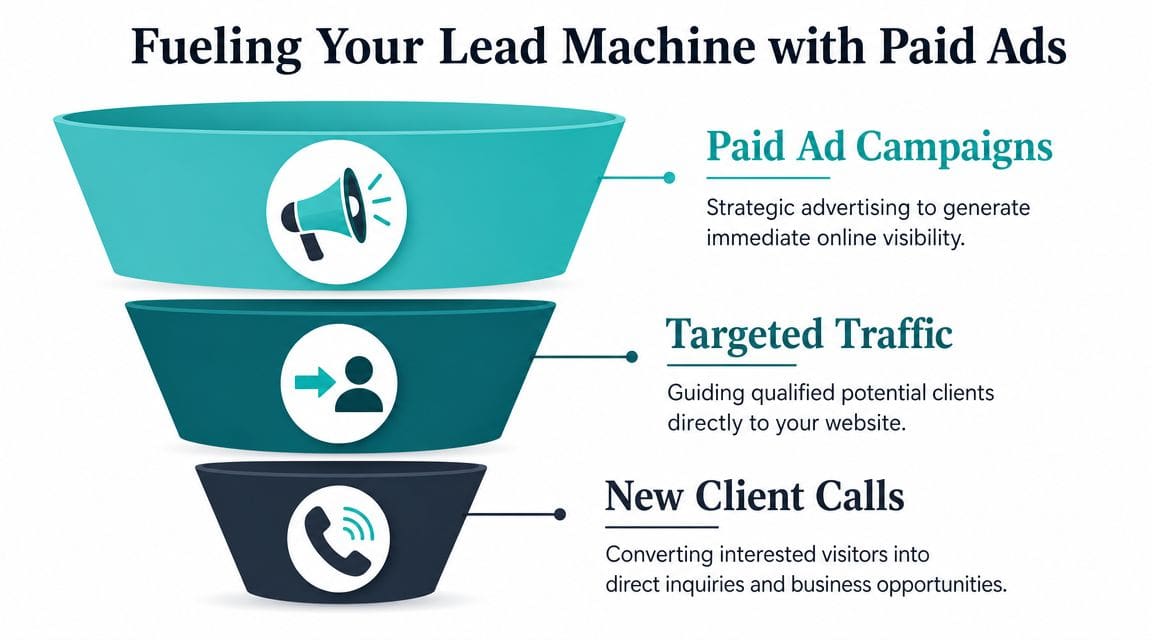
Why ads felt like a waste before
A lot of contractors say ads don't work.
What usually happened is this. They paid for traffic and sent it to a weak site. The site didn't match the search well. It didn't build trust fast. It didn't make the next step easy. So the traffic bounced, and the owner blamed the ads.
That's understandable. But the problem wasn't just the traffic source. The problem was the system.
Ads don't fix a bad destination.
They expose it.
What ads are supposed to do
Ads create visibility fast. They put you in front of buyers who are already searching for your service. That matters when you want calls now, not months from now.
But the ad click has to land on something built to convert.
That's where the city-based Lead Machine matters. The page needs to line up with the buyer's location and service need. Then the phone call becomes much more likely because the search, the page, and the offer all match.
Service area businesses can do this the right way
Contractors often cover multiple cities without having an office in each one. That doesn't kill the strategy. It changes what the pages need to show.
The right approach is to combine dedicated city pages with service-area proof like project galleries and city-specific testimonials, which helps contractors rank across nearby cities without falling into low-value page tactics, as explained in Augurian's guide to local SEO for multiple locations.
That matters for ads too.
When somebody clicks from a nearby city, they need to see signs that you really work there. Real jobs. Real service area language. Real trust signals. Not vague claims.
If ads are the fuel, the page has to be the engine. Otherwise you're just burning money.
The system changes the kind of work you get
When visibility improves, the phone doesn't just ring more. It rings better.
You can start filtering out weak jobs. You can stop chasing every tiny project that comes along. You can aim at the bigger work in the cities that make sense for your crews, schedule, and margins.
One practical option in this space is The Cherubini Company, which builds Lead Machines and runs visibility ads for local and regional service businesses. The point isn't the brand name. The point is the model. A site built for service-and-city coverage paired with paid visibility gives contractors a system instead of guesswork.
That's the shift.
No more random traffic.
No more hoping the old website somehow saves the month.
No more feast or famine by accident.
The System for Predictable Leads and Bigger Jobs
Here's the simple version.
If you want more control over your business, you need more control over visibility.
That means two parts working together. First, a website built around your services and the cities you want to own. Second, paid visibility that puts your company in front of people searching right now. That combination is what breaks the feast-or-famine cycle.
What control actually looks like
When the system is working, a few things change fast:
- You stop depending on luck because calls come from a repeatable process
- You stop saying yes to everything because better lead flow lets you be selective
- You stop losing nearby work unnoticed because you show up where buyers search
- You stop guessing because the business has a real engine behind it
That matters more than most owners realize.
A contractor with no visibility system is always one slow patch away from stress. A contractor with predictable lead flow can plan crews, protect margins, and go after bigger jobs without panic.
The choice is pretty clear
You can keep doing what most contractors do. Rely on referrals. Hope the phone rings. Blame the season. Try another random ad run when things get tight.
Or you can build a system that covers your real service area and drives people into it on purpose.
Customers don't hire the company they never saw.
That's the part many overlook.
You think customers can find you. Maybe they can if they dig hard enough. But if customers don't find you when they search, none of your experience, equipment, crew quality, or reputation gets a vote.
That's why this matters.
Predictable leads give you control.
No control means a fragile business.
If you're tired of guessing and want a straight answer about how to get visible in more cities, The Cherubini Company helps contractors build Lead Machines that turn visibility into calls. If customers don't find you, nothing else matters. Lead Machines are built to fix that.