You searched for build your own contractor website because you want more jobs, not because you want a new hobby.
That matters.
Most contractors who search that phrase are already busy. You've got estimates to run, crews to manage, phones to answer, and jobs to finish. You don't need another half-finished project sitting on your desk at night. You need your business to show up where buyers are looking.
The hard truth is simple. A website by itself doesn't fix a lead problem. If you're not visible in the towns around you, the site won't save you. It will just sit there and wait.
You Don't Need Another Website You Need More Jobs
You've probably been through this already.
Maybe you paid for a site that looked clean but didn't bring calls. Maybe you tried ads and got junk leads. Maybe an agency sold you a story, locked you into a contract, and left you with a pretty homepage and no real change in your pipeline.
That frustration is real. But searching for build your own contractor website is still the wrong move if your goal is leads.

The problem isn't your homepage
Most website advice for contractors talks about the same basic stuff. Add services. Add photos. Add testimonials. Add a contact form.
Fine. But that misses the main problem.
The common advice for building a contractor website overlooks a critical problem: generating leads in multiple cities. While most tutorials focus on generic pages like services and galleries, they fail to explain how to structure a site for territory expansion. Over 80% of smartphone users research online before purchasing, meaning if you're not visible in their specific location, you don't exist to them. The job is gone before you even knew it was there, as noted in this construction website guide from Wix.
Practical rule: If your website only talks about your home town, don't expect it to bring you work from the next town over.
You have a visibility gap
Most contractors are known in their own town. People there know the trucks. They know the family name. They may even know your crew.
Drive ten miles away and that disappears.
Online, that gap gets worse. Your website, your business profiles, and your marketing usually point back to one city. Your office city. Your mailing city. Your home base. So that's where you show up. Everywhere else, you fade out.
If you want a better way to think about it, stop asking how to build a site and start looking at lead generation for contractors as a visibility problem first.
That's the shift. You don't need another website. You need a system that helps buyers find you where they live.
Why You Are Invisible 10 Miles Down the Road
A lot of contractors think people can find them because they have a website.
That's not how local search works.
When someone types your service plus "near me," they aren't really searching for your company name. They're searching for a contractor in their current city. Google matches that search to location intent. If the person is standing in the next town over, the search becomes your service in that town.
Google isn't guessing
If you've told Google about one city, Google takes you seriously in one city.
If you never mention the next city, why would Google assume you work there?
That's the whole issue. It isn't personal. It isn't some mystery. It's basic logic. You have to make your service area clear. If you don't, another contractor will.
In the first quarter of 2023, there were over 919,000 construction businesses in the United States, according to Associated General Contractors of America construction data. That's a crowded market. Hope isn't a plan in a market that dense.
The jobs you're losing never feel like losses
This is what burns contractors.
You don't get told about the jobs you never showed up for. The phone doesn't ring. The form never gets filled out. No one says, "We were going to call you, but you didn't appear in our town."
You just feel a slow leak in revenue.
This is what that looks like on the ground:
- Your trucks already work there. You service the area every week, but your online presence doesn't match reality.
- Your competitors show up first. Buyers call who they see.
- Word of mouth stops carrying the load. Referrals help, but they don't cover every open slot on your schedule.
If you're not visible in the town where the buyer is searching, you have no shot at that job.
If you want to understand the mechanics more clearly, this comprehensive guide for contractor local SEO gives a useful overview of how local visibility connects to contractor search presence.
A lot of owners discover this only after months of dead spots in the schedule. If that sounds familiar, read this breakdown on why your business doesn't show up on Google. It usually isn't because nobody needs your service. It's because Google has never been clearly told where you work.
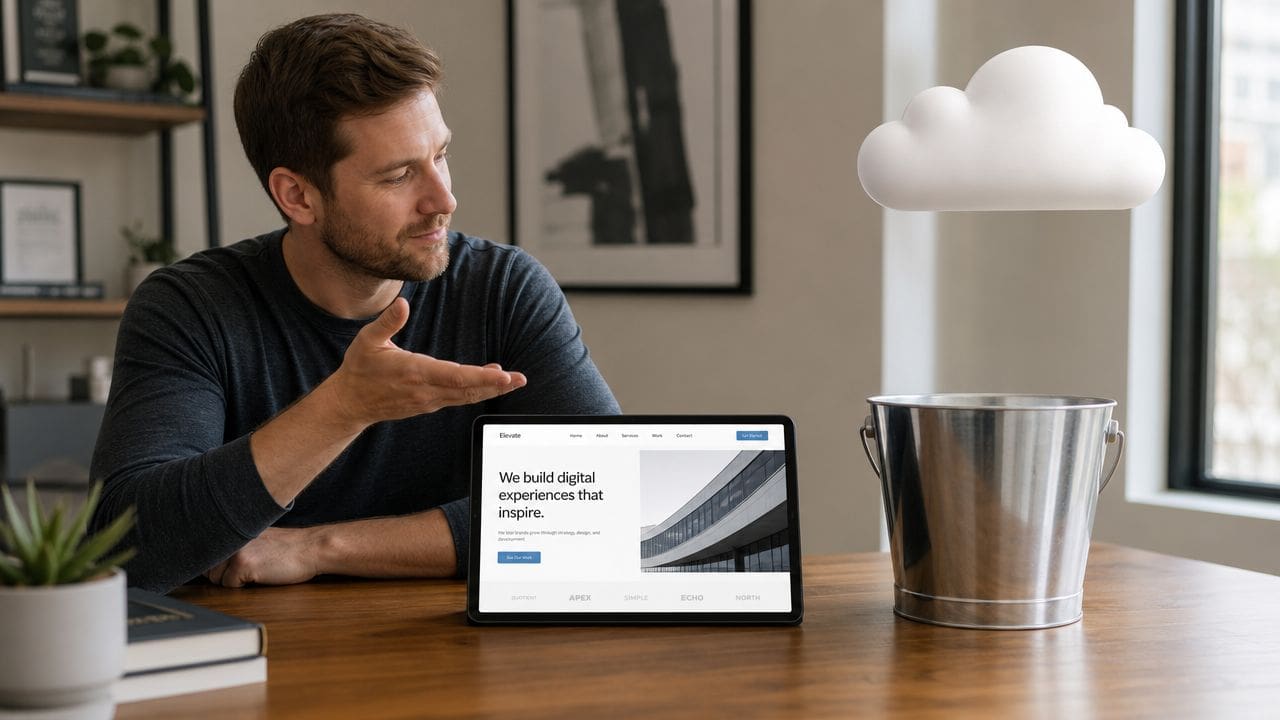
Your Website Is a Bucket Not a Raincloud
A website is not a raincloud. It doesn't create demand.
It's a bucket.
It sits there and catches demand when demand is sent to it. If nobody sends traffic, the bucket stays empty. If traffic shows up and the bucket has holes, leads leak out.
A pretty site doesn't solve a lead problem
Contractors often suffer serious setbacks.
They pay for design. They get animations, nice colors, big photos, and a slick home page. Then nothing happens. They think marketing failed, when really they bought a brochure and expected it to act like a salesperson.
Data from a construction website benchmark report shows that the average visitor to a construction website views 2.46 pages and stays 2 minutes and 46 seconds. That's not much time. If the site doesn't quickly show the right service, the right area, and a clear path to call or request a quote, the visitor leaves.
Most contractor sites leak
The problem isn't only traffic. It's conversion.
A lot of contractor websites fail in simple ways:
| Common problem | What it causes |
|---|---|
| Weak service pages | Buyers don't see that you do the exact work they need |
| Hidden phone number | Ready-to-buy visitors don't call |
| Generic contact page | People leave without taking action |
| No city relevance | Buyers don't trust that you serve their area |
A website that doesn't convert is just an online brochure with a monthly bill attached.
If you've ever wondered why your site feels dead, that's why. It isn't a lead source on its own. It's a tool that has to be fed and built to convert. This is the same core issue behind why websites don't generate leads.
The System That Turns Visibility Into Phone Calls
You don't need random tactics. You need a system.
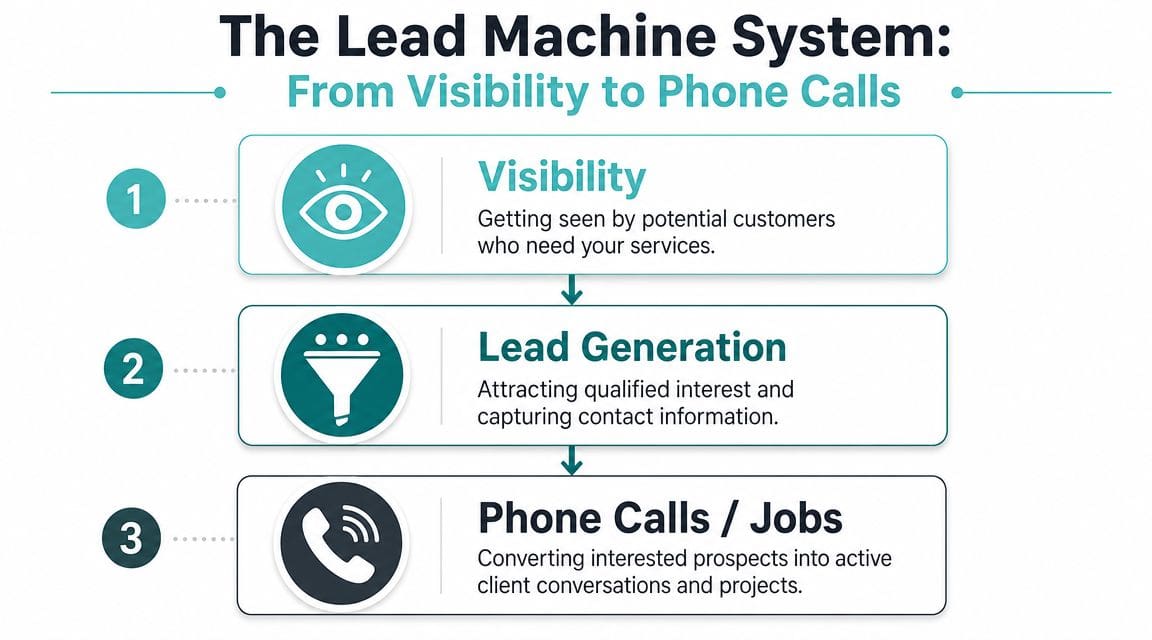
A real lead system for a contractor has two parts. The website is one part. Traffic is the other. Split them apart and both underperform.
Part one is the Lead Machine
This is not a pretty brochure site.
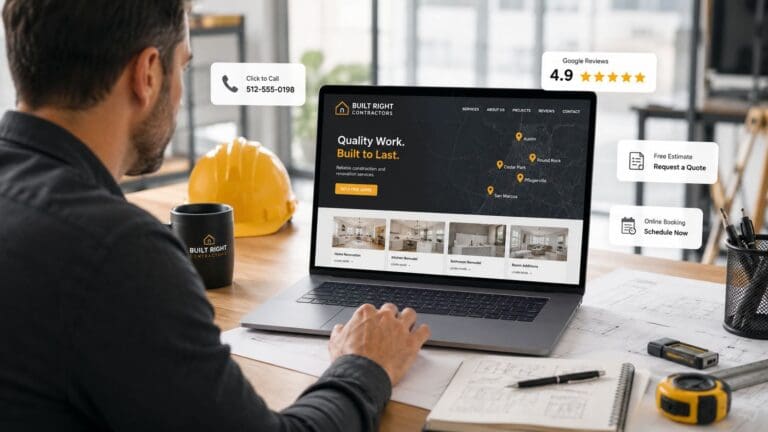
A Lead Machine is a website built to turn traffic into calls and quote requests. It is structured by service and city. It gives people a fast path to contact you. It matches what buyers are searching for. It is built to capture demand, not just sit there.
Part two is the fuel
The second part is paid traffic.
Ads create visibility. They put you in front of buyers who are already searching right now. They don't replace the site. They feed the site. Without that traffic source, the website waits. Without a conversion-focused site, the ad spend gets wasted.
That is why contractors get mixed up. They try one without the other.
- Website only: looks fine, stays quiet
- Ads only: gets clicks, wastes money
- System together: visibility goes in, calls come out
Websites without traffic don't work. Ads without conversion waste money.
Some companies build around this exact model. For example, The Cherubini Company describes a Lead Machine as a website asset built to rank, convert, and capture demand across multiple nearby cities, then fueled with paid traffic.
That setup makes sense because it matches how buyers act. They search. They click. They judge fast. They call the business that looks relevant and easy to reach.
What a Real Lead-Generating Website Includes
A contractor site should do one job. It should help the right buyer become a real lead.
Most DIY builds don't start there. They start with templates, colors, and page layouts. That's backward.
Generic pages are not enough
A standard DIY website build process focuses on a generic checklist: choose a builder, outline basic pages, and add testimonials. That approach misses the most important part for a contractor, which is structuring the site to win jobs in specific service areas. A real lead generation system is built around conversion assets and local search architecture from day one, as noted in this construction website setup guide from Yola.
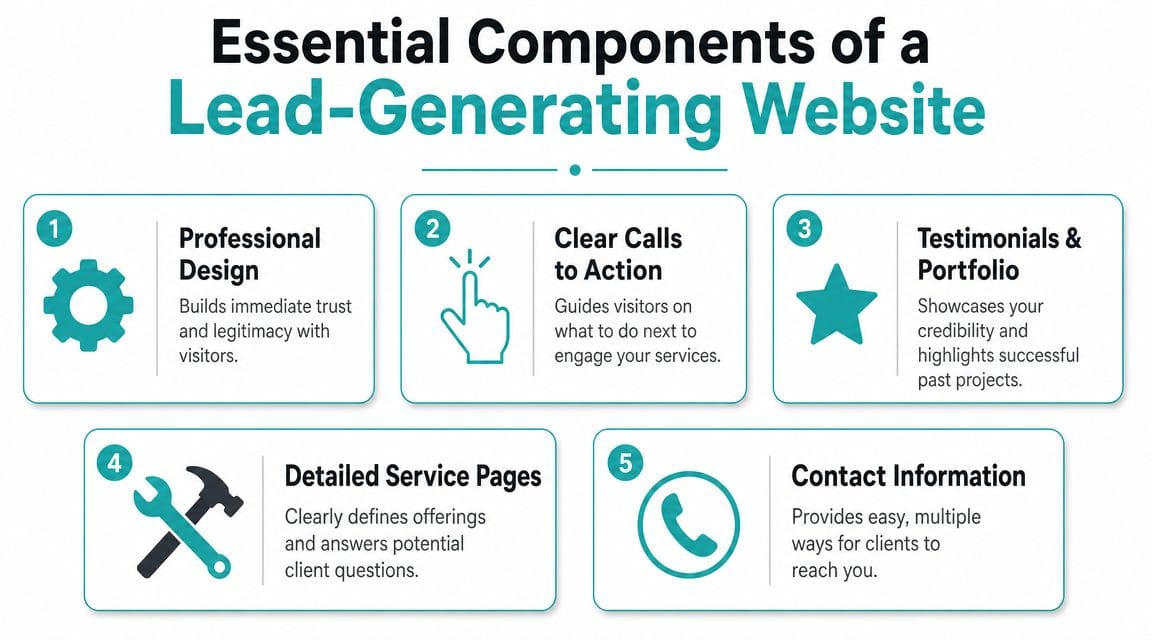
That means your website should include the pieces below, not because they sound nice, but because each one has a job.
What each piece is there to do
- Service pages that match what buyers want: If you do excavation, grading, septic, or well drilling, each service needs its own place. Buyers search for the exact job they need.
- City pages that match where buyers live: If you want work in nearby towns, the website has to make that clear.
- Clear calls to action: Serious buyers should never have to hunt for a phone number or quote form.
- Reviews and proof: People want signs that you're real, active, and trusted.
- Tracking: If you don't know what made the phone ring, you're still guessing.
Here's the difference in plain terms:
| Brochure website | Lead-focused website |
|---|---|
| Talks about the business | Pulls buyers toward action |
| Focuses on design first | Focuses on calls and forms first |
| Mentions one city | Covers real service areas |
| Gives you something to show people | Gives buyers a reason to contact you |
The right website doesn't just explain what you do. It helps the buyer decide to call you now.
If you want a simple benchmark for what should be present, this list of must-have features for a high-converting contractor website is a strong gut check. If your current site is missing those pieces, it's not built as a lead tool.
Stop Guessing and Start Controlling Your Leads
You don't have a website problem.
You have a control problem.
If word of mouth slows down, your pipeline slows down. If your home town dries up for a month, you feel it. If your business doesn't show up where people are looking, the jobs go to somebody else and you never even enter the conversation.
That's what makes this fragile.
Control comes from visibility
Predictable lead flow starts when you stop hoping people will find you and start making sure they do.
That means:
- Showing up in the cities you serve
- Using a site built to turn visits into calls
- Driving traffic on purpose instead of waiting around
- Tracking what works so you can make decisions with confidence
If you also want the front end to waste less time, this guide on how to automate lead qualification for businesses is worth a look. It helps clarify how businesses handle incoming interest faster and more cleanly once visibility starts producing leads.
A contractor with no control over visibility has no control over revenue. That's the truth behind the stress, the feast-or-famine cycle, and the constant feeling that you're working hard but still guessing.
You think that customers "can" find you but, If customers "don't" find you, nothing else matters. Lead Machines are built to fix that.
If you're done guessing and want a straight answer on what your visibility problem is, talk to The Cherubini Company. They help contractors build lead-focused websites and visibility systems designed to get found in the cities where the jobs are.