Your website isn't broken because it looks old. It's broken because it doesn't help enough people find you, trust you, and contact you fast.
You're already busy. You have crews out. You have estimates to send. You have jobs to finish. But the phone still doesn't ring enough with the right work. Bigger jobs. Better jobs. Jobs in the towns around you, not just your home base.
That's where most contractors get this wrong. They think the website is supposed to create leads by itself. It won't. A website sits there and waits. If nobody sees it, it does nothing. If the wrong people see it, it wastes your time. If traffic lands on it and can't take action fast, you lose the job.
The problem is visibility. You're known in your hometown. Then someone 10 miles away searches for your service in their city, and you don't show up. You never get the call. You never even get the chance.
That means the must have features for a high converting contractor website aren't about making it pretty. They're about turning the site into a Lead Machine. A tool built to convert visibility into calls, quote requests, and real jobs.
1. Click-to-call buttons and mobile optimization
A contractor website should make calling you stupid simple.
Most buyers don't want to dig through your site looking for a phone number. They want to tap and talk. If they're standing in a wet basement, staring at a dead furnace, or trying to line up site work before a deadline, they won't hunt for your contact page.
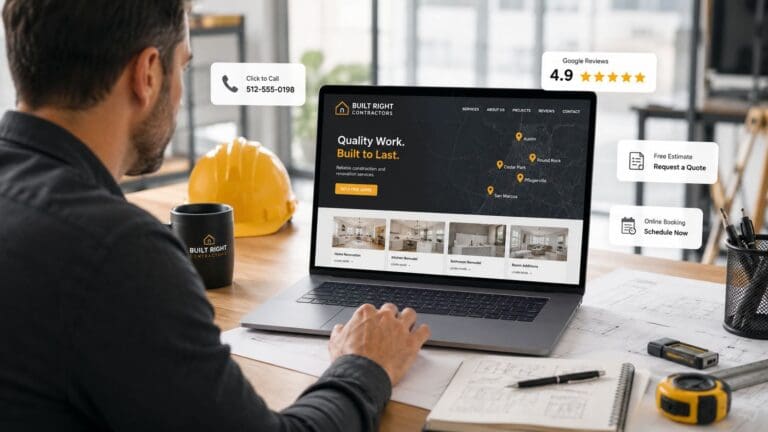
Start with the phone button. Put it high on the page. Keep it visible as people scroll on mobile. Repeat it on service pages, city pages, and quote pages.
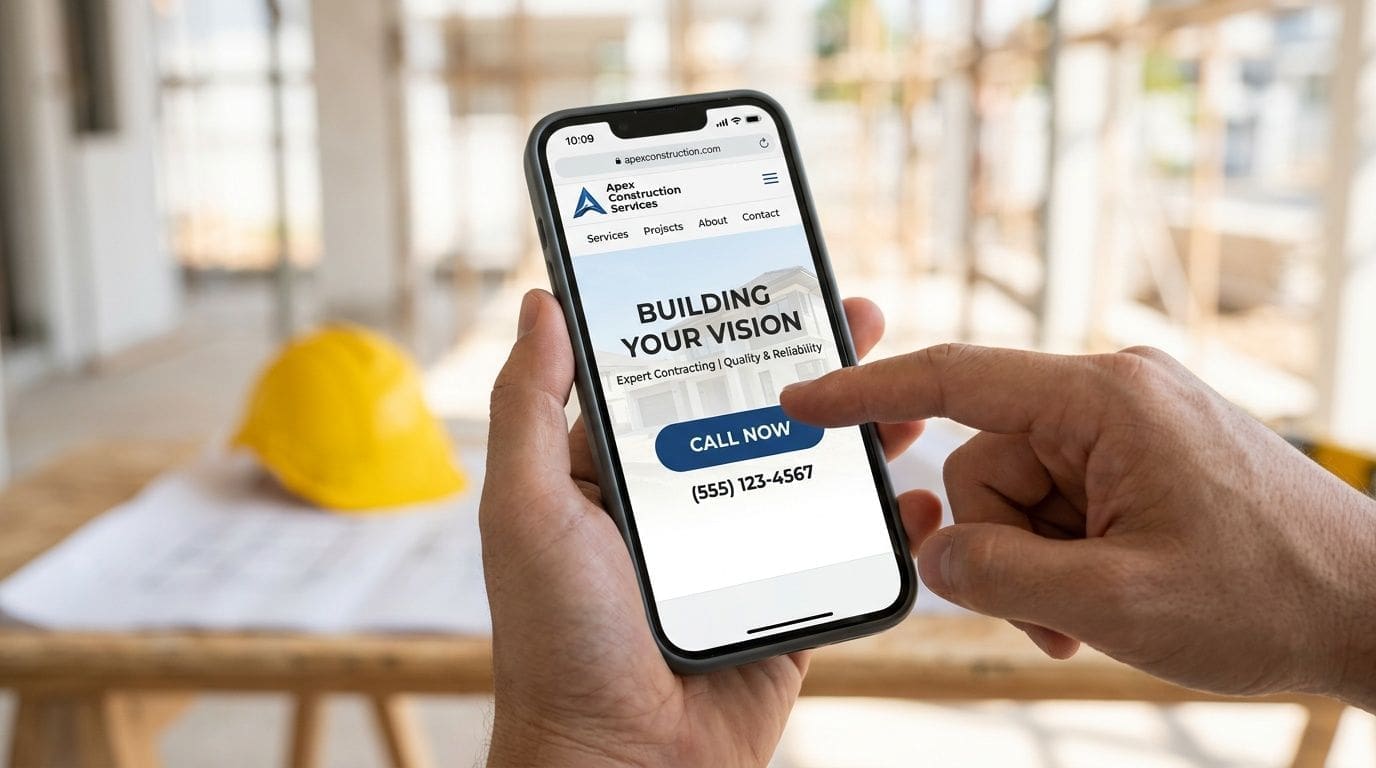
Put the call button where buyers can use it
Contractor buyers are often on their phones. That's why your site has to work cleanly on small screens, with big tap targets, short sections, and clear next steps. If you want a good example of what that looks like, review these websites optimized for mobile.
The button text matters too. "Contact us" is weak. Use action language tied to the job. Industry guidance for construction websites recommends specific calls to action like "Get Your Free Project Estimate" and "Schedule Your On-Site Consultation," placed above the fold, on service pages, after project sections, and in sticky mobile headers, with contrasting colors and reassurance language such as "No Sales Pressure" or "No Obligations" (construction website call to action guidance).
Practical rule: If a visitor has to think about how to call you, the page is already losing.
A plumbing company should say "Call Now for Plumbing Service." A septic contractor should say "Request a Septic Estimate." A restoration company should say "Call Now for Emergency Cleanup." Match the button to the service and the urgency.
Mobile design isn't optional
This isn't just about convenience. A bad mobile site kills good traffic.
If your ad sends someone to a page with tiny text, hard-to-tap buttons, and a buried phone number, you paid to lose that lead. That's why mobile optimization and click-to-call need to work together. Ads bring the visitor. The page has to finish the job.
2. Google Business Profile optimization with review integration
Your website doesn't live alone. It works with your Google Business Profile.
When someone searches for a contractor near them, they often see your profile before they see your site. If that profile is weak, incomplete, or filled with old photos, you're losing trust before the click even happens. If it's strong, it pushes more people to call, visit your site, and take you seriously.
For a contractor, your profile needs real photos, correct hours, service categories, service areas, and recent reviews. Not stock junk. Real work. Real trucks. Real jobs.
Reviews should support the site, not sit off to the side
The strongest setup connects your reviews to the website so visitors see proof fast. That matters because buyers are comparing risk. They want to know if you're legit, active, and safe to hire.
A simple rule is this:
- Show real proof: Feature review snippets on the homepage and service pages.
- Keep photos current: Add fresh project and team photos to your profile.
- Match your service areas: If you want work in nearby towns, your profile and your website need to say so clearly.
Contractors who need help collecting more reviews should build a repeatable process. This guide on how to get Google reviews shows the basic idea.
Reviews don't replace visibility. They make visibility pay off.
If buyers see you in search but find thin proof, they keep scrolling. If they see you, your review history, and a site that backs it up, you have a real shot at the call.
3. Strategic service pages with localized landing pages
Most contractors often stay invisible.
They build one services page. One contact page. Maybe one homepage that says they serve "Central Ohio" or "the surrounding area." Then they wonder why they don't show up in nearby towns.
Google isn't going to guess where you work. If your website only talks about your home city, that's the city it connects to your business. That's the visibility gap.
One page for every service. One page for every target area.
If you do excavation, land clearing, grading, septic, and concrete work, those should not live on one catch-all page. Each service needs its own page.
Then each key city or county you want jobs from needs its own landing page tied to those services. That's how a buyer searches. They search for the work and the place.
A strong page structure might include:
- Service pages: Excavation, grading, septic installation, land clearing, concrete work
- Location pages: Excavation in Newark, septic installation in Granville, grading in Heath
- Intent-based forms: Forms that ask what kind of job they need and where the job is located
This matters beyond search visibility. Newer contractor website guidance specifically recommends separate service pages, location-based structure, and conditional forms that qualify job type, budget, and timeline because that setup reduces friction and helps route leads better across multiple towns or counties (contractor website lead-routing structure).
A generic quote page treats every lead the same. That's a mistake. A small cleanup job in your backyard town is not the same as a larger project in a county you want to expand into.
If you want to see how these pages should be built to convert, study these best practices for landing pages.
Visibility comes from structure
A website becomes a Lead Machine when it gives each service and each city a clear place to rank and convert. That's how you stop relying on luck, referrals, and random hometown traffic.
4. Trust-building elements with licenses insurance and proof
People hire contractors they trust. Not contractors they have to guess about.
If a homeowner or property manager lands on your site and can't quickly tell whether you're licensed, insured, experienced, and real, you've created doubt. Doubt kills calls. Especially on higher-risk work like excavation, septic, concrete, and restoration.
Your trust signals need to show up fast. Don't hide them on an about page nobody reads.
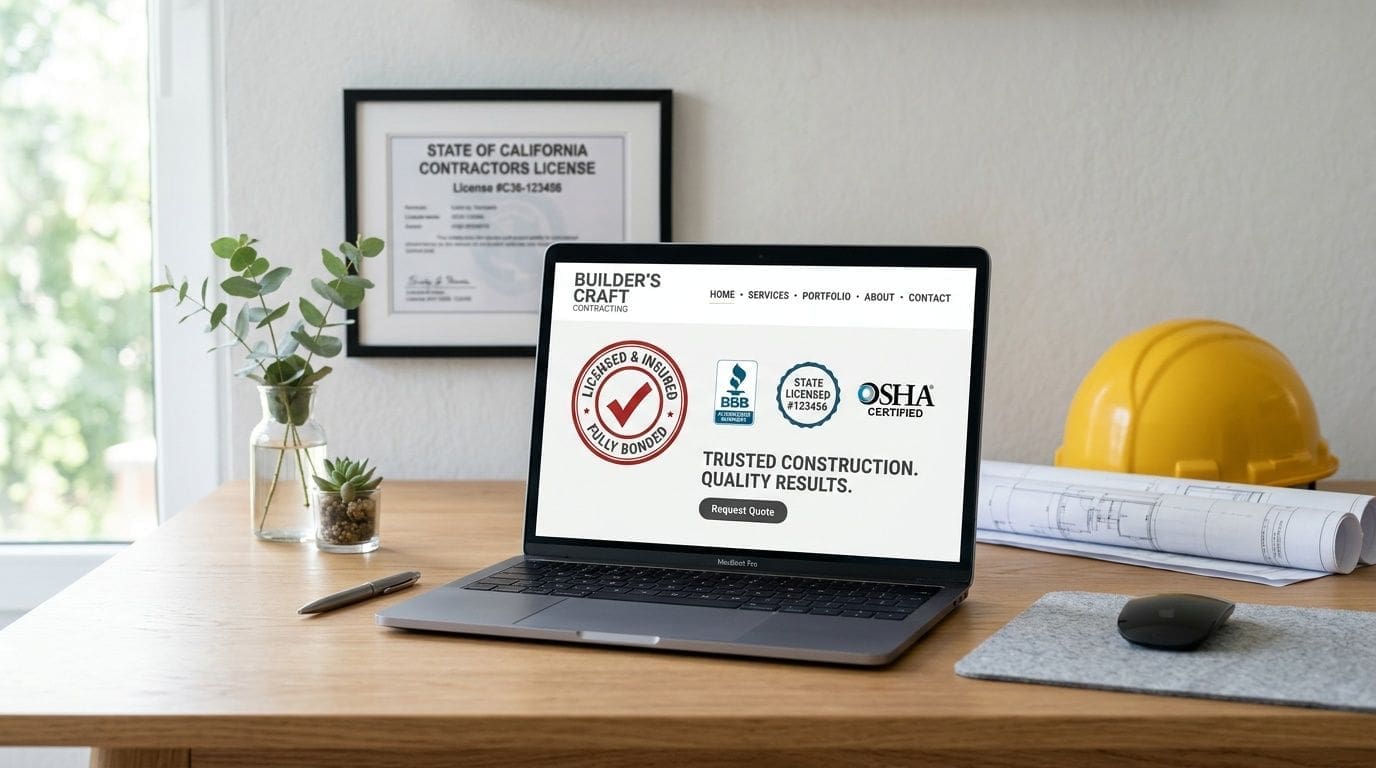
Put proof near the action
The best place for trust elements is close to your call button, form, and headline. Buyers should see proof before they have to commit.
That means showing things like:
- License status: State or local license details when relevant
- Insurance proof: Clear mention that you're insured
- Service credentials: Brand, manufacturer, or trade certifications you hold
- Local credibility: Years in business, service area, and real project history
Don't fake this stuff. Don't clutter the page with meaningless badges either. Show the proof that lowers risk for your buyer.
A contractor website should answer one silent question fast. "Can I trust these people on my property?"
A restoration company may need to show insurance-related experience and cleanup credentials. A septic installer may need to show permit knowledge and service area experience. A concrete contractor may need to show project photos and business credibility right beside the estimate button.
Trust isn't a design style. It's evidence.
5. Prominent before and after photo galleries and project showcases
Contractors sell proof.
You can say you're reliable. You can say you do quality work. You can say you've handled jobs like this before. None of that hits as hard as showing the work.
That's why a project gallery is one of the must have features for a high converting contractor website. Buyers want to see what you did. They want to judge quality with their own eyes.
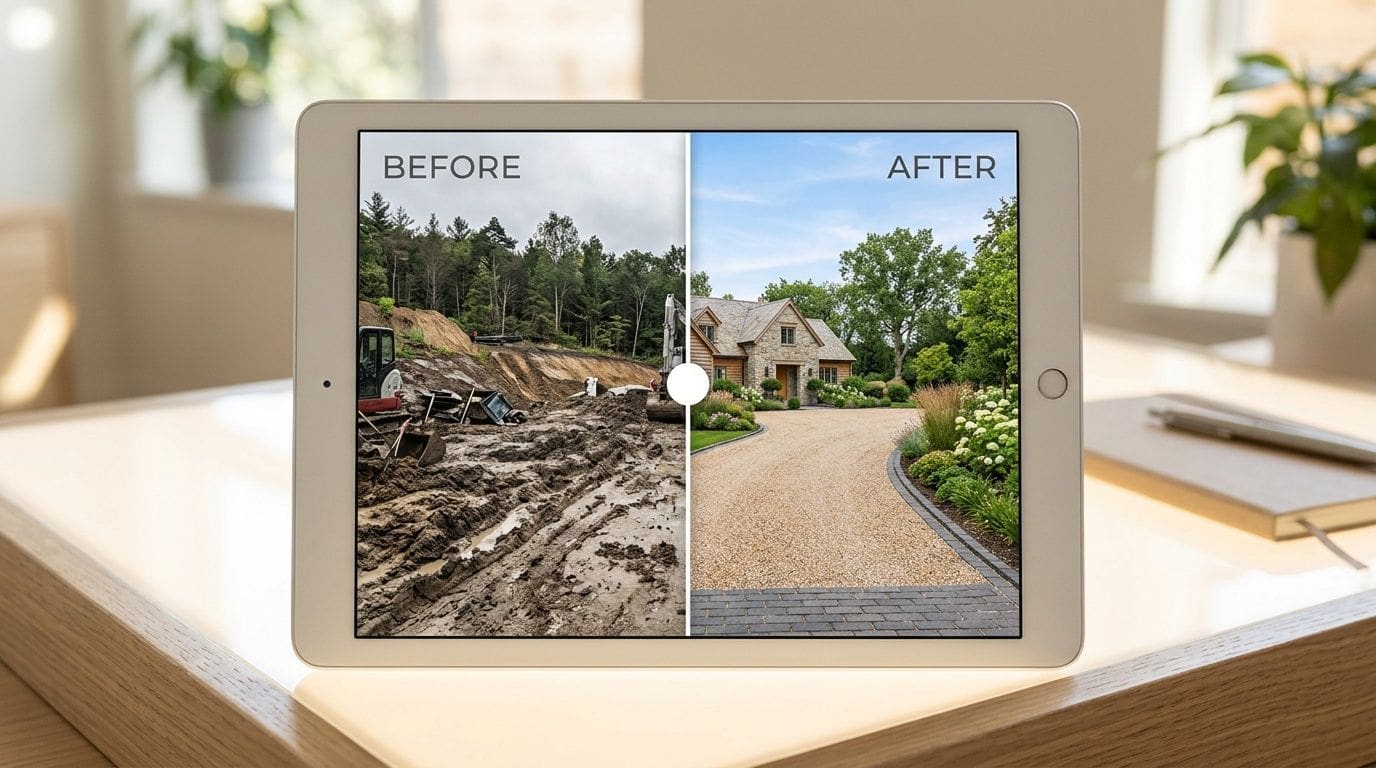
Show the job, not just the finished shot
A weak gallery is a pile of random images. A strong gallery helps a buyer understand the problem, the work, and the result.
Best-practice guidance for contractor sites recommends a project portfolio with high-quality images, before-and-after photos, and contextual descriptions. It also recommends organizing the gallery clearly, pairing project images with material details and problem-solution notes, placing testimonials next to the project visuals, and updating the portfolio regularly so visitors can see the business is active and current (construction website portfolio guidance).
That means every project entry should answer basic questions:
- What was the job: Land clearing, grading, water cleanup, trenching, driveway replacement
- Where was it: City or service area
- What changed: Before condition and after result
- Why it mattered: Access issue fixed, drainage corrected, damage removed, site prepared
Galleries help you win better jobs
This is especially important if you're tired of small jobs and price shoppers.
Better buyers want proof that you've done larger or more complex work. A strong gallery helps them self-qualify before they call. It also gives ads and city pages something real to support. That's how the website stops feeling like a brochure and starts acting like a sales tool.
6. Strategically placed contact forms with low-friction design
A form should help a serious buyer reach you. It should not feel like paperwork.
Too many contractor websites use one generic form on one generic page. Name. Email. Message. That's lazy. It doesn't help the customer, and it doesn't help your team sort out what the lead wants.
Ask for the right information
The form should match the page. If someone is on a septic page, the form should reflect septic work. If they're on a city page, the location should already be part of the lead path.
Keep the form short, but make it useful. Good contractor forms usually capture:
- Contact details: Name and phone, with email if needed
- Job type: The service they want
- Service location: Where the work will happen
- Basic notes: Enough detail for your team to call prepared
The quality of leads improves. A person asking for emergency cleanup is different from a person asking about a future excavation project. A land clearing lead in your growth market is different from a tire kicker outside your radius.
Forms should support routing
Your site should help separate service-area and job-type intent so the right person on your team gets the right lead fast. That's one of the biggest gaps on contractor websites. Many have contact forms, but very few use them as a routing system for multi-city growth.
If every lead goes through the same form, your website is treating every job like it's the same. It isn't.
Put forms where buying decisions happen. On service pages. On city pages. Near project proof. Near review sections. Don't force every visitor to click around and hunt for a single contact page.
7. Fast mobile-first website performance and Core Web Vitals optimization
A contractor in a growth market clicks your ad from their phone, lands on your page, waits, gets a blank screen or jumping layout, then hits back and calls the next company. That is what a slow site does. It burns paid traffic and hands your lead to a competitor.
One industry guide cites Google data showing that 53% of users abandon pages that take more than 3 seconds to load. For contractors, that number matters because your website is not a brochure. It is the lead machine. Ads are the fuel. If the machine is slow, the fuel is wasted.
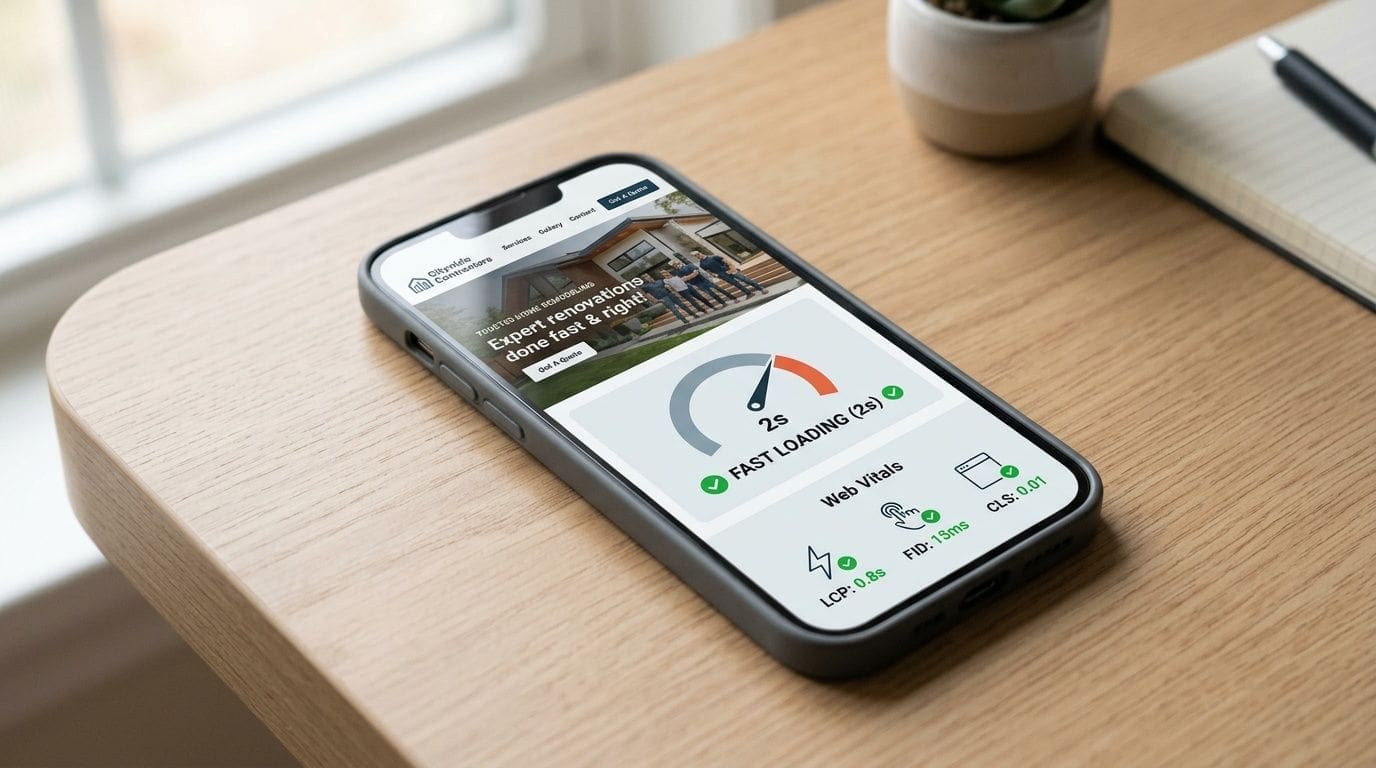
Speed decides whether the lead machine works
Mobile visitors are impatient because they are often in motion, comparing options, or dealing with a problem that needs a fast answer. If your page loads slowly, shifts around while loading, or lags when they tap, they leave before they see your proof, your service area, or your call button.
Core Web Vitals matter here for a simple reason. They measure whether the page appears quickly, stays stable, and responds fast enough to feel usable. A contractor site should also keep image sizes under control, use reliable hosting, and cut bloated scripts. Fancy effects do not win jobs. Fast pages do.
Fast pages protect ad spend and improve conversion
This gets more expensive once you start running Google Ads or Local Services Ads support traffic into city and service pages. You paid to get that click. The page still has to do its job.
A fast page gives the visitor a clean first screen, working buttons, readable copy, and a form or phone number they can use right away. A slow page creates friction before the sales process even starts.
If you want your site to bring in leads outside your home city, treat performance like infrastructure, not decoration. Build pages that load fast on a weak mobile connection, stay stable while assets load, and respond immediately when someone taps to call or request an estimate. That is how the website side of the lead machine keeps up with the traffic you are paying to generate.
8. Social proof with reviews testimonials and real customer voices
People trust other customers more than they trust your headline.
That's why reviews and testimonials should show up throughout the site, not buried on one page. If a visitor lands on your homepage, service page, or city page, they should see proof that real people hired you and were glad they did.
Use proof close to the buying decision
Put the strongest reviews near forms, calls to action, and project galleries. That way the customer sees trust and takes action in the same moment.
Strong social proof can include:
- Short review quotes: Best on home and service pages
- Service-specific testimonials: Put septic reviews on septic pages, restoration reviews on restoration pages
- City-specific proof: Use testimonials from the same town or county when possible
- Project-linked proof: Pair reviews with photos of the work
A buyer looking at a water damage page wants to hear from someone who had water damage. A buyer looking for grading or land clearing wants to know you handled site conditions like theirs.
Testimonials should sound real because they are real
Use names when you have permission. Use city names when relevant. Keep the wording natural. Don't over-polish it into fake marketing copy.
This is also where your website and ads work together. Ads can create visibility in the city you want. The page then needs proof that makes that buyer comfortable enough to call. Without that proof, visibility alone won't carry the sale.
High-Converting Contractor Website: 8-Feature Comparison
| Feature | Implementation Complexity 🔄 | Resource Requirements ⚡ | Expected Outcomes 📊 | Ideal Use Cases 💡 | Key Advantages ⭐ |
|---|---|---|---|---|---|
| Click-to-Call Buttons and Mobile Optimization | Low–Medium, placement, testing, call-tracking setup | Low, minimal dev + tracking, staffing for increased calls | Strong uplift in mobile calls and conversions (often 20–40%) | Emergency services, high-intent mobile searches, local contractors | Removes friction for immediate contact; measurable via call tracking |
| Google Business Profile Optimization with Review Integration | Medium, verification and ongoing management | Low, time to manage, collect reviews, upload photos | Significant local visibility and lead capture via Search/Maps | Multi-city contractors, businesses reliant on local search | Free, high-trust channel; reviews directly influence decisions |
| Strategic Service Pages with Localized Landing Pages | Medium–High, planning, unique content per location | Medium–High, content creation, SEO, template scaling | Dramatic local SEO gains and targeted traffic per service+location | Multi-service, multi-location expansion strategies | Captures both "what" and "where" searches; highly scalable |
| Trust-Building Elements: Certifications, Licenses, Insurance Badges | Low, design placement and verification links | Low, collect badges, periodic updates | Increased credibility and conversions (15–30% uplift) | High-ticket projects, first-time customers, regulated trades | Reduces perceived risk quickly; supports premium pricing |
| Before/After Photo Galleries and Project Showcases | Medium, gallery UX and organization | Medium–High, professional photography, releases, storage | Strong visual proof that boosts conversions and engagement | Restoration, landscaping, excavation, renovation projects | Demonstrates quality and outcomes; emotional persuasion through visuals |
| Strategically Placed Contact Forms with Low-Friction Design | Low–Medium, form design, progressive profiling | Low–Medium, form tools, integrations, follow-up systems | Captures non-calling leads and builds nurture lists (variable CR) | Prospects preferring messaging, lead nurturing, large territories | Captures qualified info with low friction; supports automation |
| Fast, Mobile-First Performance & Core Web Vitals Optimization | High, technical optimization and continuous monitoring | Medium–High, developers, CDN, monitoring tools, maintenance | Better rankings, lower bounce, higher conversions (10–25%+) | Mobile-heavy traffic, emergency services, image-rich portfolios | Foundational for SEO and conversions; critical for mobile users |
| Social Proof: Reviews, Testimonials & Social Media Integration | Medium, integrations and content production | Medium, review solicitation, video production, management | Higher trust and conversion; stronger long-term reputation | Long sales cycles, premium services, reputation-focused businesses | Multi-source credibility; video and aggregated reviews are highly persuasive |
Stop guessing. Start controlling your leads.
A high converting contractor website isn't a random bundle of features. It's a system.
Click-to-call buttons help mobile visitors act fast. Service pages and city pages fix the visibility gap. Review integration and trust signals reduce hesitation. Project galleries prove you can do the work. Fast load speed keeps buyers from bailing before they even see the page. Forms help sort and route the right leads. Social proof backs up every claim.
Put together, that's a Lead Machine.
That matters because websites don't create traffic. They wait for traffic. If nobody sees the site, it doesn't matter how nice it looks. If ads send visitors to a weak site, you waste money. That's why the effective answer is a system. A website built to convert, plus traffic that puts you in front of buyers searching right now.
Big companies buy visibility. Small contractors often rely on hope. Hope won't get you into the next town over. Hope won't make Google believe you work in places your website never mentions. Hope won't turn expensive clicks into booked jobs.
Control comes from structure. It comes from visibility by service and city. It comes from a site that turns attention into calls. It also comes from using proven effective lead generation strategies that connect visibility with conversion instead of treating them like separate problems.
If you want a company that works in that model, The Cherubini Company builds Lead Machines for contractors and service businesses. Their approach combines a conversion-focused website with visibility campaigns so the site doesn't just sit there waiting.
You think customers can find you. But if customers don't find you, nothing else matters.
Lead Machines are built to fix that.
If you're tired of guessing, The Cherubini Company helps contractors fix the core problem, invisibility. They build Lead Machines that are structured by service and city, built to convert calls and quote requests, and paired with ads that put you in front of buyers in the places you want work from.