You’ve probably said some version of this already.
“We tried ads. They didn’t work.”
“That’s what the last agency said.”
“We got burned.”
“I don’t believe any of this stuff anymore.”
That reaction makes sense. A lot of small construction business owners have spent money on websites, ads, or agencies and got little back besides confusion. The hard truth is your marketing usually isn’t failing because you didn’t try hard enough. It’s failing because your business is not visible where buyers are looking.
You may have a solid name in your town. People may know your trucks. Past customers may refer you. None of that fixes the core issue when someone in the next town searches for your service and you don’t show up.
That’s why learning how to market a small construction business starts with one ugly truth. Your issue usually isn’t effort. It’s invisibility.
Stop Guessing and Start Getting Calls
Most contractors aren’t short on hustle. They’re short on control.
You work. You quote. You follow up. You ask for referrals. You try a website. Maybe you try ads. Then the phone gets quiet again and you’re right back in the same cycle. Busy one month. Dead the next. Too many small jobs. Not enough of the work you want.

Your problem probably isn’t what you think
A lot of owners think they need better branding, more social media, or a nicer logo. They don’t. They need people to find them when they search for the service.
There are 1.7 million online searches for independent contractors each month according to construction marketing statistics from WebFX. That should tell you something fast. Demand exists. People are searching every day. If your company isn’t showing up across the places you serve, those searches go to somebody else.
That’s the game.
Not effort. Not hope. Visibility.
Why guessing keeps costing you money
Contractors get trapped by random acts of marketing.
They boost a post. Run a few ads. Change website text. Ask a nephew to help. Hire an agency that talks fast and reports on things that don’t matter. None of that creates a real lead system.
What you need is something built to produce calls, not just exist online. If you want a deeper look at that shift, this page on construction lead generation lays out the difference between being online and generating opportunities.
You don’t have a lead shortage first. You have a visibility shortage first.
When owners miss that, they stay stuck with the same pains:
- Too many weak leads: You stay busy with work that fills the week but doesn’t grow the company.
- Not enough bigger jobs: Better jobs usually go to businesses that get found first.
- No control over results: You spend money and still don’t know what’s working.
- Constant stress: When the phone depends on luck, the business stays fragile.
Big companies don’t rely on luck. They buy visibility and build systems around it.
Small contractors often rely on hope, then wonder why growth feels uneven.
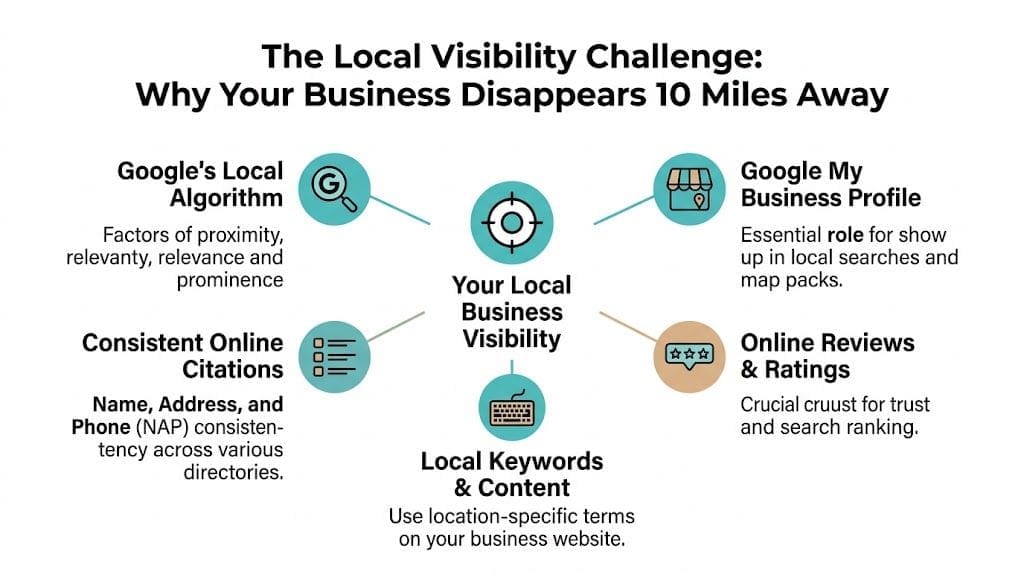
The Real Reason You Are Invisible 10 Miles Away
If somebody searches “septic installer near me,” Google doesn’t treat that like magic. It turns that search into a local intent search based on where the buyer is standing.
So if they’re in a nearby town, Google is reading that as “septic installer in that town.”
That’s where most contractors lose.
Google only works with what you’ve told it
You’ve probably made it very clear that you work in your home city. Your address is there. Your business profile is tied to it. Your website likely mentions that town over and over.
But what about the next city over?
What about the county seat?
What about the town where the bigger lots are getting developed?
If your online presence never clearly says you do work in those places, Google has no reason to show you there. That’s the visibility gap. You can be well known at home and almost nonexistent a few miles away.
If you never tell Google where you work, Google won’t guess for you.
That’s why owners say, “People can find us.” Yes, branded searches can find you. If someone already knows your company name, they’ll get there.
That is not the actual lead problem.
Your lead problem involves all the people who don’t know your name yet. They search by service and location. If you don’t appear in that moment, you’re out. No quote. No call. No shot.
Offline visibility still helps, but only if it points somewhere
Truck wraps, yard signs, and decals can support what you’re doing online. They work best when they push people toward a simple next step. If you want a practical example, QR code decals for vehicles can make it easier for someone to scan and reach your business while your trucks are out in the field.
But don’t confuse that with a full system.
A truck decal helps a person who already saw you. It does nothing for the buyer searching online in a city you’ve ignored.
What invisibility looks like in the real world
Here’s how this usually plays out:
| What you believe | What’s actually happening |
|---|---|
| “We serve the whole area.” | Google only sees strong signals in your home city. |
| “People know us.” | Only people who already know your name know you. |
| “Our website should handle it.” | Your website may not mention all service areas in a useful way. |
| “Near me searches should find us.” | Those searches favor businesses visible in the searcher’s city. |
That’s why some contractors stay packed with small local work but never break into nearby markets. They didn’t lose on skill. They lost on visibility.
Why Your Website Is Not a Lead Machine
A website is not automatically a marketing system.
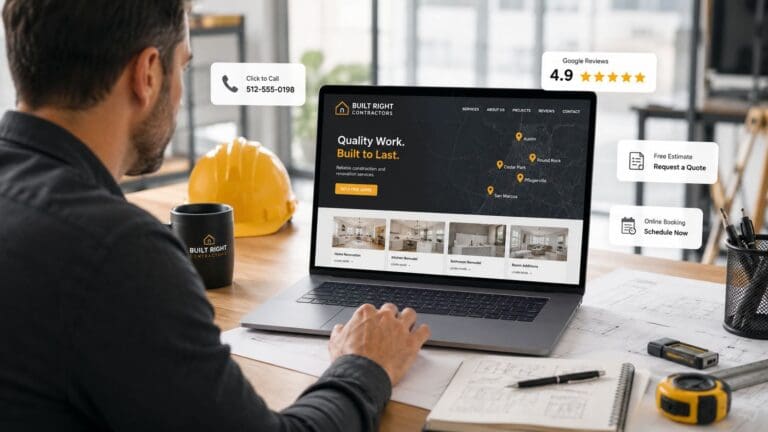
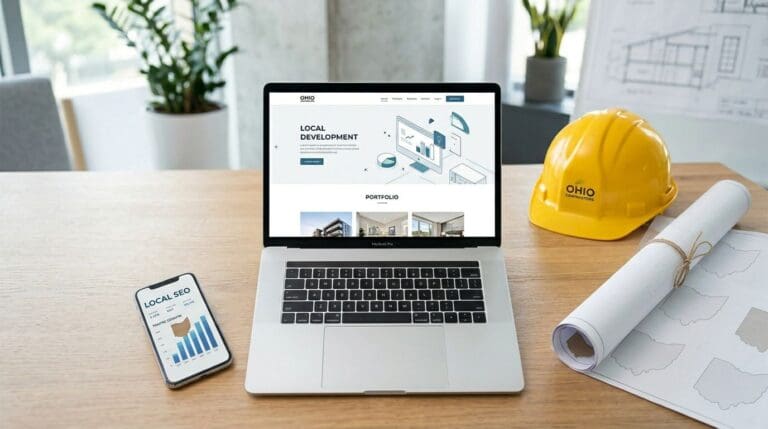
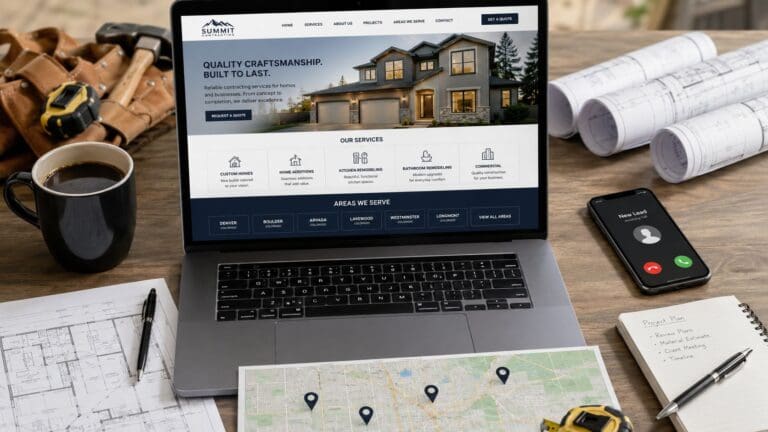
Most contractor websites are digital brochures. They show a logo, a few photos, a list of services, and a contact page. That’s not a lead machine. That’s an online business card.

A brochure site waits around
This is the mistake.
Owners think, “We have a website, so we should be getting leads.” No. A website doesn’t create traffic by itself. It sits there and waits. If nobody lands on it, it does nothing. If the wrong people land on it, it still does nothing. If people land on it and can’t quickly call, trust you, or request a quote, it fails again.
That’s why “pretty” means almost nothing.
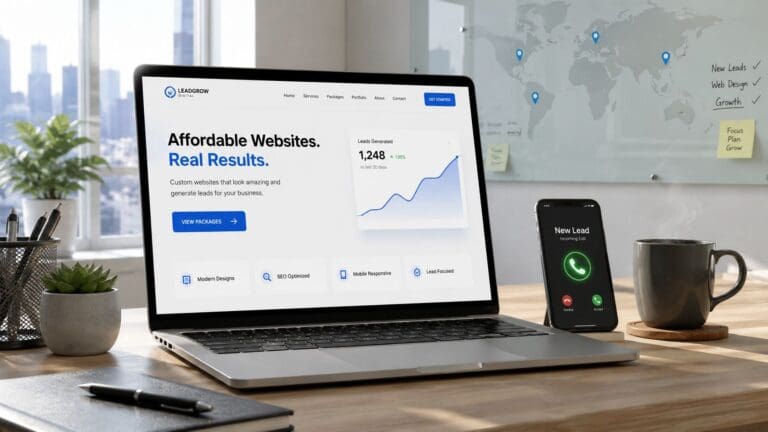
A website for a small construction company should be built for one job. Turn traffic into calls and quote requests.
A Lead Machine is built for demand that already exists
Businesses that build websites with optimized city and service pages, review systems, and clear calls to action can see lead increases of 200% to 400% within six months according to Gushwork’s construction marketing guidance. That doesn’t happen because the website is fancy. It happens because the website is built to capture demand that’s already out there.
If you want to see what that idea looks like in practice, this page on how to turn your website into a lead machine shows the difference between a passive site and a site built for leads.
Practical rule: If your website looks nice but doesn’t help buyers in each target city take action fast, it’s not doing its job.
The wrong tool versus the right tool
Think about it the same way you think about equipment.
You wouldn’t use a skid steer when the job calls for an excavator. Yet contractors do the online version of that every day.
- A standard website is made to say you exist.
- A Lead Machine is made to help you get found in the places you want work from.
- A standard website gives visitors information.
- A Lead Machine pushes visitors toward a call or form submission.
- A standard website treats all traffic the same.
- A Lead Machine is structured around services and cities.
What a real lead site needs to do
Not as a do-it-yourself checklist. As a standard.
It needs to be organized around your services and service areas. It needs strong calls to action. It needs mobile-friendly pages because buyers aren’t always at a desk. It needs review proof. It needs clear ways to call. It needs to line up with your business profile so your online presence makes sense.
That’s not “extra.” That’s the baseline if you want the site to earn its keep.
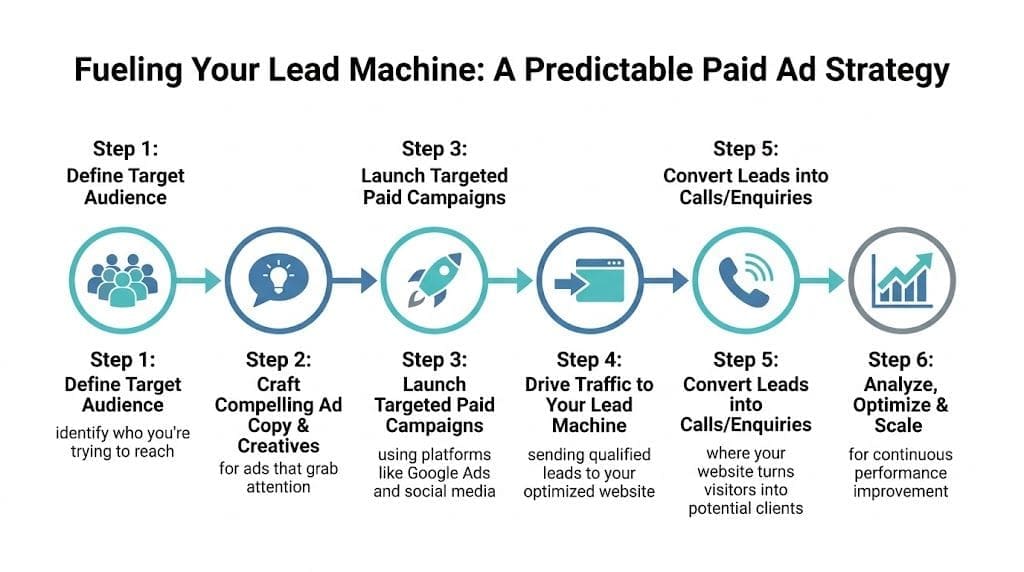
Fueling the Machine with Paid Ads for Visibility
A lead machine without traffic is idle.
That’s where paid ads come in. They are not a casino. They are a visibility tool. They put your business in front of people searching right now in the cities you want.
Why contractors think ads failed
Most of the time, ads didn’t fail. The system around the ads failed.
If you send paid traffic to a weak website, you’re paying to expose the weakness faster. That’s why some owners spend money and get poor results. The traffic showed up. The site didn’t do its job.
Ads without a conversion system waste money.
A conversion system without traffic sits still.
The two pieces have to work together.
What paid ads are really doing
They create immediate visibility in the places that matter. They let you stop waiting for Google to slowly figure out where you want business. They put you in front of high-intent buyers while they are actively looking.
For high-ticket jobs, Google’s ad platforms are seeing strong growth. Local Services Ads for contractors grew 25% year over year, and dominating the map pack through optimized profiles and ads can boost calls by 35%, according to Build Your Trade’s contractor advertising analysis.
That matters for one reason. It proves buying visibility works.
If you want a direct look at that channel, this page on Google Ads for contractors explains why paid traffic works best when it’s tied to a site built to convert.
Think of ads like fuel, not magic
This is the cleaner way to look at it:
- Your website is the machine. It needs to be built to convert.
- Ads are the fuel. They drive buyers into the machine.
- Calls and quote requests are the output. That’s the result that matters.
You don’t run ads because ads are trendy. You run ads because visibility can be bought faster than it can be hoped for.
Where owners go wrong
A lot of contractors either fear ads or misuse them.
| Bad approach | Better approach |
|---|---|
| Run ads to a generic homepage | Send traffic to pages tied to the service and area |
| Treat ads like a test with no system | Treat ads like fuel for a working lead machine |
| Judge results by clicks alone | Judge results by calls and quote requests |
| Stop after one weak attempt | Fix the destination before blaming the traffic |
That’s the difference between gambling and running a system.
Building Your System for Predictable Growth
When your lead flow gets predictable, your whole business changes.
You stop taking every job out of fear. You stop saying yes to work that keeps you busy but doesn’t move the company forward. You stop waking up wondering whether next month will be strong or thin.

Better leads change the jobs you can accept
At this point, the payoff shows up.
With a steady flow of leads, you gain the power to choose. You can turn down smaller work. You can focus on the jobs that fit your crew, your margins, and your goals. You can target better service areas instead of waiting for random calls from the same small radius around your office.
That matters even more for excavation, grading, septic, land clearing, concrete, and other heavy equipment contractors. Most marketing advice is aimed at general remodelers, but heavy contractors can grow by going after developers and municipalities for larger work, and a multi-city visibility system fits that kind of expansion, as noted by I AM Builders on small construction company marketing.
Growth gets simpler when you stop guessing
A lot of owners think growth means more chaos. It doesn’t have to.
If your visibility is structured, expansion becomes more practical. You can target nearby cities, then counties, then wider service areas without relying on word of mouth to do all the work. The business gets stronger because the lead flow is less random.
A useful planning step is to decide what you can invest before you try to grow. This guide on small business marketing budget can help owners think through budget planning in a realistic way.
The point of marketing isn’t activity. The point is control.
What control looks like
Here’s what a stronger system gives you:
- More selectivity: You can stop chasing every small lead.
- Wider reach: You can show up in more than your hometown.
- Better job mix: You can pursue larger and more profitable work.
- Less volatility: You’re not depending on referrals alone.
- Clearer decisions: You can invest based on results instead of hunches.
That’s the part many contractors miss. Predictable marketing is not just about getting more calls. It’s about building a business that isn’t fragile.
Your Next Step to Fixing the Lead Problem for Good
If you’ve been wondering how to market a small construction business, stop looking for a magic tactic.
The answer isn’t posting more. It isn’t tweaking your logo. It isn’t hiring another agency that throws jargon at you and hopes you won’t ask hard questions. It’s building a system that fixes invisibility.
Your hometown reputation is not enough. Your website alone is not enough. A few random ads are not enough.
You need a setup that makes your business visible where people are searching, then turns that visibility into calls.
The shift you need to make
Stop thinking in terms of “marketing stuff.”
Start thinking in terms of a machine.
- A website built to convert
- Paid ads that create visibility
- A service area strategy that reaches beyond your home city
That’s how you stop guessing.
If you want a broader read on paid reach and how small companies can think about it without getting lost in fluff, this Online Advertising for Small Business Playbook is a useful resource.
The hard truth
You can be excellent at the work and still lose jobs if buyers never see you.
You can have great crews, good equipment, and strong reviews and still stay stuck if your visibility ends at the city limit.
You think that customers “can” find you but, If customers “don’t” find you, nothing else matters. Lead Machines are built to fix that.
If you’re tired of guessing and want a system that helps your business show up, get calls, and grow into the cities you want work from, talk to The Cherubini Company. They build Lead Machines and visibility ad systems for contractors who are done wasting money on pretty websites and weak marketing.