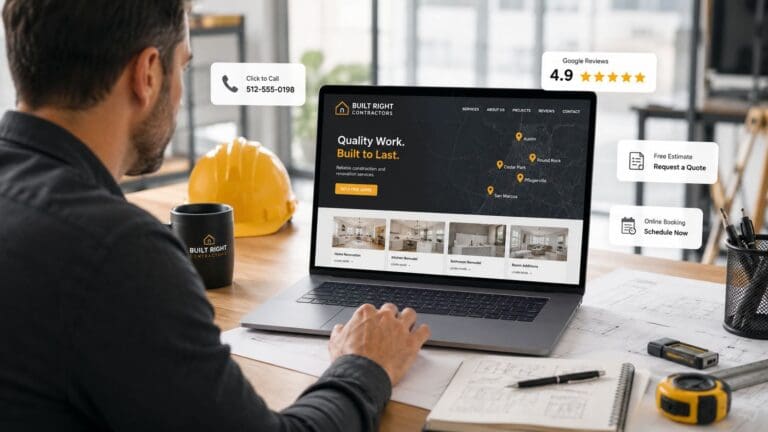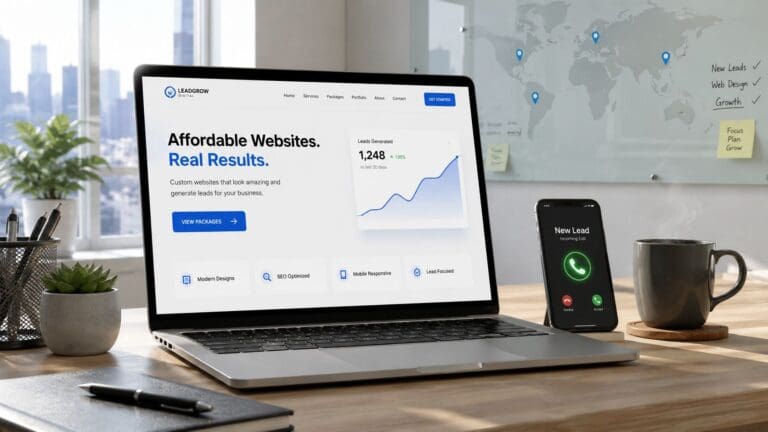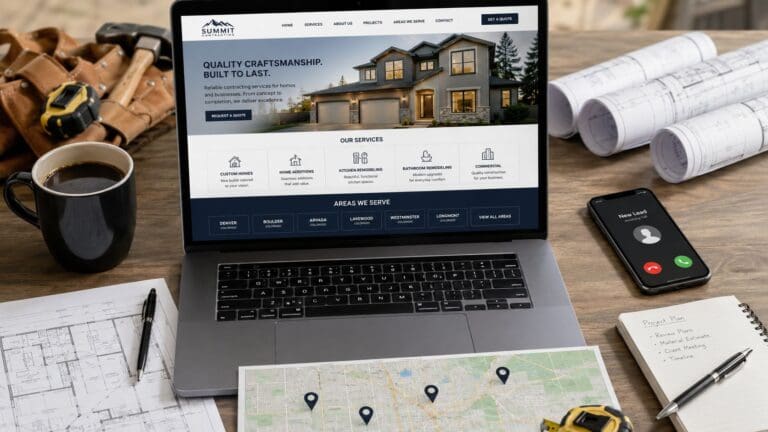

You’re probably not short on work.
You’re short on control.
A lot of small contractors stay busy all week and still feel stuck. The schedule is full, but it’s full of the wrong jobs. Too many small jobs. Too much driving. Too many price shoppers. Then the phone goes quiet and everyone acts surprised.
That isn’t a work ethic problem. It isn’t because you “need to post more.” It’s a visibility problem.
Most contractors are known in their home town. People know the trucks. People know the name. But a few miles away, when someone searches for the exact service they need, that contractor doesn’t show up. If you don’t show up, you don’t get a shot at the job.
That’s why a simple marketing plan for small home service businesses needs to start with one hard truth. Websites don’t create traffic. They wait for traffic. If nobody sees you, nothing else matters.
You’re Busy But Are You In Control
A lot of owners confuse motion with control.
You can be slammed for three weeks straight and still have a weak business. If the work comes mostly from word of mouth, old contacts, and random referrals, then the pipeline is fragile. One slow month, one weather shift, one competitor getting more visible online, and the gap shows up fast.

Busy isn’t the same as stable
Here’s the pattern.
You take whatever comes in because crews need work. Then you get buried. Then estimates pile up. Then follow-up slips. Then the phone slows down and everybody starts worrying again. That cycle keeps repeating because nothing is controlling lead flow.
For contractors working outside one town, the problem gets worse. Existing marketing content mostly targets residential trades like heating, cooling, and plumbing, with 82% of guides focused on single-city optimization, which leaves site-prep and regional contractors underserved. That same gap matters because 65% of leads come from targeted regional ads in rural and suburban markets, according to LocaliQ’s home services marketing overview.
Practical rule: If your crews work in more places than your business shows up online, you are losing jobs before the phone can ring.
The jobs you’re missing never show up on a report
This is what stings. You usually don’t know what you lost.
Nobody calls and says, “We were going to hire you, but you didn’t appear in our city search.” They just hire the company they saw. That company may be worse than you. Doesn’t matter. They were visible.
A simple plan starts by fixing that gap.
- Stop calling it a lead problem: It’s a visibility problem first.
- Stop trusting hometown reputation alone: That only helps where people already know your name.
- Stop measuring success by being busy: Measure it by whether you can predict where the next qualified calls will come from.
If you don’t control visibility, you don’t control revenue. That’s the whole issue.
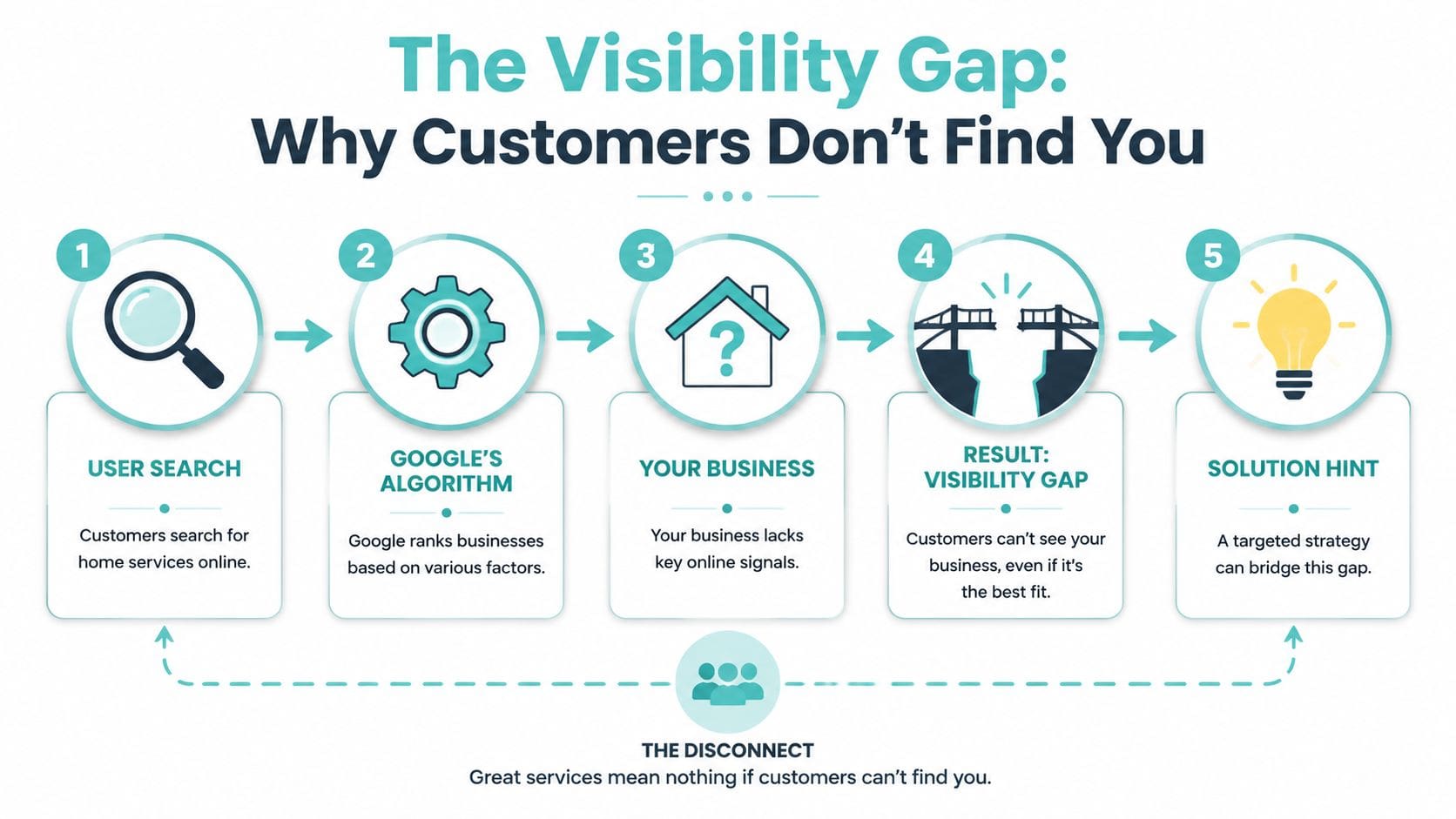
The Visibility Gap Why Customers Don’t Find You
When someone searches “contractor near me,” Google doesn’t treat that like a mystery.
It turns that search into a city-based search. If the person is in another town, Google reads it like “contractor in that town.” If your business has only made it clear that you work in your home town, then Google has no reason to show you somewhere else.
That’s the visibility gap.
Your name can be known and still not be found
A lot of owners push back on this because customers can find them.
Of course. If a customer already recognizes your company name, they can usually find you. That is not the definitive test. Success is actually measured by what happens when a stranger needs the service immediately and searches by service and city.
That buyer doesn’t search your brand name. They search what you do and where they need it done.
You’re a local hero in your town and a ghost ten miles away.
That’s why your service area matters more than your office address. If your online presence doesn’t clearly match the places where you want work, you won’t appear often enough in those searches.
Google doesn’t guess
Google works off signals. Clear service areas. Clear city pages. Clear business details. Clear alignment between your site and your business profile.
If those signals are weak, your visibility is weak.
For local search, your business profile is one of the first places that needs to be cleaned up and aligned. If you want to understand that piece better, this guide on how to optimize your Google Business Profile lays out what that profile is supposed to do.
Here’s the simple version:
| What the customer does | What Google looks for | What happens to you |
|---|---|---|
| Searches by service and location | Clear local relevance | You appear or you disappear |
| Searches from a nearby town | Signals tied to that town | You win visibility there or you don’t |
| Compares multiple contractors | Strong local trust signals | You get the call or get ignored |
The mistake is thinking “we serve that area” is enough.
It isn’t enough to know it. Google has to know it. And the buyer has to see it.
Your Website Is a Brochure Not a Lead Generator
A website without traffic is a brochure.
That’s not an insult. It’s just the truth. It sits there. It waits. It doesn’t go out and get attention on its own.
A lot of owners got sold a pretty website and were told leads would come. Then nothing happened. Of course nothing happened. A better billboard still fails if nobody drives past it.

A normal website waits around
Most contractor websites have the same problems.
- They talk in general terms: Lots of “quality service” language, not enough clear service and city relevance.
- They don’t guide the next step: No strong call buttons, weak forms, and no urgency.
- They treat mobile like an afterthought: That’s a direct hit to conversions.
That last point matters. 93% of customers read online reviews before a purchase, and mobile-first design with large click-to-call buttons and simple forms can lift call lead conversions by 7%, based on CallRail home services marketing statistics.
So yes, your site matters. But not because it magically creates demand.
A lead website has one job
Its job is to turn existing visibility into calls and form submissions.
That means the site has to be built for action. Not for compliments. Not for awards. Not to impress other marketers. It needs to help a buyer decide fast and contact you fast.
If you want to see what that kind of build looks like, this page on lead generation website design for home services contractors shows the difference between a standard site and one built to produce inquiries.
A website should answer three questions fast. What do you do, where do you do it, and how do I contact you right now?
A plain website is not the engine.
It is the landing place. It is where traffic turns into leads. If there is no traffic, it just sits there. If there is traffic but the site is weak, you pay for clicks and get little back.
Both failures are common. Both are fixable.
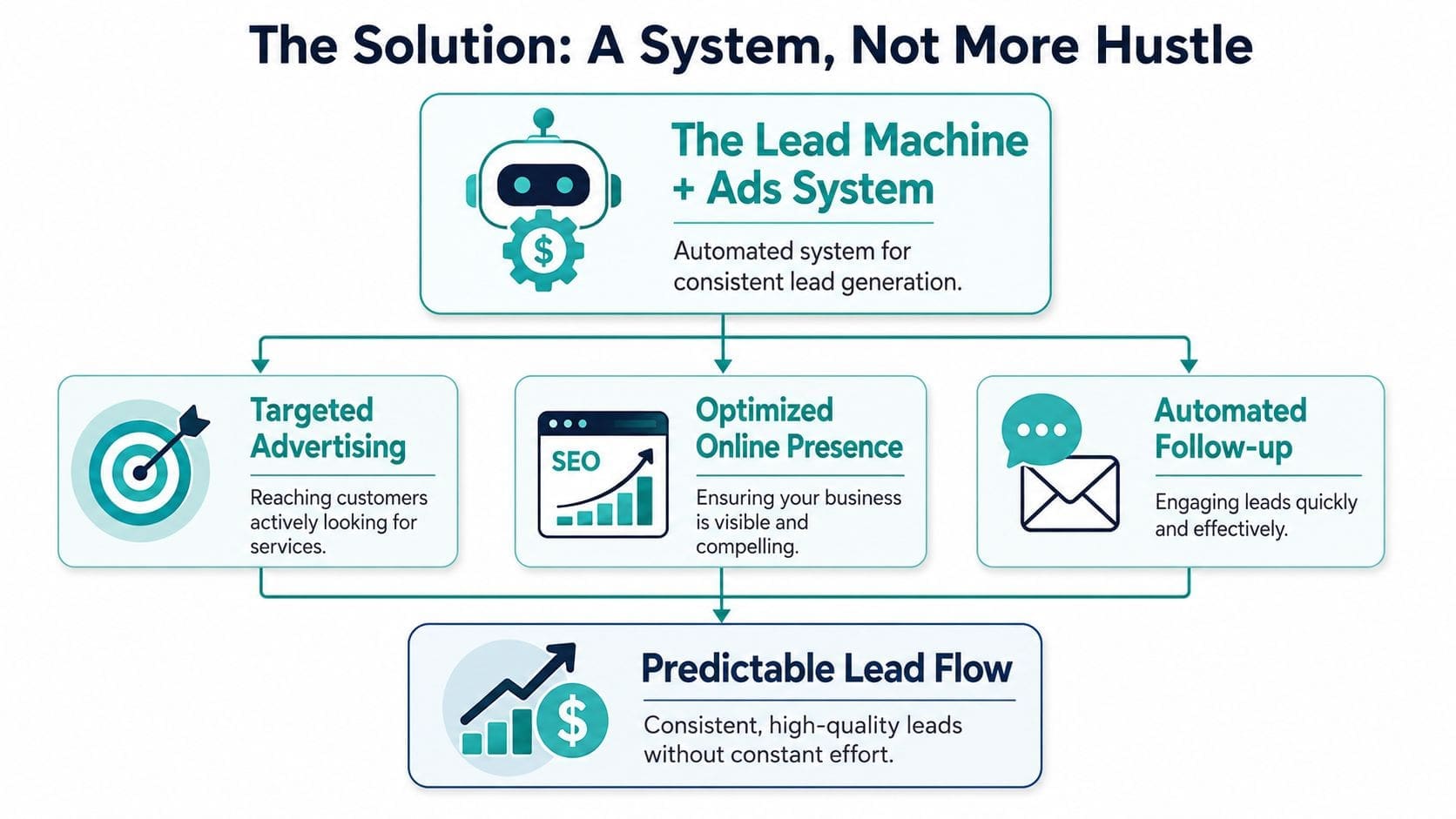
The Solution A System Not More Hustle
You do not need more random marketing tasks.
You need a system.
The clean answer is a Lead Machine plus ads. One part captures demand. The other part creates visibility. Together they give you a repeatable way to get found and turn that attention into calls.
What each part does
A Lead Machine is a website built around service pages, city pages, clear calls to action, mobile use, reviews, forms, and tracking. It is built to convert traffic.
Ads create visibility. They put you in front of buyers who are already looking.
Those two parts belong together.
- Lead Machine without ads: You built the truck but never put fuel in it.
- Ads without a Lead Machine: You paid for traffic and sent it to a weak page.
- System with both: You create visibility, capture demand, and track what happens next.
This isn’t theory. A multi-channel approach works better. 76% of small business owners who use at least two marketing channels report better results, and consistent branding across those channels can lead to a 23% revenue uplift, according to Coalmarch’s DIY guide for home services.
What this looks like in the real world
A contractor wants jobs from more than one city. The system gets built around the services and the cities that matter. Then ads send active buyers to those pages. Calls get tracked. Forms get tracked. Booked jobs get reviewed against spend.
That’s the whole point. Simple inputs. Clear outputs.
One option in this space is The Cherubini Company’s Lead Machine, which is a website and visibility system built around service-and-city structure, call capture, reviews, and paid traffic support for contractors who need broader local reach.
If you want steady lead flow, stop buying pieces. Buy the system.
A simple marketing plan for small home service businesses should not be a pile of disconnected tactics. It should be one machine that gets seen, gets clicked, and gets calls.
Your 90-Day Plan to Control Lead Flow
You don’t fix a visibility problem with random posting and guesswork.
You fix it in phases. Build the asset. Send traffic to it. Tighten what works. Expand where the results are strongest.

First 30 days
Month one is about setup.
Your site gets structured around the services you sell and the cities you want. Calls and forms need tracking. The message needs to be clear. A buyer should land on the page and know within seconds that you do this work in this area.
This is also where a lot of old clutter gets cut. Weak pages. Confusing navigation. Vague copy. Dead-end forms. A simple system starts by removing friction.
Days 31 through 60
Month two is about traffic.
Ads start driving buyers to the right pages. Not to a generic homepage. Not to a page that talks about the company in broad terms. To the exact service and location combinations that match demand.
At this stage, you watch for basic signals:
- Qualified calls: Are the right people calling?
- Form submissions: Are real buyers reaching out?
- Service-area spread: Which towns are producing actual opportunities?
You are no longer hoping people somehow discover you. You are putting your business in front of them when they are looking.
Days 61 through 90
Month three is where control starts to show up.
You tighten weak pages. You keep the pages and ads that bring the right leads. You gather more reviews. You expand into nearby service areas that make sense for your crews and margins.
A simple 90-day plan looks like this:
| Time frame | Main move | Result you want |
|---|---|---|
| First month | Build the machine | Clear service and city visibility |
| Second month | Fuel it with ads | Calls and form leads start coming in |
| Third month | Refine and expand | Better lead quality and stronger coverage |
This is not more hustle. It is less chaos.
The goal is not to make marketing feel busy. The goal is to make lead flow easier to predict.
Budgeting and Tracking What Actually Matters
Most contractors don’t hate marketing because they hate growth.
They hate it because they were shown reports full of junk that didn’t connect to jobs.
Clicks. Impressions. Reach. Graphs. Screenshots. None of that means much if the phone didn’t ring with the right people. Tracking should be simple enough that an owner can look at it and know whether money is working.
Start with a real budget
If you want steady growth, budget for visibility on purpose.
For sustainable growth, home service businesses should put 5% to 12% of gross revenue into marketing, and a firm in growth mode should usually be in the 8% to 12% range, with 25% to 35% of that budget going to local search work and 25% to 35% going to paid ads, based on this 2026 home service marketing budget breakdown.
That’s the math most owners skip. They buy a website once, then expect it to keep producing forever. It won’t.
If cash timing is tight and you need to map out what your business can support month to month, a simple planning resource like this MCA cashflow tool for business owners can help you see whether the spend fits your real cash position before you commit.
Track only what ties to jobs
You do not need a giant dashboard.
You need a short list that tells the truth.
- Qualified calls: Not every call. The calls from buyers you want.
- Real form leads: Not spam. Not junk. Genuine estimate requests.
- Booked jobs: The number that settles the argument.
The cleanest report in marketing is this one. How many good leads came in, and how many turned into work?
That’s how trust gets rebuilt after a bad agency experience. Not with prettier reports. With plain numbers tied to revenue.
What to ignore
A lot of activity looks impressive and does nothing for the business.
Don’t get distracted by vanity metrics when the pipeline is the actual issue.
| Useful | Noise |
|---|---|
| Qualified calls | Raw traffic with no intent |
| Form leads from target areas | General “engagement” |
| Booked jobs | Pretty charts with no revenue link |
A simple marketing plan for small home service businesses should make budgeting and tracking easier, not harder. Spend with intent. Measure what leads to jobs. Cut the rest.
If your business is known in one town but invisible in the next one over, that problem won’t fix itself. The Cherubini Company helps contractors build visibility systems that pair a lead-focused website with paid traffic so more of the right buyers can find them. You think customers can find you, but if they don’t find you, nothing else matters. Lead Machines are built to fix that.