
You already know the feeling.
The phone rings hard for a while. Then it slows down. Payroll is still due. Trucks still need fuel. Crews still need work. So you do what most contractors do. You lean harder on word of mouth, referrals, and hope.
That’s not a lead system. That’s a gamble.
If you’ve paid for a website before and it didn’t move the needle, you’re not crazy. The problem usually wasn’t that you “needed a better logo” or more fluff on the home page. The problem was visibility. Your company might be known in your town, but if customers in the next town over don’t see you when they search, you don’t exist to them.
That’s why website design for contractors that generates leads has to do more than look professional. It has to support a real lead system. The website is the tool that turns traffic into calls. It is not the thing that creates demand by itself.
Why You Have a Lead Problem (And It’s Not What You Think)
Most contractors don’t have an effort problem.
They have an invisibility problem.
You’re already working. You’re already bidding. You’re already juggling jobs, callbacks, payroll, equipment, and problems that pop up before breakfast. Lack of effort isn’t the issue. The issue is that buyers search by service and city, and too many contractors only show up where their shop or office happens to be.

The visibility gap is killing jobs you never see
Here’s how it works in plain English.
A customer types in something like “plumber near me” or “excavation contractor near me.” Google ties that search to the city where that person is standing. So if you work in that city but your website never clearly says you do, Google has no reason to put you there.
That’s the part many contractors miss.
You may serve ten, twenty, or more nearby towns. But if your site mostly talks about your home base, your business card, truck wrap, and old website have all trained Google to think that’s your turf and nothing else. Then you wonder why leads are spotty outside your home area.
Customers aren’t searching for your company name first. They’re searching for the work they need done.
That means people who don’t already know you are not “failing to find you.” They’re finding somebody else.
Your website shapes trust before you ever get the call
A lot of contractor websites look thrown together. Bad photos. Weak copy. No clear next step. A layout that feels old on a phone. That hurts trust before you even get a shot.
One guide on contractor web design points out that 48% of people judge contractor credibility based on website design, and over 60% of traffic is mobile, while many guides still fail to explain how contractors can structure pages for multiple service areas and cities (contractor web design guide).
That matters even more if you run bigger jobs across counties or multiple towns.
A few common signs of the problem:
- You only show up in one town: Even though you work far beyond it.
- You get too many small jobs: Because better jobs never saw you.
- You rely on referrals for almost everything: So your pipeline swings up and down.
- You’ve been burned by agencies before: They sold style, not visibility.
- You don’t know what your site is supposed to do: So it sits there and looks busy.
If your current site is making people hesitate, this breakdown of how to stop scaring clients away online is worth your time.
Practical rule: If a customer in a nearby city needs your service today and your business doesn’t show up, your lead problem isn’t effort. It’s visibility.
Your Website Is a Brochure Collecting Dust
A website doesn’t create traffic.
It waits for traffic.
That’s the mistake right there.
Too many contractors think, “I paid for a website, so where are the leads?” But a normal website is just an online brochure. It says who you are. It lists services. It shows a few photos. Then it sits there doing nothing unless somebody already finds it.
A brochure site looks fine and still fails
That’s why so many contractor websites disappoint. They weren’t built to move a buyer toward a call or a quote request. They were built to exist.
If that sounds harsh, good. It should.
A brochure site can still be clean, polished, and completely useless for growth. If the site has no real path to conversion and no system feeding buyers into it, it’s just digital wallpaper.
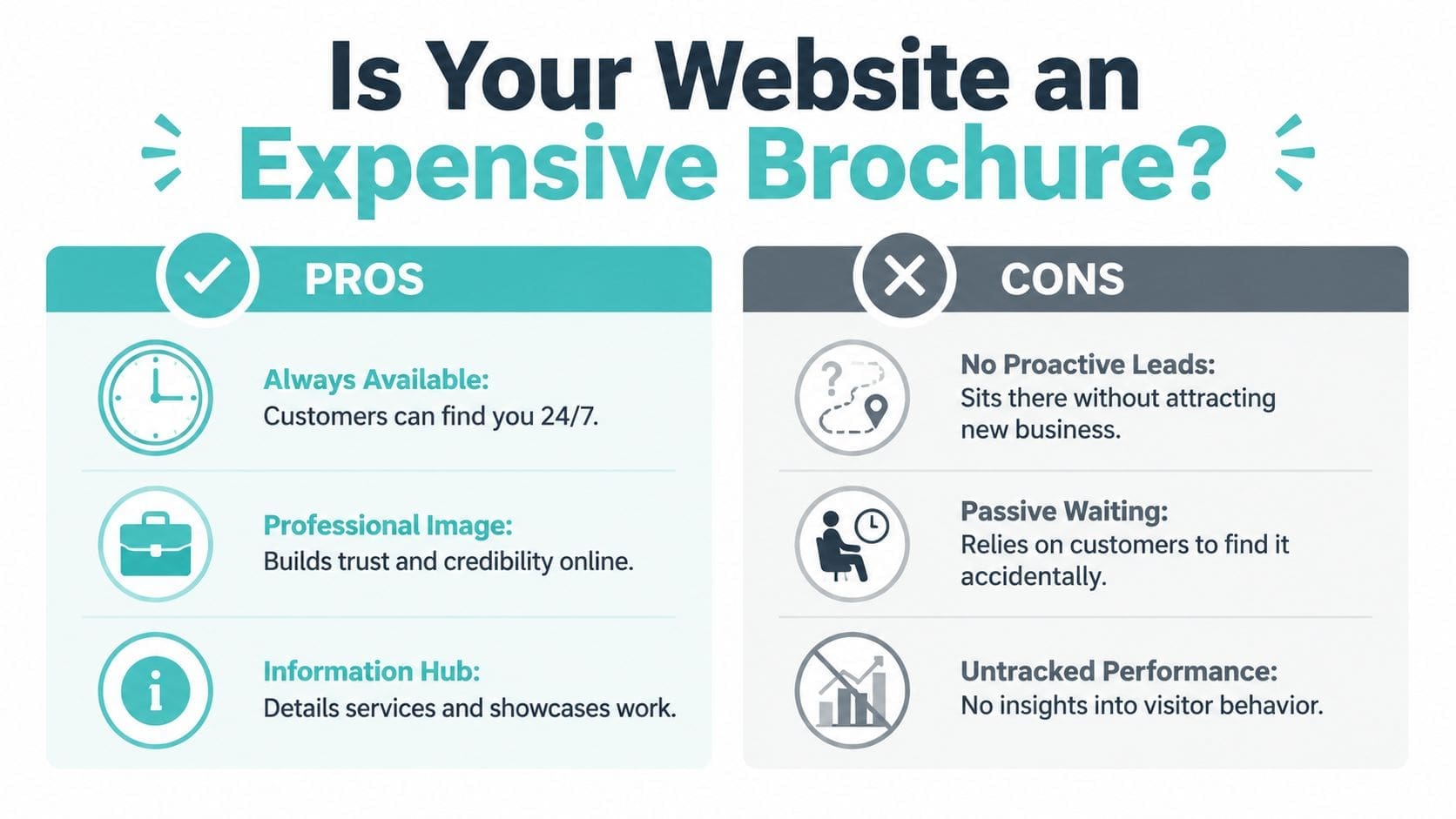
What a brochure does and what it doesn’t do
| Website type | What it does | What it doesn’t do |
|---|---|---|
| Brochure site | Shows basic business info | Create demand |
| Brochure site | Lists services | Target every city you serve |
| Brochure site | Gives people a contact page | Push visitors toward action |
| Lead-focused site | Supports calls and quote requests | Sit passively and hope |
That’s the whole issue.
A website can help close the gap after a buyer lands on it. But by itself, it doesn’t go out and get seen. It doesn’t force visibility in nearby towns. It doesn’t put you in front of buyers searching right now.
Why contractors get frustrated with websites
Most contractors aren’t wrong to feel burned.
They were told a website would “generate leads.” Then they got a site that was basically an online business card. No serious city structure. No real conversion thinking. No system around it. Then the agency disappeared or blamed time, algorithms, or your market.
Here’s the truth.
- A website is an asset: It can help convert attention into action.
- A website is not traffic: It does not create demand on its own.
- A website without visibility is dead weight: It may look nice, but it won’t solve feast or famine.
- A website without tracking keeps you guessing: You can’t fix what you can’t see.
A brochure website tells people who you are. A lead system gives buyers a reason to call now.
If you want steady leads, stop asking for “a better website.”
Start asking for a website that is part of a system.
Build a Lead Machine Not Just a Website
A contractor site should have one job.
Turn visitors into calls and quote requests.
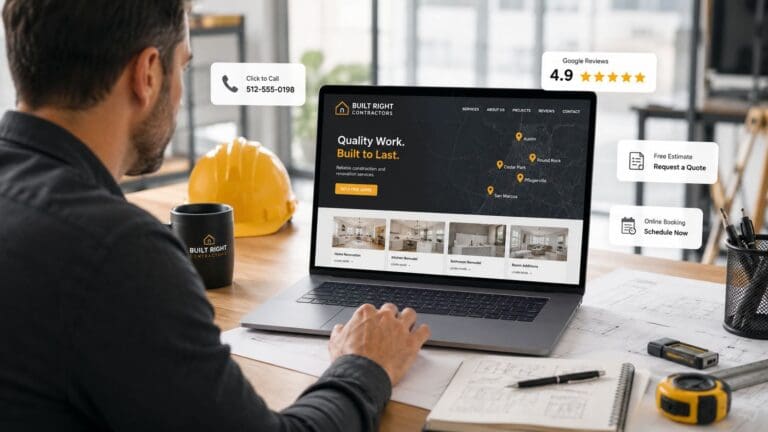
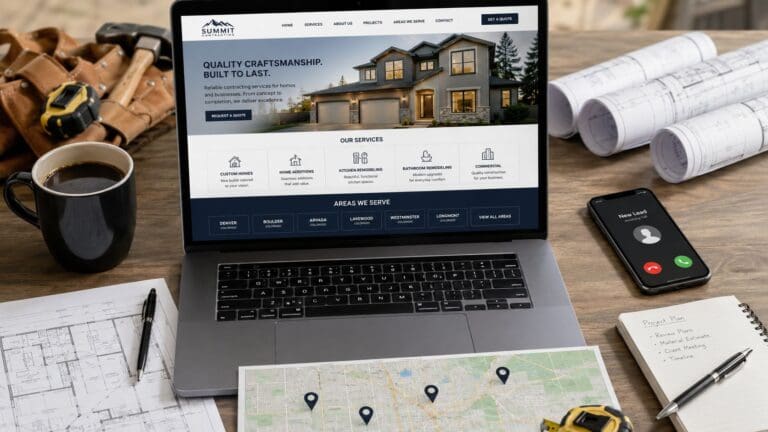
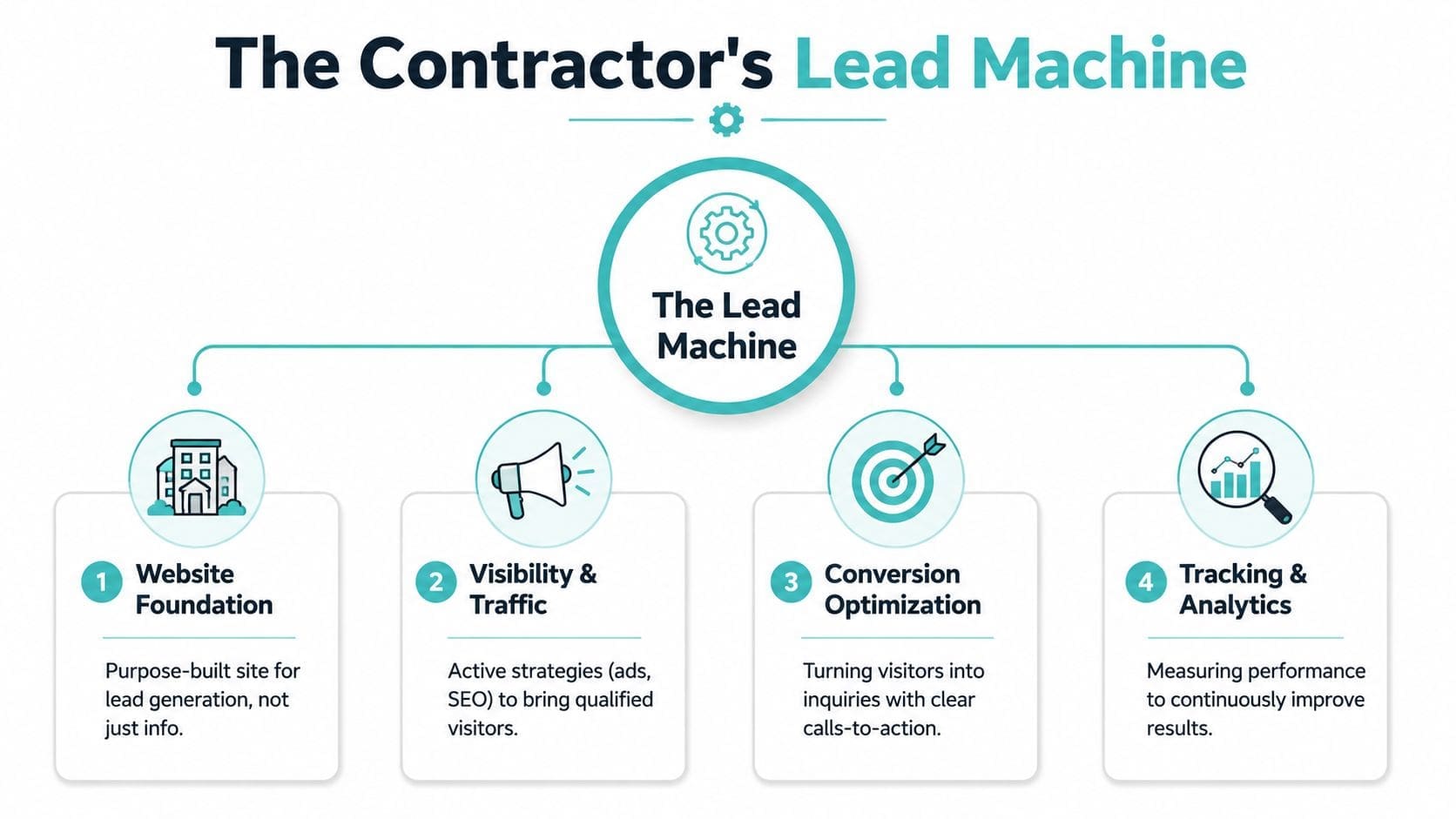
That’s what a Lead Machine does. It is not a pretty placeholder. It is not a design trophy. It is a website built to support visibility, convert traffic, and help you show up across the cities where you want work.
What has to be built into it
A lead-focused contractor site needs structure. Not fluff. Not trendy design. Structure.
According to Social Status Inc. on contractor website leads, contractor websites built with conversion in mind convert at 4%, while the industry average is 2 to 3%. The same source says mobile traffic now accounts for 58.4% of all web traffic, and a 1-second delay in page load time reduces conversions by 7%. That’s why mobile speed, clear calls to action, service pages, location pages, reviews, and trust signals are not optional.
A real lead machine includes:
- Service pages: One page for each main thing you do, so your work is clear.
- City pages: One page for each target area, so your service area is clear.
- Calls to action near the top: Not buried halfway down the page.
- Simple forms: Easy to fill out. Easy to route.
- Real reviews on the right pages: Not hidden on one lonely testimonial page.
- Trust signals near estimate forms: So people feel safe taking the next step.
Why city pages matter so much
Here, most contractor sites break down.
If you do roofing in one county, drainage in another, and site prep across a wider region, your website has to reflect that reality. Otherwise Google keeps associating you with one location and one weak version of your business.
That’s why a lead machine is built by service and by city.
It tells search engines what you do and where you do it. It also helps buyers land on a page that matches what they need. That match matters. A person looking for septic installation in one town should not land on a vague homepage that tries to talk to everybody.
The page has to match the job. The job has to match the city. That’s how you stop losing local searches.
If you want a plain-English breakdown, this page on what a Lead Machine is explains the model clearly.
One example in the market is The Cherubini Company, which builds contractor lead websites with service pages, city pages, conversion elements, and ad support. That kind of structure is the point. The brand name matters less than whether the site is built to produce action.
Create Visibility with Ads That Send Buyers to You
A good website with no traffic is like a wrapped truck sitting in the dark.
Nobody sees it.
That’s why ads matter. Ads create visibility. They put your company in front of buyers who are already searching for the work you do. Not next year. Not someday. Right now.

Big companies buy visibility. Small contractors often buy hope.
That’s the blunt truth.
Larger companies don’t sit around waiting for referrals to save the month. They pay to be seen. They put themselves in front of local buyers and drive those people to a page built to convert.
Smaller contractors often do the opposite. They avoid ads because they got burned once, or because they don’t understand them, or because they think the website alone should do all the work. Then they wonder why the pipeline dries up.
Here’s the cleaner way to think about it:
- Ads do one job: They create immediate visibility.
- The website does a different job: It converts that attention into calls and form fills.
- You need both: One without the other wastes money or wastes opportunity.
Send buyers to the right place
A bad setup sends paid traffic to a weak homepage.
A smart setup sends buyers to a page that matches what they searched for and where they searched from. That is how a lead system works. The website catches demand. The ads create it on command.
This is also how you stop being trapped in your home city.
When a contractor wants work in nearby towns, the system has to put them in those towns online. That means visibility first. Then conversion. Then tracking.
If you want to see how this works in practice, this overview of Google Ads for contractors shows how paid visibility fits into the bigger lead system.
A website without traffic won’t grow your business. Ads without a strong website will waste your money.
Stop Guessing and Start Tracking Your Results
Most contractors don’t know where leads come from.
They guess.
They ask the caller, “How’d you hear about us?” The caller says, “Google, I think.” That’s not tracking. That’s fog.
If you’re spending money on marketing and still can’t tell what produced the phone call, you don’t have a system. You have activity.

Good tracking changes the conversation
Once a real lead system is in place, you can stop arguing about opinions.
You can see which city pages are pulling calls. You can see which services are drawing form fills. You can see whether traffic is turning into real opportunities or just noise. That lets you make decisions based on facts instead of frustration.
Lead flow usually builds over time, especially from organic visibility. According to The Nordic Nerd on contractor website lead volume, new contractor websites can expect 2 to 5 leads monthly in their first six months, while established sites with active search work generate 5 to 20 leads monthly. That same source says the pattern is predictable. Early months are light, then traction builds as the site matures.
That should tell you two things.
First, real results come from a consistent system. Second, if nobody is tracking, you can’t tell whether the system is improving or stalling.
What tracking should tell you
You don’t need a pile of dashboards. You need answers.
A strong setup should help you answer questions like these:
- Which cities are producing calls: So you know where visibility is working.
- Which services bring in better leads: So you can focus on job types you want.
- Which pages turn visitors into inquiries: So weak pages can be fixed.
- Which lead sources are worth keeping: So money stops leaking into blind spots.
If you can’t trace a lead back to the page or campaign that produced it, you’re still guessing.
Why this matters to the business, not just marketing
This isn’t about vanity reports.
It’s about control.
When you know where leads come from, you can put more effort behind what works and stop funding what doesn’t. You can make better decisions during slow periods. You can spot when one service area goes cold. You can stop stuffing the schedule with the wrong jobs just because the phone happened to ring.
That’s also why a digital marketing audit for contractors can be useful. It gives you a clear look at what’s broken, what’s missing, and where the visibility gap is hurting you.
Take Control of Your Lead Flow and Your Business
Feast or famine doesn’t happen by accident.
It happens when a contractor does not control visibility.
If your lead flow depends on referrals, random repeat customers, and whatever happens to come through the phone this week, then your business is fragile. It may look busy today, but it’s still fragile. One weather shift, one slow month, one crew sitting too long, and the pressure is back.
Control starts with visibility
The contractors who keep growing usually aren’t better at hoping.
They’re better at being found.
They show up in more than one city. They don’t rely on people already knowing their business name. They put a system in place that gets them seen where buyers are searching. Then they send that traffic to a site built to turn attention into action.
That is what website design for contractors that generates leads is supposed to mean.
Not art direction.
Not fluff copy.
Not a homepage slideshow.
A working system.
What the right system gives you
A real lead machine setup changes the business in practical ways.
- More control over job mix: Better leads let you stop chasing every tiny job.
- More stability in slow stretches: You’re not sitting around waiting for referrals.
- Better reach outside your hometown: You stop losing nearby work by default.
- Clearer decisions: You can see what’s producing calls and what isn’t.
That kind of control matters because contractors don’t just need more leads. They need the right visibility so the right buyers can find them.
Stop believing customers will “eventually” find you
This belief costs contractors a lot of work.
You think people can find your company because you have a website, a Google listing, and maybe some social pages. But that only helps if you show up when they search for the service in the city they’re in. If they don’t see you, they hire somebody else and you never even know the job existed.
The market does not reward the best contractor it never sees.
That’s why the right answer isn’t “try harder.”
It’s to stop running your lead flow on guesswork.
Build the website as a lead machine. Fuel it with ads that create visibility. Track what happens. Keep improving what brings in real calls. That is how a contractor moves from unstable to predictable.
You think that customers “can” find you but, If customers “don’t” find you, nothing else matters.
Lead Machines are built to fix that.
If you’re tired of guessing and want a clear plan, The Cherubini Company helps contractors build lead-focused websites and visibility systems that are designed to turn local searches into calls. If your business is strong but your reach is weak outside your home city, that’s the problem to fix first.