
You already know the feeling.
One month you're slammed. The phone won't stop. Crews are busy. You think, "We're good."
Then it goes quiet.
You start calling old contacts. You start checking on jobs that should have landed by now. You tell yourself it will pick back up. That's not a pipeline. That's survival.
The hard truth is simple. Most contractors don't have a work problem. They have a visibility problem. The work exists. The issue is that buyers don't see them when they search.
The Real Problem Is Invisibility Not Effort
A lot of contractors think the answer is to work harder, ask for more referrals, or wait for word of mouth to kick back in. That's why the cycle never ends.
The work is there. The construction sector is projected to add 380,100 new jobs by 2033, growing faster than the overall economy, according to the U.S. Bureau of Labor Statistics projection on construction employment growth. That means demand isn't the issue. Getting seen consistently is.
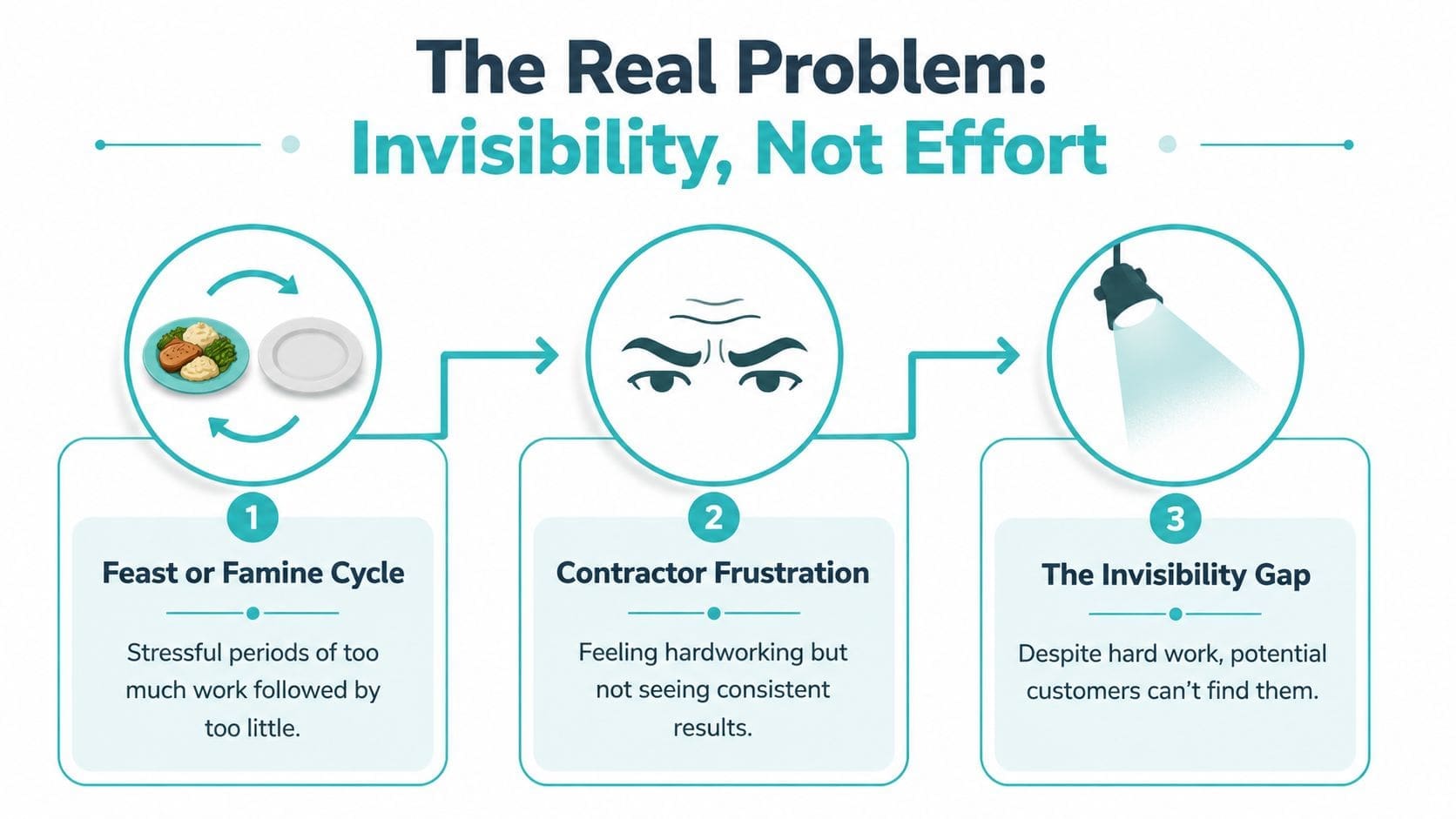
The feast or famine cycle isn't random
If you rely almost entirely on referrals, repeat customers, and luck, your pipeline will always swing.
You get busy from jobs already in motion. Then you stop paying attention to visibility because you're working. Then the backlog dries up. Then you panic and start chasing work again.
That's the cycle.
Practical rule: If you only market when you're slow, you'll stay on the roller coaster.
The invisibility gap is killing your pipeline
Most contractors are known in their hometown. Maybe even well known. But a few miles away, they're invisible.
That's the part most owners miss.
When someone searches for "excavation contractor near me" or "concrete contractor near me," Google reads that as a city search based on where that person is standing. If the searcher is in the next town over, Google is looking for a business that clearly serves that town.
If your business only talks about your home city, then Google has no strong reason to show you in the surrounding cities where you desire work.
That isn't a marketing gimmick. It's common sense.
If you've never clearly said you work in Newark, Heath, Granville, Pataskala, or the other places around you, why would Google assume you do?
You're losing jobs you never even knew existed
This is what makes the problem expensive.
You're not just losing jobs you bid and didn't win. You're losing jobs you never had a shot at because the buyer never saw you. They searched by service and city. A competitor showed up. You didn't.
That's why so many contractors feel like they're doing everything right and still can't build a steady flow of better work.
They're working hard. They're just not visible where buyers are looking.
If this sounds familiar, this breakdown on why contractors don't get enough leads gets to the same core issue. It isn't effort. It's exposure.
What invisibility looks like in the real world
- You stay busy on small jobs: You take whatever comes in because you don't have enough larger opportunities to choose from.
- You compete too hard on price: Buyers who don't know you compare numbers, not quality.
- Your slow season gets worse: You wait for old lead sources to wake back up instead of creating demand.
- Your service area stays stuck: You can physically work in nearby towns, but online you barely exist there.
If people don't see you when they search, you don't get to make a pitch. You don't get to explain your process. You don't get to win.
That's the answer to how to build a steady pipeline of jobs year round. Fix the visibility gap first. Everything else sits on top of that.
Your Website Is a Brochure Not a Salesperson
A lot of contractors got sold the same bad idea.
"Let's build you a great website."
So they paid for one. It looks clean. It has a few nice photos. Maybe it has a contact form. Then nothing happens.
That doesn't mean websites don't matter. It means you were told the wrong job.

A website doesn't create traffic
Your website is not a lead source by itself.
It's more like a stack of brochures sitting in an empty room. The brochure may look good. It may explain your services well. But if nobody walks in, nobody reads it.
That's what most contractor websites are. Digital brochures collecting dust.
A buyer has to find the site first. Then the site has to make that buyer call. Those are two separate jobs.
If you want a good example of how buyers use information before they make contact, look at tools people use to compare boiler service quotes. People don't just want a business to exist online. They want clear, useful information that helps them decide what to do next.
Most contractor websites were built for looks, not leads
That's why a pretty site often does nothing.
A regular website says, "Here's our company."
A lead-focused website says, "We show what we do, where we do it, and here's how to contact us right now."
Those are not the same thing.
If your current site talks mostly about your business history, your team, and your hometown, but barely speaks to the actual services and cities you want to target, then it isn't set up to help you win nearby searches.
The wrong expectation
Contractors often expect the website to "generate" leads. It won't.
Its real job is to convert attention into action.
That means when traffic shows up, the site needs to make the next step easy:
- Call now
- Request a quote
- See the service area
- Trust the company enough to reach out
If the traffic never shows up, the website just sits there.
A website without visibility is a sign on a road nobody drives.
A lot of owners need this distinction spelled out clearly. This comparison of a lead generation website vs a regular website for contractors gets right to the point.
Stop expecting the website to do a job it was never built to do alone.
The System That Turns Visibility Into Jobs
Big companies don't rely on hope. They buy visibility.
That's one reason they keep showing up, even in places where they aren't the best at the work. They're in front of the buyer first. They built a system.
Small contractors usually do the opposite. They wait for referrals. They lean on an old site. They try a few random ads. They quit when nothing clicks fast enough.
That's backwards.
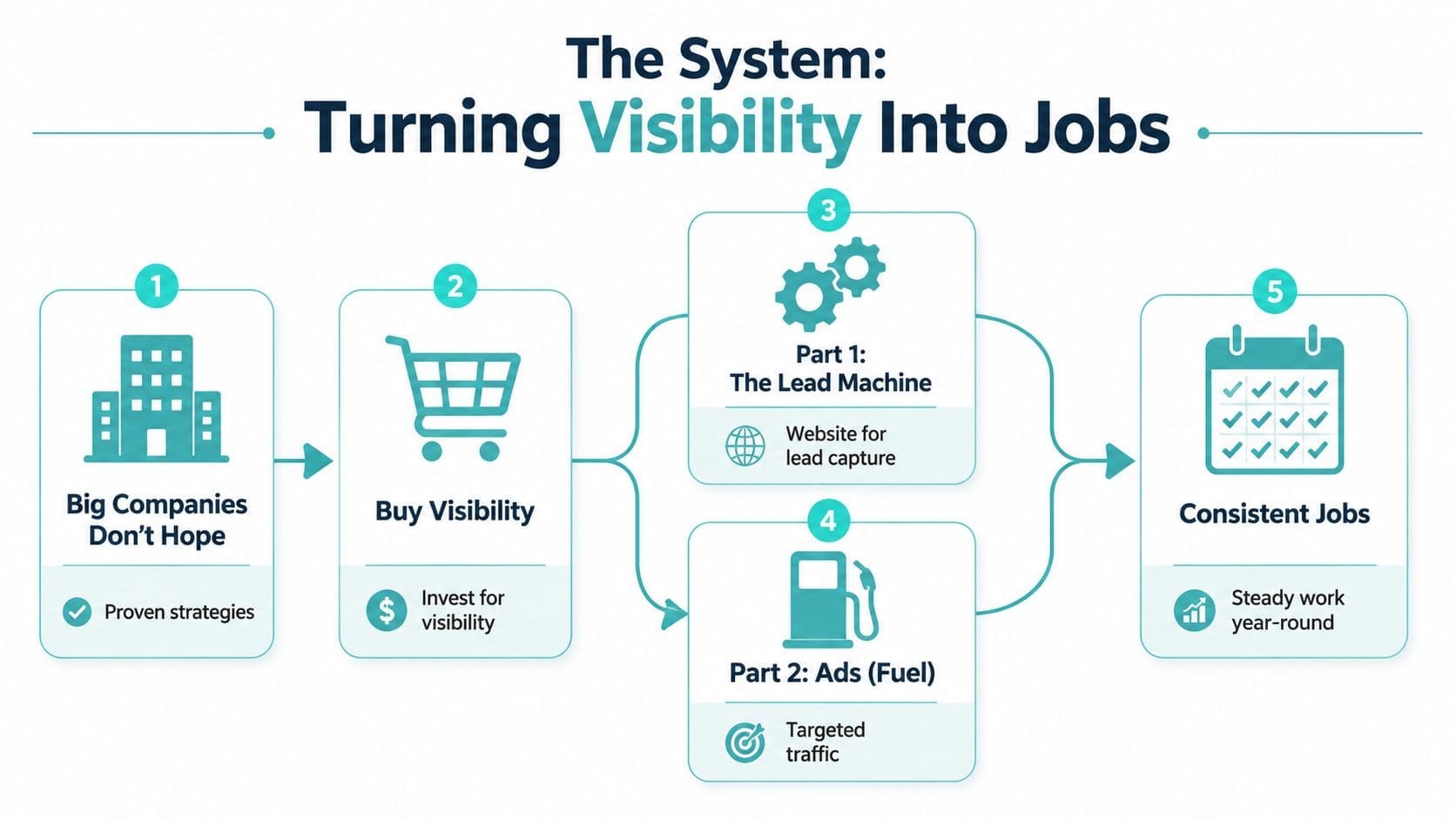
The system is simple
You need two parts.
Part one is the Lead Machine
A Lead Machine is a website built for one job. It turns visitors into calls and quote requests.
Not awards. Not compliments. Not "brand awareness."
Leads.
That means the site is built around service pages, city pages, clear contact paths, mobile use, and fast action. It is supposed to help a buyer say, "Yep, this company does what I need in my area. I'm calling."
Part two is ads
Ads create visibility.
They put you in front of people searching right now. Not next month. Not someday. Right now.
The website is the asset. The ads are the fuel. One without the other breaks down fast.
- Website only: It waits around for traffic.
- Ads only: They send buyers to a weak page that doesn't turn into calls.
- System together: Visibility goes in. Jobs come out.
You need a pipeline, not random bursts
Here, most owners need to get serious.
To avoid dry spells, contractors need to bid a "decent number of jobs per month," and a proactive sales pipeline with daily lead checks and relentless follow-up is essential, as explained in this guidance on maintaining a construction pipeline.
That same thinking applies to local lead flow. You don't want random spikes. You want a steady stream of chances to quote, follow up, and close.
Consistency beats intensity. A system that runs every week will outproduce heroic effort that only shows up when things get slow.
Control is the real payoff
The point isn't to "do marketing."
The point is to control your revenue better than you do today.
A system gives you that control because it does three things:
| What you need | What the system does |
|---|---|
| More visibility | Ads put you in front of active buyers |
| Better coverage | The Lead Machine helps you show up across your service area |
| More predictability | Steady inquiries give you jobs to price and pursue |
One example of this kind of setup is The Cherubini Company, which builds contractor Lead Machines and pairs them with managed ads focused on visibility across service areas. That's not magic. It's just a structured way to stop guessing.
If you're serious about how to build a steady pipeline of jobs year round, stop chasing one-off tactics. Build the machine, then feed it.
Building Your Lead Machine to Claim Your Service Area
Most contractors talk online like they only work in one town.
That is the problem.
If you want jobs from the towns around you, your website has to clearly claim those towns. Not vaguely. Not in one buried sentence. Clearly.

Service pages and city pages do the heavy lifting
This is the basic structure.
If you offer excavation, grading, septic, concrete, or land clearing, each service needs its own clear page. Then each city you want work from needs its own clear page tied to those services.
Not because it's trendy. Because it matches how people search.
A buyer in one town doesn't search for your company name if they've never heard of you. They search for the service they need in the place they are.
That means a page about "grading in one city" tells Google and the buyer something specific. A generic homepage doesn't.
This is how you close the visibility gap
Think about the difference:
| Weak setup | Strong setup |
|---|---|
| One homepage for everything | Pages built by service and city |
| Mostly talks about your home base | Clearly names the areas you serve |
| Makes Google guess | Gives Google a direct match |
| Gets found less often outside town | Creates more chances to show up nearby |
Contractors using a systematic approach to lead generation can reduce manual search time by 70%, and by expanding their reach to 5 to 10 target counties and monitoring pre-bid projects, they can access 60% more opportunities than firms waiting for public bid invitations, according to ConstructConnect's guidance on building a consistent pipeline.
The lesson is bigger than software. The contractors who win more work build coverage on purpose. They don't sit in one city and hope buyers from other towns somehow find them.
Your service area is not the area you can drive to. It's the area where buyers can actually find you.
What a Lead Machine should make clear
A strong Lead Machine answers the buyer fast.
What do you do
Your services should be obvious right away.Where do you do it
Your target cities and surrounding areas should be plainly stated.How do I contact you
Calling or requesting a quote should take no effort.Why should I trust you
Reviews, proof, and clear language should back up the offer.
Stop being vague
A vague website forces Google to guess. It also forces the buyer to work too hard.
Nobody wants to investigate whether you "might" serve their town.
If you do the work there, say so. If you want bigger jobs from surrounding areas, claim those areas directly. That's how a contractor starts to build a steady pipeline of jobs year round instead of waiting for home-city leftovers.
Using Ads to Fill Your Pipeline on Demand
A lot of contractors avoid ads because they got burned once.
Fair enough.
Most bad ad results come from the same two problems. Wrong traffic, or traffic sent to a weak site. Then the owner decides "ads don't work" when the underlying problem was the system.
Ads are not the enemy. Bad visibility strategy is.

Ads give you speed and control
A Lead Machine helps you capture demand. Ads help you create visibility now.
That's the missing piece for contractors who are tired of waiting around for referrals to show up.
When somebody searches for your service, ads let you get in front of that buyer at the moment intent is highest. That matters because ready-to-buy people don't spend weeks hunting. They look, click, compare, and call.
If you're not there, someone else is.
This is how you handle slow seasons
Slow seasons don't have to blindside you.
If work drops, the answer isn't to sit still and hope spring fixes it. The answer is to increase visibility where you want work from. That's what ads let you do.
You can treat lead flow more like a dial and less like weather.
Buyers are searching every day. The real question is whether you're showing up when they do.
For contractors aiming to scale, a consistent bidding system matters. By bidding 10 to 15 jobs per month with a 25% win rate, a contractor can maintain 3 steady projects, and this disciplined approach is how 40% of general contractors achieve predictable growth, according to this industry video on contractor pipeline math.
That same discipline applies to lead flow. Predictable growth doesn't come from random bursts. It comes from a steady stream of real chances to quote and close.
What ads should actually do
Not all calls are good calls. Not all clicks matter.
Good ads should help you get:
- Active buyers, not people casually browsing
- Coverage in the cities you want, not just your home base
- A flow of quote requests, not random traffic
- Faster response opportunities, so your team stays in motion
If you want to see how this fits into the broader system, this page on Google Ads for your Lead Machine lays out the role ads play without drowning you in tech talk.
Stop treating ads like a gamble
Contractors gamble when they spend without a system.
Ads used the right way are not a gamble. They're a purchase of visibility. And visibility is what gives you a shot at the job.
No visibility means no call.
No call means no estimate.
No estimate means no revenue.
That's why ads matter. They don't replace good operations. They feed them.
Stop Guessing and Start Controlling Your Revenue
A fragile business waits.
It waits for referrals. It waits for repeat customers. It waits for the phone to ring. It waits for the season to turn. That isn't control. That's dependence.
A stronger business builds demand on purpose.
The old way keeps you stuck
If you're still depending on word of mouth to carry the whole load, you already know what happens. You get busy, then quiet. You make decisions late. You take work you shouldn't take. You keep crews busy with whatever comes through the door.
That isn't growth. That's patching holes.
For owners in remodeling or adjacent trades, even buyer research habits tell the same story. People compare services, costs, and options before they ever call. A resource like this guide to 2026 kitchen remodeling cost per square foot shows how buyers gather local service information before choosing who to contact. If you're not visible during that search, you're out before the race starts.
The right goal is not more activity
The right goal is more control.
Control comes from a system that does this:
- Makes you visible in the cities where you want work
- Turns that visibility into calls
- Creates a steadier flow of opportunities
- Gives you room to choose better jobs
That is the answer to how to build a steady pipeline of jobs year round.
Not more guessing.
Not more random vendor pitches.
Not another pretty website sitting there doing nothing.
A contractor who controls visibility has a better shot at controlling revenue.
You don't need more noise. You need a machine that gets you found and a fuel source that drives buyers into it.
You think that customers "can" find you but, If customers "don't" find you, nothing else matters. Lead Machines are built to fix that.
If you're done guessing and want a clear system, talk to The Cherubini Company. They build Lead Machines for contractors who need better visibility across the cities they serve, then pair that with ads that drive real search traffic into the system. No bloated package. No mystery. Just a practical way to get seen, get calls, and build a steadier pipeline.