You've probably said some version of this already.
“We've got a website.”
“We tried ads.”
“It didn't work.”
“That's what the last agency said.”
Here's the real problem. Your website isn't helping you win jobs if people leave before it loads. And even if it does load, it still won't save you if nobody in the next town can find you.
That's why most contractors stay stuck in feast or famine. They lean on referrals, hope the phone rings, and blame the market when things slow down. Meanwhile, better-positioned competitors buy visibility, show up in relevant searches, and capture the calls first.
This is what how fast loading websites increase leads and calls really means. It's not some nerdy website score. It's whether a real buyer sees your page, waits for it, trusts it, and taps the phone button before they go back to Google and call someone else.
Your Website Is Costing You Jobs You Never See
A homeowner in a nearby town searches for your service on their phone. They click your site. It hangs.
They don't complain. They don't send feedback. They don't give you a second chance. They hit back and call the next contractor.
That job is gone, and you never even knew it existed.
Most contractors think a website is enough because they can pull it up on their own computer and it “looks fine.” That means nothing. Your customer is standing in a kitchen with a leaking pipe, sitting in a hot house with no air, or trying to line up a site job from a phone in a truck. They are not browsing. They are deciding.
Good enough is losing
A slow site doesn't fail later. It fails first.
Before your reviews get read. Before your photos build trust. Before your financing offer matters. Before your phone number gets tapped. If the page drags, the lead is dead before the sales process even starts.
Practical rule: If your site makes people wait, it makes them leave.
That's why the old “brochure website” model is worthless for lead generation. A brochure sits there. A lead system has one job. Get the visitor to act now.
What you're really losing
You're not just losing random clicks. You're losing high-intent local buyers.
- People ready to call: They searched because they need help now.
- Jobs outside your word-of-mouth circle: These are the buyers who don't know your company name yet.
- Revenue you can't track: You never see the person who bounced and hired someone else.
If your website is slow, it's not neutral. It's actively costing you leads, calls, and jobs you never even get a chance to quote.
Speed Is The First Step To Getting Found
Google isn't in the business of helping contractors feel good about having a website. Google wants to give searchers the fastest, easiest answer.
If people click your site and leave because it's slow, Google learns from that. That's bad for your visibility.
Google watches what people do
Google found that the probability of a visitor bouncing rises by 32% when page load time increases from 1 second to 3 seconds, which matters because each extra second gives people more time to leave before they click your form or phone number, as explained in Shopify's write-up of Google page speed data.
That's not a small issue. That's the first gate.
You can think of Google like a dispatcher. If a dispatcher knows one contractor answers fast and another never picks up, who gets the next call? The one who responds.
A slow website sends the same signal. It tells Google your page is a bad result for that search.
Mobile is where this gets ugly
Most local service searches happen on phones. That means your site has to load fast on a small screen, on real mobile service, for a person who wants an answer now.
If your site was built like a desktop brochure and shrunk down for a phone, it's already behind. That's why websites optimized for mobile matter. Not because it sounds modern. Because that's where your buyer is.
Google won't keep sending traffic to a page people keep abandoning.
Just having a website is not visibility
Contractors get sold this lie all the time. “You need a website.” No. You need a website people can use fast enough to stay on.
Here's the difference:
| What contractors think | What actually happens |
|---|---|
| “I have a website, so people can find me” | A slow site gets skipped and abandoned |
| “If they need me, they'll wait” | They won't. They'll go back and pick another company |
| “The website should generate leads” | The site only works if traffic reaches it and stays on it |
Speed is the first step to getting found because a slow site kills visibility before it ever turns into a lead.
How A 3-Second Delay Kills Phone Calls
A phone lead is not a long decision.
It's a short chain of moments. Search. Tap. Wait. Judge. Leave or call.
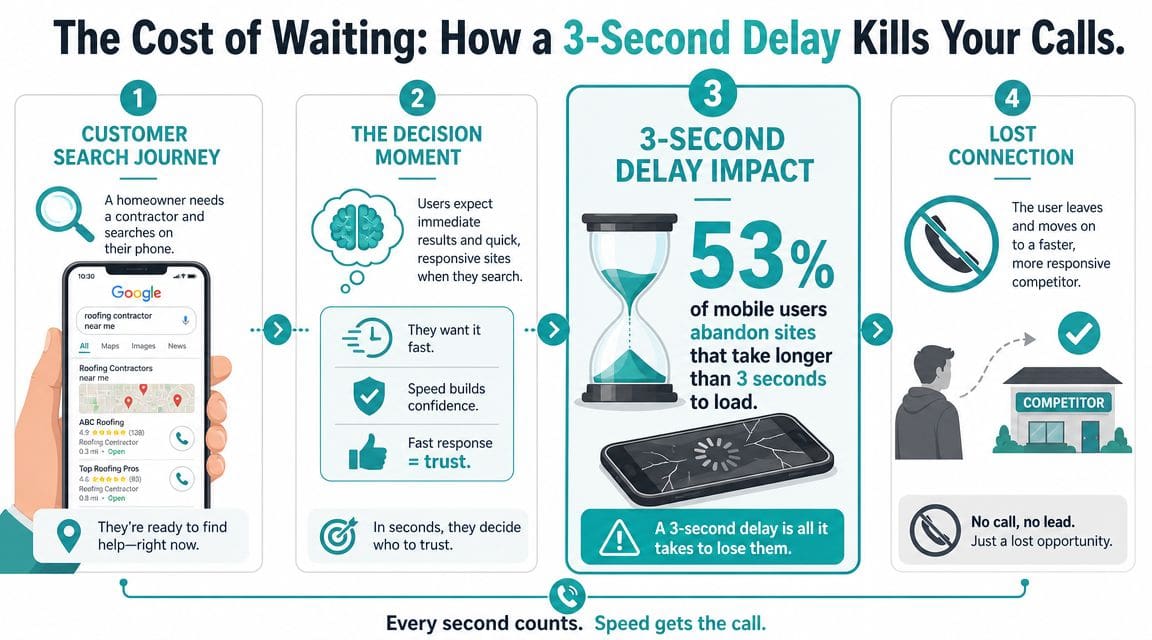
When that chain breaks, the phone never rings.
The mobile buyer has no patience
Contractors often fool themselves. They think, “If somebody really needs the work done, they'll stick around.” That's backwards. The more urgent the need, the less patience the buyer has.
DesignRush reports that 53% of mobile users abandon sites that take longer than 3 seconds to load, which is why faster pages keep more people around long enough to tap a phone number or request a quote, according to DesignRush's website speed statistics roundup.
That one fact explains a lot of failed marketing.
You ran ads. You paid for the click. The person landed on your page. Then the page hesitated. The money was spent, but the call never happened.
Slow pages break the call path
Phone calls come from simple actions. The buyer has to see the offer, trust the business, and tap the call button. Slow pages get in the way of all three.
The usual failures look like this:
- The page loads too slowly: The buyer goes back before the main content appears.
- The phone button appears late: The buyer never sees the easiest next step.
- The form feels like work: A slow, clunky page makes every field feel heavier.
If you're sending traffic to landing pages, this is why structure matters too. Strong landing page best practices help only when the page loads fast enough for people to use them.
If the phone button isn't visible and easy to tap fast, your website is wasting ready-to-buy traffic.
The back button is your real competitor
A lot of contractors think their competition is the other company across town. Sometimes it is. But on mobile, your first competitor is the back button.
The buyer doesn't need to think hard. They just leave and pick the next option in the search results. That's how a few seconds turn into a lost estimate, a lost call, and a lost job.
The Visibility Gap Why You're Invisible 10 Miles Away
Speed matters. But speed alone won't fix the whole problem.
A lot of contractors are known in their hometown and nowhere else online. That's the visibility gap.
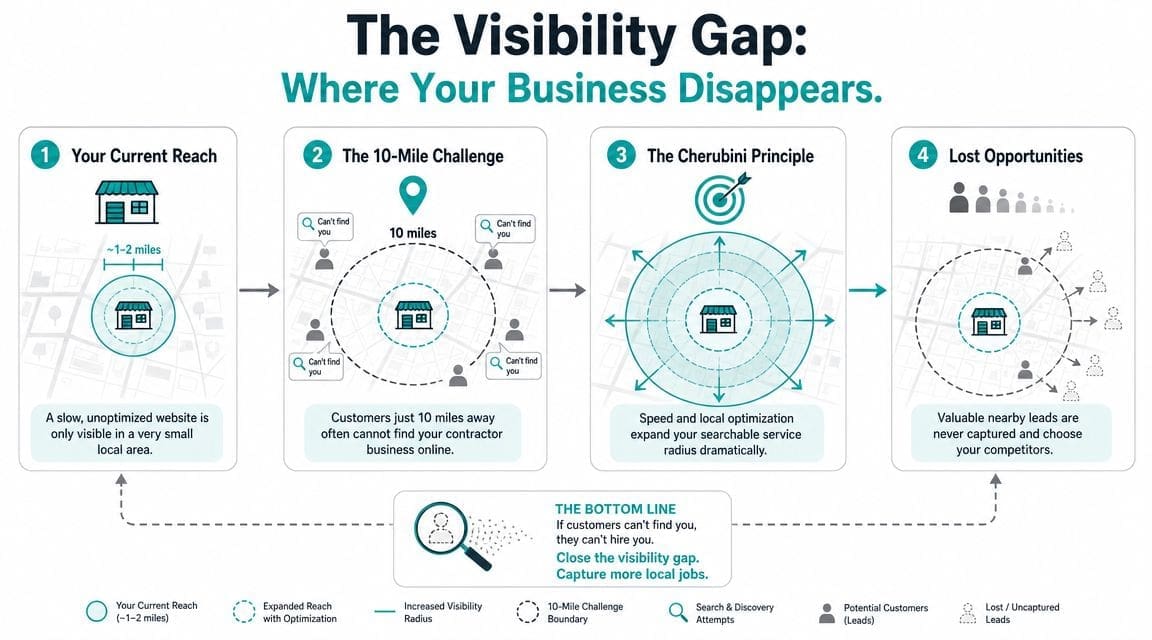
You might do work across a wide area. Google doesn't care what you do “in real life” if your online presence only points to one city.
Near me does not mean near your office
When someone searches for “excavation contractor near me” or “plumber near me,” Google reads that based on the searcher's location. If they're in another city, Google wants results tied to that city.
If your website mainly talks about your home base, your address, and your main town, Google gets a simple message. This company is for that town.
Why would Google assume you work in places you never mention?
This is why crews can be busy and still be invisible
A contractor can have a solid name in one town and still miss jobs all around it. That's why being “well known” doesn't mean you have a strong lead system.
Here's the split:
| Offline reality | Online reality |
|---|---|
| You serve multiple towns | Your site may only signal one town |
| You'll drive for the right job | Google only shows what it understands |
| People could hire you | They won't if they never see you |
You think customers can find you because you know you serve that area. Google only knows what you clearly show it.
Speed and location work together
A site that loads fast but only talks about one city is still limited.
A site that mentions many cities but loads slowly is also weak.
What works is both at once. Fast load. Clear service areas. Strong call paths. Pages that match what people are actually searching for in each city. That's how you stop disappearing outside your hometown.
This is the part most agencies miss. They either build a pretty site with no regional visibility, or they stuff city names onto a slow mess and call it strategy. Neither one solves the core problem.
Lead Machines Are Built For Speed and Visibility
A Lead Machine is not a pretty website. It is not an online brochure. It is not a “brand piece.”
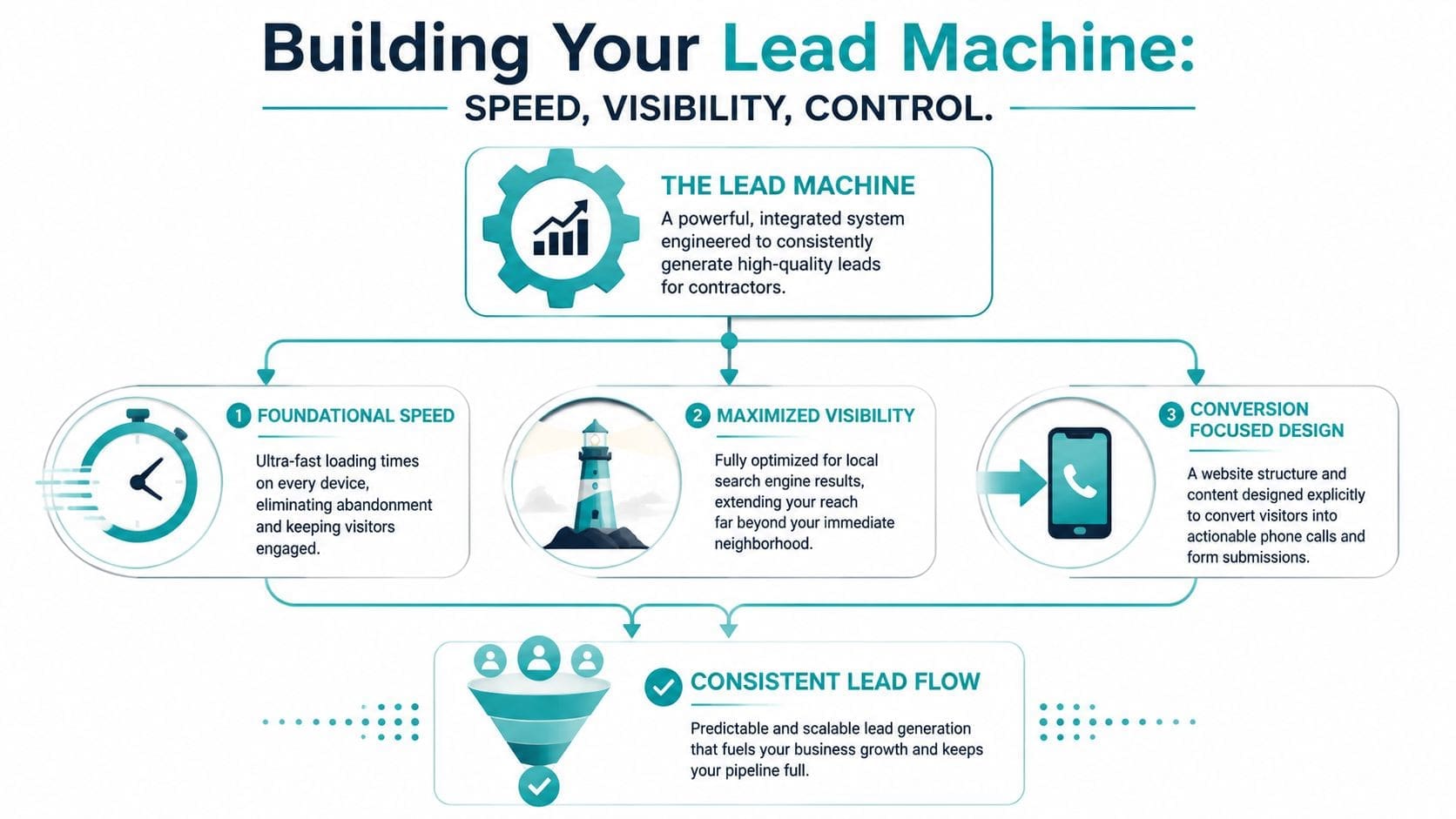
It is a website built to turn visibility into calls.
What it has to do
A Lead Machine has to solve two problems at the same time.
First, it has to load fast enough that the visitor stays.
Second, it has to be built so people in the cities you want work from can find the right page when they search.
That means the structure matters. The page flow matters. The city targeting matters. The phone path matters.
What separates a Lead Machine from a normal website
Here's the difference in plain English:
- A normal website waits for traffic: It sits there and hopes somebody shows up.
- A Lead Machine is built for demand: It is structured to capture service searches and convert them into calls.
- A normal website talks about the company: A Lead Machine focuses on the buyer, the service, the city, and the next action.
One practical example is a setup with separate service pages and city pages, mobile-friendly calls to action, quote forms, call tracking, and alignment with your business profile. That's the kind of structure used in lead generation websites for home services.
The website is the asset. Ads are the fuel
Contractors often receive bad advice. They are told the website alone will generate leads. It won't.
Websites do not create traffic. They sit and wait for traffic.
Ads create visibility. They put you in front of buyers searching right now. Then the website has to do its job and turn that visibility into calls and quote requests.
That system is the point.
One example in the market is The Cherubini Company, which builds contractor lead-generation websites with service pages, city pages, click-to-call actions, forms, and tracking so the site can support local visibility and convert traffic into leads.
Fast without visibility is wasted. Visibility without conversion is wasted. You need the system.
Stop Guessing Start Controlling Your Leads
If your lead flow depends on referrals, slow seasons will keep hitting you in the face. If your website is slow, single-city, and built like a brochure, you're guessing. If you run ads into that kind of site, you're paying to lose.
That's the truth most contractors need to hear.
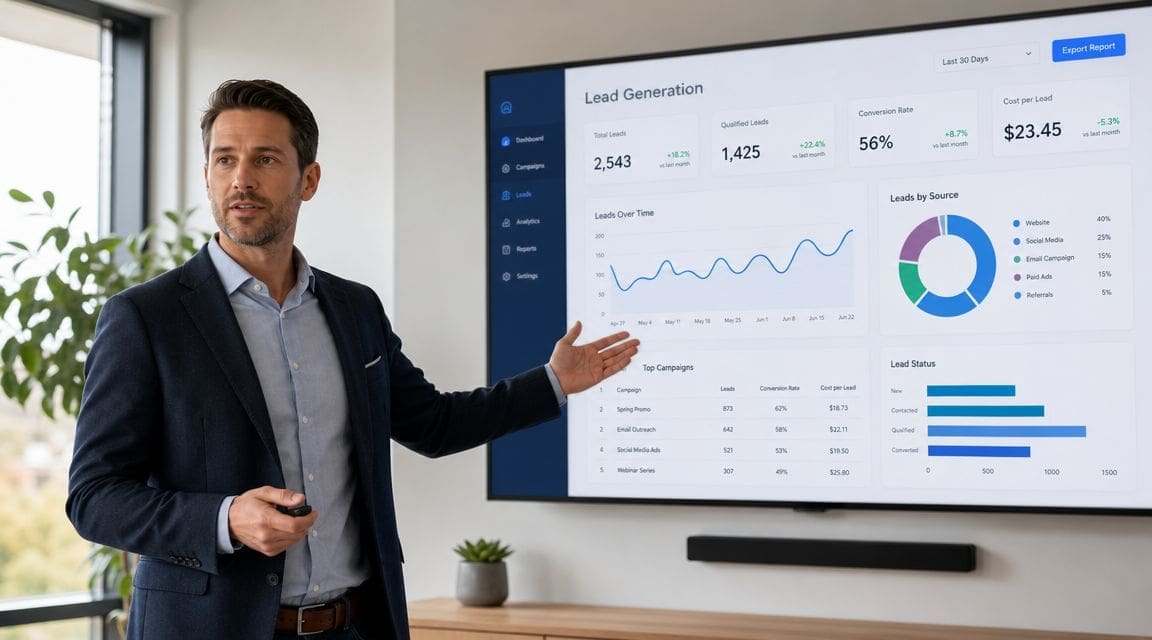
Control comes from a system
You need a system that does three things well:
- Shows up in the places you want work from
- Loads fast enough to keep people on the page
- Makes calling or requesting a quote easy
That's how you stop relying on luck.
Not hustle. Not hope. Not another agency pitch full of charts and excuses. A system.
The choice is simple
You can keep running a business where customers might find you.
Or you can build one where you control visibility, capture demand, and give buyers a fast path to call.
Those are not the same business.
You think that customers can find you but, If customers don't find you, nothing else matters. Lead Machines are built to fix that.
If you're tired of guessing and want a clear system for visibility, calls, and better leads, talk to The Cherubini Company. They build Lead Machines for contractors who need to show up in more cities, load fast on mobile, and turn traffic into real phone calls instead of wasted clicks.